Executive Overview
In the sprawling landscape of contemporary world music, few acts manage to bridge the chasm between ancestral heritage and modern alternative sensibilities quite as seamlessly as Saodaj. Hailing from Réunion, the volcanic French island department situated in the western Indian Ocean, the collective has long carved out a unique space for itself by subverting, honoring, and expanding upon the traditional musical forms of their homeland.
At the core of their artistic identity is maloya—a hypnotic, historically rich genre handed down by the enslaved Malagasy and African populations who once toiled on the island’s ruthless sugar plantations. Once banned by French authorities for its perceived seditious potential, maloya has experienced a profound cultural renaissance over the past several decades. Saodaj stands at the vanguard of this movement, infusing the driving, three-beat traditional rhythms with the sonic grit of contemporary alternative rock, the emotive depth of classical cello arrangements, and soaring vocal harmonies.
Yet, art does not exist in a vacuum; it is frequently forged in the crucible of profound human experience. In February 2024, the Réunionese music community suffered a devastating loss with the untimely passing of Adrien Laxénaire, one of the foundational musicians and early pillars of Saodaj. Faced with an unspeakable void, the band chose not to let their sorrow dissipate into silence. Instead, they channeled their collective grief, mourning, and remembrance into “Lodèr la Vi” (The Scent of Life)—the titular centerpiece of their sophomore full-length album, released via Buda Musique.
Sung entirely in Réunion Creole from the imagined vantage point of life’s ultimate twilight, "Lodèr la Vi" is an extraordinary exercise in emotional catharsis. It is a song where a dying man thanks the mortal vessel that has carried him as far as it possibly could, accepts that his tomorrow stops here, and commands his body to dance regardless: "Dans aou mon kor / Sant aou mon lam" (Dance within me, my body / Feel within me, my soul). Written collaboratively by co-founders Marie Lanfroy and Jonathan Itéma, the track serves as both a heartbreaking elegy for Laxénaire and a universal meditation on mortality, breath, and legacy.
This comprehensive review and journalistic exploration delves into the anatomy of "Lodèr la Vi," tracing the chronology of its creation, examining the rich cultural and musical heritage of maloya, breaking down the intricate instrumentation that drives Saodaj’s sonic architecture, and evaluating the broader implications of this release on the global world music stage.
Detailed Chronology: From Foundation to Catharsis
The Genesis of Saodaj (2011)
To truly understand the weight of "Lodèr la Vi," one must first examine the evolutionary trajectory of Saodaj itself. The project was officially galvanized at the tail end of 2011 by Marie Lanfroy, a native of Réunion whose artistic vision sought to honor the island’s complex multicultural fabric. Lanfroy recognized that maloya—while historically serving as a vehicle for political resistance, spiritual communion, and storytelling among the oppressed—was not a static museum piece. It was a living, breathing tradition ripe for dialogue with contemporary global sounds.
In its nascent stages, the band brought together a collective of kindred spirits committed to pushing musical boundaries. Among these early pioneers was Adrien Laxénaire, whose instrumental prowess and creative synergy helped establish the band’s foundational sonic footprint. Over the subsequent decade, Saodaj evolved from a local Réunionese act into an internationally respected ensemble, captivating audiences with their dynamic live performances, socio-political lyricism, and uncompromising dedication to acoustic-electric fusion.
The Turning Point: February 2024
The harmonious trajectory of the band was irrevocably altered in February 2024 with the passing of Adrien Laxénaire. The loss of a co-creator, friend, and musical brother sent shockwaves through the ensemble. In the immediate aftermath, the members of Saodaj—Marie Lanfroy, Jonathan Itéma, along with collaborators Frederick Cipriano, Zélito Deliron, Mélanie Badal, and Blaise Cadenet—found themselves grappling with the complex architecture of grief.
Rather than shelving their creative ambitions, the ensemble leaned heavily into the communal healing properties inherent to their craft. Drawing on the ancestral traditions of maloya, which has historically functioned as a mechanism for communal catharsis and spiritual processing in times of crisis, the band turned their shared mourning into creation. The result was a suite of compositions that would ultimately form their second studio album, anchored by the poignant title track, "Lodèr la Vi."
The Writing and Recording Process
The construction of "Lodèr la Vi" was an exercise in intense emotional vulnerability. Marie Lanfroy and Jonathan Itéma sat down to write the lyrics and vocal melodies, weaving a narrative that speaks directly to the final moments of earthly existence.
The perspective adopted in the song is staggering in its intimacy. It imagines a man standing at the precipice of mortality, looking back over his journey. He expresses profound gratitude to the physical body that has carried him through decades of joy, hardship, and triumph, fully accepting that his tomorrow terminates here. Yet, in a subversion of conventional elegiac sorrow, the protagonist implores his failing frame to defy death through movement: "Dans aou mon kor / Sant aou mon lam."
Beneath this defiant acceptance lies a poignant human regret—the admission that he had desperately hoped to live long enough for his hair to turn grey. Throughout the arrangement, the chorus acts as a vital, rhythmic anchor. Written collaboratively by Lanfroy and Itéma, the refrain repeatedly commands the departing soul to breathe: "Souf, souf, souf" (Breathe, breathe, breathe). This visceral repetition encourages the listener to inhale the very scent of life that gives the track its name, urging them to cling to it with every remaining fiber of their being.
The song reaches its emotional crescendo in its closing line, where the remaining members bid their final farewell, affectionately calling him "Adri" and leaving his spirit suspended on a slackline high up in the air—a metaphor for a life balanced on the razor-thin edge between the terrestrial and the eternal.
Release and Visual Companion (November 2025)
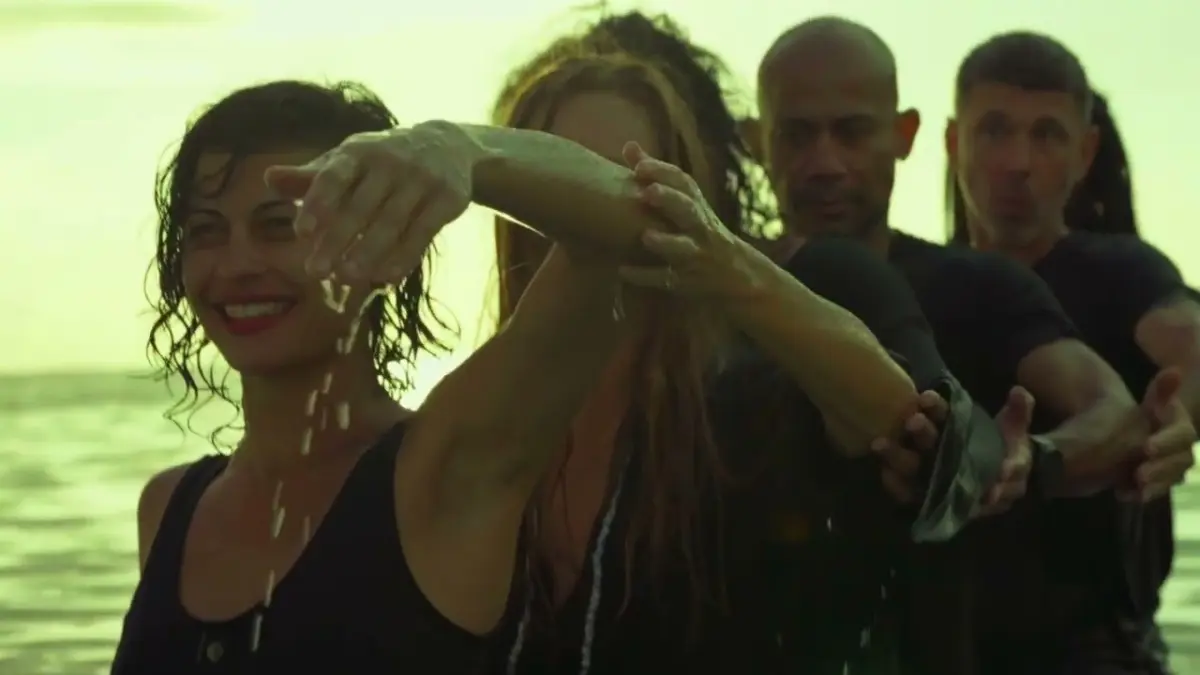
Following a meticulous production and mixing process, Buda Musique officially released Lodèr la Vi as Saodaj’s second full-length studio album in November 2025. The release was strategically paired with a striking official music video for the title track, directed by Erika Souriguere.
Souriguere’s visual interpretation avoids heavy-handed literalism, instead opting for a poetic, atmospheric landscape that mirrors the song’s thematic obsession with breath, movement, and ethereal suspension. The video follows in the footsteps of previous acclaimed visual releases from the band, such as "Domin" and the widely celebrated "Adyé Véli," further solidifying Saodaj’s reputation as masters of multidisciplinary storytelling.
Supporting Context & Metrics: The Architecture of Maloya Fusion
To fully appreciate the sonic weight of Lodèr la Vi, one must examine the intricate musical machinery that underpins Saodaj’s compositions. The band’s sound is a masterclass in cultural syncretism, marrying the acoustic traditions of the Indian Ocean with the heavy, atmospheric textures of Western alternative rock.
The Rhythm Section: Guardians of Maloya
At the heart of maloya lies an unmistakable, driving three-beat rhythm that commands the body to move. On the new album, Jonathan Itéma—who formally studied Réunionese music at the prestigious Saint-Pierre conservatoire—took total charge of arranging every percussion part, ensuring a deep reverence for traditional roots while allowing room for modern innovation.
The rhythmic backbone of "Lodèr la Vi" is anchored by three primary traditional instruments, deftly handled by Itéma, Frederick Cipriano, and Zélito Deliron:
- The Kayamb: A flat, raft-like rattle constructed from cane stems meticulously packed with hard, resonant seeds. When shaken in synchronization with the groove, it provides a shimmering, high-frequency percussive cushion.
- The Roulèr: A large, deep-toned barrel drum played with hands and feet, serving as the heartbeat of the ensemble. Its resonant thuds mimic the cadence of a human pulse slowing down or quickening under emotional duress.
- The Sati-Pikèr: A metallic percussion instrument played with sticks, providing a sharp, metallic counterpoint that cuts through the warm, organic textures of the kayamb and roulèr.
The Melodic Counterweight: Cello and Electric Guitar
While the percussion grounds the track in the fertile red soil of Réunion, the upper registers of "Lodèr la Vi" transport the listener into a cinematic, almost gothic expanse.
Mélanie Badal’s cello weaves sweeping, melancholic counter-melodies that echo the weeping quality of traditional laments while drawing structural inspiration from contemporary neoclassical composition. Interlocking with Badal’s strings is Blaise Cadenet’s electric guitar, which introduces subtle layers of alternative rock distortion. Rather than overwhelming the acoustic core, Cadenet’s guitar work acts as an atmospheric haze, mirroring the emotional fog of grief and the electric shock of sudden loss.
Cultural Resonances and Historical Weight
It is impossible to discuss maloya without acknowledging its fraught political history. For centuries under French colonial rule, maloya was systematically suppressed. Associated primarily with the clandestine nighttime gatherings (servis kabar) of enslaved plantation workers, the genre was viewed by authorities as a catalyst for potential rebellion. Consequently, public performances were banned for decades, forcing practitioners to keep the flame alive in secret, domestic spaces.
When Réunion was officially designated as an overseas department of France in 1946, and subsequent cultural movements gained traction in the latter half of the 20th century, maloya emerged from the shadows to become the ultimate symbol of Réunionese identity, pride, and resistance.
In this historical context, Saodaj’s music takes on an even deeper resonance. When the band sings in Réunion Creole about death, breath, and collective endurance, they are participating in an unbroken continuum of cultural survival. They are utilizing the very language and rhythms that their ancestors used to reclaim their humanity in the face of systemic erasure.
Official Statements & Artistic Vision
While official press releases and promotional materials from Buda Musique outline the structural details of the album’s release, the true manifesto of Lodèr la Vi lives within the lyrical poetry penned by Marie Lanfroy and Jonathan Itéma.
In interviews surrounding the creation of their sophomore project, the members of Saodaj have consistently emphasized that the album is not merely a collection of songs, but a collective ritual. The decision to frame "Lodèr la Vi" around the perspective of a dying man speaking to his physical vessel was a deliberate artistic choice designed to strip away the sanitizing platitudes often associated with grief.
"We did not want to write a song that simply wept over an empty chair," notes a collaborative statement from the artistic core of the band. "Adrien was a creator of momentum, a musician whose hands coaxed life out of wood and strings. When he left us, the only authentic response was to look mortality dead in the eye and demand that the body keep dancing, that the soul keep feeling, even as the horizon closes in."
The recurrent lyrical motif—"Souf, souf, souf"—functions as an invocation. In a world increasingly defined by disconnection, burnout, and collective trauma, the band positions breath as the ultimate equalizer. It is the primal tether connecting the living to the dead, the individual to the collective, and the raw earth of Réunion to the global stage.
Future Outlook: The Global Trajectory of Saodaj
The release of Lodèr la Vi via Buda Musique marks a monumental watershed moment for Saodaj. As they embark on the promotional campaign and live touring cycle supporting the new album, the ensemble stands at the intersection of local reverence and international acclaim.
Expanding the Frontiers of World Music
For decades, the global "world music" market has frequently relegated artists from overseas departments and indigenous communities to niche, exoticized categories. Saodaj actively dismantles this reductive paradigm. By fusing uncompromising traditional maloya polyrhythms with the sonic grit of alternative rock and the emotional heft of chamber strings, they have engineered a borderless genre that speaks fluently to listeners in Paris, Tokyo, New York, and Saint-Denis alike.
The critical reception of Lodèr la Vi suggests that the global audience is increasingly hungry for art that possesses authentic cultural roots coupled with fearless contemporary execution. The album demonstrates that traditional music does not need to remain frozen in amber to retain its purity; rather, it thrives when subjected to the transformative fires of contemporary human experience.
Touring and Live Interpretation
Translating the intricate emotional landscape of Lodèr la Vi to the live stage presents both a profound challenge and an extraordinary opportunity for Saodaj. The physical intensity required to maintain the three-beat maloya groove on stage—balancing the thunderous pulse of the roulèr with the delicate shimmering of the kayamb—requires elite musicianship.
As the band hits the road, backed by Erika Souriguere’s striking visual aesthetics and the enduring spirit of Adrien Laxénaire, their live performances are transforming into modern-day kabar—communal spaces where grief is metabolized into joy, and where the audience is invited to share in the collective breath of existence.
Conclusion
"Lodèr la Vi" is far more than a tribute to a fallen comrade. It is a monumental achievement in modern songwriting, a cultural artifact that honors the resilience of Réunion, and a masterclass in emotional transmutation.
In capturing the exact moment where life bleeds into memory, Saodaj has crafted an immortal anthem for the human condition. They remind us that while bodies may fail and tomorrows may abruptly halt, the mandate remains steadfast: take in the scent of life, hold onto it with everything you have, and above all else, dance.
Listen to "Lodèr la Vi" on Spotify HERE, watch the official music video via YouTube, and secure your physical or digital copy of the album through Buda Musique.