The intersection of nostalgic analog warmth and forward-thinking sound design remains one of the most fertile creative grounds in modern electronic music production. In this installment of Synth Secrets, we dive deep into the public beta of u-he Zebra 3, exploring how its advanced physical modelling capabilities can be harnessed to recreate the iconic, tuned percussive textures that defined the soundscapes of the 1980s.
From the glossy pop arrangements of Madonna and Gloria Estefan to iconic cinematic sound tracks like Predator and Romancing the Stone, the 1980s heralded a sudden, seismic shift in musical arrangements. Suddenly, music was saturated with marimba-esque, metallic, and glass-like percussive elements. While traditional subtractive analog synthesizers excel at generating fat, filtering basslines and soaring leads, they have historically struggled with the complex acoustic physics required to authentically emulate real-world objects—especially hollow surfaces or resonant structures being struck with mallets.
With the introduction of the new Modal modules in u-he’s long-awaited Zebra 3, sound designers are no longer restricted to traditional FM synthesis or static multi-sampling to achieve these tones. By employing true physical modelling, Zebra 3 calculates cascading harmonic and inharmonic resonances in real time. Even more remarkably, the base audio fed into these models is almost incidental; as we will demonstrate, a simple burst of white noise can be transformed into a dynamic, dancefloor-ready percussive masterpiece.
Detailed Chronology: Step-by-Step Production Guide
To demonstrate the immense power of Zebra 3’s physical modelling engine, we will build a rhythmic, hypnotic percussive pattern from scratch. For this tutorial, we are targeting a minimal tech house aesthetic operating at 126 BPM, though the underlying pattern structure can easily be tweaked to suit tropical, Latin, or Afro-infused grooves.
(Note: Zebra 3 is currently available in public beta. Producers can download the installer and access a beta license card directly via the KVR Audio forums.)
Step 1: Crafting the Source Envelope with White Noise
Load an instance of Zebra 3 and initialize a fresh patch (INIT preset).
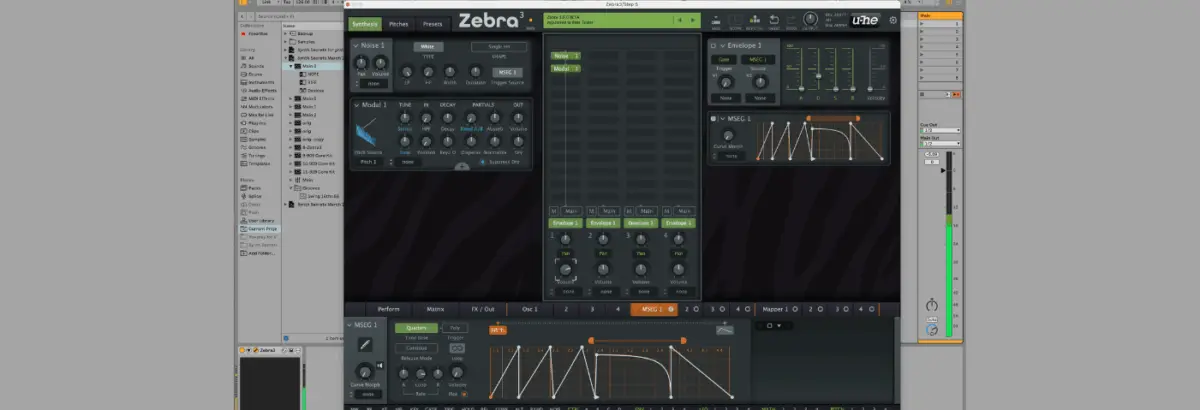
Direct your attention to the central panel, locating the default oscillator and replacing it with a Noise 1 module.
Configure Envelope 1 by setting the Attack, Sustain, and Release parameters to 0, while extending the Decay time to approximately 400ms.
Draw in a single, one-bar-long MIDI note on C2 in your DAW, hit play, and adjust the Noise Shape parameter to Single Hit.
Listen closely to the tight, punchy volume profile—this acts as our foundational striking mallet, simulating a hard stick hitting a surface.
Step 2: Introducing the Modal 1 Resonator
Chain a Modal 1 module immediately after your noise source. This module calculates realistic acoustic resonances dynamically driven by the volume profile of the white noise.
Engage the Suppress Dry parameter to remove the raw noise source from the output path, leaving only the generated resonance.
Play the pattern back. The signal immediately takes on the characteristics of a tuned acoustic drum. Note that each subsequent hit varies slightly from the last—an organic variation inherent to true modal architecture.
Step 3: Applying Physical Models with the "Punched Can" Preset
While the sound is already convincingly drum-like, it requires an authentic physical model to bridge the gap between "synth percussion" and "real-world object."
Click the small + symbol on the Modal module to reveal the dual physical modelling slots (A and B), which allow producers to blend and modulate between two distinct physical structures.
Load the "Punched Can" preset into slot A. The sound instantly transforms, acquiring the metallic, resonant character of a struck hollow container.
Step 4: Examining the Relationship Between Source and Model
To fully understand how the Noise oscillator interacts with the Modal module, temporarily toggle the Noise Shape back to Constant.
Notice how the percussive envelope breaks down: while the harmonic tonality remains intact, we lose control over the precise transient strike.
Switch the Noise Shape back to Single Hit to restore tight envelope control, ensuring both realism and playability.
Step 5: Building Rhythmic Complexity via MSEG
Set your project tempo to 126 BPM. For precise rhythmic referencing, import standard reference loops like 909_Kick.wav and 909_Hat.wav into your session.
Open the MSEG (Multi-Step Envelope Generator) window inside Zebra 3. Change the Trigger Source for both the Noise oscillator and Envelope from Gate to MSEG.
Draw in a skippy, syncopated rhythm, incorporating a looping section at the end of the phrase to inject rhythmic momentum. (Alternatively, load our pre-configured module preset directly into Zebra 3).
A Quick Note on Releases and Grooves: Using a release time of 0 creates an intentional audio click at the end of the pattern. When played in isolation, this click can sound harsh; however, when anchored against a 909 kick drum, it locks into the groove to create a tight, driving percussive transient. For breakdown sections without drums, simply extend the release time for a smoother decay.
Step 6: Mapping Melodic Riffs with the Mapper Module
Duplicate your active Zebra 3 channel so you have a secondary copy to work with.
On your original channel, right-click (or Control-click) the Modal 1 Tuning parameter and assign it to Mapper 1.
Navigate to the Mapper settings inside the Modal 1 module and set the tune modulation depth to 16. The Mapper now dynamically controls the pitch and progression of the physical model.
Program a custom melodic sequence or load our dedicated module preset to instantly transform your percussion loop into an engaging rhythmic riff.
Step 7: Adding a Clackety Top Layer
Duplicate your channel once more, bringing your total active Zebra 3 tracks to three.
On this third layer, select the Metal Bowl modelling preset.
Disable Suppress Dry, set the Tune to +12, and right-click the tuning parameter to expand the range to -24.
Adjust the Position parameter to 100, shorten the Decay to 19, pull the Disperse control to 0, and push the Stereo Tune to 32 cents. The resulting patch delivers an aggressive, clackety, and deeply driving high-end layer.
Step 8: Assembling the Final Arrangement
To introduce complex polyrhythms, load the MIDI file Busy.mid across all three instrument channels.
This pattern utilizes overlapping notes of varying lengths to dynamically trigger the loop points within the Zebra 3 patches.
Experiment by panning the three distinct channels across the stereo field, automating decay times, and blending between the various percussive riffs for a rich, evolving sonic tapestry.
Supporting Context & Metrics: The Evolution of Synthesis
To fully appreciate what makes Zebra 3’s physical modelling architecture revolutionary, one must examine the technological trajectory of electronic music production over the past four decades:
The Analog Era (Late 1970s): Characterized by subtractive synthesis using voltage-controlled oscillators (VCOs) and filters (VCFs). While unmatched for warm bass and sweeping pads, analog circuits inherently lack the mathematical algorithms needed to replicate the chaotic, non-linear harmonic structures of vibrating metals and woods.
The Digital Revolution (1983–1990s): The commercial rise of Frequency Modulation (FM) synthesis (typified by the Yamaha DX7) and hardware sampling allowed producers to approximate acoustic instruments (such as electric pianos, marimbas, and bells) by layering complex sine-wave carriers and modulators.
The Modern Hybrid Paradigm (2020s): Software synthesizers like u-he Zebra 3 bridge the gap between classic subtractive workflow and advanced physical modelling. Rather than relying solely on static audio samples, real-time mathematical algorithms simulate the physical properties of objects—tension, mass, resonance, and damping—giving producers infinite control over acoustic parameters that never sound static or repetitive.
Official Statements & Developer Insights
Reflecting on the development philosophy behind Zebra 3’s new architecture, representatives from u-he have consistently emphasized the importance of organic variability in modern digital sound design.
"When designing the Modal modules for Zebra 3, our primary objective was to move beyond the static, predictable nature of traditional wavetable and sample playback," explains the u-he development team. "By simulating the actual physical properties of struck materials, we allow the synthesizer to breathe. Every single trigger produces a microscopic variation in harmonic resonance, mirroring the physical reality of acoustic instruments. Paired with modular routing, it opens up a completely new frontier for rhythmic sound design."
Industry early-adopters and beta testers have similarly praised the flexibility of the engine, noting that the ability to route unorthodox sound sources—such as plain white noise or atmospheric field recordings—through physical resonators redefines how textures are generated in electronic music production.
Future Outlook
As software instruments continue to evolve past the limitations of traditional emulation, tools like u-he Zebra 3 point toward a future where the boundaries between synthesis, sampling, and acoustic modelling dissolve entirely. The ability to organically sculpt tuned percussion from basic noise floors not only streamlines the production workflow for genres like minimal techno, house, and experimental electronica, but also encourages a more exploratory, hands-on approach to sound design.
With Zebra 3 currently maturing through its public beta phase, electronic music producers now have unprecedented access to cutting-edge synthesis tools. Whether you are seeking to recreate the glossy percussive soundscapes of 1980s pop blockbusters or forge entirely unchartered sonic territories, physical modelling has firmly cemented itself as an indispensable weapon in the modern producer’s arsenal.