Executive Overview
Pianist and composer Malcolm Braff has never been one to comfortably occupy the conventional role of a jazz musician. To Braff, the piano is not a badge of identity, nor is performance an ego-driven exercise in self-expression. Instead, it is an action of the body, a physical conduit, and a momentary negotiation of energy shared within an ensemble. In his worldview, a trio does not consist of three separate individuals executing distinct parts; rather, it operates as a single, breathing organism.
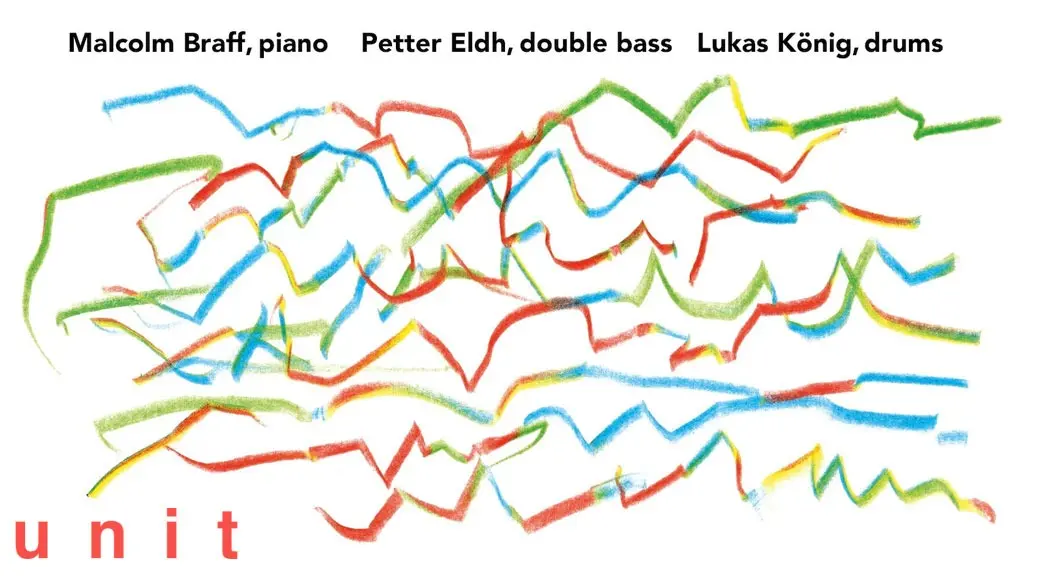
Braff’s latest project, the critically acclaimed release Outside, captures this philosophy in its purest and most disorientating form. Recorded alongside Swedish bassist Petter Eldh and Austrian drummer Lukas König, the album is a profound meditation on temporality, rhythm, and spatial awareness in modern improvised music. Far from being a standard piano trio recording, Outside challenges the listener’s perception of time, treating it not as a rigid, linear progression, but as a fluid, undulating wave.
This release is the culmination of more than two decades of rigorous academic and artistic research into what Braff terms the "mechanics of swing." Having spent years deconstructing the micro-rhythms that govern jazz pulse—work that directly informs his pedagogy at Jazzcampus Basel—Braff has formulated a witty yet deeply ambitious "Generalized Theory of Swing." The resulting album is a testament to this intellectual pursuit, yet it never succumbs to cold academicism. Instead, Outside connects on a deeply visceral, emotional level before the listener’s conscious mind even begins to question the structural acrobatics taking place beneath the surface.
This comprehensive review explores the philosophy, background, and musical architecture of Outside, diving deep into Braff’s unique transnational heritage, his academic breakthroughs, and the incendiary chemistry he shares with Eldh and König.
Detailed Chronology and Artistic Evolution
From Rio to Senegal: A Transnational Foundation
To truly understand Malcolm Braff’s musical vocabulary, one must examine the vast geographic and cultural topography of his upbringing. Born in Rio de Janeiro, Brazil, to a missionary father, Braff’s childhood was defined by cultural displacement and immersion. Growing up across Cape Verde and Senegal before eventually settling in Switzerland, Braff absorbed a rich tapestry of polyrhythmic traditions long before he ever formalized his classical and jazz conservatory training.
Yet, perhaps the most decisive turning point in his artistic development came through his decade-long collaboration with the late Burkinabé percussionist Yaya Ouattara. Working side-by-side with Ouattara fundamentally reshaped Braff’s relationship with rhythm. For Braff, Ouattara was "more than a brother"—he was a master teacher of pulse and communal groove. Most notably, Ouattara’s djembe took the traditional place of a drum kit in Braff’s boundary-pushing trio, a configuration famously captured on the critically acclaimed 2006 live album Yele, released via Unit Records.
This foundational relationship permanently decoupled Braff’s understanding of swing from the standard, American-centric post-bop paradigm. Swing, to Braff, is a universal human phenomenon rooted in bodily movement and wave dynamics rather than an arbitrary rhythmic formula tied strictly to the ride cymbal and hi-hat.
The Decades-Long Quest: The Mechanics of Swing
For over twenty years, Braff has dedicated himself to researching the hidden physics of jazz timing. This obsession led him to establish the "Generalized Theory of Swing," a pedagogical and analytical framework he currently teaches at Jazzcampus Basel.
The core of Braff’s theory investigates the "distortion of time as perceived by the listener." Traditional jazz instruction often treats swing as a mathematical subdivision—the classic triplet feel or the pushing and pulling of the eighth note. Braff, however, views swing as a psychological and physiological illusion. By manipulating micro-timing, accent placement, and harmonic anticipation, Braff creates an auditory environment where time appears to bend, warp, and fold back on itself.
When applied to Outside, this theory transforms what could be standard avant-garde experimentation into a thrilling, albeit dizzying, sonic ride. The listener is constantly kept off-balance, caught in a temporal landscape where expectations are systematically built up and instantly subverted.
Supporting Context and Metrics: Deconstructing Outside
The Ensemble: Eldh and König as Catalysts
A theoretical framework is only as effective as the musicians tasked with executing it. For Outside, Braff enlisted two of the most forward-thinking, technically fearless improvisers on the European contemporary jazz scene: Swedish bassist Petter Eldh and Austrian drummer Lukas König.

- Petter Eldh: Known for his relentless curiosity, elastic phrasing, and deep, thrumming vibrations, Eldh acts as the gravitational anchor and the restless disruptor of the trio. His bass lines do not merely walk; they weave, stretch, and react in real-time to Braff’s harmonic explorations.
- Lukas König: Bringing a "whiplash styling" to the kit, König possesses a ferocious percussive attack. His ability to deploy frenetic rim clicks and explosive accents like gunshots provides the ideal volatile counterpoint to Braff’s fluid piano lines.
Track-by-Track Architectural Breakdown
While Outside runs lean on duration—tipping the scales closer to an Extended Play (EP) than a traditional Long Play (LP)—its density of ideas far surpasses many full-length releases. In the realm of experimental jazz, time is relative; duration holds no authority over impact.
1. "Viennese Gröt à la Berlinaise"
The album opens with a culinary-inspired auditory assault. Translated loosely as "Viennese Porridge Berlin-Style," the track is immediately arresting. König’s percussive strikes crack through the mix like gunshots, stirring dynamically into the warm, viscous gloopiness of Eldh’s low-end bass tones. Meanwhile, Braff’s buoyant piano bounce acts as the sticky, structural glue holding the chaotic elements together. It is an extraordinary masterclass in contrasting textures—simultaneously heavy and light, structured and chaotic.
2. "3TOES"
Appearing as the second track on the record, "3TOES" sees Braff completely dismantle his own theory of swing, turning it inside out. On this piece, all three musicians operate with absolute, democratic weight. König’s frenetic rim clicks and Eldh’s resonant, vibrating bass pulses are granted expansive space for sharp, telepathic dialogue, all anchored by Braff’s exuberant, yet deeply fractured, sense of swing. The result is a piece that feels both intellectually stimulating and viscerally thrilling.
Official Statements and Critical Reception
While Outside operates largely within the upper echelons of contemporary European improvised music, early critical reception has highlighted its unique ability to bridge the gap between rigorous cerebral composition and unbridled emotional release.
Critics have frequently noted Braff’s rare self-effacing approach to performance. By stating, "this is not what I am, just something I enjoy doing," Braff distances himself from the self-aggrandizing virtuosity that often plagues modern instrumentalists. Instead of searching for a singular, static "personal voice," Braff treats the act of playing as an end in itself—an ongoing dialogue with the room, the instruments, and his collaborators.
In academic and jazz education circles, his work at Jazzcampus Basel on the "Generalized Theory of Swing" has garnered quiet reverence. Colleagues and students alike have praised his capacity to translate complex rhythmic psychology into practical, bodily actions. As one reviewer aptly summarizes the listening experience:
"That at least begins to explain what’s going on as I listen to Outside and why this disorientating, expectation-defying record is such an enjoyable ride."
Future Outlook: The Ongoing Evolution of Malcolm Braff’s Sonic Universe
As Outside continues to find its audience among aficionados of adventurous, boundary-pushing jazz, Malcolm Braff shows no signs of slowing his relentless exploration of time and sound.
The implications of the "Generalized Theory of Swing" extend far beyond this single recording. As Braff continues to refine his pedagogical methods at Jazzcampus Basel, a new generation of European jazz instrumentalists is being trained to view time not as a metronomic prison, but as a malleable, expressive canvas. The dismantlement of standard rhythmic conventions witnessed on tracks like "3TOES" points toward a broader paradigm shift in improvised music—one where groove and abstraction are no longer opposing forces, but two sides of the same coin.
Looking ahead, the trio of Braff, Eldh, and König represents a formidable alliance in modern creative music. Their telepathic interplay on Outside proves that when master musicians strip away ego and submit entirely to the physical action of sound, the results can redefine the boundaries of what a piano trio can achieve.
Whether performing live or expanding upon his theoretical writings, Malcolm Braff remains a vital, restless catalyst in global improvised music—reminding us all that to truly understand music, we must first learn how to let go of ourselves and simply step Outside.