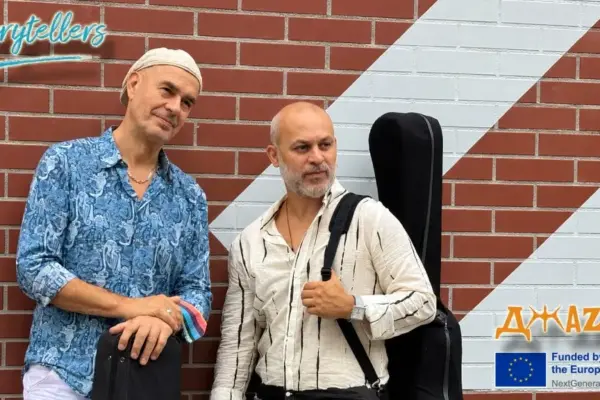
Norwegian guitar virtuosos Knut Reiersrud and Geir Sundstøl have achieved a rare masterwork in modern acoustic and folk-fusion collaboration. By taking the 17th-century compositions of English baroque master Henry Purcell and filtering them through decades of collective experience in blues, folk, and ambient improvisation, the duo has crafted an auditory artifact that defies easy categorization.
Recorded with deliberate intimacy at Sundstøl’s home studio in central Oslo, their new collaborative album serves as an unexpected cross-cultural bridge. It connects the royal playhouses of 1690s London with the idiosyncratic sonic vernacular of Norway’s premier session musicians. Rather than approaching Purcell with academic reverence, Reiersrud and Sundstøl treat the classical canon as loose raw material. Working entirely by ear—without reading sheet music—they rely on memory, intuition, and a shared sense of humor to reinvent works ranging from Dido and Aeneas to The Fairy-Queen.
The album’s rollout is anchored by a high-profile tour of Norway, beginning at the historic Fredrikshalds Teater in Halden—Norway’s only preserved baroque theater—before moving to Scene 2 at the Oslo Opera House. This critical evaluation examines the genesis of the collaboration, the granular recording methodology, the cultural placement within the Grappa and Elevator record labels, and the future performance outlook for two of Norway’s most enduring musical figures.
Detailed Chronology
Early Parallels and Decades of Near-Misses
The partnership between Knut Reiersrud and Geir Sundstøl is built on a foundation of mutual respect spanning over thirty years. Born in Oslo in 1961, Reiersrud established himself as a prodigiously talented blues guitarist during his teenage years. His trajectory shifted dramatically in 1991 with the release of Blå koral, a groundbreaking collaboration with organist Iver Kleive. The record won a Spellemannpris (Norway’s equivalent to the Grammy Award) and sparked a liturgical partnership that continues to fill Norwegian churches over three decades later.
Geir Sundstøl, eight years Reiersrud’s junior, has made a continuous living as a professional musician since 1988. He is widely recognized as one of Norway’s most prolific session guitarists, contributing to several hundred studio recordings and touring extensively with avant-garde jazz artist Nils Petter Molvær and pop icons a-ha. Sundstøl eventually stepped into the spotlight with his 2015 solo debut, Furulund, which was followed by acclaimed releases on the Hubro label.
Despite their paths crossing frequently in plain sight—both artists earned the prestigious Gammleng Prize in its studio class (Reiersrud in 1992, Sundstøl in 1994)—the two guitarists rarely performed together outside of occasional guest sessions for mutual friends. Key collaborators like keyboard player David Wallumrød and bassist Nikolai Hængsle have played in Reiersrud’s touring bands while simultaneously lending their talents to Sundstøl’s studio projects.
The Conception of the Purcell Project
The catalyst for their official full-length collaboration was an intentional search for creative constraint. A conventional folk-and-blues guitar duet record presented too many familiar pathways. Seeking a rigorous conceptual framework, Reiersrud proposed restricting their entire repertoire to the works of a single historical composer.
Sundstøl suggested Henry Purcell, inspired in part by Wendy Carlos’s synthetic arrangement of Purcell’s funeral music for Queen Mary, which famously opens Stanley Kubrick’s cinematic masterpiece A Clockwork Orange.

Neither musician reads traditional staff notation. Instead, they absorbed the source material strictly by listening to archival recordings. They dismantled complex pieces, sometimes retaining entire melodies while discarding others, or distilling multi-minute movements down to fleeting ten-second phrases. When losing the exact tune led to a more compelling musical destination, they allowed memory to slip, embracing truth, invention, and selective recollection as their primary working tools.
Supporting Context & Metrics
The Micro-Recording Methodology at Studio Intim
The physical production of the album prioritized absolute proximity and organic room tone. Tracking took place at Studio Intim, Sundstøl’s creative hub located in central Oslo. The setup was disarmingly simple: a stereo microphone placed at either end of a domestic kitchen table captured every performance live in the room.
The logistical limitations imposed on Reiersrud added a distinct tactile character to the sessions. Cycling to the studio from the Oslo suburbs, Reiersrud was physically restricted to carrying a single instrument per session. His primary weapon of choice was his Lowden acoustic guitar, which appears on four tracks. The remainder of his contributions showcase an eclectic arsenal:
- A Smith & Young resonator
- A Gibson ES-175 electric archtop
- A Johnny Jamgrav acoustic
- A customized CooderCaster
- An authentic Middle Eastern oud
- A traditional harmonica
- A Minimoog synthesizer (appearing on a single track)
- Electric bass
In contrast, Sundstøl utilized his extensive personal collection and deployed overdubbing techniques, occasionally taking the lead melodic role. His absolute constant across the recordings is a National Duolian resonator guitar, featured prominently on six of the nine tracks. Notably, the atmospheric pedal steel guitar most listeners instantly associate with Sundstøl appears on only two tracks across the entire record.
Track-by-Track Architectural Breakdown
Side A
- "Den Gordiske Knut": Derived from Purcell’s suite The Gordian Knot Unty’d, the track features a playful linguistic nod with Reiersrud’s first name replacing the Norwegian word for knot (knute). Reiersrud’s Smith & Young resonator dialogues seamlessly with Sundstøl’s Epiphone Olympic archtop.
- "Dido’s Lament": Chosen as the album’s lead single, this iconic piece from Dido and Aeneas anchors itself around a ground bass—a single descending line repeated from the first bar to the last. This 17th-century structural device mirrors the cyclical vamps of American blues. Reiersrud couples his Lowden acoustic with a Minimoog synthesizer, while Sundstøl counters with his National Duolian and a high-strung Takamine.
- "Sørgemarsj": Purcell’s solemn 1695 march for Queen Mary’s funeral is stripped of its original orchestral pomp. Eschewing drums entirely, the duo reduces the piece to an intimate dialogue between Lowden acoustic and National Duolian resonators.
- "Timon fra Athen": The longest track on the record draws from Purcell’s incidental music for a Restoration-era staging of Shakespeare’s Timon of Athens, featuring subtle atmospheric layers of pedal steel and mandolin courtesy of Sundstøl.
Side B
- "Passacaglia": Opening Side B, this dance utilizes another repeating bassline characteristic of Purcell’s catalog. It is performed on the record’s most traditional instrumentation: Reiersrud on a Gibson ES-175 and Sundstøl on a Martin HD-28.
- "Jerusalem": The most heavily orchestrated track on the album. It features a rare rhythmic foundation of real timpani and tubular bells, accompanied by a fretless banjo, mandolin, Hohner bass harmonica, and Reiersrud’s electric bass.
- "Eventyrdronningen": Sourced from the 1692 semi-opera The Fairy-Queen (itself adapted from A Midsummer Night’s Dream), this short vignette marks the second and final appearance of Sundstøl’s signature pedal steel.
- "Maurernes hevn": Drawing on music for Abdelazer, or The Moor’s Revenge, this track leans into Mediterranean and Middle Eastern textures. Reiersrud handles the oud and harmonica, while Sundstøl navigates a Shankar guitar, mandolin, and Duolian.
- "Gift i Bø": The album closes with a bilingual pun, transforming the title of Purcell’s 1694 comedy The Married Beau into a Norwegian regional joke. Reiersrud plays a CooderCaster opposite Sundstøl’s reliable Duolian.
Official Statements & Label Ecosystem
The album finds its natural home on Elevator, a boutique imprint nested within the broader Grappa record label family. Founded in Oslo in 1983 by Helge Westbye, Grappa has long served as a bastion for boundary-pushing Norwegian music, housing the Hubro imprint and releasing pivotal historical works like Reiersrud’s 2004 album Himalaya Blues with Hans Fredrik Jacobsen.
Westbye acts as an elder statesman within Elevator’s staff structure, maintaining a curatorial vision that places traditional Norwegian vernacular music directly alongside contemporary classical and jazz traditions. This commitment to meticulous craftsmanship—from initial microphone placement through final mastering—ensures that eccentric cross-genre experiments like a guitar-duet interpretation of Henry Purcell receive world-class production values.
Future Outlook & Live Itinerary
The physical release of the album coincides with an exclusive series of live performances across Norway. The concert dates bridge intimate historical spaces with grand national institutions, showcasing the adaptability of Reiersrud and Sundstøl’s acoustic architecture.
Upcoming Tour Dates
- Friday, October 9, 2026: Knut Reiersrud & Geir Sundstøl – Fredrikshalds Teater, Halden (Homecoming performance in Sundstøl’s childhood district)
- Saturday, October 10, 2026: Knut Reiersrud & Geir Sundstøl – Den Norske Opera & Ballett, Scene 2, Oslo (Official Album Release Concert)
- Friday, October 23, 2026: Iver Kleive & Knut Reiersrud – Lillestrøm kirke, Lillestrøm (Return to liturgical organ-and-guitar collaboration)
- Thursday, December 10, 2026: Iver Kleive & Knut Reiersrud – Bergen Domkirke, Bergen
As these seasoned performers take Purcell’s baroque frameworks out of the studio and onto the historic stage of Fredrikshalds Teater—a venue built precisely during the era these compositions were written—they continue to prove that true artistry lies not in academic preservation, but in fearless, living reinvention.