Executive Overview
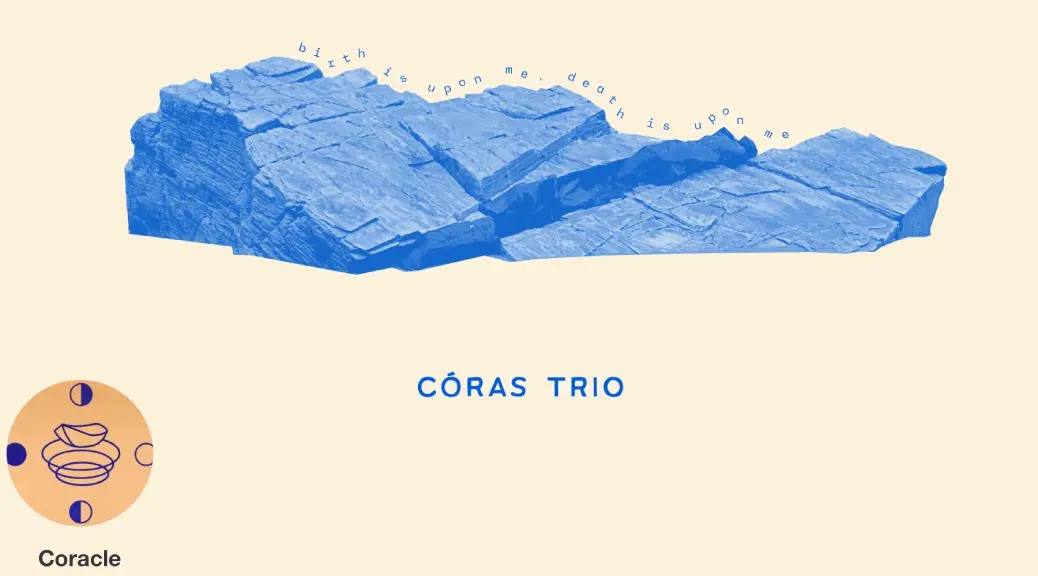
At the intersection of ancestral memory and contemporary sonic architecture lies a radical reconfiguration of Irish traditional music. On their sophomore full-length release, Birth Is Upon Me, Death Is Upon Me, the Belfast-based Córas Trio—comprising fiddler Kevin McCullagh, guitarist Paddy McKeown, and drummer Conor McAuley—dispenses entirely with the museum-piece approach that has occasionally calcified folk idioms. Instead, they treat foundational melodies not as sacred artifacts to be preserved behind glass, but as dynamic, living matter capable of undergoing profound genetic mutation.
Spanning eleven intellectually rigorous and emotionally resonant tracks, the album synthesizes the microtonal bends of traditional fiddle playing with the abrasive textures of free improvisation, electroacoustic sound manipulation, and contemporary composition. Rather than relying on polite modern arrangements, the trio deliberately dismantles canonical tunes—such as Tommie Potts’s legendary slip jig "The Butterfly"—and reassembles their constituent DNA in real time. The resulting record is an uncompromising, frequently beautiful, and structurally unpredictable masterclass in modern European experimentalism. It asks a vital question for the twenty-first-century musician: Can a tradition survive only if it is willing to die, decompose, and be reborn in an entirely alien form?
Detailed Chronology and Artistic Evolution
The Crucible of Belfast: Forging a Collective Identity
The genesis of the Córas Trio cannot be understood outside the socio-cultural landscape of Belfast. A city defined by complex historical intersections, trauma, and an enduringly resilient creative underground, Belfast has long fostered a distinct brand of artistic defiance. It was within this close-knit, cross-genre musical ecosystem that McCullagh, McKeown, and McAuley first gravitated toward one another.
For years, the trio operated within overlapping circles of traditional sessions, jazz workshops, and contemporary composition circles before crystallizing their permanent collective identity.
- Kevin McCullagh anchors his technique in the deep grammar of Irish fiddle music, yet his playing is intensely informed by an exploratory fascination with electronic sound generation, signal processing, and extended techniques.
- Paddy McKeown bridges the worlds of traditional accompaniment and avant-garde guitar texture, utilizing repetition, pedal chains, and harmonic deconstruction to challenge the conventional rhythmic role of the fretted instrument.
- Conor McAuley brings a expansive vocabulary rooted in jazz, free improvisation, and contemporary classical percussion. As a co-director of the long-standing experimental QUBe Ensemble at Queen’s University Belfast, McAuley approaches the drum kit not merely as a time-keeping apparatus, but as a textural palette capable of shifting from subtle, painterly brushwork to cataclysmic percussive eruptions.
From First Principles to Second-Album Breakthrough
While the trio’s debut album established their foundational interest in dialogue between acoustic folk forms and abstract soundscapes, Birth Is Upon Me, Death Is Upon Me represents a quantum leap in compositional daring and execution. The group spent months in rehearsal spaces and studio environments treating improvisation as an editorial tool, capturing spontaneous performances and subsequently editing, splicing, and transforming musical fragments into cohesive structural arches.
The resulting LP is divided into two distinct experiential movements across its eleven tracks. It avoids the trap of treating electronics as a mere novelty layer slapped on top of acoustic playing; instead, the synthesis is total. The analog wood of the fiddle and the digital pulse of the synthesizer engage in a continuous, high-stakes dialogue where power dynamics shift constantly.
Supporting Context & Metrics: The Anatomy of an Album
To fully appreciate the scope of Birth Is Upon Me, Death Is Upon Me, one must examine the specific methodologies applied across the album’s tracklist and the historical lineages the trio consciously subverts or honors.
Deconstructing the Canon: Key Track Analyses
The album’s intellectual framework is laid bare on tracks that take canonical material and subject it to radical sonic physics:
- "The Butterfly Effect": Serving as a programmatic thesis statement for the album, this track takes its cue from "The Butterfly," the iconic slip jig universally associated with the idiosyncratic, genre-defying fiddler Tommie Potts. Rather than launching directly into the familiar dance meter, the track begins with a minute, nearly imperceptible electronic gesture. Slowly, microscopic frequencies gather momentum, dragging in fractured phrases of the fiddle tune until the entire ensemble is locked in a fierce, cascading interplay of acoustic strings and drums. It stands as a literal musical illustration of chaos theory: a tiny initial sound altering the atmospheric pressure of the entire composition.
- "Chicago Dreams" and "The Road to Tarbolton": On these pieces, the trio abandons traditional structural safety nets. They use traditional tune titles and initial melodic fragments as launchpads for extended, open-ended free improvisations. The destination is never predetermined; the musicians rely on deep listening and collective intuition to navigate uncharted harmonic territory.
- "Mountains of Mourne" and "Beyond Palmer’s Gates": Showing a more contemplative, meditative dimension, these tracks prove that radicalism does not always require sonic aggression. "Mountains of Mourne" allows McCullagh’s fiddle lines to unfold with devastating emotional clarity against a backdrop of shimmering, sustained guitar pads and hushed, minimalist percussion. Similarly, "Beyond Palmer’s Gates" explores the acoustic-electronic interface through patience, demonstrating that subtle shifts in timbre can carry as much emotional weight as violent deconstruction.
- "Death and Rebirth": Acting as a dark, gravitational counterweight to the album’s lighter moments, this track utilizes dense, abrasive sound design and heavy percussive textures. It evokes elemental, unsettling forces, aligning directly with the thematic preoccupations of the album’s title.
Historical Lineages and Aesthetic Influences
The Córas Trio’s artistic lineage traces back through several key figures who refused to treat Irish traditional music as static folklore:
- Seán Ó Riada: The visionary composer and musician who revolutionized Irish music in the 1960s by bringing traditional tunes out of the solitary kitchen session and onto the concert stage via ensemble arrangements (most notably with Ceoltóirí Chualann). Ó Riada proved that traditional music could sustain complex, multi-voiced settings without losing its vernacular soul.
- Tommie Potts: The legendary, deeply eccentric fiddle player whose recordings for RTÉ in the 1970s baffled purists and mesmerized avant-gardists alike. Potts played with elastic phrasing, microtonal tuning adjustments, and a total disregard for standard metric constraints, treating every rendition of a tune as a completely new emotional journey.
The Córas Trio inherits this iconoclastic spirit, pushing it past the boundaries of mid-century folk revivalism and straight into the twenty-first-century domain of electroacoustic improvisation and noise art.

Official Statements and Critical Perspective
Reflecting on the philosophy driving Birth Is Upon Me, Death Is Upon Me, the members of the Córas Trio have consistently emphasized that their departures from orthodoxy are born out of profound respect for the tradition, rather than iconoclasm for its own sake.
"Traditional music has survived centuries precisely because past generations felt no compunction to freeze it in amber," notes the ensemble in production notes surrounding the release. "Every time a player learns a tune by ear, forgets a bar, improvises an ornament, or borrows a modal shift from another genre, the tradition changes. We are simply accelerating that natural evolutionary pressure, listening to what the music is telling us when we strip away the nostalgic comfort zones."
Critics and contemporary composers have similarly praised the record for bridging worlds that are too often kept artificially segregated. Jazz and improvised music curators have noted the rare degree of telepathic communication required for a trio to move fluidly from rigid folk ornamentation to total collective free improvisation without losing the thread of narrative coherence.
As noted by contemporary music critics:
"What particularly stands out is how the emotional connection remains intact, even when the original tune becomes almost unrecognisable. Adventurous without ever feeling detached from its roots, the album captures three musicians developing a genuinely individual language that carries Irish musical heritage confidently into unfamiliar territory."
Future Outlook and Cultural Significance
The release of Birth Is Upon Me, Death Is Upon Me arrives at a pivotal juncture for Irish traditional and experimental music. As global audiences grow increasingly fatigued by hyper-commercialized pastiche and algorithmic homogenization, the appetite for authentic, risk-taking artistry is surging.
The Evolution of the Irish Avant-Garde
The success of the Córas Trio points toward a broader, highly encouraging trend within contemporary European arts: the dismantling of genre silos. No longer must a musician choose between strict adherence to regional folk purism and alienation in the academic contemporary classical world. Projects like the Córas Trio—alongside parallel developments in Scottish, Scandinavian, and Appalachian experimental folk scenes—prove that vernacular idioms contain infinite, untapped reservoirs of modern compositional potential.
Upcoming Touring and Pedagogical Impact
Looking ahead, the Córas Trio is slated to bring their immersive live show to a series of specialized contemporary music festivals and independent arts spaces across the UK, Ireland, and continental Europe. Their performances are expected to incorporate live signal processing, spatial audio installations, and site-specific improvisations that react dynamically to the architecture of each venue.
Furthermore, the trio’s working method holds significant pedagogical implications. By demonstrating to younger generations of musicians that traditional repertoires can be scrutinized, deconstructed, and rebuilt using the tools of modern electronic and improvised music, they are actively cultivating a new mindset. They teach that heritage is not a heavy anchor weighing down progress, but a rich, fertile soil from which entirely unexpected sonic ecologies can grow.
In sum, Birth Is Upon Me, Death Is Upon Me is more than an exceptional sophomore album; it is a manifesto for the survival of living traditions. By staring unflinchingly into the cycle of artistic mortality and regeneration, the Córas Trio has crafted one of the most intellectually compelling, emotionally stirring, and radically original musical statements of the decade.