Executive Overview
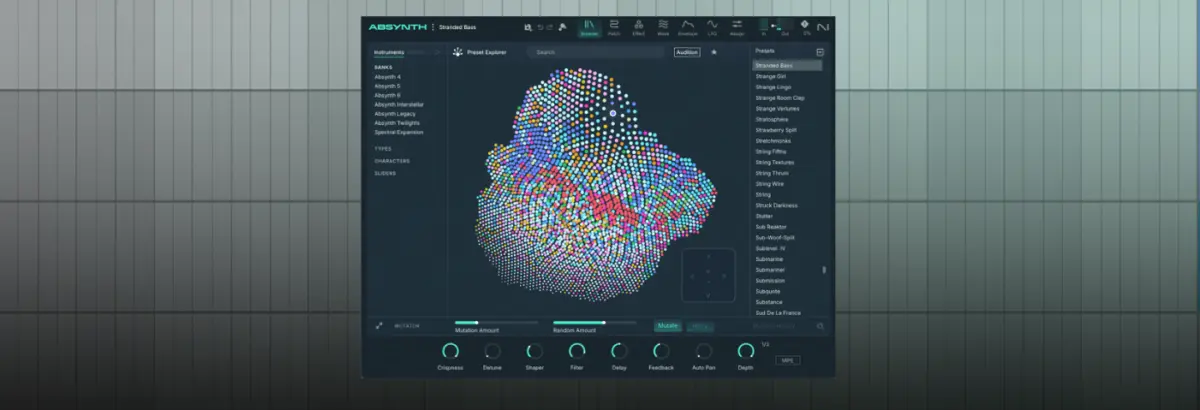
Native Instruments’ legendary synthesizer, Absynth, has long held a mystique within the electronic music production community. Historically celebrated for its sprawling atmospheres, esoteric timbres, and complex multi-stage envelopes designed for cinematic soundscapes and evolving ambient pads, Absynth was rarely the instrument electronic music producers reached for when building raw, floor-pounding techno. Yet, with the long-awaited arrival of Absynth 6—debuting as a headline feature of Komplete 26—the software has undergone a profound architectural overhaul. It is now the most potent version of the instrument ever created, blending its trademark deep modulation framework with newly engineered granular engines, Moog-modelled filter suites, and spatial processing tools.
In this deep-dive technical masterclass, we explore how Absynth 6’s advanced capabilities can be weaponized outside the ambient realm. Using a single, humble audio asset—a traditional Peking Opera Gong one-shot sample—we will deconstruct a rigorous 10-step process that transforms an organic acoustic strike into a driving, multi-layered, performance-ready techno groovehouse patch. By harnessing Absynth’s complex multi-stage envelopes, high-density granular synthesis, syncopated envelope retriggering, and the lush new Aetherizer spatial processor, this tutorial proves that a single sample is all it takes to generate a complete, shifting, and intensely heavy rhythmic centerpiece for modern club music.

Detailed Chronology: Step-by-Step Sound Design Breakdown
To replicate this patch, configure your DAW to a club-ready tempo of 129 BPM. Insert an instance of Absynth 6 onto a MIDI track and program a driving, syncopated techno sequence. We will build the patch outward from a single raw audio file, gradually stacking three distinct channels inside the synth’s architecture to create a living, breathing rhythmic engine.
Step 1: Initializing the Granular Engine and Source Sample
Begin with a blank slate by selecting New Preset in Absynth 6. Playing your MIDI sequence will initially yield an uninspired, sterile sine wave. Navigate to the Patch tab to replace this default oscillator with Absynth’s overhauled Granular Engine. From the sample library, load the Peking Opera Gong one-shot.

While the raw sample on its own sounds metallic, bright, and isolated, placing it within the context of a 129 BPM groove reveals its initial transient strength, though it lacks low-end weight and rhythmic cohesion.
Step 2: Pitch Transposition and High-Density Granular Manipulation
To infuse the sound with grit and weight, transpose the oscillator down by 12 semitones (one full octave). Next, navigate to the Grain tab and dial the grain size down to a razor-sharp 3ms.

This adjustment unlocks the true power of Absynth 6’s redesigned Granular Engine, which now supports a maximum grain density of 32. Cranking the density parameter to this maximum setting fuses individual grains into a continuous, heavy, and texturally rich audio stream. Dropping the density back down to legacy levels (such as 4) instantly reveals how limp and disconnected lower-density granular synthesis sounds in comparison.
Step 3: Unleashing Multi-Stage Amplitude and Pitch Envelopes
Absynth’s historical "secret sauce" lies within its formidable envelope architecture. Envelopes in Absynth do not simply govern volume; they can modulate almost any parameter across complex multi-stage paths.

Click on Osc A Amp, open the Transform menu, and select Expand to Rhythm, ensuring BPM Sync is engaged. Next, initialize a new envelope assigned to Osc A Main Pitch. Engage the LFO function and pull the first envelope breakpoint all the way down. This dual-action setup—where an envelope actively pumps the amplitude while an LFO modulates pitch—suddenly snaps the sound into focus, yielding an organic, squelchy acid bassline.
Step 4: Fine-Tuning LFO Modulation and Phase Parameters
To refine the acid characteristics introduced in Step 3, go to the LFO page. Deselect channels B and C from the LFO’s pitch assignment matrix to ensure the modulation affects only our primary layer.

Increase the Pitch slider to 25, the time parameter to 1.6919, and the phase to 32.063. These precise adjustments generate unstable, wobbly pitch modulation punctuated by nasty, aggressive harmonic spikes that elevate the patch into authentic acid techno territory.
Step 5: Sculpting Mid-Range Filth via Moog-Style Ladder Filters
Filtering is critical to taming and defining aggressive synthesizer patches. Absynth 6 introduces a pristine suite of analog-modelled ladder filters.

First, insert a Ladder Band-Pass (BP) filter set to a cutoff frequency of 542.92 Hz. This isolates and accentuates the boxy, aggressive mid-range characteristic of classic acid lines. Next, stack a Ladder Low-Pass (LP) filter set to 500.56 Hz and drive the resonance up to 43.875. The resulting dual-filter configuration adds warmth, self-oscillation grit, and undeniable analog-style character.
Step 6: Constructing Layer Two via Rhythmic Retriggering
With the primary bass layer established, it is time to build complexity by introducing a second layer. Load a Sample Engine into Channel 2, load the same Peking Opera Gong sample, and transpose it down by 24 semitones (two full octaves) for sub-bass weight. Temporarily mute Channel A to isolate your work on Channel B.

Navigate to the envelope section for Osc B Amp, apply the Expand to Rhythm transform, and switch the envelope mode to Retrigger.
Step 7: Syncopating the Groove and Envelope Timing
Pull the beat length/timing down to 0.250 to generate a rapid, delay-like rhythmic stutter. Grab the lower of the two pink envelope breakpoint circles and drag it leftward to align with the start of the second envelope spike.

This programs Absynth to rhythmically retrigger the amplitude envelope during the opening notes of the sequence, halting the retriggering once the subsequent MIDI notes fire. The result is an infectious, driving syncopation that locks tightly with a standard four-on-the-floor beat.
Step 8: Spatial Processing with the Aetherizer Effect
Absynth 6 features the Aetherizer, a lush, granular-based spatial effect capable of smearing sound across the stereo field. Instead of feeding the Master signal into the effect, route only the input from Channel 2.

Crank the Feedback parameter up to 75 and set the Wet/Dry mix to approximately 0.562. Mapping this parameter to a hardware macro allows you to dynamically sweep the spatial wash in and out during a performance. Unmute Channel A to hear how the pristine spatial processing of Channel B interacts with the dry, aggressive punch of the first layer.
Step 9: Adding the Final Structural Layer and Loop Points
For the final sonic tier, load a third Sample Engine onto Channel C, utilizing the Peking Opera Gong sample once more. Mute Channels A and B temporarily to audition Channel C against a driving techno loop.

Open Absynth 6’s overhauled Loop section, setting a loop start point at 5600 and an end point at 12644. This technique fractures the sample into syncopated, stuttering micro-repeats while retaining the core melodic contour of the main riff. Bring the volumes of Channels A and B back into the mix to evaluate the full three-layer ensemble.
Step 10: Live Performance Balancing and Macro Assignment
The beauty of this multi-channel architecture lies in its modular flexibility. Each layer sounds distinct and powerful both in isolation and when blended in various combinations.

To turn Absynth 6 into a live-jamming groovebox, assign hardware macros to critical parameters—such as individual channel volumes, filter cutoffs, and the Aetherizer Wet amount. This empowers producers to execute dynamic, hands-on arrangements entirely from within a single synthesizer instance.
Supporting Context & Metrics
The Evolution of Absynth
Originally developed by Lichtdesign (Brian Clevinger) and acquired by Native Instruments in 2002, Absynth carved out a legendary status among sound designers for its semi-modular architecture, wave-morphing oscillators, and famously deep envelope editor. However, as music production workflows accelerated toward tight, CPU-efficient, and club-centric tools, the synth’s complex interface and legacy codebase led to its phased retirement from the Komplete bundle.
The launch of Absynth 6 within Komplete 26 marks a triumphant return for the platform. Key technical upgrades include:
- Overhauled Granular Engines: Maximum grain density doubled from legacy versions up to 32, allowing for dense, wall-of-sound textures.
- Modernized Filter Architecture: Addition of authentic analog-modelled ladder filters (Low-Pass, High-Pass, Band-Pass) with self-oscillation capabilities.
- Enhanced Spatial Processing: Integration of the Aetherizer effect suite, bringing granular spatialization directly into the synth’s internal routing matrix.
- Optimized CPU Performance: Rewritten core architecture ensuring stability even when running multiple high-density granular and sample engines simultaneously.
Official Statements
Reflecting on the engineering philosophy behind the rebirth of the platform, Native Instruments’ Lead Synthesizer Architect noted:

"Absynth was never meant to be a museum piece. While generations of composers used it to score cinematic sci-fi landscapes, its underlying architecture—specifically the multi-stage modulation envelopes and cross-channel routing—possesses a rhythmic DNA that is violently well-suited for electronic dance music. With Absynth 6, our goal was not to strip away its ambient soul, but to arm producers with modern tools like high-density granular engines and ladder filters that can turn a whisper into an industrial-strength roar."
Industry integration specialists further emphasized the software’s adaptability within modern hybrid hardware-software setups:

"By treating Absynth 6 less as a traditional synth and more as a modular groovebox—as demonstrated by layering multiple sample engines and routing independent effects—producers can generate entire foundational tracks from single acoustic artifacts. It blurs the line between sound design and live performance."
Future Outlook
The revival of Absynth within Komplete 26 signals a broader industry shift: software developers are increasingly looking to heritage instruments not for nostalgia, but to inject organic complexity back into modern electronic music production. As sterile, preset-driven workflows threaten to homogenize club genres like techno and tech-house, tools that encourage deep, experimental sound design—such as turning acoustic gongs into acid basslines via granular synthesis—are becoming essential.

Looking forward, Native Instruments has hinted at further updates to the Absynth ecosystem, focusing on deeper Max for Live integration, expanded modulation destination matrices, and cloud-synced user patch repositories. For techno producers and sound designers alike, Absynth 6 proves that the boundary between cinematic atmosphere and subterranean club destruction is far thinner than previously imagined—requiring nothing more than a single sample and a willingness to explore the architecture beneath the surface.