Executive Overview
The fundamental human desire to bridge the insurmountable chasm of mortality has never entirely belonged to the realm of pure philosophy or quiet mourning. Across eras marked by rapid industrialization and technological disruption, the bereaved have consistently sought avenues to maintain a dialogue with those who have passed on.
Today, this yearning manifests as a booming digital sector: AI-powered "deathbots," synthetic voice cloning platforms, and an array of consumer software broadly categorized as "grief tech." These modern tools offer the ability to recreate the digital footprint, voice, and likeness of the deceased, generating fresh commercial opportunities alongside profound ethical questions. Critics and philosophers alike are left grappling with an uncomfortable, age-old dilemma: Should human grief be capitalized upon?
Yet, long before artificial intelligence made it possible to synthesize a familiar voice for a monthly subscription fee, 19th-century Britain navigated a nearly identical paradox. The Victorian spiritualist movement wrestled with issues of credibility, authenticity, and commercial exploitation while transforming one of humanity’s most enduring psychological needs into a marketable commodity.
Recent business history research into 19th-century spiritualism reveals that the parallels between Victorian seance rooms and modern Silicon Valley startups run far deeper than a shared fascination with the afterlife. Both eras demonstrate how cutting-edge technologies—whether 19th-century optical physics and large-scale plate glass or 21st-century neural networks—are eagerly co-opted to make the invisible visible, reproducible, and, crucially, profitable.
Detailed Chronology: A History of Commercializing the Beyond
To understand how modern grief tech operates within a continuum of capitalism, it is necessary to examine how humanity has historically transformed spiritual longing into economic enterprise.
1. The Mid-19th Century: The American Spark and Modern Mediumship
The modern spiritualist movement traces its institutional roots to upstate New York in the late 1840s. It was catalyzed by the Fox sisters—Margaretta, Kate, and Leah—who claimed that mysterious, rhythmic rapping noises in their home were the result of communications with spirits.
- 1848: The Fox sisters publicize their auditory phenomena, capturing the public imagination and establishing the archetype of the professional medium.
- Early 1850s: The movement rapidly crosses the Atlantic. American mediums tour Victorian Britain, introducing seances, public demonstrations, and specialized paraphernalia to an eager public.
2. The Late Victorian Era: Industrializing the Macabre
By the 1870s, Victorian Britain was simultaneously a beacon of industrial progress, scientific discovery, and engineering feats—and a society deeply obsessed with ghosts, spiritualism, and the macabre.
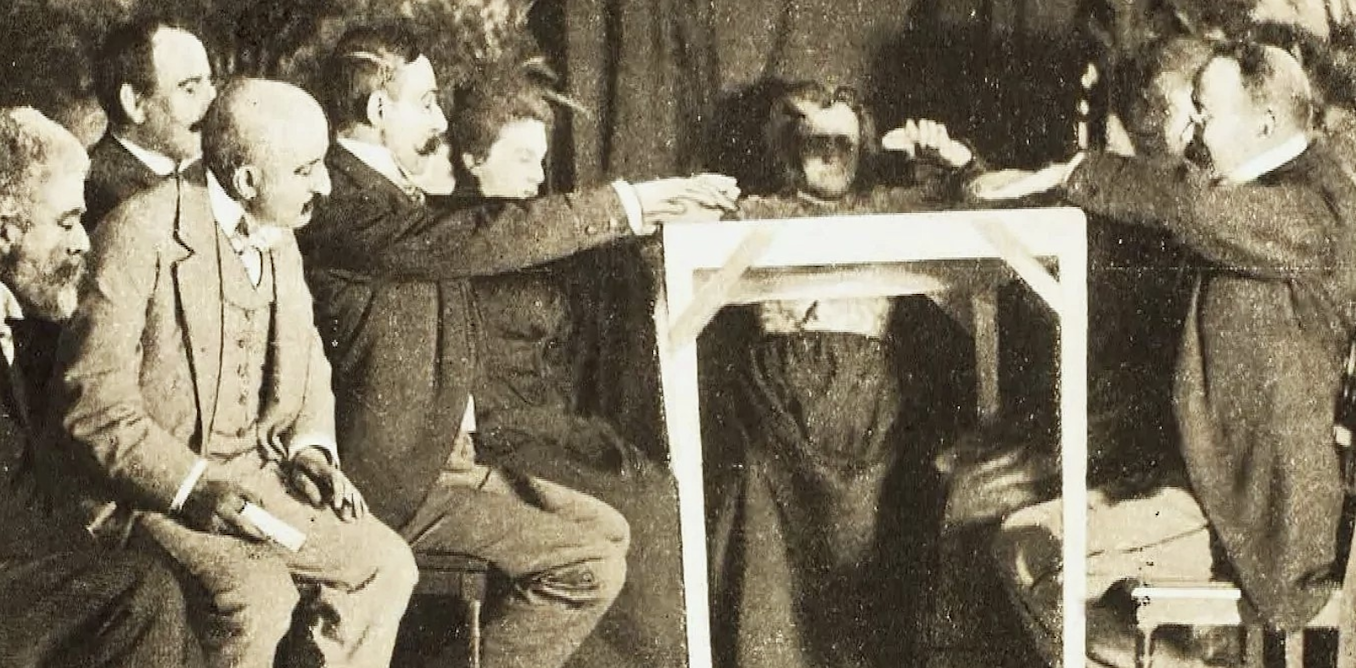
- 1872: The Times of London expresses public bewilderment that “a generation which boasts itself to be one of exact science” has cultivated such an immense appetite for spiritualism.
- 1880: Accounts in publications such as Medium and Daybreak document photographic seances near Newcastle. Mediums increasingly lean on emerging technologies, utilizing darkroom mechanics and specialized illumination to legitimize spirit materialization.
3. The 20th and 21st Centuries: From Spiritualism to Silicon Valley
As traditional organized spiritualism waned in the mid-20th century, the underlying desire for contact evolved alongside media technologies, moving from tape-recorded Electronic Voice Phenomena (EVP) to modern digital infrastructure.
- 2010s–Present: The proliferation of generative artificial intelligence, large language models (LLMs), and deepfake voice generation gives rise to "digital necromancy."
- Present Day: Startups launch commercial applications that ingest a deceased person’s text messages, social media posts, and voice notes to construct interactive chatbots, commercializing grief for the digital age.
Supporting Context & Metrics: The Philosophy of the "Obscene Supplement"
At first glance, the explosion of spiritualism in an era defined by exact science, department stores, and railways appears to be a contradiction—the stubborn persistence of premodern superstition within a hyper-modern society. However, cultural and business historians argue that these two forces were mutually constitutive.
The Technological Enablers
The supernatural did not survive on the margins of Victorian industrial modernity; it actively utilized its innovations.
- Optical Physics and Glass: Large-scale plate glass production and advanced illumination techniques allowed for the staging of phantasmagorical illusions, most notably "Pepper’s Ghost," which projected translucent, spectral figures onto stages.
- Photography: The burgeoning photographic industry was quickly co-opted to produce "spirit photography," purporting to capture deceased loved ones hovering behind the living.
- Print Culture: Gothic fiction and cheap paperbacks known as "penny dreadfuls" fed a mass market hungry for tales of the strange and supernatural.
Slavoj Žižek and the "Obscene Supplement"
Philosopher Slavoj Žižek offers a framework for understanding this phenomenon through the concept of the "obscene supplement." Žižek argues that complex societies are sustained partly through an underside of practices and desires that outwardly appear to contradict official values.
This underside provides psychological outlets for what official societal values exclude, thereby helping individuals endure the pressures of the wider social order. Victorian spiritualism functioned as precisely this kind of supplement. It offered a poignant, emotionally resonant escape from the cold, hyper-materialistic demands of industrial capitalism, yet it did so entirely through the mechanisms of consumer culture: paid encounters, purchasable photographs, and advertised products.
Official Perspectives: Navigating Authenticity and Commerce
Managing the friction between spiritual purity and commercial survival required delicate maneuvering from the architects of both 19th-century spiritualism and 21st-century grief tech.
The Victorian Balancing Act
Spiritualist publications frequently warned their readers that true mediumship could not be bought or sold. Yet, the realities of logistics demanded capital: mediums required livelihoods, publishers needed subscription revenue, and organizers had to cover hall rentals.
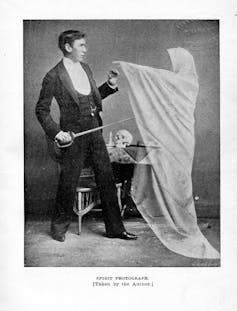
To resolve this cognitive dissonance, mediumship was reframed as an exhausting, physically draining, and hazardous duty. Practitioners were cast as selfless conduits who deserved fair compensation.
- Daniel Dunglas Home: One of the most famous mediums of the era, Home publicly refused direct payment for conducting seances. Instead, he accepted "gifts," hospitality, travel expenses, and material support from wealthy, adoring patrons.
- The Publishing Paradox: Periodicals such as Medium and Daybreak routinely dedicated their front pages to fiery denunciations of materialism and worldly attachments. Yet, their back pages were packed with advertisements for patent medicines, elixirs, and quasi-scientific gadgets marketed directly to the faithful.
The Modern Tech Parallels
Today’s grief-tech founders face a remarkably similar public relations tightrope. Operating in a space defined by emotional vulnerability, companies must constantly assert their technological credibility and ethical boundaries while scaling their user acquisition models.
Ethicists and psychologists warn that monetizing grief risks exploiting individuals at their lowest points of vulnerability. In response, modern developers emphasize therapeutic value, framing their AI products not as commercial novelties, but as legitimate psychological tools designed to assist in the processing of loss.
Future Outlook: The Enduring Legacy of Digital Necromancy
As artificial intelligence continues to advance at an exponential rate, the boundary between remembrance and recreation will only blur further. The ghosts of Victorian capitalism have not been exorcised; they have simply migrated to the cloud.
The modern appetite for digital necromancy highlights a permanent truth about the human condition: technological sophistication does not eradicate the fundamental fear of finality or the desperate longing for continuation. Rather, every leap forward in human engineering—from the plate-glass illusion theaters of the 19th century to the neural networks of the 21st—is immediately conscripted into the service of our oldest emotional project.
Ultimately, the most unsettling takeaway from examining the business history of spiritualism is that desires which appear to challenge a society’s dominant values often end up reinforcing them. Far from subverting the established economic order, the commercialization of grief creates new vectors for its expansion. As long as human beings experience the pain of loss, entrepreneurs will find innovative ways to market the illusion of eternity—ensuring that the business of the afterlife remains remarkably, enduringly profitable.