Executive Overview
In the contemporary landscape of acoustic and avant-garde music, few artists occupy as singular a space as Brìghde Chaimbeul. Hailing from the Isle of Skye, Chaimbeul is a master of the Scottish smallpipes whose career represents a masterclass in bridging ancient cultural lineages with radical, modern experimentation. Her biography describes her not merely as a traditionalist, but as a leading purveyor of Celtic experimentalism—a title earned through a decade of relentless artistic evolution, cross-genre collaborations, and an uncompromising commitment to expanding the sonic vocabulary of her chosen instrument.
From her early days as a BBC Radio 2 Young Folk Award winner to global stages, high-profile collaborations with artists like Colin Stetson and Caroline Polachek, and a landmark NPR Tiny Desk Concert that quickly amassed hundreds of thousands of views, Chaimbeul has reshaped how the world perceives the Scottish smallpipes. This report traces her meteoric rise, charting her pivotal albums, critical acclaim, and the unique methodologies that have cemented her status as a global pioneer of contemporary experimental folk.
Detailed Chronology
The Formative Years and the BBC Radio 2 Young Folk Award (2016)
Brìghde Chaimbeul’s musical journey began on the Isle of Skye at age four, when she was first inspired by the veteran piper and pioneer of canntaireachd—a phonetic, vocal piping tradition used for teaching complex tunes—Rona Lightfoot. Captivated by this auditory legacy, Chaimbeul began studying the Highland pipes formally at age seven, immersed in an environment deeply saturated with piping history.
Her transition from a promising regional talent to an artist of national significance accelerated dramatically in 2016 when she won the prestigious BBC Radio 2 Young Folk Award. This accolade propelled her onto major festival stages, including a memorable performance at Fairport’s Cropredy Convention alongside her sister Màiri on harp and guitarist Michael Ferrie. Even in these early live sets, observers noted that her musical palette extended far beyond standard Highland repertoire. Soon after, her performances at events like Sidmouth Folkweek and early contributions to specialty broadcasts—such as performing Wee Donald alongside Innes White—signaled the arrival of an exceptional new voice.
The Reeling: A Critical Breakthrough (2018–2019)
In late 2018, Chaimbeul announced the launch of her debut solo album, The Reeling, set for release at Celtic Connections 2019 on Rough Trade’s specialized folk imprint, River Lea. Produced with an illustrious cast of contributors—including Aidan O’Rourke (Lau), Radie Peat (Lankum), and her early inspiration Rona MacDonald Lightfoot—the record was an immediate critical triumph.
The Reeling showcased not only Chaimbeul’s masterclass execution on the smallpipes but also her idiosyncratic global influences. A pivotal research trip to Bulgaria in March 2017 exposed her to the hypnotic, microtonal intricacies of the country’s folk music and, crucially, its kaba gaida (deep-droning bagpipe) tradition. Integrating these Balkan sensibilities with Scottish forms yielded a debut that stunned critics. Tim Chipping of River Lea famously remarked that the sheer strength of their first three releases—by Ye Vagabonds, Lisa O’Neill, and Chaimbeul—suggested the label had achieved a creative peak right out of the gate.
LAS and Collaborative Exploration (2022)
Before embarking on her next major solo project, Chaimbeul expanded her collaborative footprint. In 2022, she released LAS, a collaborative album alongside fellow Scottish musicians Ross Ainslie and Steven Byrnes. Reviewers hailed the record as a triumph of conceptual unity, brilliantly balancing forward-thinking structural innovations with deep respect for traditional cadence. LAS proved that Chaimbeul was not an isolated purist, but a dynamic conversationalist capable of blending her drone-heavy instrument seamlessly with diverse acoustic textures.
Carry Them with Us: The Avant-Garde Convergence (2023)
The year 2023 marked a watershed moment in Chaimbeul’s career with the release of Carry Them with Us via tak:til / Glitterbeat. For this project, she enlisted Canadian avant-garde saxophonist Colin Stetson, a partnership that pushed her sound deeper into contemporary sonic art.
Crucially, Carry Them with Us also featured Chaimbeul’s debut as a vocalist. The introduction of the human voice amidst the dense, mechanical wail of her smallpipes created an uncanny, ethereal atmosphere. Tracks like the album-closer, Bonn Beinn Eadarra (The Haunting), featured her voice hovering like a disembodied benediction over a shifting landscape of drones and saxophone, cementing her reputation as an artist of immense theatrical and emotional ambition.
Sunwise: Refining the Solitary Drone (2025)
Released in 2025, Sunwise saw Chaimbeul lean back into a more localized, solo-focused creative space, while still embracing select collaborative textures. On pieces like Sguabag / The Sweeper, she recorded live alongside a cadre of master uilleann pipers—John McSherry, Francis McIlduff, and Jamie Murphy—creating a cross-Celtic dialogue of reeds and air. Sunwise further solidified her pivot from a regional folk competitor to a fixture of the international experimental music circuit, with festival appearances spanning boundary-pushing institutions like Le Guess Who? and Supersonic.
All the Light in the World and the NPR Tiny Desk Triumph (Present)
Chaimbeul’s artistic trajectory reached a new apex with her collaborative album alongside Colin Stetson, All the Light in the World. Distributed via Invada, the record is built entirely on deep listening, live improvisation, and emotional intensity, fusing Stetson’s circular-breathing saxophone innovations with Chaimbeul’s hypnotic smallpipe drones.
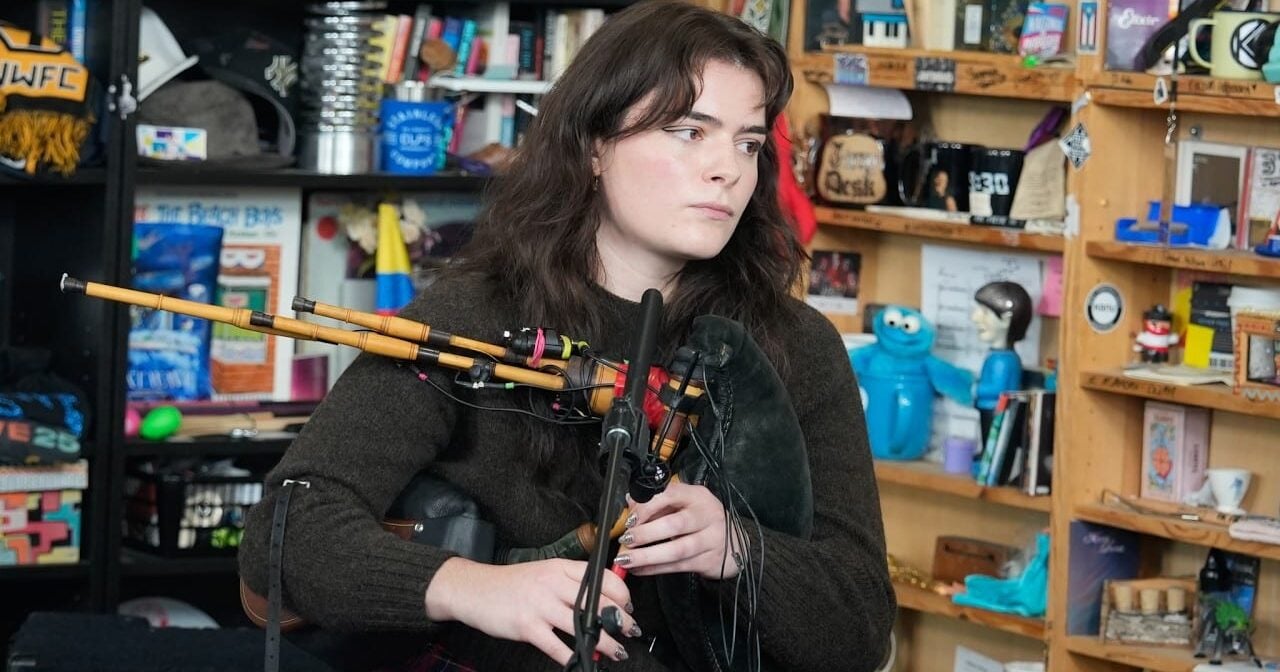
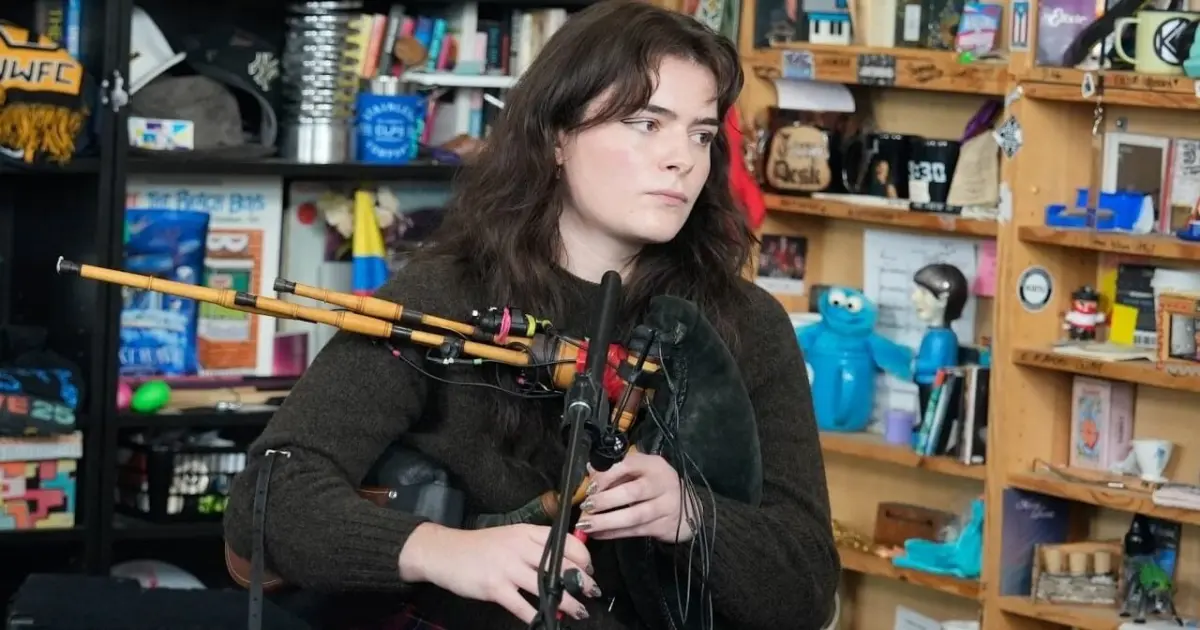
This momentum culminated in her debut NPR Tiny Desk Concert. Backed by Shahzad Ismaily on synthesizers, Chaimbeul delivered a mesmerizing set drawing from Sunwise and Carry Them with Us. The performance rapidly surpassed 340,000 views, introducing her singular brand of Celtic experimentalism to a massive, global mainstream audience.
Supporting Context & Metrics
The quantitative and qualitative markers of Brìghde Chaimbeul’s career illustrate a rare trajectory for a traditional folk instrumentalist:
- Digital Reach: Her debut NPR Tiny Desk Concert crossed the 340,000-view threshold within weeks of release, demonstrating significant international appetite for avant-garde acoustic music.
- Genre-Defying Festival Circuit: Her performance resume transcends traditional folk festivals, encompassing avant-garde and experimental strongholds such as Le Guess Who? and Supersonic.
- High-Profile Cross-Overs: Beyond her core folk releases and collaborations with Colin Stetson, Chaimbeul’s cross-genre appeal is underscored by her guest contribution to pop auteur Caroline Polachek’s critically acclaimed album.
- Instrumental Mechanics: The Scottish smallpipes allow Chaimbeul to produce two simultaneous, continuous musical drones while articulating an intricate melody overhead. This physical characteristic of the instrument serves as the structural foundation for her seamless fusions of ancient modal folk and minimalist contemporary composition.
Official Statements & Critical Commentary
Music critics and record labels have consistently struggled—and succeeded—to articulate the rare alchemy present in Chaimbeul’s work.
Thomas Blake, reviewing Carry Them with Us for KLOF Mag, noted:
"It is a quirk of musical fate that some of the most traditional forms can produce the most experimental sounds. Brìghde Chaimbeul is an instrumentalist from Skye who is steeped in the musical and oral traditions of the islands and highlands of Scotland but whose music is as invigorating and new as anything currently being produced in either folk or contemporary avant-garde circles."
Reflecting on her vocal debut on the same record, Blake added:
"It marks the first instance of Chaimbeul’s singing, and the sudden insertion of a human voice in this otherwise wild landscape feels almost uncanny… It brings the listener back to consciousness after an extraordinary experience that has slowly begun to resemble a series of strange, beautiful dream-stories."
Describing her ongoing collaboration with Colin Stetson on All the Light in the World, Invada Records stated:
"Built from deep listening, improvisation, and an instinct for emotional intensity, the record merges Stetson’s innovative approach to the saxophone with Chaimbeul’s singular command of the Scottish smallpipes, creating music that drifts between drone, ritual, and cinematic expanse."
Future Outlook
As Brìghde Chaimbeul looks toward the horizon, her position in the global music ecosystem is stronger and more dynamic than ever. She has successfully dismantled the rigid boundaries that historically separated folk preservation from modern experimentalism.
By treating tradition not as a museum artifact to be protected under glass, but as a living, malleable dialect, Chaimbeul has opened pathways for a new generation of acoustic artists. Whether she is performing solo iterations of ancient Piobaireachd, engaging in deep-listening improvisations with avant-garde saxophonists, or mesmerizing digital audiences via platform-defining broadcasts like NPR’s Tiny Desk, her work guarantees that the resonant, hypnotic drone of the Scottish smallpipes will echo far into the future of contemporary music.