Executive Overview
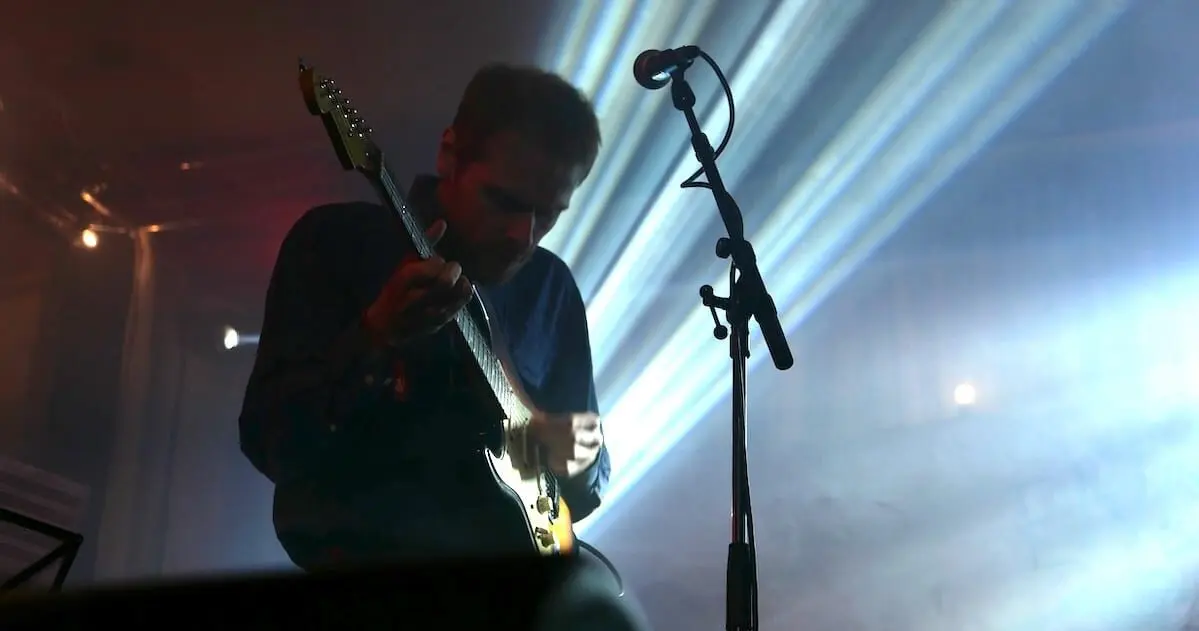
Backstage at the picturesque Folly stage, approximately an hour before his Saturday evening performance, idiosyncratic British composer, multi-instrumentalist, and songwriter Kiran Leonard is remarkably at ease. Marking the momentous twentieth-anniversary milestone of the beloved End of the Road Festival, Leonard’s presence anchors a long-standing, deeply sentimental relationship with an event that first welcomed him as a teenage prodigy back in 2014.
This comprehensive feature explores Leonard’s evolving artistic ethos, tracing his trajectory from the frantic, maximalist adolescent intensity of early works like Bowler Hat Soup and Grapefruit to the structural sophistication of his current repertoire. Through an expansive interview touching on Ben Lerner’s novel Transcription, compositional techniques rooted in both piano and guitar, the pragmatic realities of scoring music for working-class musicians, and his nuanced relationship with the "prog-rock" label, this piece presents a definitive portrait of a singular modern artist building an uncompromising, cohesive musical language.
Detailed Chronology: From Teenage Prodigy to Mature Composer
The Setup and Ben Lerner’s Transcription
The interview begins before the formal questions even drop. Strikingly composed compared to the nervous journalist fussily configuring primary and backup voice recorders to protect against technical catastrophe, Leonard seizes the initiative.
"Have you read that book Transcription? It’s a new novel by Ben Lerner," Leonard asks.
When the interviewer confesses he has not, Leonard summarizes:
"It’s about a guy who goes to interview his old professor and just as he’s about to do it, he drops his iPhone in the sink. Well, I won’t spoil it, but it’s about how recording conversations affects your memory of the conversation."
This literary icebreaker establishes the thematic core of the dialogue: memory, preservation, the weight of documentation, and how our understanding of creative work shifts across time.
Roots at End of the Road (2014–Present)
Transitioning to the twentieth anniversary of End of the Road, Leonard reflects on his deep-rooted personal history with the festival. First performing here in 2014 just prior to his nineteenth birthday—playing a clandestine secret set on the very same Folly stage—Leonard expresses profound gratitude toward festival founder Simon Topley.
Unlike many artists whose festival bookings fluctuate wildly based on corporate backing, major label representation, or booking agency clout, Leonard notes that End of the Road has maintained a consistent, open-door policy. Over a professional context spanning more than a decade, this festival has remained a rare, reliable home base.
[2014: First Secret Set] ---> [Subsequent Appearances] ---> [2024: 20th Anniversary Set on Folly Stage]
          |                                                               |
          +--- (Age 18, Pre-Nineteenth Birthday)                         +--- (Early 30s, Mature Composer)
Navigating the Repertoire: From Adolescent Maximalism to Present Day
Confronted with the stark stylistic chasm between his early-2010s output (exemplified by Bowler Hat Soup) and his current output, Leonard discusses the impossibility of re-accessing his adolescent mindset. Now in his early thirties, he looks back on his early records with immense pride, describing them as honest, earnest documents of youth:
- Adolescent Maximalism: Characterized by an additive, kitchen-sink approach where "everything is at a very hysterical pitch because time feels very…" urgent.
- The Inaccessibility of Youth: Leonard admits that he cannot authentically play those songs today with the same visceral rage because his internal state of mind has fundamentally evolved. Consequently, he feels a creative imperative to continuously look forward.
Supporting Context & Metrics: Festivals, Audiences, and Instrumentation
Festival Curatorial Philosophy as a Punter and Performer
When asked what he seeks in a festival environment from both sides of the stage, Leonard champions human scale and sonic diversity:
- Ideal Capacity: At roughly 15,000 attendees, End of the Road hits the "good size" sweet spot, avoiding the alienating gigantism of mega-festivals.
- The Z-Axis of Sonic Cohesion: Leonard praises the festival’s unique ability to connect disparate musical traditions. Citing back-to-back experiences of watching The Space Lady at the Boat Stage on Thursday alongside KeiyaA, he highlights how placing divergent experimental approaches within a consistent, high-quality contextual framework allows audiences to perceive unexpected cross-genre structural connections.
- Audience Reception: Describing the crowd at End of the Road as balanced and attentive, Leonard humorously defends his fragile ego: “Obviously, I want people to listen, but my ego is as fragile as everyone else’s, and I still want to hear people go ‘yeah!’ But it’s always a good balance here.”
The Mechanics of Composition: Piano, Guitar, and Working-Class Pragmatism
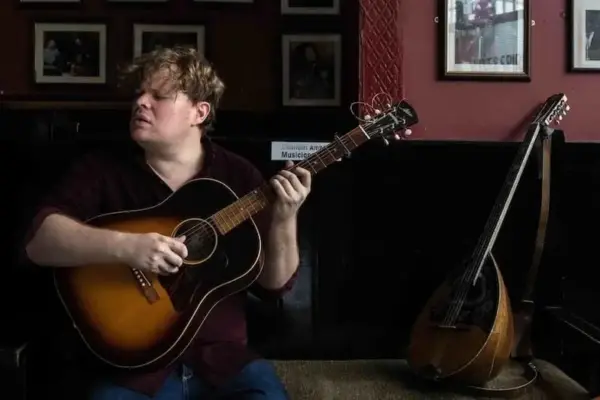
Leonard’s technical command of multiple instruments informs his highly distinctive compositional methods. As a multi-instrumentalist who works day-to-day as a secondary school music teacher, his approach bridges classical rigor with punk-rock tactility.
+-----------------------------------------------------------------+
|                    LEONARD'S INSTRUMENTAL MATRIX                |
+---------------------+-------------------------------------------+
| Piano               | Egalitarian visual range; best for large  |
|                     | orchestrations because "it has most notes."|
+---------------------+-------------------------------------------+
| Guitar & Cittern    | Physical, shape-based, dissonant; ideal   |
|                     | for teaching teens alternative harmony.   |
+---------------------+-------------------------------------------+
| Score Notation      | Respectful of collaborators' limited time |
|                     | by providing a clear structural baseline.|
+---------------------+-------------------------------------------+
When writing for his live group, Leonard utilizes the guitar while bandmate Mike O’Malley anchors parts on the cittern. For grander arrangements, he relies exclusively on the piano:
"The piano’s sort of egalitarian; there are white keys and black keys, but basically every note looks the same. It allows you to visualise a huge range of notes…"
When teaching thirteen and fourteen-year-old students the basics of songwriting, Leonard outlines a dual pedagogical framework:
- The Theoretical Route: Analyzing chord progressions, harmonic compatibility, and interval structures.
- The Punk-Rock Shape Route: Shifting physical finger shapes up a fret to discover radical dissonance and textural vitality without requiring advanced musicology degrees.
Official Statements & Direct Quotations
To preserve the authentic voice and intellectual rigor of Kiran Leonard, key declarations from the interview are synthesized below:
-
On Categorisation and Broad Structures:
"I’m not striving to be uncategorisable; I try to work in very broad categories. I’m interested in song… I’m interested in structure and playing around with structure, trying things that supposedly aren’t supposed to belong in song. Structural techniques that might be more appropriate for composition, trying to use them with songs."
-
On Physical Response over Mere Experimentation:
"What I’m really interested in is things that give an almost physical response. Certain types of volume and density, certain types of spaciousness… I’m always striving to follow these threads."
-
On Rehearsal Pragmatism and Scored Music:
"Because the structures are jumping around a lot and because I and everyone I play with, we all have other jobs; time is very limited… I find a lot of what we play is notated; it’s scored out… That is the most respectful way really to deal with people’s limited time."
-
On Playing Festival "Bangers":
"Yeah, the bangers, you know? (laughs) As a performer, I don’t have any obstinacy at all; I want people to enjoy the performance, I want to give a version of what I do that is immediate and exciting for people."
-
On the "Prog Rock" Label:
"I had a compilation of recordings that was between my first two records, which I called ‘Adolescence Of Prog’ because that’s what my adolescence was like. I loved a lot of then more contemporary prog; my first favourite was the Mars Volta… The one prog band I still return to and love is Henry Cow… It’s very theatrical, but structurally I love it. It’s not ponderous… it’s very very rigorous."
Future Outlook: Building a Unified Musical Language
As Kiran Leonard moves past his early thirties, public perceptions labeling him a "musician’s musician" or worrying over stylistic versatility point toward an artist continuously refining a deeply personal lexicon. Rather than viewing his stylistic shifts as disjointed departures, Leonard views every left turn as part of an ongoing trajectory:
- Building a Language: The overarching goal is the construction of a flexible personal language capable of traversing disparate emotional and sonic spaces while maintaining structural integrity.
- Live Adaptations: Striking the right balance between immediate, high-energy festival crowds and complex, non-conventional structural formats ensures that Leonard remains an essential fixture of progressive modern music.
- Continued Documentation: With recent intimate live sessions—such as his recorded performance at The State51 Factory—capturing the raw immediacy of his current touring incarnation, Leonard’s creative momentum shows no signs of decelerating.
Recommended Viewing & Further Reading
- Watch: Kiran Leonard Live at The State51 Factory (YouTube)
- Explore: Danny’s full review of the End of the Road Festival anniversary celebrations.