Executive Overview
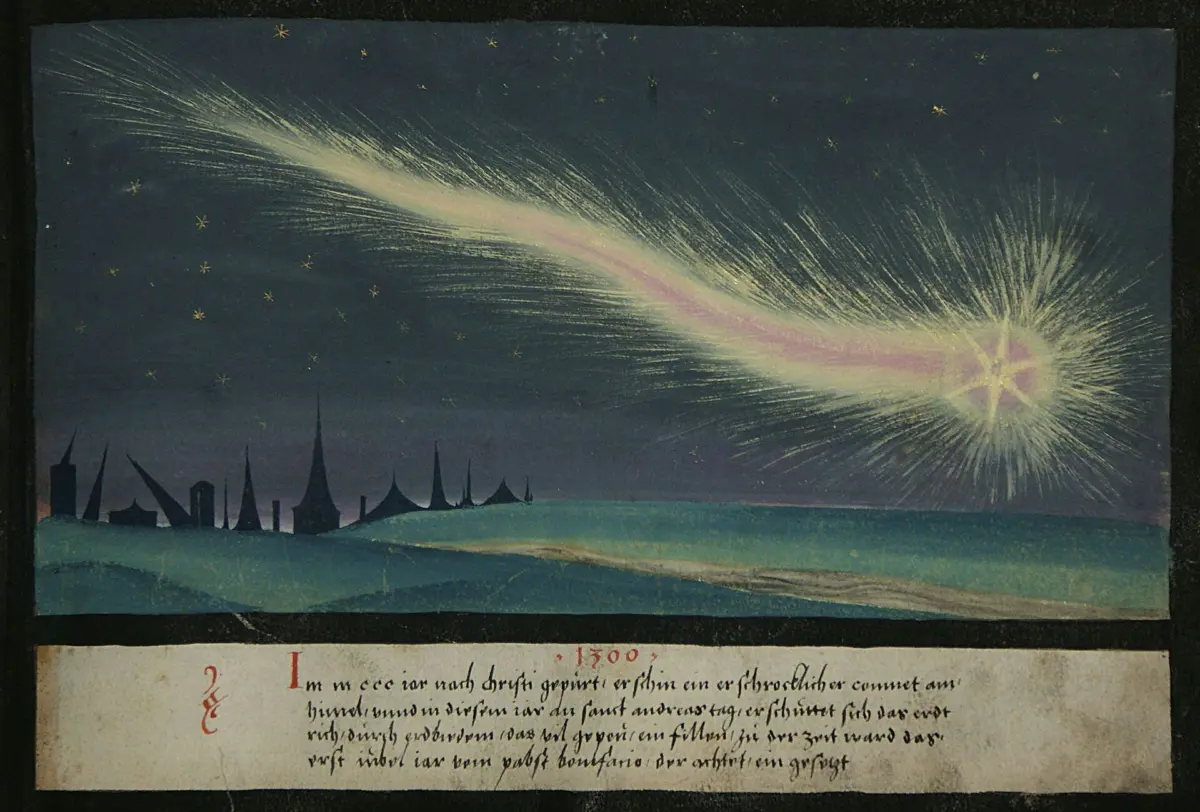
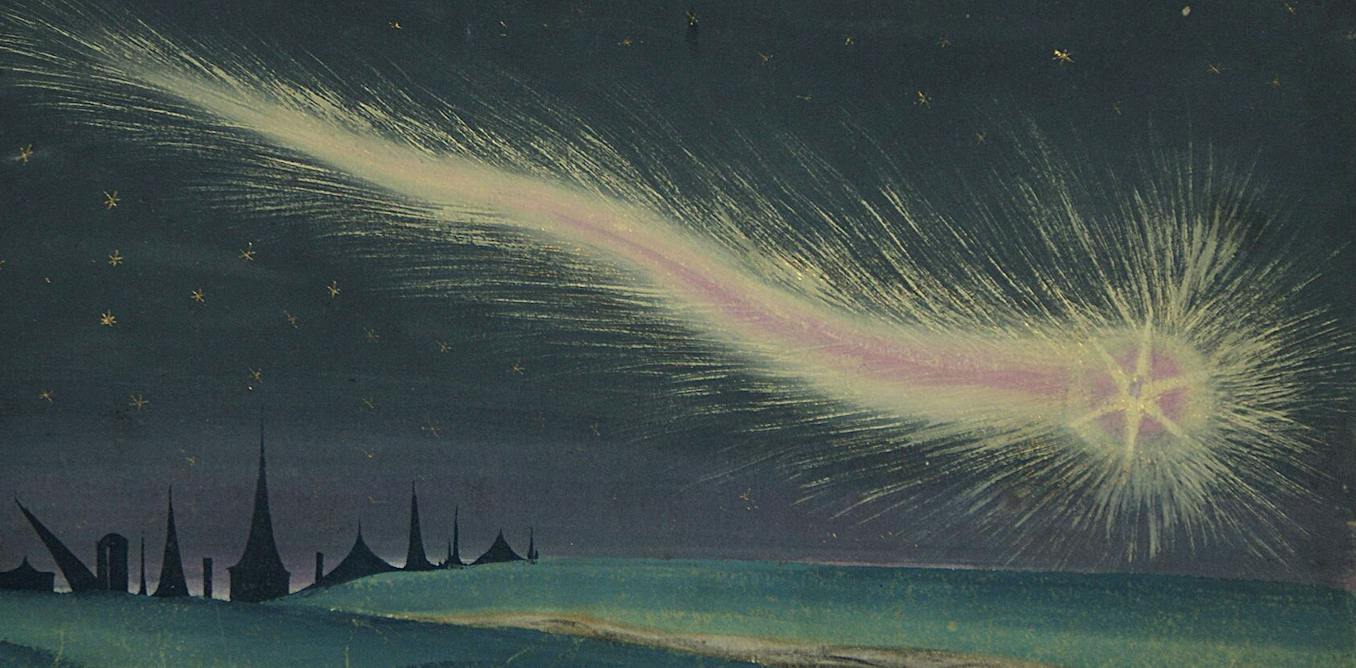
In the spring of 1066, a celestial visitor sliced across the evening skies of Western Europe, blazing as brightly as the planet Venus with a dramatic 15-degree tail. To modern astronomers, this was simply Halley’s Comet on its predictable orbital path, passing within 15 million kilometers of Earth. To the people of the 11th century, however, it was regum terror—the "terror of kings."
Its sudden appearance, occurring just four months after the coronation of the Anglo-Saxon King Harold Godwinson, ignited a firestorm of political anxiety, divine speculation, and historical myth-making. Immortalized most famously in the Bayeux Tapestry—where King Harold and his subjects gaze up in dread beneath the embroidered words Isti mirant stella ("Those people marvel at the star")—the comet became a potent canvas for political propaganda. Norman chroniclers leveraged the celestial phenomenon to cast Harold as a doomed usurper whose betrayal invited rightful destruction, while contemporary chroniclers across England and Normandy wrestled with the deeper philosophical implications of what the cosmos was trying to tell mankind.
Far from mere medieval superstition, the tracking, recording, and debating of Halley’s Comet in 1066 opens a vital window into the state of medieval science, the inseparable bond between astronomy and astrology, and the sophisticated global network of learning that spanned Christendom and the Islamic world.
Detailed Chronology: The Appearance and Aftermath of 1066
Spring 1066: The Fiery Portent Appears
According to the overwhelming consensus of Western European historical sources, Halley’s Comet first became visible in the evening sky on April 24, 1066. At this stage, King Harold Godwinson had been on the English throne for roughly four weeks, following the death of Edward the Confessor in January and a chaotic succession crisis.
Modern computational astrophysics confirms contemporary records—including vital observations from Song Dynasty China—that the comet was an exceptionally bright, awe-inspiring spectacle. Remaining visible for one to two weeks, its luminosity and striking morphology left an indelible psychological mark on a populace already teetering on the edge of political instability.
The Norman Framing and the Bayeux Tapestry
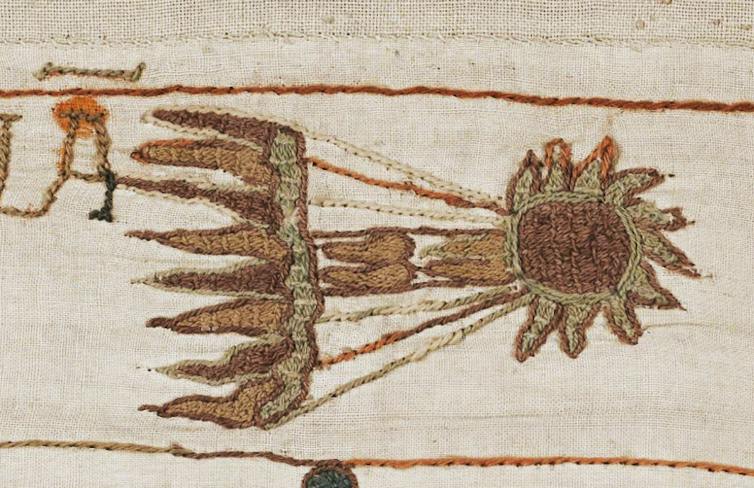
The most enduring cultural artifact of this celestial event is the Bayeux Tapestry, an embroidered masterpiece likely commissioned by Bishop Odo of Bayeux, the half-brother of William the Conqueror. The tapestry strategically juxtaposes the gazing crowd and King Harold with the fiery form of Halley’s Comet above, while ghostly, menacing invasion boats sail across the border below.
This visual narrative served a distinct ideological purpose. As articulated by contemporary Norman writer William of Poitiers, the comet was an undeniable portent of regime change and divine disfavor. By placing the comet sequence prominently in their histories and visual art, the Normans crafted a deterministic narrative: Harold’s reign was illegitimate, and the heavens themselves had signaled his impending doom at the Battle of Hastings in October 1066.
Chronicling the Heavens: Divergent Reactions
Not all contemporary observers shared the Norman view of the comet as a preordained death warrant for Harold:
- The Anglo-Saxon Chronicles (C and D MSS): These vernacular English annals record the appearance of the "haired-star" with striking objectivity. They note it as "a sign such as men never saw before," but pointedly omit any causal link to political regime change or divine retribution against Harold.
- William of Jumièges: Recording the event from a Norman perspective, he described the comet appearing in the north-west with a distinct three-forked tail that lingered for 15 days, interpreting it as an unmistakable harbinger of shifting geopolitical power.
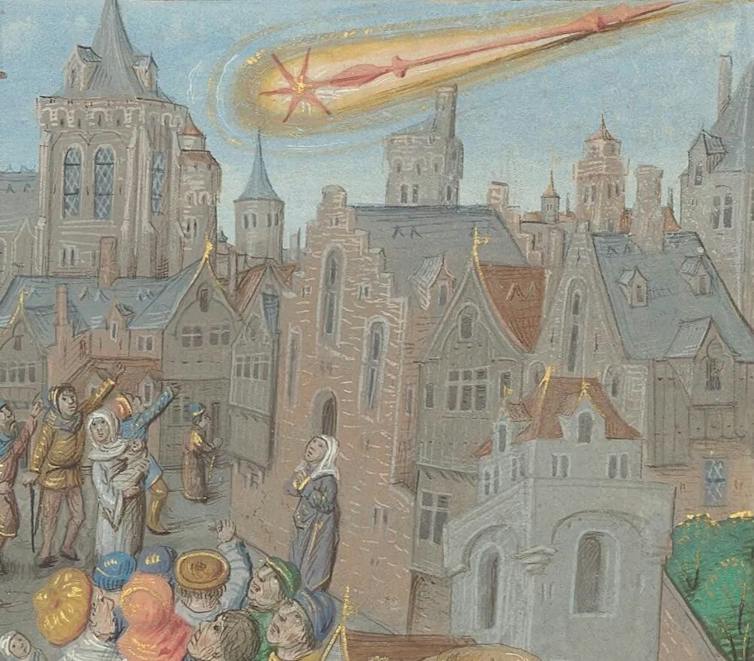
- Later Chroniclers (12th Century): The next generation of historians leaned heavily into the portentious nature of the event. English monk Orderic Vitalis (1075–c. 1142) asserted that "learned astrologers who investigate the secrets of natural science" immediately recognized it as an omen for the transfer of a kingdom. Meanwhile, William of Malmesbury (c. 1095–1143) framed the comet through the retrospective lens of an older monk named Aethelmaer, who supposedly lamented upon seeing the 1066 apparition: "It is a long time since I saw you; but as I see you now you are much more terrible, for I see you brandishing the downfall of my mother-country." (Historians note Aethelmaer may have previously witnessed the faint, long-tailed comet of 1018).
Supporting Context & Metrics: The Medieval Cosmos and Scientific Thought
To understand why a streak of ice and dust in the sky could paralyze an empire, one must examine the intellectual framework of the medieval universe.
The Two-Realm Universe
Medieval natural philosophy operated on a bifurcated cosmological model inherited from antiquity:
- The Super-Lunary Realm: Spanning from the Moon outward, this was the domain of planets and fixed stars. Composed of the "ether"—a pristine element believed to be completely incorruptible—this sphere was thought to be subject only to diurnal motion (the smooth, east-to-west rotation of the cosmos) and incapable of sudden generation or decay.
- The Sub-Lunary Realm: Everything beneath the Moon—comprising the four fundamental elements of fire, air, water, and earth—was localized, unstable, and subject to constant change, corruption, and decay.
Within this geocentric cosmos, the heavens exerted a direct, active physical and metaphysical influence on the sub-lunary world. Human affairs, politics, health, and agriculture were understood through an intricate web of astrological and alchemical forces.
Aristotle vs. Seneca: An Ancient Debate Inherited by the Middle Ages
The classification of comets exposed a fundamental rift in ancient philosophy that trickled down to medieval Christendom:
- Aristotelian Meteorology: The influential Greek philosopher Aristotle argued that comets must be sub-lunary, meteorological phenomena (akin to fiery exhalations in the upper atmosphere). His reasoning was rigid: because the super-lunary spheres were perfect and unchanging, they could not accommodate intermittent, transient objects like comets.
- The Stoic and Islamic Challenge: Conversely, Roman philosopher Seneca and subsequent Islamicate astronomers challenged Aristotle, correctly positioning comets as complex celestial bodies traversing the permanent heavenly spheres high above the Moon.
The 12th-Century Renaissance and Islamic Scholarship
During the 12th century, European intellectual life underwent a massive expansion fueled by the translation of Arabic scientific texts into Latin. Scholars gained access to advanced works in natural philosophy, astronomy, and astrology from the medieval Islamic world. Among the most popular authorities was the Persian astrologer Abu Ma‘shar (787–886), whose sophisticated treatises on horoscopes and astral influences deeply shaped European thought.
This synthesis of classical and Islamic learning is brilliantly embodied in the 13th-century treatise On Comets by English philosopher Robert Grosseteste (c. 1170–1253), written in the wake of Halley’s Comet’s 1222 reappearance. Grosseteste attempted to solve the ultimate cosmological paradox: how an intermittent, transient phenomenon could exist in the unchanging super-lunary sphere. Rejecting earlier Greek models for logical inconsistencies, Grosseteste proposed an alchemical-astrological hybrid theory. He argued that comets were formed from earthly matter drawn upward and sublimated by celestial energies, directed by specific stars or planets to evoke dread and awe in the populations below.
Official Statements and Scholarly Perspectives
Historians of science and medievalists emphasize that the reaction to Halley’s Comet in 1066 should not be dismissed as simple, unlettered superstition. Rather, it represented a rigorous, if fundamentally different, scientific methodology.
"The accurate record of the appearance of the comet is not the point of the depiction in the Bayeux tapestry," notes recent historical analysis on medieval astronomy and propaganda. "How the comet was recorded and described by medieval writers tells us a great deal about how medieval astronomy operated, its links with astrology and the wider context of global observation and book-learning…"
Scholars stress that 11th-century observers were meticulous record-keepers. They noted exact dates, times, durations, trajectory angles, and morphological characteristics (such as multiple tails or color variations). Their conclusions—that celestial anomalies signaled terrestrial shifts—were the logical outcome of a worldview where the macrocosm and microcosm were inextricably linked.
Future Outlook: The Evolution of Comet Study
The psychological and political shockwaves of Halley’s Comet in 1066 ultimately catalyzed a centuries-long evolution in human scientific inquiry. The intellectual friction between Aristotelian orthodoxy and empirical observation forced medieval and Renaissance scholars to continually refine their models of the cosmos.
As later thinkers—such as Tycho Brahe in the 16th century—began to prove through parallax measurements that comets indeed moved far beyond the Moon, the ancient barrier between the "perfect" heavens and the "corruptible" Earth began to shatter. This paved the way for Newtonian physics and modern orbital mechanics, transforming comets from terrifying regum terror into predictable, mathematically calculable ambassadors of the deep solar system.
Yet, the legacy of 1066 endures. Today, as modern space agencies track Near-Earth Objects and model the trajectory of Halley’s Comet for its next return in 2061, humanity still looks upward with a mixture of scientific curiosity and primordial awe—proving that while our understanding of the cosmos has radically transformed, our instinct to marvel at the star remains entirely unchanged.