Executive Overview
Since its inception in 2015, Roland’s Boutique series has carved out a unique, highly revered space in the modern electronic music production landscape. By bridging the gap between vintage analog warmth and contemporary digital workflow, the ultra-compact desktop synthesizers have brought legendary hardware within reach of producers, bedroom artists, and touring professionals alike. Utilizing sophisticated emulation technologies, the line has previously successfully paid homage to classic units like the JD-08, the JX-08, and the much-loved JU-06A—frequently hailed by users as encapsulating everything that made the vintage Juno series a cornerstone of modern music production.
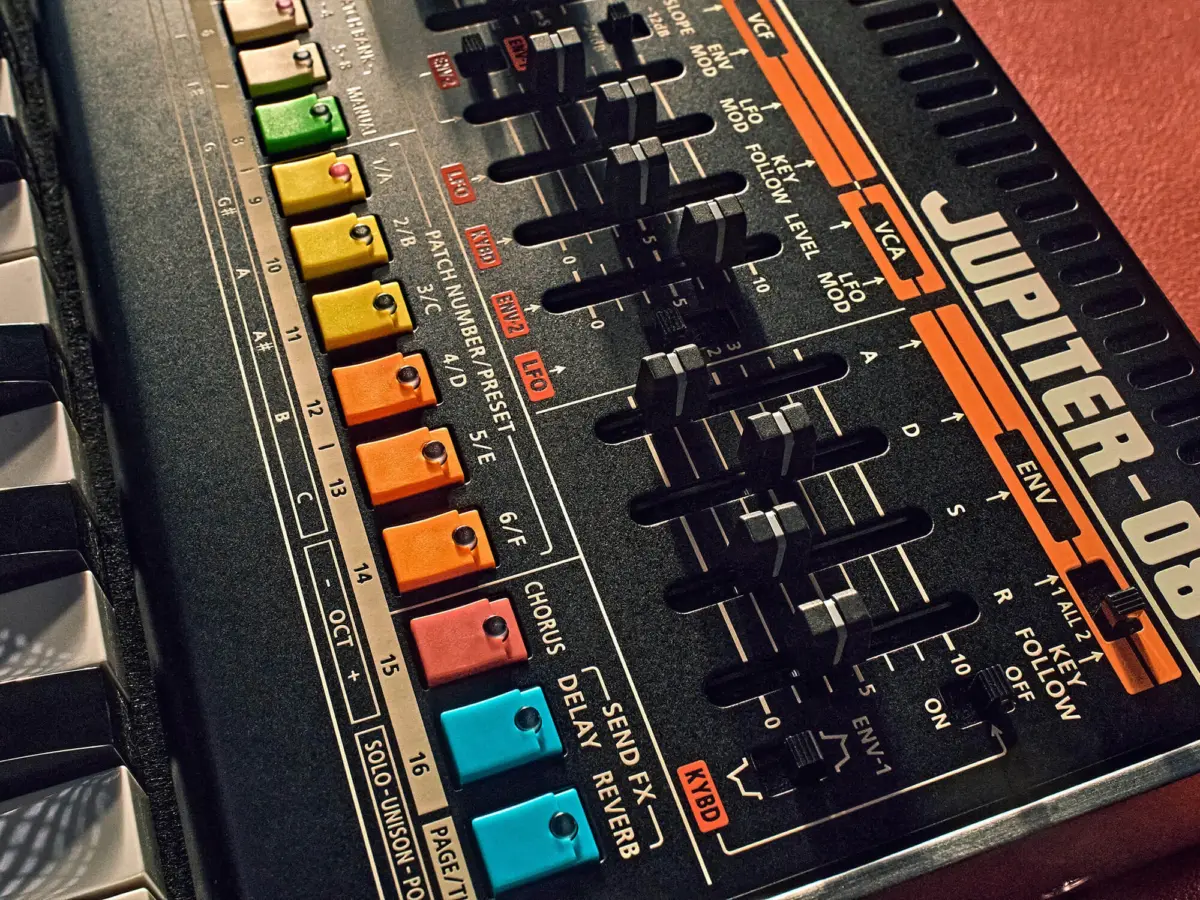
Now, Roland is significantly expanding the Boutique footprint with a monumental double release. First comes the long-awaited, downsized digital recreation of the iconic JUPITER-8—a polysynth whose sonic DNA helped define the soundscape of early 1980s pop, rock, and electronic music. Marking its 45th anniversary, this new iteration, dubbed the JUPITER-08, strives to put a legendary sound into a go-anywhere, modernized footprint.
Simultaneously, Roland is pushing the Boutique series into uncharted territory with the introduction of the n/vision. Eschewing the strict mandate of vintage hardware cloning, the n/vision is an entirely new wavetable synthesizer designed specifically for the platform. By marrying a dual-layer wavetable architecture with analog-modelled filters and tactile, hands-on control, the n/vision provides a forward-looking sound-shaping platform crafted for contemporary sound designers. Both units retail for $549.99 and are available immediately, complete with detachable 25-key keyboards, robust connectivity options, and advanced onboard production tools.
Detailed Chronology: The Evolution of Roland’s Boutique Line and Its Newest Additions
The 2015 Genesis: The Birth of the Boutique Philosophy
When Roland first unleashed the Boutique series in late 2015, the initial trio—featuring compact emulations of the Jupiter-8, Juno-106, and JX-3P (the JP-08, JU-06, and JX-03)—sent shockwaves through the synthesizer community. At a time when original vintage units were commanding astronomical prices on the secondary market and demanding high maintenance costs, Roland offered a portable, highly accessible alternative.

Powered by the company’s proprietary ACB (Analog Circuit Behavior) technology, these miniature modules captured the nuanced, non-linear behaviors of vintage electrical components. Though some early critics debated the tactile ergonomics of the scaled-down faders and knobs, the sound quality and sheer portability made them immediate commercial successes. Over the subsequent decade, Roland refined the concept, updating form factors, expanding polyphony, and introducing models like the JD-08 and JX-08 to capture the complex digital-analog hybrid realms of the late ’80s and early ’90s.
The JUPITER-8: A 45-Year Legacy
To understand the significance of the new JUPITER-08, one must look back to 1981, the year Roland released the original JUPITER-8. As polyphonic synthesizers began dominating the commercial airwaves, the JUPITER-8 emerged as a luxury flagship instrument. Equipped with dual-oscillator architecture per voice, rich resonant filters, and a massive sonic footprint, it quickly became the weapon of choice for a pantheon of artists ranging from Duran Duran and Tears for Fears to Tangerine Dream and Michael Jackson.
Over four and a half decades, the JUPITER-8 has attained mythical status. Its ability to effortlessly transition from razor-sharp brass leads to lush, shimmering pads has ensured its continued presence on contemporary pop records, film scores, and high-end video game soundtracks. The challenge for Roland, therefore, was not merely to replicate its sonic parameters, but to package its immense presence into a modern, portable format without sacrificing the tactile, hands-on programming experience that defined the original.
Enter ABM: The Technological Leap Behind the JUPITER-08
While previous iterations in the Boutique series relied almost exclusively on ACB technology, the JUPITER-08 introduces a major technological evolution: ABM (Analog Behaviour Modelling). Developed to push the boundaries of modern digital signal processing (DSP), ABM retains the microscopic circuit-level accuracy of ACB while offering vastly enhanced processing power.

This technological leap directly addresses one of the primary historical limitations of compact hardware emulations—polyphony constraints. While the original JUPITER-08 operated on an eight-part, two-voice architecture, the new JUPITER-08 retains this authentic foundation while allowing users to internally expand polyphony up to a staggering 32 voices. Furthermore, the introduction of refined voice allocation and pitch behavior algorithms ensures that players receive an animated, emotionally resonant playing experience that honors the genuine vintage character of the 1981 hardware while seamlessly meeting modern production demands.
The n/vision: Breaking New Ground in Wavetable Synthesis
While the JUPITER-08 looks backward with reverence, the n/vision looks firmly to the future. Marking a historic first for the Boutique lineup, the n/vision abandons the vintage-clone framework to offer an entirely original wavetable synthesis platform.
Equipped with 63 factory wavetables, the n/vision utilizes a sophisticated dual-layer architecture. This allows sound designers to blend and morph between distinct wavetable sources, generating complex, evolving timbres, aggressive leads, and shifting atmospheric pads. To bridge the gap between digital wavetable flexibility and organic warmth, Roland has paired the engine with an analog-modelled filter section featuring multiple vintage-inspired filter profiles.
Supporting Context & Metrics: Hardware Specifications and Capabilities
Both the JUPITER-08 and the n/vision share a unified hardware philosophy, balancing desktop compactness with performance versatility. Below is an exhaustive breakdown of their technical specifications, user interfaces, and connectivity features.

Shared Hardware Architecture & Form Factor
- Dimensions & Portability: Housed in the classic rugged yet lightweight Boutique chassis, each unit measures to easily fit into backpack setups and mobile production rigs.
- Keyboard Interface: Both units ship with a detachable 25-key keyboard dock, allowing them to function seamlessly as standalone portable instruments or as desktop sound modules driven by external master keyboards.
- Onboard Monitoring: Each synthesizer includes a built-in miniature speaker, facilitating instant sound creation, patch editing, and practice sessions on the go without the need for external monitors or headphones.
- Power & Connectivity:
- USB-C port for bus power, audio interface capabilities, and MIDI communication.
- 5-pin DIN MIDI In and Out ports for legacy hardware integration.
- 3.5mm stereo main output and dedicated headphone output.
- 3.5mm auxiliary input for audio passthrough or chain-mixing setup.
Deep Dive: JUPITER-08 Specifications
- Synthesis Engine: ABM (Analog Behaviour Modelling) digital architecture.
- Polyphony: Authentic 8-part / 2-voice configuration, expandable internally up to 32 voices.
- Sequencer & Arpeggiator: Integrated two-part, 64-step polyphonic sequencer alongside a flexible onboard arpeggiator.
- Effects Section: 17 unique onboard effects, including classic Roland chorus, multi-effects (MFX), and dedicated, high-quality delay and reverb algorithms.
- Control Interface: Hands-on panel layout featuring direct sliders and rotary potentiometers mapped to filter cutoff, resonance, envelope generators, and oscillator parameters, replicating the expansive front panel of the 1981 original.
Deep Dive: n/vision Specifications
- Synthesis Engine: Dual-layer wavetable synthesis platform.
- Sound Source: 63 factory wavetables with deep morphing and blending capabilities.
- Filter Section: Analog-modelled multi-mode filter featuring various vintage hardware-inspired filter characteristics.
- Modulation & Motion: Step LFO, flexible envelope modulation, oscillator modulation, and advanced motion recording for dynamic, evolving parameter automation.
- Sequencing & Effects: Two-part 64-step polyphonic sequencer, onboard arpeggiator, and a comprehensive suite of spatial and modulation effects.
Official Statements and Industry Perspectives
Roland’s executive and engineering teams have emphasized that these releases represent a maturation of the Boutique concept—moving beyond simple nostalgia toward active, creative tools for modern electronic musicians.
Highlighting the design philosophy behind the wavetable newcomer, Roland released a statement regarding the n/vision:
"Powered by Roland’s latest sound advancements, n/vision allows players to build evocative textures through a tactile synthesizer workflow. Users can easily blend and shape two wavetable layers to create animated movement, moving pads, aggressive leads, complex timbres, and more."
Concurrently, industry analysts and early reviewers have praised Roland for addressing long-standing criticisms of the Boutique line. By implementing ABM technology in the JUPITER-08, Roland has effectively neutralized concerns over polyphony limits that plagued earlier generations of miniature desktop synths. Furthermore, the introduction of the n/vision signals a willingness to take creative risks outside of the company’s extensive back catalog, proving that the Boutique series is no longer just a museum for past glories, but a vibrant platform for contemporary sound design.

Future Outlook: The Impact on Live Performance and Modern Production
The launch of the JUPITER-08 and the n/vision arrives at a fascinating cultural juncture in music production. As software synthesizers and virtual studio technology (VSTs) reach unprecedented levels of fidelity, the demand for tactile, hardware-based workflows has experienced a massive resurgence. Producers and live performers increasingly seek gear that offers physical engagement, immediate parameter access, and freedom from computer screens.
At $549.99 each, both units occupy a strategic sweet spot in the market. They are competitively priced for semi-professional producers and hobbyists, while offering enough sonic depth and connectivity to satisfy touring professionals looking to downsize their live rigs.
Looking forward, the success of ABM technology in the JUPITER-08 opens up tantalizing possibilities for future Roland Boutique releases. If ABM can successfully deliver expanded polyphony and enhanced vintage character without sacrificing processing stability, we may soon see modernized versions of other polyphonic titans from Roland’s golden era. Meanwhile, the n/vision paves the way for entirely original digital sound engines to inhabit the Boutique form factor, ensuring that the series will continue to evolve well into the next decade.
Whether used to recreate the lush, cinematic warmth of 1980s synth-pop or to forge jagged, futuristic wavetable textures for modern electronica, Roland’s latest offerings demonstrate that great things truly do come in small packages.