Executive Overview
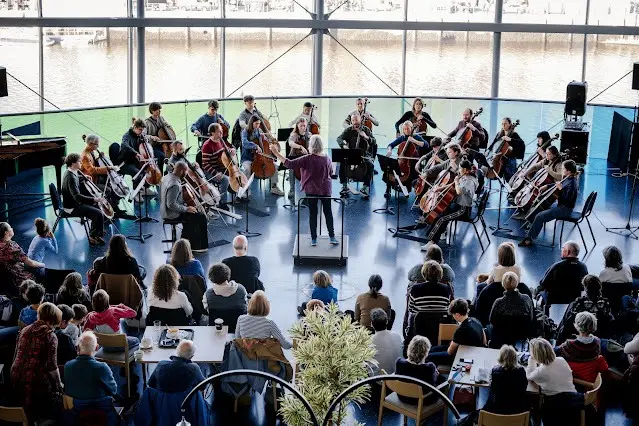
In a powerful demonstration of mentorship, community engagement, and artistic collaboration, world-renowned cellist Sheku Kanneh-Mason recently concluded an acclaimed regional tour by trading the grand concert hall stage for an open concourse, leading a 24-strong massed cello ensemble at The Glasshouse International Centre for Music.
This inspiring pop-up performance followed a triumphant series of concert dates across Northern England, where Kanneh-Mason performed Camille Saint-Saëns’ Cello Concerto No. 1 alongside the prestigious Royal Northern Sinfonia under the baton of conductor Dinis Sousa. Stops in Middlesbrough, Kendal, and Gateshead had already cemented the tour’s status as a major classical music highlight of the season. However, the true emotional climax of the residency occurred on a Sunday morning, when the internationally celebrated soloist stepped away from the spotlight to stand shoulder-to-shoulder with the region’s most promising young string players.
Organized as part of The Glasshouse’s ongoing Make Music Young People initiative, the event brought together participants from the venue’s Young Sinfonia and Centre for Advanced Training (CAT) programmes, alongside dedicated tutors, professional members of the Royal Northern Sinfonia, and accomplished alumni of the institution’s educational pathways. Together, this cross-generational collective of 24 cellists delivered a vibrant, open-air performance that captivated weekend visitors and passersby alike.
Far from being a mere photo opportunity, the collaboration underscored Kanneh-Mason’s long-standing commitment to grassroots music education and accessibility. By blending masterclasses, rigorous rehearsal processes, and free public performance platforms, the event served as a textbook example of how world-class cultural institutions can actively bridge the gap between elite international artistry and local community development. This comprehensive report explores the chronology of the residency, the mechanics of The Glasshouse’s educational frameworks, the cultural significance of the repertoire performed, and the broader implications of artist-led mentorship in the modern classical music landscape.
Detailed Chronology: From Orchestral Triumph to Concourse Collaboration
The events leading up to the massed cello performance unfolded over an intensive week of high-level music-making across Northern England, showcasing both the physical demands of a professional orchestral tour and the deep rewards of educational outreach.
The Regional Tour: Saint-Saëns with the Royal Northern Sinfonia
The journey began with a rigorous schedule that tested the artistic stamina and interpretive depth of both soloist and orchestra. Kanneh-Mason, whose virtuosic yet deeply lyrical playing style has made him a household name since winning the BBC Young Musician competition in 2016, teamed up with the Royal Northern Sinfonia and conductor Dinis Sousa.
The centerpiece of the tour was Saint-Saëns’ Cello Concerto No. 1 in A minor, Op. 33—a staple of the cello repertoire known for its continuous, unified movement structure, soaring lyrical melodies, and demanding technical passages. The tour kicked off in Middlesbrough, offering regional audiences a rare chance to experience a major international soloist in an intimate regional setting. Subsequent performances in Kendal and at The Glasshouse in Gateshead received rave reviews from critics and audiences alike, praised for the palpable synergy between Kanneh-Mason and the orchestra under Sousa’s precise, dynamic direction.
The Rehearsal Process: Northern Rock Foundation Hall
While the evening concerts drew traditional classical music audiences to seated auditoriums, the work behind the scenes was heavily focused on the future of the art form. Following the completion of the orchestral dates, Kanneh-Mason transitioned from soloist to mentor.
The day of the massed performance began early inside the state-of-the-art Northern Rock Foundation Hall, a premier rehearsal space within The Glasshouse complex. Here, 24 young cellists—ranging from early teens to advanced pre-college students—gathered alongside faculty members, professional section players from the Royal Northern Sinfonia, and former participants of The Glasshouse education programmes.

The atmosphere in the room was electric yet focused. Kanneh-Mason took a hands-on approach to the rehearsal, offering technical advice, demonstrating phrasing choices, and sharing insights on stage presence and ensemble listening. Rather than delivering a top-down masterclass, he positioned himself as an equal collaborator within the section, fostering an environment where young musicians felt empowered to voice their musical ideas and match the intensity of a professional ensemble.
The Concourse Performance: Lunchtime Concerts Series
Following the rigorous morning workshop, the ensemble moved out of the rehearsal hall and onto the sweeping, sunlit concourse of The Glasshouse. Performing as part of the venue’s popular Lunchtime Concerts series—a staple initiative providing free, accessible public performances on Sundays—the 24 cellists took their positions before an unsuspecting and quickly gathering crowd of weekend visitors, families, and classical music aficionados.
The unexpected sight and sound of two dozen cellists resonating through the architectural masterpiece of The Glasshouse instantly drew a crowd. The programme was thoughtfully curated to be both engaging for casual listeners and technically rewarding for the students. It featured a captivating movement from Heitor Villa-Lobos’s Bachianas Brasileiras No. 1—a monumental work written for an orchestra of cellos that brilliantly bridges Brazilian folk idioms with classical counterpoint in the style of J.S. Bach—alongside swinging, rhythmically vibrant arrangements of music by George Gershwin and Scott Joplin.
The performance concluded to rapturous applause, marking the emotional crescendo of Kanneh-Mason’s Northern residency and leaving an indelible impression on the young participants, the audience, and the artist himself.
Supporting Context & Metrics: The Ecosystem of The Glasshouse
To fully appreciate the significance of this event, one must examine the institutional framework that made it possible. The Glasshouse International Centre for Music (formerly Sage Gateshead) has long operated as a beacon of musical inclusivity, education, and performance in the North East of England.
The Make Music Young People Framework
The collaborative residency was hosted under the umbrella of Make Music Young People, a multi-faceted institutional framework designed to remove barriers to music education. In regions where funding for arts education in traditional schools has faced continuous pressure, centers like The Glasshouse play a vital role in sustaining the musical pipeline.
The framework operates on a philosophy of lifelong, inclusive participation. It supports everything from early-years sensory music sessions to pre-professional training academies. By embedding international touring artists directly into these educational pipelines, The Glasshouse ensures that students do not merely study music in isolation; they experience its living, breathing community context firsthand.
The Centre for Advanced Training (CAT) and Weekend Schools
At the heart of the youth programming are the Centre for Advanced Training (CAT) and the venue’s extensive weekend school networks.
- The Centre for Advanced Training: Funded in part by the Department for Education’s Music and Dance Scheme, the CAT programme provides intensive, high-level training for young people showing exceptional musical potential and dedication. It offers individualized instrumental tuition, chamber music coaching, aural training, and performance opportunities, effectively preparing students for conservatoire entry and professional careers.
- Inclusive Weekend Schools: Running parallel to the elite CAT track are non-auditioned, highly accessible ensembles, youth bands, and choirs. These programs operate on an open-door policy with applications accepted year-round, ensuring that financial background or prior formal training level never acts as a barrier to entry.
Repertoire Breakdown: Bridging Genres
The eclectic setlist performed on the concourse reflects the pedagogical philosophy of modern music education: versatility.

- Villa-Lobos (Bachianas Brasileiras No. 1): Utilizes the unique sonic architecture of multiple cellos to mimic the rich, polyphonic textures of the Brazilian rainforest and urban soundscapes, demanding precise intonation and deep, resonant tone production.
- George Gershwin & Scott Joplin: Introduced syncopated American jazz rhythms, ragtime syncopation, and popular idioms into the classical cello medium. This challenges students to step outside traditional European classical phrasing and embrace swing, groove, and stylistic flexibility.
Official Statements and Perspectives
The resonance of the event was captured most clearly in the reflections of the participants, organizers, and the star soloist himself, whose dedication to educational outreach remains a defining hallmark of his career.
Reflecting on the culmination of his residency, Sheku Kanneh-Mason shared his deep enthusiasm for the next generation of players:
"After my concerts in Middlesbrough, Kendal, and then here at The Glasshouse this week, it was a really special conclusion to hear the young cellists play in the rehearsal and then to join them out on the Concourse, on Sunday morning. The next generation of musicians matters so much, and I loved seeing all the enthusiasm and hearing the talent."
Educational leaders at The Glasshouse echoed these sentiments, noting that interactions of this caliber fundamentally shift a young musician’s trajectory. For a teenager sitting in a regional youth orchestra, sharing a music stand or section with a soloist they have previously only listened to on streaming platforms or watched win televised competitions provides an invaluable psychological shift. It transforms classical music from an intimidating, distant historical canon into a living, accessible, and deeply personal career path.
Future Outlook: The Role of Artist-Led Mentorship in Classical Music
As the classical music industry navigates the post-pandemic landscape, questions surrounding audience development, diversity, and community relevance have taken center stage. Traditional models of orchestral performance—where artists arrive, perform behind a proscenium arch, and depart immediately—are increasingly being supplemented by deeply integrated residency models.
Events like the Kanneh-Mason collaboration at The Glasshouse point the way forward for the genre. By demonstrating that high-level artistic excellence and grassroots educational outreach are not mutually exclusive, but rather mutually reinforcing, institutions can build resilient, engaged communities of music lovers and makers.
Key Takeaways for the Future of Music Education:
- De-elicitizing Performance Spaces: Moving classical music out of traditional auditoriums and onto open concourses breaks down psychological barriers, inviting casual listeners and non-traditional concertgoers to engage with the art form organically.
- Peer-to-Peer and Cross-Generational Mentorship: Allowing students to play alongside both professional orchestral musicians and international soloists accelerates technical growth and demystifies the professional music industry.
- Inclusive Curricula: Combining rigorous classical repertoire (Saint-Saëns, Villa-Lobos) with rhythmically diverse American vernacular music (Gershwin, Joplin) ensures that young musicians develop well-rounded, adaptable skill sets suited to the demands of the 21st-century music scene.
Ultimately, the image of 24 cellists resonating in unison under the glass canopy of Gateshead’s premier music venue serves as a powerful metaphor. It highlights a thriving ecosystem where the echoes of master composers are not preserved in amber, but actively handed down, string by string, bow by bow, to the eager hands of tomorrow’s musical leaders.