Executive Overview
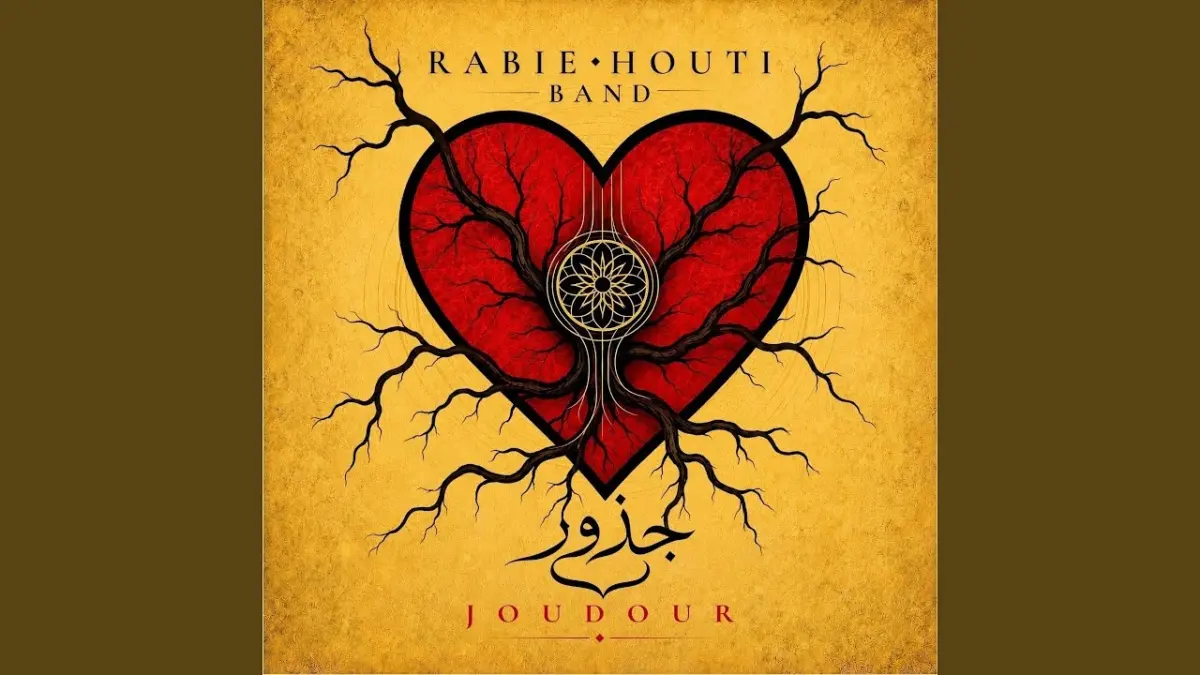
In an era defined by the continuous globalization of sound, few artists navigate the delicate intersection of ancestral heritage and contemporary electronic production quite as fearlessly as Algerian-born violinist and vocalist Rabie Houti. Based in Montpellier, France, since 2014, Houti has carved out a unique space within the modern Mediterranean music landscape. His latest artistic statement, the sophomore album Joudour—derived from the Arabic word for "roots"—represents a definitive maturation for the Rabie Houti Band.
At the center of this new record stands "Rokia," a hypnotic, high-energy single and music video that encapsulates the band’s overarching ethos: a seamless collision of classical Arabo-Andalusian violin lines, contemporary electronic beats, raw rock guitars, and the distinct, haunting breath of traditional Maghrebi flutes provided by Gasba Électrique.
The narrative of "Rokia" is deceptively classic yet universally resonant—a young villager falls deeply in love with his neighbor, only to face fierce opposition from the girl’s mother, the eponymous Rokia. Yet, within Houti’s hands, this localized folk tale transforms into a sprawling sonic journey that builds inexorably into a full-scale auditory trance. This concept of "trance" is not merely a stylistic descriptor for Houti; it is the heartbeat of the ensemble’s electrifying live performances, which have captivated audiences everywhere from intimate European clubs to international stages across Canada, Algeria, and Kazakhstan.
Following their critically praised 2019 debut album, Tahtaha—which Houti candidly characterizes as an exploratory testing ground—Joudour finds the ensemble cementing its definitive sonic signature. Comprising entirely original compositions, the new record pushes further into heavy rock configurations and sharp electronic textures while remaining anchored to the rich soil of North African melodies. Operating proudly within the tradition of Sono Mondiale, the cross-cultural musical movement famously championed by the late, great Franco-Algerian rocker Rachid Taha, the Rabie Houti Band is actively redefining what it means to be a modern Mediterranean migratory artist in Europe today.
Detailed Chronology: From the Opera Houses of Oran to the Stages of Montpellier
To understand the intricate architectural design of Joudour and the compelling narrative driving "Rokia," one must trace the winding geographical and artistic path of Rabie Houti himself. His trajectory is a testament to the resilience of musical transmission across generations and borders.
The Oran Genesis: Foundations in Classical Arabo-Andalusian Tradition
Born and raised in Oran, Algeria—a vibrant coastal city historically renowned as a crucible of musical innovation, fado-adjacent emotional depths, and the birthplace of Raï music—Houti was immersed in sound from infancy. His domestic environment was rich with culture; his father possessed a profound, encyclopedic love for Arabo-Andalusian music, constantly filling their home with the intricate modal structures and poetic lyricism of the Nûba.
This early immersion laid a subconscious foundation for the young musician, but the spark of active participation was ignited closer to home. It was his older sister, Khedija, who first placed a mandolin in his hands, patiently guiding his small fingers through the rudimentary mechanics of string placement and melody. That initial mentorship opened the door to formal musical education.
By the time he was approximately eight years old, Houti’s prodigious talent and dedication had earned him a spot in the junior orchestra of the prestigious Nassim El Andalous school. In a milestone moment for any young classical instrumentalist, he stepped out onto the grand stage of the Oran Opera House to perform his first major concert on the violin. This rigorous classical grounding instilled in him a deep reverence for traditional scales (maqamat), microtonal phrasing, and ensemble discipline—elements that continue to serve as the unyielding anchor for his most avant-garde sonic experiments today.
Migration and Metamorphosis: The Montpellier Years
As Houti developed as a professional artist, the socio-economic and creative realities of North Africa prompted him to look outward. In 2014, he made the pivotal decision to relocate to Montpellier, a sun-drenched cultural hub in the south of France known for its vibrant artistic community and openness to Mediterranean cross-currents.
Relocating to France presented both the classic challenges of immigrant assimilation and exhilarating opportunities for cross-pollination. European cities like Montpellier offered access to diverse pools of instrumentalists, cutting-edge production facilities, and a receptive audience eager for authentic yet forward-thinking world music. It was within this dynamic southern French environment that Houti began formulating the blueprint for a band that could reconcile his classical North African training with the rock and electronic idioms dominating the European underground.
The Formation of the Rabie Houti Band (2017)
By 2017, the foundational vision solidified into reality with the official formation of the Rabie Houti Band. From its inception, the group was designed as a vehicle for trans-cultural dialogue. Houti brought together musicians who shared his fascination with genre fluidity, pairing traditional Maghrebi instrumentation with the heavy backbeat of Western rock and the synthetic pulses of electronica.
The band quickly built a formidable reputation for their incendiary live shows. Eschewing the static presentation common in traditional folk ensembles, the Rabie Houti Band approached the stage with the raw energy of a punk-rock outfit and the hypnotic, cyclical intensity of Sufi Hadra ceremonies. This dynamic approach earned them invitations to international festivals and concert halls, expanding their footprint well beyond the borders of France to stages in Canada, their native Algeria, and as far afield as Kazakhstan.
The Epiphany of Tahtaha (2019)
The release of their debut album, Tahtaha, in 2019 marked the band’s official arrival on the recorded music scene. However, looking back, Houti is remarkably candid about the record’s experimental nature. He describes Tahtaha not as a finished destination, but as a rigorous, necessary test—a sonic laboratory where the band was actively searching for its authentic voice while navigating the tensions between acoustic preservation and modern electronic reinvention.
While Tahtaha received positive underground notices and laid the groundwork for their touring schedule, it also provided invaluable lessons regarding mix balance, structural pacing, and the precise chemistry required to make traditional North African scales lock seamlessly into a heavy rock groove.
The Genesis of Joudour and the Rockstore Premiere
Those years of experimentation and relentless touring culminated in the creation of their sophomore full-length album, Joudour. True to its Arabic title, which translates to "roots," the album represents a conscious centering of identity, even as it pushes the band’s sonic boundaries further into uncharted territory.
To mark the release of Joudour, the Rabie Houti Band performed a high-profile, free release show on October 3, 2026, at the legendary Rockstore venue in Montpellier. The concert served as a physical manifestation of the album’s ethos: packed with an eclectic crowd of long-time world music aficionados, indie rock fans, and local students, the venue transformed into a pulsating crucible of transnational energy. The performance validated Houti’s assertion that with Joudour, the band had finally unlocked its true, unmistakable signature sound.
Supporting Context & Metrics: The Mechanics of Sono Mondiale and "Rokia"
To fully appreciate the cultural and musical weight of Joudour and its breakout single "Rokia," one must examine the broader socio-musical movements that inform the Rabie Houti Band’s creative philosophy.
The Legacy of Sono Mondiale and Rachid Taha
In the liner notes of contemporary global music discourse, few terms carry as much historic resonance as Sono Mondiale. Popularized in the late 1980s and championed most fiercely by the late, legendary Franco-Algerian singer-songwriter Rachid Taha, Sono Mondiale ("World Sound") was both a musical genre and a socio-political stance. It rejected the rigid ghettoization of non-Western music into static "world music" bins, arguing instead that Arabic vocal styles, North African folk rhythms, punk rock, and electronic dance music were natural bedfellows in the modern, multicultural metropolis.
Rachid Taha famously fused Oran’s working-class Raï and Chaabi traditions with the confrontational energy of The Clash, post-punk electronics, and American blues. The Rabie Houti Band stands as a direct, vital heir to this tradition. When Houti plays his Arabo-Andalusian violin with the distorted urgency of a lead guitarist, or when Gasba Électrique layers raw, breathy wooden flute samples over four-on-the-floor club kick drums, they are actively keeping the flame of Sono Mondiale alive for a new generation.
Anatomizing "Rokia": Narrative, Structure, and Instrumentation
"Rokia" serves as the ideal gateway into the sonic universe of Joudour. Musically and narratively, the track is structured as a dramatic arc:
[ Act I: The Exposition ]
  └── Introduction of lyrical theme (Unrequited/Forbidden Love in a North African village)
  └── Traditional Arabo-Andalusian violin motifs introduced with sparse acoustic backing

[ Act II: The Conflict ]
  └── The Mother's Opposition (Rokia's stern resistance represented by rising harmonic tension)
  └── Introduction of Gasba Électrique (Maghrebi flute textures injecting breath and raw pastoral energy)

[ Act III: The Transformation ]
  └── Integration of Electronic Beats and Rock Guitars
  └── Shift from linear narrative storytelling to repetitive, hypnotic rhythmic cycles

[ Act IV: The Trance ]
└── Full sonic convergence: Maximum volume, structural dissolution, and collective euphoria- The Narrative Core: The song tells a tale as old as time—a young villager falls deeply in love with his neighbor, but her mother, Rokia, stands as an impassioned, unyielding roadblock to their union. Rather than treating this simply as a romantic ballad, Houti uses the domestic conflict as an emotional mirror for broader themes of societal barriers, generational divides, and emotional persistence.
- The Instrumentation:
- Arabo-Andalusian Violin: Houti’s lead instrument cuts through the mix with microtonal bends and ornate flourishes that trace their lineage back to the royal courts of medieval Islamic Spain and the coastal drawing rooms of Oran.
- Gasba Électrique: A brilliant conceptual integration, this element merges the breath-heavy, earthy timbre of the traditional Maghrebi flute (the gasba) with modern sound design, bridging the gap between pastoral antiquity and urban modernity.
- Electronic Beats and Rock Guitars: Rather than serving as mere background window-dressing, the heavy-rock guitar riffs and driving electronic percussion provide the kinetic engine that propels the acoustic melodies into high-octane contemporary spaces.
- The Concept of Trance: In the band’s lexicon, "trance" is not a byproduct of electronic music production; it is an ancient spiritual technology. By looping hypnotic rhythmic figures and allowing melodic motifs to build in intensity over several minutes, the track induces a state of communal ecstasy reminiscent of Sufi trance rituals (dhikr) or the ecstatic heights of all-night wedding celebrations in North Africa.
Album Metrics and Production Evolution
- Album Joudour (Roots)
- Release Date (Live Premiere): October 3, 2026, at Rockstore, Montpellier.
- Precursor: Tahtaha (Released 2019).
- Tracklisting Characteristics: 100% original compositions; zero traditional covers, emphasizing the band’s commitment to contemporary songwriting within traditional frameworks.
- Geographical Footprint: Core base in Montpellier, France; touring history spanning France, Canada, Algeria, and Kazakhstan.
Official Statements and Artistic Philosophy
The philosophy driving the Rabie Houti Band is articulated clearly through Rabie Houti’s own reflections on his artistic evolution, cultural identity, and the intentional shift from their debut record to their current masterwork.
Reflecting on the exploratory nature of their first album, Houti has noted:
"Tahtaha was a test. It was a time when the band was still searching for its footing, trying to understand how all these different musical worlds could live inside the same room without stepping on each other’s toes. With Joudour, we finally found our signature."
This search for a signature sound was not merely aesthetic; it was an existential necessity for an artist living and working in the diaspora. Moving from the culturally specific, rich musical ecosystem of Oran to the cosmopolitan, sometimes alienating landscape of southern France required Houti to forge a musical language that could speak across cultural divides without diluting its heritage.
Discussing the thematic and sonic weight of the new album’s title, Joudour ("Roots"), Houti emphasizes that looking backward is the only way to look forward effectively:
"You cannot build something new and enduring if you do not know where your feet are planted. Our roots—the Arabo-Andalusian scales, the rhythms of the Maghreb, the stories of our families and villages—are the soil. But the branches, the electronic beats, the rock guitars, and the global stages—that is where we reach for the sky."
This dual commitment to preservation and innovation is precisely what has earned the band respect from traditionalist purists and modern indie-rock tastemakers alike. By refusing to treat traditional music as a museum artifact preserved under glass, Houti treats it as a living, breathing, mutable organism capable of absorbing the electric shock of modern urban life.
Future Outlook: The Global Trajectory of the Rabie Houti Band
As the dust settles from their triumphant album release show at Montpellier’s Rockstore, the future for the Rabie Houti Band looks remarkably expansive. Joudour has successfully established a new benchmark for trans-Mediterranean music, proving that the sonic territory pioneered by artists like Rachid Taha remains fertile ground for radical, joyous reinvention.
Upcoming Tour Objectives and International Reach
Building upon a touring history that has already taken them across Europe, North America, North Asia, and North Africa, the band is actively planning an extended international tour in support of Joudour. Promoters across cultural festivals in Europe and North America are taking notice of the unique demographic makeup of their audiences—a diverse mosaic of North African diaspora communities, indie rock enthusiasts, and electronic music club-goers all dancing to the same microtonal violin hook.
Artistic Innovations and Collaborations
Looking ahead, Houti has hinted at further sonic explorations that push the boundaries established on Joudour. Plans are currently underway for cross-genre collaborations with electronic producers from the Berlin and Parisian underground scenes, as well as acoustic exchanges with classical Andalusian masters in Spain and Morocco. These upcoming projects aim to further dissolve the artificial boundaries separating "traditional" and "contemporary" art.
Ultimately, the Rabie Houti Band stands at the vanguard of a vital cultural movement. Through tracks like "Rokia" and immersive albums like Joudour, they demonstrate that music can simultaneously honor the ghosts of the past and violently, beautifully embrace the realities of the present. For listeners ready to experience the transcendent collision of Maghrebi folklore and modern electronic rock, the road ahead—mapped out by Rabie Houti’s soaring violin—is limitless.
Fans and new listeners can stream "Rokia" and purchase or stream the full album "Joudour" directly via the band’s official digital channels and Bandcamp release pages.