Executive Overview
For three decades, Danish composer and pianist Jakob Davidsen has operated at the precarious, fertile intersection where written composition and improvised music meet. In his latest major recording project—commissioned by the renowned contemporary chamber group Figura Ensemble and captured in the resonant acoustics of Trekroner Church in Roskilde—Davidsen returns to the visionary poetry of Ursula Andkjær Olsen. Specifically, he draws inspiration from her critically acclaimed 2012 collection, Det 3. Årtusindes hjerte ("The Heart of the Third Millennium").
Featuring soprano Signe Asmussen alongside an elite, cross-genre ensemble, the album weaves together classical operatic rigor, contemporary chamber instrumentation, and avant-garde jazz textures. Recorded in January and rooted in a live premiere that took place during Figura Ensemble’s festival in November 2024, the resulting work is an uncompromising artistic statement sung entirely in Danish.
Yet, as this review and comprehensive analysis will explore, the album occupies a fascinating cultural liminal space. It challenges genre boundaries, exposes the friction between classical vocal traditions and contemporary jazz-adjacent instrumental arrangements, and poses provocative questions about how modern chamber music communicates with diverse listening communities. This deep-dive feature examines the genesis of the project, the intricate mechanics of the musical performance, the structural breakdown of its movements, and the broader implications for contemporary European crossover composition.
Detailed Chronology and Project Genesis
A Thirty-Year Exploration of the Written and the Improvised
Jakob Davidsen’s career has consistently defied easy categorization. Operating firmly within the Scandinavian avant-garde, his methodology bridges the disciplined world of score-bound chamber music with the spontaneous, breathing architecture of improvised performance. This dual focus has positioned him as a vital voice in modern Danish composition, allowing him to collaborate fluidly with musicians drawn from both classical institutions and the upper echelons of the European jazz scene.
The Ursula Andkjær Olsen Connection
This album marks the second time Davidsen has turned to the labyrinthine, cosmological, and deeply psychological poetry of Ursula Andkjær Olsen. One of Denmark’s most celebrated contemporary poets, Andkjær Olsen is known for constructing vast intellectual and emotional landscapes in her verse. Her 2012 collection, Det 3. Årtusindes hjerte, serves as a prime example of her work—dense with imagery concerning machinery, the human heart, industrial alienation, and spatial expansion.
Setting such text requires a composer who can match the intellectual heft of the poetry without letting the music buckle under its weight. Davidsen’s previous settings of Andkjær Olsen’s texts successfully navigated these waters by explicitly signposting their literary and musical sources. However, as subsequent sections will reveal, this new recording introduces a veil of mystery regarding its hidden musical homages and structural points of departure.
From Festival Premiere to Roskilde Recording
The project first materialized on stage when the Figura Ensemble—a collective celebrated for pushing the boundaries of contemporary music theater and chamber performance—commissioned the piece. It received its world premiere in November 2024 at the ensemble’s dedicated festival.
Recognizing the work’s profound acoustic and structural depth, the team convened in January at the historic Trekroner Church in Roskilde. Engineer John Fomsgaard captured the sessions, tasked with the delicate balancing act of harnessing the church’s generous, cathedral-like reverb without letting its natural echo swallow the complex, granular counterpoint of Davidsen’s writing.
Supporting Context & Metrics: The Ensemble and Instrumentation
The success of a genre-bridging project of this scale relies heavily on the pedigree of its performers. Davidsen assembled a formidable lineup, drawing virtuosic talents from both classical chamber traditions and the avant-garde jazz circuit.
+-------------------------------------------------------------------------+
                    THE ENSEMBLE BREAKDOWN & PEDIGREE
+--------------------+---------------------------+------------------------+
| Performer          | Instrument                | Notable Affiliation    |
+--------------------+---------------------------+------------------------+
| Signe Asmussen     | Soprano                   | Career Classical Voice |
| Jakob Davidsen     | Piano                     | Composer / Bandleader  |
| Anders Banke       | Saxophone and Clarinet    | New Jungle Orchestra   |
| Gunnar Halle       | Trumpet                   | New Jungle Orchestra   |
| Thommy Andersson   | Double Bass               | Nordic Jazz Circuit    |
| Frans Kordelin H.  | Percussion                | Contemporary Chamber   |
| Cécilie Balling    | Violin                    | Modern Classical       |
| Tobias van der Pals| Cello                     | Modern Classical       |
+--------------------+---------------------------+------------------------+
The Brass and Reed Vanguard
Much of the instrumental gravity on the record is anchored by Anders Banke (saxophone and clarinet) and Gunnar Halle (trumpet). Both musicians bring invaluable experience from Pierre Dørge’s legendary New Jungle Orchestra, an outfit renowned for blending Duke Ellington-esque swing with free jazz, global folk traditions, and avant-garde structural mischief. Their presence injects a vital, unpredictable pulse into the proceedings, ensuring the music never drifts too far into academic sterility.
The Rhythm and Strings Core
Thommy Andersson commands the double bass with a rich, woody resonance that anchors the bottom end, while Frans Kordelin Hansen handles percussion with dynamic subtlety, favoring texture and color over rigid time-keeping. The string section—featuring Cécilie Balling on violin and Tobias van der Pals on cello—brings a chamber-honed lyricism that seamlessly welds Davidsen’s piano motifs to the upper registers of the ensemble. Davidsen himself remains at the piano throughout, steering the harmonic ship with a judicious mix of percussive attack and impressionistic wash.
Movement-by-Movement Analysis
The seven-movement architecture of the album reveals a masterclass in pacing, tension, and stylistic juxtaposition. Each movement functions as a distinct psychological room within the architectural blueprint of Andkjær Olsen’s poetry.
1. "At the end of each tree"
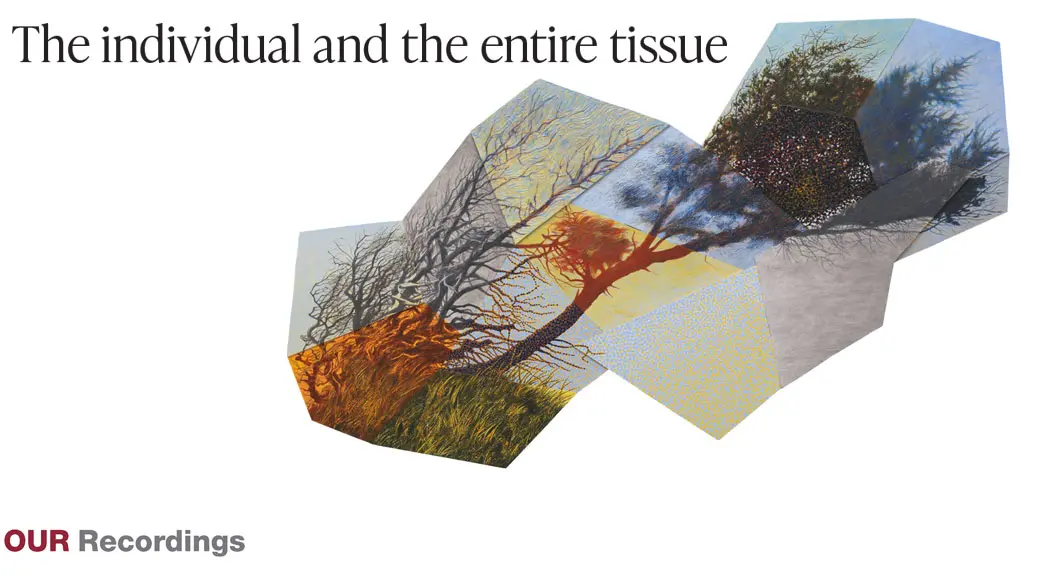
The album opens with deceptive intimacy. "At the end of each tree" begins with voice and piano alone, stretching the listener’s patience in a prolonged, meditative dialogue. This sparse opening establishes a baseline of vulnerability. However, when the full ensemble finally arrives, it completely changes the atmospheric weather of the piece, bursting forth with a sudden kinetic force that establishes the expressive rules for the rest of the record.

2. "Waiting Room"
The second movement introduces a curious cultural dislocation. Carrying a subtle, elusive German inflection, "Waiting Room" possesses an underlying cabaret-like grit that simmers beneath its surface. Yet, it is delivered by Signe Asmussen in a full-throated, uncompromising operatic manner, creating a fascinating tension between the low-culture smoky decadence implied by the rhythm and the high-culture purity of the vocal execution.
3. "It sounded like"
If the opening movements establish the intellectual framework, "It sounded like" is where the ensemble properly takes flight. This is arguably the most electrifying playing on the record. Urgent, unsettled, and formally daring, the piece showcases the interplay between Banke’s reeds, Halle’s brass, and the driving rhythm section. It is a masterclass in controlled chaos, where the boundaries between written score and improvised combustion completely dissolve.
4. "Closed orbit"
Providing a momentary and welcome respite from the high-velocity turbulence of its predecessor, "Closed orbit" gives Davidsen’s piano room to breathe. The harmonic language here is spacious, allowing listeners to appreciate the pristine recording quality achieved by John Fomsgaard, where every hammer strike and damper pedal movement is rendered with crystalline clarity.
5. "Sun, up and down"
Clocking in as the shortest movement on the album, "Sun, up and down" acts as an ephemeral sonic flash. It comes and goes almost before the listener can fully orient themselves, serving structurally as a transitional bridge rather than a standalone statement.
6. "You are inside me like"
On this penultimate track, the vocal approach shifts markedly. Asmussen pares back her delivery, adopting a more intimate, conversational tone that allows the internal breathing of the ensemble to reconfigure the texture. The music feels closer, more tactile, and deeply psychological.
7. The Closing Masterpiece
The longest movement is saved for last, and it stands as the absolute artistic peak of the recording. Moody, deeply dramatic, and structurally ambitious, this closing tour de force features the horns working in a recognizably contemporary jazz manner while the vocal performance is held deliberately back. It is here that Davidsen’s compositional vision and the formidable talents of his band find their most potent expression, fusing modern classical weight with the kinetic swing of avant-garde jazz.
Official Statements, Critical Perspectives, and Curatorial Friction
The Vocal Dichotomy: Opera Meets Jazz
A critical assessment of this record must reckon squarely with the vocal performance. Signe Asmussen is a career classical singer of the highest order, executing Davidsen’s demanding vocal lines with complete technical and artistic authority. The inherent difficulty of the material poses no obstacle for her.
However, this creates a profound reception barrier. The vocal writing is operatic in weight, timbre, and projection, dominating six of the album’s seven movements.
- The Jazz Listener’s Dilemma: Audiences arriving from a contemporary jazz or improvised music background are likely to encounter the soaring soprano lines as an imposing wall, potentially obscuring the intricate jazz-inflected interplay occurring within the rhythm and horn sections.
- The Art Song Perspective: Conversely, listeners hailing from the world of contemporary classical music and art song will hear the project through an entirely different lens, appreciating the synthesis of modern poetry and high-art vocal staging. It is clear that this record was built primarily for the latter constituency.
The Hidden-Sources Controversy
A notable frustration centers on the album’s liner notes and curatorial framing. According to the label’s promotional material, each of the five central movements takes a specific composer, a historical composition, or a defined genre as its hidden point of departure.
Yet, the commercial CD and its physical booklet decline to name a single one. This crucial contextual claim fails to appear in the printed documentation, remaining locked away in press releases. Listeners holding the physical disc are never explicitly told that there is a treasure hunt of musical quotations and stylistic homages embedded within the tracks. Given that Davidsen has a well-established history of spelling out his sources—as he did with his earlier Andkjær Olsen settings—this omission feels like a missed opportunity to invite the listener deeper into the composer’s intellectual workshop.
Future Outlook and Artistic Legacy
As contemporary music continues to dismantle the artificial walls separating the conservatory from the bandstand, projects like Jakob Davidsen’s Det 3. Årtusindes hjerte settings serve as vital, if occasionally polarizing, signposts.
The album demonstrates that ambitious collaborations between classical ensembles like Figura and jazz-adjacent luminaries from the New Jungle Orchestra can yield moments of breathtaking beauty and formal rigor. Superbly executed, fiercely intelligent, and uncompromising in its artistic vision, the recording carves out a distinct territory in the modern Nordic music landscape.
Whether it successfully converts jazz purists remains an open question. Yet, as a testament to the enduring power of Ursula Andkjær Olsen’s poetry and Davidsen’s restless compositional curiosity, it stands as a major achievement in European new music—a work that proves the seam between the written and the improvised is still wide open for exploration.