Executive Overview
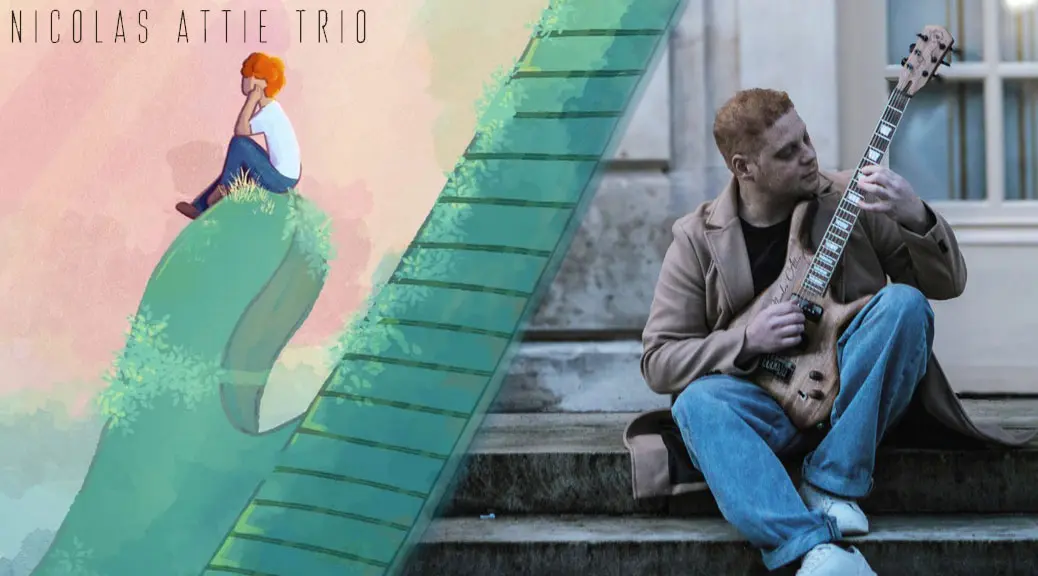
In an era where contemporary jazz is frequently pulled into the orbit of electronic experimentation, dense digital production, and genre-blurring hybridity, there is something deeply grounding about an ensemble that returns to the bedrock of the art form. Enter Borderline, the striking debut album from Guadeloupe-born guitarist and composer Nicolas Attie. Eschewing studio trickery, synthesizers, and unnecessary embellishments, Attie places his trust entirely in the classic, uncluttered architecture of the guitar trio. Featuring the formidable rhythm section of double bassist Yves Torchinsky and drummer Léo Rodier, the album is a masterclass in acoustic intimacy, dynamic interplay, and understated sophistication.
Rooted in the timeless virtues of traditional jazz—strong melodic frameworks, sympathetic accompaniment, spacious improvisation, and profound ensemble telepathy—Borderline demonstrates that the guitar, bass, and drums configuration remains a boundless vehicle for emotional expression. Attie’s journey to this moment is as unconventional as it is inspiring; discovering jazz relatively late in life at the age of twenty, he approached the discipline with an outsider’s fresh curiosity rather than an academic’s burden. The resulting record is an engaging, beautifully paced statement that balances contemporary harmonic exploration with a deep, reverent connection to jazz history. This comprehensive review examines the creation, musical architecture, and cultural significance of Borderline, shedding light on a trio poised to make a lasting mark on the international jazz landscape.
Detailed Chronology and Musical Journey
To fully appreciate the narrative arc of Borderline, one must examine the trajectory of its creator. Hailing from the Caribbean island of Guadeloupe, Nicolas Attie’s initial exposure to music was rich in cultural rhythm, yet his encounter with jazz occurred much later than is typical for contemporary bandleaders. Falling in love with the genre at age twenty, Attie underwent a rigorous, self-motivated immersion into the complex worlds of jazz harmony, improvisation, and composition.
This late bloom proved to be a distinct advantage. Free from the rote conditioning of conservatory jazz programs, Attie approached the genre with a sense of unvarnished wonder. When he finally stepped into the studio to record Borderline, he brought with him a perspective that prioritized emotional resonance and storytelling over technical gymnastics.
The studio sessions brought together three musicians who shared an instinctive, conversational approach to making music:
- Nicolas Attie (Guitar): Providing clean, articulate phrasing and a warm, organic guitar tone.
- Yves Torchinsky (Double Bass): Serving as the rhythmic anchor and a melodic counterweight, driving the ensemble forward with intelligence.
- Léo Rodier (Drums): Acting as a subtle colorist, acutely responsive to every micro-shift in dynamic and tempo.
The sequence of Borderline unfolds like a well-crafted novel, taking the listener on a curated journey through varied emotional and rhythmic landscapes.
+-------------------------------------------------------------------------+
                    THE TRACK ARCHITECTURE OF "BORDERLINE"
+-------------------------------------------------------------------------+
 1. "Caperucita Roja"  --> Immediate purpose & thematic springboard
 2. "Eritaj"           --> Rhythmic flexibility & warm Caribbean undertones
 3. "Stella By Starlight" --> Masterstroke standard interpretation
 4. "Chiara"           --> Lyrical, spacious original composition
 5. "Borderline"       --> Searching harmonic territories (Title Track)
 6. "Eighty Two"       --> Balanced structural freedom & narrative closure
+-------------------------------------------------------------------------+
The album opens with "Caperucita Roja," a track that establishes an immediate sense of purpose. Rather than easing the listener in with a slow-burn vamp, the trio dives straight into an attractive, driving theme that acts as a springboard for group interplay. This is followed by "Eritaj," a composition that pulses with warmth and rhythmic flexibility, subtly nodding to Attie’s multicultural roots without descending into pastiche.
Perhaps the most daunting task for any jazz guitarist is tackling the standard repertoire. On Borderline, the inclusion of Victor Young’s evergreen masterpiece "Stella By Starlight" could have easily felt like a mandatory, routine inclusion. Instead, Attie and his trio treat the composition as a canvas for fresh dialogue, sidestepping both over-reverence and the urge to needlessly deconstruct the tune. They play it with grace, reminding listeners why the standard remains a touchstone of the genre.
The original compositions on the second half of the album elevate the project further. "Chiara" showcases Attie’s penchant for space and lyricism, allowing his clean guitar lines to hang in the air and speak with absolute clarity. The title track, "Borderline," ventures into more searching harmonic territory, pushing the trio to stretch the boundaries of their collective vocabulary without ever losing their structural footing. Finally, the album closes with "Eighty Two," a piece that encapsulates the record’s core philosophy: a seamless equilibrium between rigid compositional structure and uninhibited improvisational freedom.
Supporting Context and Metrics: The Guitar Trio Tradition
To understand the weight of Borderline, it is vital to contextualize it within the historical lineage of the jazz guitar trio. From the pioneering work of Nat King Cole’s guitar-led configurations to the legendary trios of Jim Hall, Pat Metheny, John Scofield, and Julian Lage, the format has always demanded an extraordinary level of transparency. In a trio setting, there are no horn sections to hide behind, no piano chords to fill the mid-range frequencies, and nowhere to mask deficiencies in timing or intonation.

| Album Feature | Traditional Approach | Borderline Implementation |
|---|---|---|
| Production Style | Heavy compression / Reverb washes | Organic, dry room acoustics / Unprocessed guitar tone |
| Ensemble Dynamics | Hierarchical (Soloist + Rhythm Section) | Highly conversational and non-hierarchical |
| Improvisational Space | Dense, note-heavy solos | Patient, space-conscious phrase development |
| Harmonic Language | Complex modal or avant-garde shifts | Accessible yet sophisticated contemporary jazz language |
Attie’s choice to keep the production completely organic pays massive dividends. By avoiding unnecessary electronics and post-production compression, the album achieves a rare acoustic realism. Listeners can hear the wood of the double bass resonating, the crisp articulation of Rodier’s snare work, and the natural sustain of Attie’s clean guitar tone.
Furthermore, the metrics of the trio’s interaction reveal a distinct lack of ego. In many modern guitar-led dates, the bandleader dominates the aural spectrum with endless, high-velocity soloing. On Borderline, Torchinsky’s double bass is elevated to a co-lead voice, providing melodic counterpoint rather than simply walking through chord changes. Rodier’s drumming operates on a similar plane of sensitivity; he does not merely keep time, but comments actively on the harmonic and melodic shifts initiated by Attie and Torchinsky. This egalitarian distribution of musical responsibility is what allows a three-piece ensemble to sound remarkably expansive.
Official Statements and Critical Perspectives
Music critics and industry insiders have been quick to praise the unpretentious brilliance of Attie’s debut. In his review for UK Vibe, noted jazz critic Mike Gates offered high praise for the project’s authentic ethos:
"It’s incredibly refreshing to hear a guitar trio that trusts the format. No unnecessary electronics, no elaborate production tricks, no attempt to disguise the basic ingredients… Borderline is a great guitar trio record in the old-school sense, and that is meant as the highest compliment."
Gates’s assessment strikes at the heart of what makes the album stand out in the contemporary landscape. In a market saturated by over-produced releases aiming for algorithmic playlist placement, Attie’s commitment to pure musicianship feels revolutionary precisely because it is traditional.
Reflecting on his stylistic approach, Attie’s playing has frequently been characterized by a preference for melodic patience over technical flash. Rather than filling every available beat with frantic subdivisions, Attie understands the power of silence. As noted during critical evaluations of tracks like "Chiara" and "Eighty Two," his style allows phrases to breathe, giving the listener space to digest harmonic shifts and emotional nuances.
Yves Torchinsky and Léo Rodier have likewise received widespread acclaim for their contributions. Torchinsky’s ability to anchor the low end while remaining melodically agile provides the album with its vital forward momentum, while Rodier’s coloristic drumming ensures that the rhythmic landscape remains dynamic and unpredictable. Together, they form a rhythm section that operates with telepathic precision, validating Attie’s decision to build his debut around a tight, cohesive unit.
Future Outlook
As Borderline establishes its footprint on the international jazz scene, the trajectory for Nicolas Attie, Yves Torchinsky, and Léo Rodier points toward broader recognition and anticipation for future collaborative work. In an industry where debut albums are often treated as stepping stones toward commercial compromise, Attie has planted his flag firmly in the soil of uncompromising artistic integrity.
Looking ahead, several key developments are expected for the trio:
- Live Touring and Festival Circuits: With a critically acclaimed debut under their belts, the trio is poised to take Borderline to international jazz festivals, where their acoustic intimacy and spontaneous interplay will undoubtedly translate powerfully to live audiences.
- Exploration of Hybrid Roots: Future compositions may see Attie lean further into the rhythmic subtleties of his Guadeloupean heritage, fusing Caribbean cadences with the sophisticated harmonic framework of modern jazz.
- Collaborative Expansion: While the core guitar-bass-drums format proved immensely successful on Borderline, industry observers are already speculating on how Attie’s compositional voice might translate to expanded instrumentation, such as the addition of a horn player or a guest vocalist, on subsequent sophomore recordings.
Ultimately, Borderline is far more than a promising first outing; it is a fully realized artistic statement from a musician who understands the deep history of his instrument while speaking with a distinct, contemporary voice. For jazz enthusiasts weary of superficial trends and digital over-production, Nicolas Attie and his trio offer a welcome sanctuary of craft, heart, and authenticity. They are unquestionably a musical force well worth keeping a close eye on in the years to come.