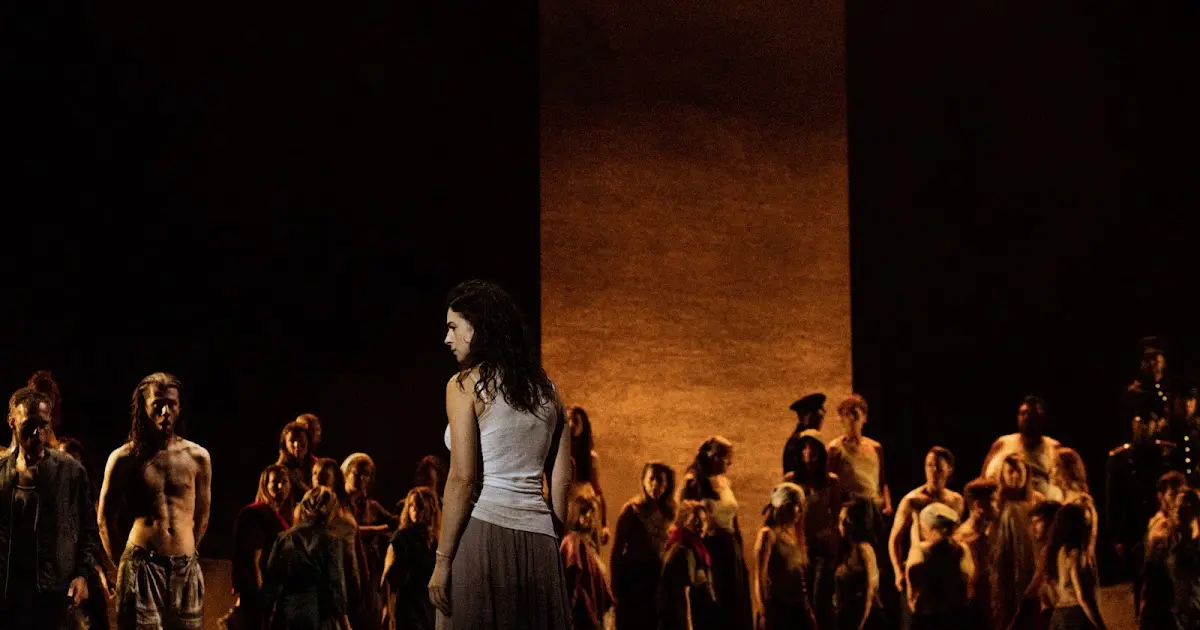
The 2026 Salzburg Festival witnessed one of the most polarizing and visually arresting operatic experiments of the decade: a radical reimagining of Georges Bizet’s Carmen at the Grosses Festspielhaus. Reviewed on August 8, 2026, this high-stakes production was spearheaded by an elite creative triumvirate—director and choreographer Gabriela Carrizo, founder of the Brussels-based dance-theatre company Peeping Tom; firebrand conductor Teodor Currentzis leading the Utopia Orchestra; and an international stellar cast anchored by Asmik Grigorian in the title role and Jonathan Tetelman as Don José.
Shorn of its traditional spoken dialogue and heavily integrated with hyper-surrealist choreography, sound design by Raphaelle Latini, and abstract set pieces by Christof Hetzer, this Carmen discarded the sun-drenched, operetta-like tropes of 19th-century French exoticism. Instead, it plunged audiences into a visceral, dark-toned psychological thriller. While the excision of spoken French and the introduction of avant-garde dance sequences alienated traditionalists and occasionally obscured narrative clarity in the earlier acts, the production ultimately justified its bold deviations. It culminated in an astonishing, emotionally devastating final confrontation that redefined the psychological dynamics between the tragic antiheroes.
Detailed Chronology and Act-by-Act Breakdown
Act I: Establishing the Dark Aesthetic and Narrative Disruption
The evening immediately signaled a departure from convention. Eschewing the traditional spoken dialogue that bridges Bizet’s musical numbers, Carrizo replaced the dialogue-heavy exposition with unsettling gestural movement, physical theatre, and Raphaelle Latini’s stark, industrial soundscapes. For first-time attendees, the absence of spoken text created immediate narrative friction: the first time the audience hears Don José, he is already singing to Micaëla, and Carmen herself is stripped of her customary playful laughter and verbal taunts.

The production’s tone was established early through a menacing visual arc, beginning with the soldiers’ vicious mistreatment of an anonymous citizen. Asmik Grigorian’s Carmen commanded the stage not through predatory sexuality, but via a chilling, independent autonomy. Yet, within the massive acoustic expanse of the Grosses Festspielhaus, Grigorian’s soprano middle and lower registers occasionally lacked the sheer weight needed to punch through massive ensemble blocks, though her phrasing remained relentlessly compelling.
Act II: Breaking Mold and Tradition
Act Two introduced further structural shocks. The curtain rose not to a picturesque Seville tavern, but to the haunting strains of cante jondo performed traditionally by guest artist Amparo Cortés in the guise of Lilas Pastia. While visually and aurally striking, Cortés’s authentic Andalusian laments created a deliberate stylistic friction against Bizet’s French orchestration.
Carrizo’s choreography shone brightest here, utterly purging the stage of clichéd "stage Spain" gestures. Grigorian’s Seguidille featured the striking substitution of plate-smashing in lieu of traditional castanets, feeding a burgeoning bitterness and fierceness that matched Jonathan Tetelman’s vocally sublime, dramatically intense Flower Song. Tetelman proved to be a near-ideal Don José: tall, strikingly magnetic, possessing a dark-toned tenor capable of ringing high notes balanced by delicate, hushed dynamics.

Act III: Surrealism, Mime, and Psychodrama
The third act leaned heavily into Peeping Tom’s signature surrealism. An elaborate, slow-moving religious procession served functionally to introduce Kristina Mkhitaryan’s Micaëla, who delivered her solo aria with laser-focused intensity, maintaining an angelic demeanor amidst surreal chaos. Simultaneously, Grigorian and Tetelman utilized extended mime sequences to redefine their deteriorating relationship without the aid of text.
Visual metaphors abounded: a persistent pool of water dominated the stage floor, into which Eurodike De Beul—playing Don José’s mother as an omnipresent ghost—ultimately stripped naked and symbolically drowned. Elsewhere, male dancers sporting deer antlers engaged in violent combat pursued by smugglers, and a Christ-like dancing figure punctuated the spiritual landscape. The act concluded with a near-feral escalation between Tetelman’s unhinged Don José and an utterly indifferent Carmen, setting the stage for a psychological collapse.
Act IV: The Crushing Climax
Stripped of its opening celebratory chorus and any introductory dance interludes, the final confrontation took place within a minimalist, blood-red arena. The stage’s physical architecture mirrored the psychological entrapment of the characters: a massive roof slowly, inexorably lowered throughout the scene, threatening to crush them.

This final sequence achieved an overwhelming emotional peak. The raw, unfiltered freedom of the performances stripped away all operatic artifice, translating Bizet’s musical tragedy into an authentic physical and psychological death match.
Supporting Context & Metrics
Creative & Artistic Personnel
- Composer: Georges Bizet
- Director & Choreographer: Gabriela Carrizo (Peeping Tom)
- Conductor: Teodor Currentzis
- Orchestra & Choir: Utopia Orchestra, Utopia Choir, and Bachchor Salzburg
- Set Design: Christof Hetzer
- Lighting Design: Tom Visser
- Sound Design: Raphaelle Latini
- Key Cast Members:
- Carmen: Asmik Grigorian (Soprano)
- Don José: Jonathan Tetelman (Tenor)
- Micaëla: Kristina Mkhitaryan (Soprano)
- Escamillo: Davide Luciano (Baritone)
- Frasquita / Mercédès: Iveta Simonyan, Anita Monserrat
- Zuniga / Morales: Matthias Winckhler, Liviu Holender
- Lilas Pastia (Cante Jondo performer): Amparo Cortés
Orchestral & Technical Execution
Teodor Currentzis and the Utopia Orchestra delivered a polarizing yet electrifying account of Bizet’s score. From the opening notes of the overture, Currentzis treated the orchestra as a hyper-expressive, forward-driving protagonist. While the approach was fierce and uncompromising, it frequently accommodated moments of delicate, haunting tenderness.
Lighting designer Tom Visser and set designer Christof Hetzer constructed stunning pictorial tableaux. However, their heavy reliance on deep shadows and silhouette work occasionally compromised theatrical practicality, making it difficult for the audience to clearly observe the singers’ vocal articulations.

Official Statements and Critical Reception
The production ignited fierce debates among international critics and opera purists alike. The central point of contention remained Carrizo’s decision to excise spoken dialogue in favor of gestural dance theatre—a technique previously attempted by Sally Potter in her 2007 English National Opera production, with similarly divisive results.
Artistic administration and Festival representatives noted that the decision was pragmatically driven by an international cast navigating the complexities of spoken French, but acknowledged its narrative risks. In statements regarding her directorial approach, Gabriela Carrizo defended the integration of surrealist dance as an attempt to bypass 19th-century Orientalist clichés and expose the raw, subconscious drives of Bizet’s characters.
Musicologists and critics observed that while the orchestration adhered closely to Bärenreiter’s modern critical editions—allowing audiences minor glimpses into alternative instrumental balances—the average attendee was far more struck by the theatrical shock value than musicological nuances. Overall, critical consensus framed the evening as a brilliant, if occasionally disjointed, work-in-progress that pushed the boundaries of traditional festival stagings.

Future Outlook
The Salzburg Festival’s 2026 Carmen leaves a complex legacy for future stagings of standard-repertoire masterworks. By demonstrating how avant-garde physical theatre and modern dance companies (such as Peeping Tom) can interface with traditional grand opera, the production opens new avenues for directors seeking to purge 19th-century works of colonialist and romanticized tropes.
However, the production also serves as a cautionary tale regarding the structural fragility of opera: discarding narrative scaffolding like spoken dialogue requires an airtight theatrical substitute if the plot is to remain accessible to uninitiated audiences. As opera houses globally grapple with how to modernize aging repertoires without alienating their core base, Carrizo and Currentzis’s experiment will undoubtedly serve as a crucial reference point. Whether future iterations will adopt its radical excision of text or simply borrow its fearless psychological intensity remains to be seen, but Carmen at Salzburg 2026 has irrevocably altered the conversation around contemporary opera direction.