Executive Overview
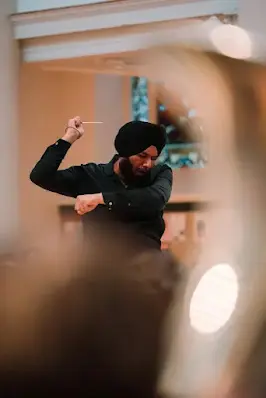
In the sprawling, tightly bound ecosystem of classical music—where pedigree, early-conservatory training, and decades of rigorous mentorship traditionally dictate who steps onto the podium—a rare and paradigm-shifting anomaly has emerged in London. Jashandeep Reehal, a self-taught musician hailing originally from a small town in Punjab, India, is rapidly reshaping the contours of orchestral leadership. Within an astonishingly brief timeframe, Reehal has transitioned from an absolute novice experiencing his very first live orchestral concert to founding and leading his own ensemble, the Holland Park Sinfonia.
Breaking cultural, geographical, and institutional barriers, Reehal stands as a trailblazer: he is widely believed to be the first-ever turbaned Sikh orchestral conductor. His journey is not merely a tale of rapid artistic acceleration; it is a profound narrative of raw instinct, sheer audacity, and the democratization of classical music. Arriving in the United Kingdom just a few years ago without a formal musical education, a professional network, or a traditional background in the Western classical canon, Reehal has carved out a space for himself through bold risk-taking and relentless determination.
At the core of this movement is the Holland Park Sinfonia, an orchestra birthed out of both artistic ambition and acute personal necessity. Facing an impending visa expiration and the urgent need to secure a foothold in the competitive British arts landscape, Reehal bypassed the traditional, gatekept routes of assistant conductor applications and masterclasses. Instead, he forged his own institution. This deep-dive report examines the extraordinary trajectory of Jashandeep Reehal—tracing his origins in Punjab, his pivotal awakening in a London concert hall, his rapid self-education in the art of conducting, and the broader implications of his ascent for diversity, representation, and the future of classical music in the United Kingdom.
Detailed Chronology: From Rural Punjab to the London Podium
Roots in Punjab: A Cultural Void and Musical Awakening
To fully grasp the magnitude of Jashandeep Reehal’s achievement, one must first understand the cultural geography of his upbringing. Growing up in a small town in Punjab, India, Western classical music was virtually nonexistent. Within the traditional Sikh culture of his community, orchestral music, symphonies, and conducting were entirely absent from the cultural fabric. There were no local youth orchestras, no Saturday morning music schools, and no towering cathedrals echoing with choral masterworks.
Despite this total absence of institutional infrastructure or exposure, a deep musical curiosity stirred within Reehal. Without the benefit of formal teachers, private lessons, or academic guidance, he embarked on a solitary path of self-discovery. He taught himself how to play the guitar and the piano, slowly decoding the complexities of harmony, rhythm, and melody entirely by ear and through independent study. Beyond performance, he naturally gravitated toward the structural architecture of music, teaching himself the fundamentals of composition and arrangement. Yet, for all his early exploratory efforts, the world of the symphonic conductor remained entirely alien—a distant universe operating under strict, unwritten rules of pedigree and tradition.
The Catalyst: February 2024 and the Royal Philharmonic Orchestra
The pivot point of Reehal’s life occurred shortly after his relocation to London, England, roughly three to four years ago. In February 2024, Reehal did something he had never done before in his life: he attended a live orchestral concert. Seated within a historic London concert hall, he watched the Royal Philharmonic Orchestra perform under the baton of Principal Conductor Vasily Petrenko.
For most attendees, a classical concert is an evening of aesthetic appreciation. For Reehal, it was a thunderclap of revelation. Watching Petrenko command the vast sonic forces of the orchestra, shape phrasing with subtle gestures, and unify dozens of instrumentalists into a single expressive organism, Reehal experienced an immediate and unshakeable conviction. He realized in that exact moment that he wanted to be a conductor.
At the time of this revelation, Reehal possessed zero formal knowledge of conducting technique, no baton-handling skills, no understanding of orchestral transposition, and absolutely no professional contacts within the classical music industry. By conventional wisdom, his ambition was an impossibility. But unencumbered by the dogma of how a conductor "ought" to be trained, Reehal set out to reverse-engineer the craft entirely on his own terms.
The Leap into Amateur Orchestras
Armed with intense focus and a rapidly expanding self-taught knowledge base, Reehal began seeking practical experience. In a field where young conductors typically spend years assisting established maestros, entering competitions, or studying at elite conservatories like the Royal Academy of Music or the Guildhall, Reehal took a radically direct approach.
Through sheer persistence and an uncanny ability to communicate his vision, he managed to convince an amateur orchestra in London to take a chance on him. In late 2024, with no prior podium experience, he stepped before the ensemble to conduct Carl Nielsen’s sweeping and turbulent Helios Overture.
By all accounts, the experiment was a success. Rather than freezing under the pressure of live performance, Reehal displayed a natural, commanding physical presence and an intuitive grasp of pacing and balance. Buoyed by this initial breakthrough, he went on to conduct two subsequent concert programs with the amateur ensemble, rapidly accumulating vital practical experience in front of living, breathing musicians—the ultimate proving ground for any conductor.
The Birth of the Holland Park Sinfonia
By 2025, Reehal faced a ticking clock that threatened to cut his burgeoning conducting career short. His UK visa was slated to expire the following year, and to remain in the country to pursue his artistic ambitions, he needed a viable pathway to secure a Global Talent visa—a notoriously selective designation reserved for individuals demonstrating exceptional promise in the arts.
Rather than waiting for an established institution to recognize his potential, Reehal engineered his own destiny. Recognizing that he needed to showcase his leadership, vision, and organizational capacity on an independent platform, he founded his own professional-caliber ensemble: the Holland Park Sinfonia.
The orchestra’s inaugural concert in February 2026 served as a bold statement of intent. Reehal curated a demanding and eclectic program that included Erich Wolfgang Korngold’s lush, cinematic suite from The Private Lives of Elizabeth and Essex, the virtuosic Warsaw Concerto (demanding immense technical precision from the collaborative forces), and a atmospheric suite from Casablanca.
Following the resounding success of their debut, the Holland Park Sinfonia returned for their second major concert on June 19, 2026. This performance cemented the orchestra’s rising reputation within the London classical scene, featuring a deeply moving reading of the Adagio from Sergei Rachmaninoff’s monumental Symphony No. 2—as captured in recent live recordings—alongside Samuel Barber’s lyrical and technically demanding Violin Concerto, featuring acclaimed soloist Charlie Lovell-Jones.

Supporting Context & Metrics: Cultural Representation and Institutional Disruption
Demographics and the Turbaned Pioneer
To understand the cultural weight of Jashandeep Reehal’s rise, one must examine the demographic makeup of classical music leadership in the West. Historically, the podium has been one of the most homogeneous spaces in the performing arts. While recent decades have seen significant and welcome strides toward gender parity and broader ethnic representation among orchestral conductors, representation from South Asian communities—particularly visibly observant, turbaned Sikh men—remains virtually nonexistent.
[Traditional Classical Music Pipeline]
  Elite Conservatories -> Private Mentorships -> Assistant Conductor Roles -> Major Podium

[Jashandeep Reehal's Trajectory]
  Self-Taught in Punjab -> London Awakening (Feb 2024) -> Direct Amateur Debuts -> Founder: Holland Park Sinfonia
In cultural terms, Sikh men have excelled globally in fields ranging from business and politics to sports and medicine, but the Western classical canon has remained culturally distant, viewed as an insular European tradition. By stepping onto the podium in a traditional turban, Reehal is not only making music; he is actively dismantling long-standing visual and cultural barriers. He transforms the concert hall into a space of radical inclusion, signaling to younger generations of minority artists that the classical canon belongs to anyone with the passion to interpret it.
The Mechanics of Self-Taught Conducting
How does one teach oneself to conduct an orchestra? In the digital age, Reehal utilized every available resource—masterclasses available online, historical recordings of legendary maestros like Carlos Kleiber, Leonard Bernstein, and Evgeny Svetlanov, and exhaustive study of orchestral scores.
However, book learning and video study are a far cry from the real-time feedback loop of a live orchestra. Conducting is a kinetic, psychological, and communicative art. It requires split-second micro-adjustments in intonation, balance, articulation, and tempo, all communicated through physical gestures, facial expressions, and eye contact. That Reehal managed to bridge the gap between solitary score study and the effective physical direction of dozens of musicians in a matter of months points to an extraordinary, innate communicative intelligence.
Official Statements & Artistic Vision
While Jashandeep Reehal’s journey is largely defined by his independent actions, the ethos of the Holland Park Sinfonia speaks volumes about his artistic philosophy. In statements regarding the formation of the orchestra and its programming choices, Reehal has emphasized a commitment to emotional directness and narrative-driven repertoire.
The choice of repertoire for the Sinfonia’s early concerts—spanning Korngold’s late-Romantic cinematic grandeur, the pyrotechnics of the Warsaw Concerto, the sweeping architectural expansiveness of Rachmaninoff’s Symphony No. 2, and the poignant lyricism of Barber’s Violin Concerto—demonstrates a conductor who is unafraid of the grand, emotional gestures of the late 19th and 20th centuries.
Speaking about his rapid ascent, cultural background, and the formation of the ensemble, Reehal has noted the profound responsibility he feels not only as an artist, but as a cultural pioneer:
"Growing up in a small town in India, classical music was never something that existed, and as a culture, Sikh people never ever ventured into that world. To be standing on the podium, bringing these monumental works to life with the Holland Park Sinfonia, is an incredible privilege. Music speaks a universal language, but breaking open the doors of tradition requires stepping into the unknown without hesitation."
Collaborating artists have similarly lauded his instinctive musicality. Soloist Charlie Lovell-Jones, who performed Barber’s Violin Concerto under Reehal’s baton in June 2026, praised the conductor’s attentive listening and supportive collaborative spirit on the podium—qualities that often take seasoned conductors decades to refine.
Future Outlook: Securing a Legacy in British Classical Music
As Jashandeep Reehal looks toward the remainder of 2026 and beyond, several critical milestones lie ahead that will test the sustainability and long-term viability of his ambitious enterprise.
1. Visa Status and Institutional Validation
The immediate hurdle remains bureaucratic. With his UK visa approaching its expiration window, Reehal’s application for the Global Talent visa will serve as a critical turning point. The establishment and rapid artistic success of the Holland Park Sinfonia provide a powerful, tangible body of work to present to arts endorsement bodies. Securing this visa will allow him to solidify his base in London, deepen his technical studies, and continue expanding the orchestra’s footprint.
2. Scaling the Holland Park Sinfonia
Founding an orchestra is a monumental achievement; sustaining one is an entirely different economic and logistical battle. Moving forward, the Holland Park Sinfonia will need to secure stable funding streams, cultivate a loyal audience base, and expand its concert calendar beyond its initial seasonal offerings. Reehal’s ability to attract high-caliber soloists like Charlie Lovell-Jones indicates that the orchestra is already punching above its weight class in terms of artistic credibility.
3. A New Blueprint for Classical Music Education
Beyond his personal career, Reehal’s trajectory offers a fascinating case study for music educators and cultural institutions. In an era where classical music institutions are desperately seeking ways to diversify their audiences and discover fresh talent outside traditional pipelines, Reehal proves that exceptional musical instincts can develop entirely outside the established academic framework.
Whether he becomes a permanent fixture of the international conducting circuit or continues to forge an independent path with the Holland Park Sinfonia, Jashandeep Reehal has already secured a historic place in the annals of classical music. He has demonstrated that with unyielding resolve, absolute artistic conviction, and a refusal to be constrained by convention, even the most traditional podiums in the world can be transformed.