Executive Overview
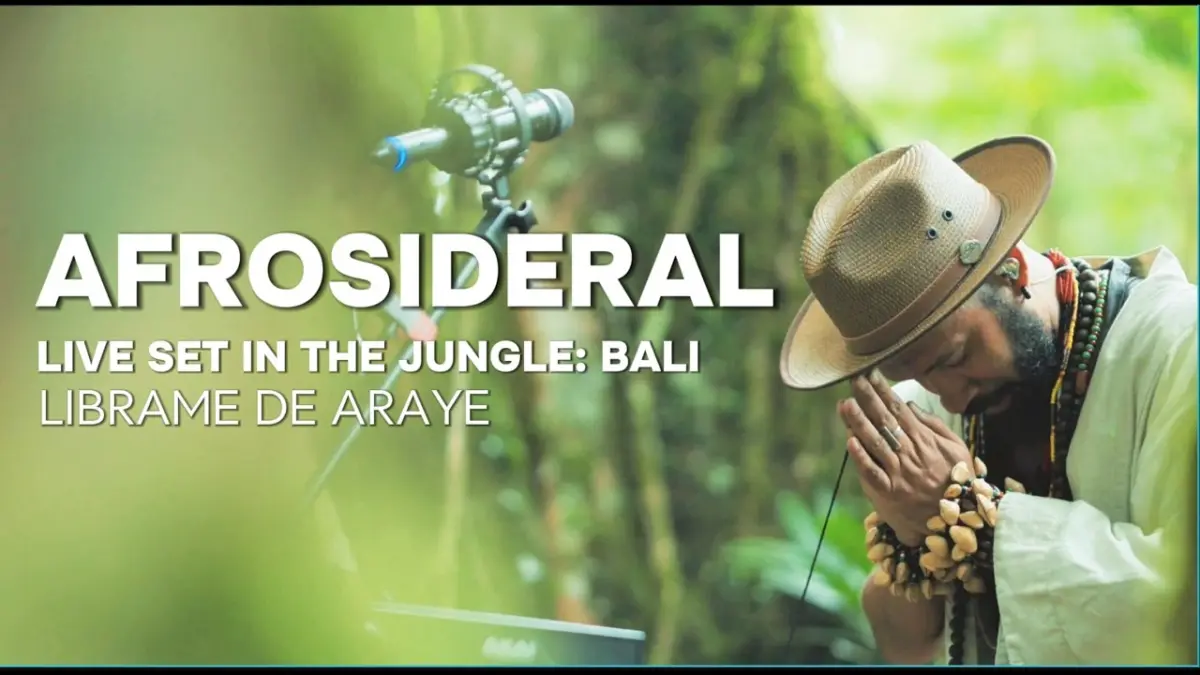
In the heart of the Balinese rainforest, far removed from the sun-bleached avenues of Havana or the bustling metropolitan studios of Europe, a profound cultural convergence took place. Cuban producer, vocalist, and multidisciplinary artist Kumar Sublevao-Beat—recording under his sonic moniker, Afrosideral—delivered a spellbinding live performance of his Afrotropical Mystic set. Surrounded by towering tropical flora and the ambient pulse of the jungle wildlife, Afrosideral utilized only his voice and intricate percussion to weave an organic bridge between ancient Afro-Cuban spiritual traditions and forward-thinking electronic music.
At the pulsating center of this immersive performance is the track "Líbrame de Arayé," an intensely personal yet universally resonant incantation. For this specific live iteration, Kumar opened the song with a haunting, meditative Balinese flute introduction—a bespoke artistic choice tailored specifically to honor the geography and spiritual gravity of the Indonesian island. According to the artist, this custom prologue was meticulously designed so that "the sound, the space, and the energy of the moment" could organically pave the way for the electronic rhythms that follow. It is an exclusive, extended opening crafted purely for live audiences, transforming an already potent studio composition into an ephemeral, transportive ritual.
This session is not merely a travelogue of global sounds; it represents the ongoing, borderless evolution of the orishas—the sacred deities of the Yoruba tradition—as they find new life through contemporary electronic production, heavy dub sub-bass, and global festival culture. From his roots in late-1990s Havana hip-hop to his landmark 2019 debut album on New York’s Wonderwheel Recordings, El Olimpo de los Orishas, Kumar has dedicated his career to keeping ancestral energies alive in modern club spaces. With his upcoming return to the prestigious Bali Spirit Festival in Ubud, Afrosideral continues to prove that electronic music can serve as a vessel for deep spiritual transmission, connecting the Caribbean diaspora to the spiritual mysticism of Southeast Asia.
Detailed Chronology
Roots in the Revolution: Havana’s Late-1990s Hip-Hop Renaissance
To understand the cosmic and rhythmic depth of Afrosideral, one must trace Kumar’s artistic lineage back to the crucible of late-1990s Havana. During this era, Cuba’s capital was navigating the severe economic hardships of the Periodo Especial following the collapse of the Soviet Union. Amidst this backdrop of scarcity, an underground hip-hop movement exploded among Cuban youth, serving as a vital outlet for social commentary, identity exploration, and artistic defiance.
Kumar emerged as a formidable MC within this dynamic scene, utilizing his lyrical agility and distinct vocal cadence to capture the realities of urban Cuban life. His exceptional talent did not go unnoticed; the underground hip-hop collective he belonged to was prominently featured in the critically acclaimed 2005 musical drama film Habana Blues, directed by Benito Zambrano. The film offered an international audience a rare, visceral glimpse into the struggles and triumphs of contemporary Cuban musicians torn between staying in their homeland and seeking opportunities abroad. This foundational period instilled in Kumar a deep appreciation for the power of storytelling through rhythm—a skill he would later carry across the Atlantic as he relocated to Europe to expand his sonic palette.
The Genesis of Afrosideral and El Olimpo de los Orishas
Relocating to Europe provided Kumar with the geographical and creative distance needed to synthesize his Cuban heritage with the expansive possibilities of European electronic music production. Abandoning standard genre classifications, he birthed Afrosideral—a project explicitly dedicated to exploring Afro-Cuban spirituality through an electronic lens.
In September 2019, Afrosideral unveiled his debut major release, El Olimpo de los Orishas (The Olympus of the Orishas), via the esteemed Brooklyn-based global-beats label Wonderwheel Recordings. Entirely self-produced, the album is a masterclass in sonic alchemy. Kumar meticulously wove together archival field recordings, sacred ancestral chants, acoustic percussion, and heavy, reverb-drenched dub electronic beats.
The second track on this landmark record was "Líbrame de Arayé," a composition that immediately captured the attention of world-music critics and underground electronic selectors alike. The phrase Líbrame de Arayé translates directly to "free me from envy and ill will." The term arayé itself originates from Lukumí, the ritual liturgical language preserved by the descendants of the Yoruba people in Cuba.
Deeply rooted in spiritual devotion, Kumar dedicated the track to Obatalá—the revered orisha who, according to Lukumí cosmology, is responsible for molding the physical form of human beings in the womb. In Yoruba tradition, Obatalá is synonymous with wisdom, peace, creation, and purity, with white serving as the sacred color representing all that is clean, untainted, and divine. By pairing the heavy, meditative weight of dub-infused electronic production with invocations of Obatalá, Kumar turned a digital-era club track into a modern prayer for spiritual protection.
The Balinese Convergence: Recording in the Jungle
The artistic evolution of Afrotropical Mystic reached a striking crescendo during Afrosideral’s residency in Indonesia. Capturing a live session deep within the Balinese jungle presented an intentional juxtaposition: the ancestral folklore of West Africa and the Caribbean meeting the hyper-spiritual, animist landscape of Hindu-majority Bali.
During this intimate live recording, Kumar chose to reinvent "Líbrame de Arayé" by incorporating a local Balinese flute player for the song’s introduction. This wasn’t merely a decorative collaboration; it was a profound act of cross-cultural dialogue. By allowing the breath of the Balinese flute to open the space, Kumar allowed the indigenous acoustics of the jungle to bleed into the electronic fabric of the track.
This extended, live-only intro serves as a psychological and sonic gateway. It forces the listener to pause, breathe, and attune their senses to the surrounding environment before the heavy electronic drums and spiritual chants drop. It is a performance philosophy that Kumar reserves strictly for live audiences, ensuring that those who experience Afrosideral in the flesh witness something entirely unique—a fleeting, unrepeatable fusion of time, space, and ancestral memory.
Supporting Context & Metrics
The Global Rise of Afro-Electronic Fusion
Afrosideral’s work sits at the vanguard of a broader, highly influential musical movement: the fusion of traditional African and Afro-diasporic folk music with cutting-edge electronic club production. Over the past decade, labels like Wonderwheel Recordings, Soundway, and Analog Africa have championed artists who refuse to separate electronic dance music from its historical and cultural roots.
- The Cultural Weight of Yoruba Cosmologies: The Yoruba religion, carried across the Atlantic during the transatlantic slave trade, successfully grafted itself onto Catholic iconography in Cuba, giving birth to Santería or Regla de Ocha. Preserving the Lukumí language and the veneration of the orishas required immense resilience among enslaved populations. Today, artists like Afrosideral utilize electronic music as a contemporary drum—a digital batá—to ensure these ancient spiritual technologies continue to resonate in the 21st century.
- The Dub Aesthetic: The inclusion of dub production techniques—heavy bass frequencies, spacious delays, and hypnotic echo chambers—is far from accidental. Dub music, with its cavernous, meditative spaces, mimics the sensation of being underwater or within a sacred cavern. When applied to ritualistic Afro-Cuban chants, dub creates a trance-inducing environment well-suited for ritualistic dancing and spiritual introspection.
- Festival Integration: Events like the Bali Spirit Festival in Ubud have become essential hubs for this global exchange. Bringing together yoga practitioners, world music aficionados, and electronic music producers, the festival offers an ideal ecosystem for artists like Afrosideral, whose music functions simultaneously as a somatic workout and a meditative practice.
Official Statements & Artistic Philosophy
Kumar Sublevao-Beat has been remarkably intentional about the philosophy driving Afrosideral. In reflections on the creative process behind El Olimpo de los Orishas and his live performances, the artist has emphasized that electronic music must retain a soul.
"The sound, the space, and the energy of the moment must open the way," Kumar explains, describing the meticulous live arrangement of "Líbrame de Arayé."
By introducing the track with a Balinese flute, he signals to the audience that technology is not being used to dominate or erase nature or local traditions, but rather to converse with them. The integration of the flute acts as a respectful greeting to the host land of Bali—an acknowledgment of shared spiritual frequencies across vast geographical divides.
Speaking on the deeper meaning of his work, Kumar has repeatedly underscored the protective and healing nature of his art. "Líbrame de Arayé" is a direct appeal to higher spiritual authorities—specifically Obatalá—to cleanse the aura of the listener and ward off the toxic energies of envy and malice. In an increasingly hyper-connected yet fragmented digital age, Afrosideral’s music offers a communal sanctuary, reminding listeners that electronic beats can carry the weight of centuries-old prayers.
Future Outlook
As Afrosideral looks toward the horizon, his trajectory points firmly toward a deeper integration of global acoustic traditions with immersive electronic sound design. Having solidified his reputation as a visionary producer with El Olimpo de los Orishas, Kumar is actively expanding the boundaries of how world music is experienced live.
His upcoming return engagement at the Bali Spirit Festival in Ubud in April 2026 marks a significant milestone. Being booked for a second consecutive year at such a renowned international gathering underscores the growing appetite for music that transcends standard club tropes in favor of holistic, spiritually grounded audio experiences. Festival organizers and attendees alike have gravitated toward Afrosideral’s ability to turn an outdoor stage into a sacred grove.
Furthermore, as digital distribution and global collaborative networks continue to expand, artists like Kumar are proving that geographical relocation—from Havana to Europe, and outward to the jungles of Southeast Asia—does not sever one’s roots; rather, it allows those roots to entwine with new soil.
For fans eager to dive deeper into this sonic universe, the studio version of "Líbrame de Arayé" remains available on major streaming and archiving platforms, while El Olimpo de los Orishas continues to serve as a foundational text for the modern Afro-electronic movement. Yet, as the jungle sessions in Bali have emphatically demonstrated, it is in the raw, unscripted air of the live performance—surrounded by the pulse of nature and the invocation of the orishas—that Afrosideral truly transcends the ordinary, offering a timeless reminder of music’s power to heal, protect, and unite.