Executive Overview
In the contemporary landscape of classical music, the chasm between historical repertoire and new composition can sometimes appear insurmountable. For centuries, the towering achievements of Renaissance polyphony have stood as museum pieces—pristine, revered, but frequently locked behind glass, admired rather than actively engaged with by modern creators. Enter ORA Singers, a pioneering force in the British choral scene that has systematically dismantled this barrier. At the heart of their visionary mission lies the ORA Singers Composers’ Pathway, a comprehensive framework designed to support and elevate writers of choral music at every conceivable juncture of their artistic journeys.
Within this overarching pathway, the Graduate Composers Scheme serves as a vital anchor. Championing early-career composers who find themselves navigating the treacherous waters between academic study and professional viability, the scheme offers a lifeline: a prestigious professional commission with ORA Singers, coupled with rigorous, regular mentorship under the guidance of Artistic Director Suzi Digby.
Now in its third iteration, the scheme is hurtling toward its culminating milestone. On October 2, 2026, the Dora Stoutzker Hall at the Royal Welsh College of Music & Drama (RWCMD) will play host to the 2026 Graduate Composers Showcase. This high-profile event will see five exceptionally talented early-career composers—Evie Atkin, Eluned Davies, Marcello Palazzo, Sarah Henderson, and Harry Rees—debuting brand-new, bespoke choral works.
True to ORA Singers’ signature aesthetic, each newly minted composition has been conceived as a direct dialogue with a Renaissance masterwork, forming part of the organization’s sprawling "100 Commissions Catalogue." By juxtaposing the pristine counterpoint of the sixteenth century with the fresh, uninhibited voices of the twenty-first century, this showcase promises not only to spotlight the next generation of choral luminaries but also to breathe vibrant, living air into ancient musical architecture. This report provides an in-depth examination of the scheme, the cohort, the pedagogical framework, and the broader implications for the future of choral composition.
Detailed Chronology: From Application to the RWCMD Stage
The journey toward the October 2, 2026 showcase is neither brief nor casual; it is an intensive, year-long crucible designed to test, refine, and elevate the technical and artistic capacities of the participating writers. Understanding the trajectory of the 2026 cohort requires a chronological tracing of how these five artists were selected, mentored, and pushed to realize their creative visions.
Phase 1: Selection and Pairing (Late 2025)
The journey for Atkin, Davies, Palazzo, Henderson, and Rees began months prior to the public announcement, navigating a highly competitive open call aimed at recent graduates of UK conservatoires and universities. Out of a vast pool of applicants showing immense promise, the final five were selected based on their distinct compositional voices, technical command of vocal writing, and an evident openness to artistic dialogue.
Upon selection, each composer was assigned a specific Renaissance masterwork to study, deconstruct, and "reflect" upon. This concept of reflection is central to ORA Singers’ artistic identity: it avoids pastiche or mere imitation, challenging the modern composer to draw inspiration from the structural, emotional, or harmonic DNA of a Renaissance piece and refract it through a contemporary lens.
Phase 2: The Mentorship Crucible (January – August 2026)
Throughout the spring and summer of 2026, the five composers entered a period of intense development. Central to this phase is the direct, one-on-one mentorship provided by Suzi Digby. As one of the UK’s most celebrated choral conductors and educators, Digby’s guidance bridges the gap between theoretical composition on the page and the physical realities of the human voice.
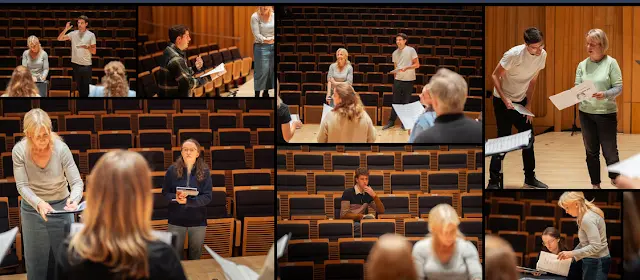
During these months, drafts were scrutinized, vocal ranges tested, and textural balances recalibrated. Writing for a professional vocal ensemble of ORA Singers’ caliber demands an acute understanding of microtonal intonation, blend, text-painting, and vowel modification. The mentors and singers workshop these drafts in a series of developmental sessions, allowing the composers to hear their ideas brought to life, make adjustments, and polish their scores into performance-ready states.
Phase 3: Final Preparations and the Showcase (September – October 2026)
As the summer of 2026 draws to a close, the scores are finalized, bound, and handed over to ORA Singers for intensive rehearsal. The culmination of this exhaustive process arrives on October 2, 2026, at the Dora Stoutzker Hall.
The concert format itself is a masterclass in contextual programming. Audience members will not merely listen to five new pieces in isolation; instead, ORA Singers will perform each Renaissance original immediately followed by its contemporary "reflection." This direct pairing allows listeners to trace the lineage of ideas across centuries, appreciating how modern sensibilities grapple with, subvert, or honor historical forms.
Supporting Context & Metrics: The Anatomy of the ORA Composers’ Pathway
To fully appreciate the weight of the Graduate Composers Scheme, one must examine the broader institutional ecosystem built by ORA Singers. Founded with a mandate to commission 100 new works that mirror Renaissance masterpieces, the organization has evolved from a daring conceptual project into a cornerstone of British new music infrastructure.
The 100 Commissions Catalogue and Educational Outreach
The "100 Commissions" project is arguably one of the most ambitious contemporary music initiatives of the twenty-first century. By commissioning leading and emerging composers to write companion pieces to works by masters such as Thomas Tallis, William Byrd, Josquin des Prez, and Giovanni Pierluigi da Palestrina, ORA has created a dynamic dialogue across time.

However, ORA recognized early on that sustaining this ecosystem requires more than just hiring established names; it demands a pipeline for fresh talent. Thus, the Composers’ Pathway was established, encompassing three distinct tiers:
- The ORA Young Composers Scheme: Targeting school-aged children and teenagers, introducing them to the fundamentals of choral writing and early music.
- The Graduate Composers Scheme: The critical bridge for emerging professionals (the tier housing Atkin, Davies, Palazzo, Henderson, and Rees) providing professional-level credits, mentorship, and high-profile performance opportunities.
- Established Commissions: Collaborations with globally renowned contemporary composers who write major works for the ensemble’s commercial recordings and international tours.
Economic and Professional Metrics for Early-Career Artists
The classical music industry presents notorious barriers to entry for early-career composers. Financial precarity, lack of access to top-tier professional ensembles, and limited performance opportunities often cause promising talent to abandon the field. The ORA Graduate Composers Scheme directly counters these structural deficits through measurable support:
- Guaranteed Professional Premieres: Unlike student readings where performers are learning the music alongside the composer, these works are premiered by seasoned professionals capable of executing hyper-complex contemporary scores with precision.
- Institutional Visibility: Performances at premier venues like the Royal Welsh College of Music & Drama place these emerging artists squarely in the view of critics, publishers, festival directors, and classical music audiences.
- Direct Mentorship Access: Access to Suzi Digby and senior ensemble members offers invaluable tacit knowledge regarding the business of music, score preparation, and vocal acoustics that cannot be gleaned from textbooks alone.
Official Statements & Artistic Insights
While formal press releases offer a baseline of information, the true ethos of the 2026 Graduate Composers Scheme is best understood through the voices of those steering its course and those living its challenges.
Suzi Digby on the Imperative of Mentorship and Heritage
Suzi Digby, Artistic Director and Founder of ORA Singers, has consistently emphasized that contemporary choral music must remain deeply connected to its historical roots while fearlessly embracing the present.
"When we established ORA Singers, our goal was never to treat Renaissance polyphony as a museum piece," Digby remarks. "It is living, breathing architecture. By inviting our graduate composers to study these historical blueprints and build their own modern structures in response, we are not looking backward—we are using the past as a springboard for radical creativity. The five composers in our 2026 cohort—Evie, Eluned, Marcello, Sarah, and Harry—represent an extraordinary breadth of imagination. Watching them wrestle with the complexities of Renaissance counterpoint and emerge with voices that are entirely their own has been one of the great privileges of our artistic season."
The 2026 Cohort: Bridging Worlds
Though each of the five selected composers brings a distinct aesthetic and background to the table, they share a common dedication to pushing the boundaries of the choral medium.
- Evie Atkin brings an acute sensitivity to text-setting, often drawing inspiration from literary sources and modern poetic rhythms to subvert traditional harmonic expectations.
- Eluned Davies infuses her writing with a deep understanding of modal textures, frequently exploring the liminal spaces between folk traditions and sacred polyphony.
- Marcello Palazzo brings a continental flair and a rigorous approach to vertical sonorities, constructing dense, shimmering harmonic clusters that challenge singers and captivate listeners.
- Sarah Henderson focuses on narrative and spatial dynamics within choral performance, utilizing the acoustics of venues like the Dora Stoutzker Hall to create immersive sonic environments.
- Harry Rees combines rhythmic drive with structural ingenuity, ensuring that his dialogue with Renaissance models is both intellectually rigorous and viscerally engaging.
Speaking on behalf of the cohort, participants have frequently highlighted the transformative nature of hearing professional singers bring their notation to life. The transition from MIDI mock-ups and theoretical scores to the warm, resonant blend of ORA Singers is described as a pivotal moment of artistic maturation.
Future Outlook: The Evolution of Choral Composition
As the classical music world looks toward the post-2026 landscape, initiatives like the ORA Singers Graduate Composers Scheme offer a blueprint for how cultural institutions can sustainably nurture new art forms. The challenges facing classical music—shrinking arts education budgets, dwindling institutional support for new works, and the struggle to diversify audiences—require proactive, interventionist strategies.
Expanding the Choral Canon
By insisting that contemporary music can sit side-by-side with Renaissance masterpieces without dilution, ORA Singers is actively reshaping audience expectations. Concertgoers attending the showcase at the Royal Welsh College of Music & Drama are not treated to an exercise in historical academicism; they are witnessing the ongoing evolution of the Western choral tradition.
The success of the first two iterations of the Graduate Composers Scheme has already resulted in alumni securing international commissions, publishing deals, and academic posts. The 2026 cohort is well-positioned to follow suit, carrying the rigorous standards instilled by Digby and ORA Singers into the wider professional sphere.
The Road Beyond October 2, 2026
For Atkin, Davies, Palazzo, Henderson, and Rees, the October 2 showcase is not a terminus, but a launchpad. The professional recording of these premieres, coupled with their integration into ORA’s touring repertoire, ensures an afterlife for these pieces far beyond a single evening in Cardiff. Furthermore, the networks forged during the mentorship phase—with performers, conductors, and fellow composers—will form the bedrock of their professional networks for decades to come.
In an era where the arts are frequently asked to justify their economic utility, ORA Singers’ Graduate Composers Scheme makes a compelling, undeniable case for cultural investment. By honoring the past while fiercely empowering the future, they ensure that the human voice remains our most profound, resonant instrument of expression.
Event Summary & Further Information
- Event: ORA Singers 2026 Graduate Composers Showcase
- Date: October 2, 2026
- Venue: Dora Stoutzker Hall, Royal Welsh College of Music & Drama (RWCMD), Cardiff
- Featured Composers: Evie Atkin, Eluned Davies, Marcello Palazzo, Sarah Henderson, Harry Rees
- Performing Ensemble: ORA Singers
- Artistic Director: Suzi Digby
For full ticketing details, programme notes, and venue information, visitors are encouraged to consult the official RWCMD Events Page and explore the broader institutional vision via the ORA Singers Graduate Composers Portal.