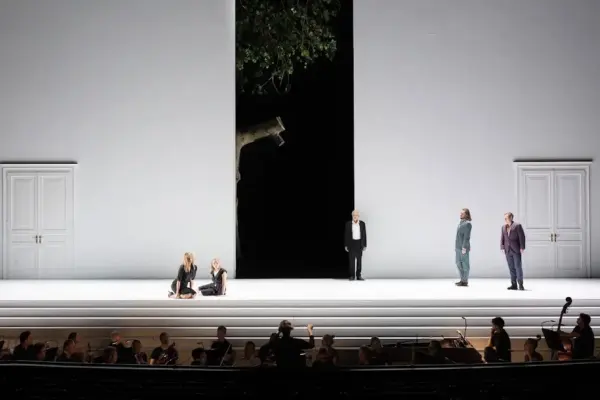
On September 5, 2026, the London Irish Centre played host to a landmark event in contemporary avant-garde music: the premiere of Here Comes Everybody: an overture to Finnegans Wake. Composed by Alastair White and produced in collaboration with his wife, Gemma Williams, the nearly hour-long work marks the grand opening salvo of a staggering 13-year compositional undertaking. This ambitious project aims to culminate in 2039, exactly one century after the initial publication of James Joyce’s notoriously dense and impenetrable 1939 masterpiece, Finnegans Wake.
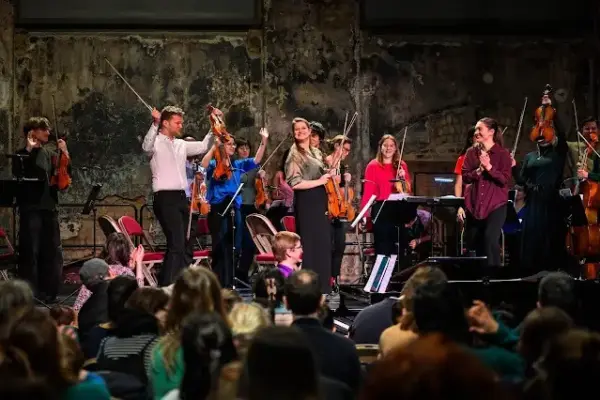
The premiere performance was brought to life by Ensemble Exposé—famed for championing ultra-complex contemporary scores since its founding in 1984 by Richard Barrett, Roger Redgate, and Michael Finnissy—under the precise baton of conductor Roger Redgate. Featuring virtuosic instrumentalists including Rowland Sutherland (flute), Christopher Redgate (oboe), Heather Roche (clarinet), Chris Brannick (percussion), Caroline Balding (violin), Bridge Carey (viola), and Clare O’Connell (cello), alongside evocative spoken-word readings by Cathal Murray, the concert challenged orthodox notions of how literature and music intersect.
Rather than attempting to translate the impenetrable linguistic puzzles of Joyce’s text into a literal musical narrative, White and Williams have adopted a structural and aesthetic framework inspired by Joyce’s own working methods. Mirroring Joyce’s 17-year piecemeal composition of the novel, the creative duo is rolling out their musical adaptation in fragments over more than a decade. Furthermore, White’s theoretical approach urges audiences to experience Finnegans Wake not as a subterranean vault of cryptic allusions to be excavated, but as a brilliant, shimmering surface to be engaged with on a visceral, sonic level. This comprehensive report explores the genesis, musical anatomy, intellectual underpinnings, and long-term trajectory of this monumental sonic journey.
Detailed Chronology: From Concept to Premiere
The roots of Here Comes Everybody stretch back well before its autumn 2026 debut, evolving through a deliberate intersection of operatic collaboration, literary obsession, and structural experimentation.
The Genesis and Irish Design Week Launch (2025)
The foundational ideas for the project coalesced years prior, driven by White and Williams’s shared passion for Joyce and Williams’s Irish heritage. Having previously collaborated on a succession of distinct modern operas—including WEAR (2018), ROBE (2019), WOAD (2020), and RUNE (2021)—the creative partners sought a canvas grander and more complex than traditional operatic forms could easily accommodate. They found their answer in Finnegans Wake.
Recognizing that the sheer scale of Joyce’s final novel defied a single, monolithic adaptation, White and Williams decided to mirror the author’s own historical workflow. Just as Joyce spent 17 years incrementally publishing fragments of his work-in-progress before the complete book debuted in 1939, White structured his musical response as a multi-decade serial endeavor. The initiative was officially previewed to the public at Irish Design Week, setting off a wave of anticipation within contemporary classical music circles.
The London Irish Centre Premiere (September 5, 2026)
The culmination of this early development arrived on a Saturday evening at the London Irish Centre. The event was anchored by Ensemble Exposé, an ensemble uniquely qualified to navigate White’s unforgivingly intricate scores. Founded over four decades ago precisely because its creators’ works were deemed too difficult for standard ensembles to execute, Ensemble Exposé brought an unflinching technical mastery to the stage.
The performance itself defied conventional overture conventions. Traditionally, an overture serves as a brief, introductory gateway to a larger dramatic work. However, because none of White’s prior operas featured overtures due to temporal constraints, he approached this composition as an independent, expansive exploration. Lasting nearly an hour, the overture functioned as a sonic microcosm of Joyce’s circular masterpiece—a work that famously loops back into itself from its final fragmented sentence to its opening clause ("riverrun, past Eve and Adam’s…").
The evening seamlessly integrated instrumental complexity with text. Broadcaster and actor Cathal Murray delivered carefully placed readings from Finnegans Wake, punctuated by White’s stark, expressionistic musical gestures, contrapuntal explosions, and meticulously calibrated moments of near-silence.
Supporting Context & Metrics
To fully appreciate the weight of Here Comes Everybody, one must examine the metrics, artistic lineage, and theoretical frameworks governing the project.
Temporal and Structural Metrics
- Total Project Timespan: 13 years (commencing in 2025/2026, culminating in 2039).
- Target Completion Date: 2039, marking the exact centenary of the 1939 publication of Finnegans Wake.
- Historical Parallel: James Joyce’s 17-year writing process for the novel (1922–1939), famously initiated the same year Djuna Barnes sketched her iconic portrait of an eyepatch-wearing Joyce.
- Ensemble Scale: A chamber force of seven instrumentalists (flute, oboe, clarinet, percussion, violin, viola, cello) plus a dedicated conductor and spoken-word artist.
- Overture Duration: Approximately 60 minutes of uninterrupted, highly dense musical architecture.
The Aesthetics of Complexity and the "Surface"
A core pillar of White’s philosophy—debated vigorously during the post-concert Q&A session moderated alongside Gemma Williams—is a rejection of hermeneutic over-intellectualization. For decades, academic critics of modernist literature have bogged down Finnegans Wake by attempting to decode every multi-lingual portmanteau word, historical allusion, and river name.
White argues that this approach misses the forest for the trees. Drawing an explicit parallel to musical literacy, he noted that millions of listeners deeply enjoy, understand, and feel emotionally moved by complex orchestral music without needing to read a score or analyze chord inversions. Applying this logic to Joyce, White contends that Finnegans Wake should be appreciated as a sonic and linguistic surface. The audience is invited to swim in the currents of the prose rhythm without feeling the exhausting obligation to unpack every esoteric reference.
Musical Architecture and Fractal Design
Musically, White’s composition leans heavily into fractal structures—patterns that repeat themselves at progressively smaller scales, mirroring the self-similar, cyclical nature of Joyce’s macro-narrative.

The overture’s opening movements initially teased a deceptive accessibility, invoking shades of mid-century English pastoralism before violently shattering into contrapuntal warfare. The three string instruments (violin, viola, and cello) engaged in fierce dialogues; notably, violinist Caroline Balding carved out a tense, fragile line resisting the surrounding sonic turbulence.
When the wind instruments (flute, oboe, and clarinet) finally entered, the texture swelled into a six-part counterpoint of radical independence. Rather than doubling lines or offering comforting harmonies, each instrument pursued its own autonomous path. Cathal Murray’s readings served as tectonic fault lines within this landscape. Ahead of the first reading, the ensemble stripped the music down to stark structural gestures and haunting silence. During the reading itself, sustained, ghostly chords floated beneath the spoken text.
As the piece progressed, the introduction of percussion added a visceral, percussive layer to the polyphonic web. Long, expressionistic string lines climbed toward a tumultuous climax dominated by shimmering cymbals, before gradually winding down into a hypnotic, repeated single tone that accompanied Murray’s closing vocalization.
Official Statements & Creator Insights
During the post-concert symposium and accompanying press disclosures, Alastair White and Gemma Williams provided profound commentary on the motivations driving their monumental undertaking.
Gemma Williams on Collaborative Roots and Operatic Ambitions
Discussing the genesis of the collaboration, producer Gemma Williams highlighted how their previous operatic ventures naturally paved the way for this Joyce adaptation:
"Having collaborated on several operas—WEAR (2018), ROBE (2019), WOAD (2020), and RUNE (2021)—we knew we wanted to continue creating large-scale operatic work. Combined with a strong desire to produce something rooted in Ireland, and our mutual obsession with James Joyce, Finnegans Wake presented itself as the ultimate horizon. Because the book is infinitely vast, breaking it down into manageable fragments was the only way to honor Joyce’s own serialized method of creation."
Alastair White on Structural Liberation and Modernist Composition
Composer Alastair White elaborated on how engaging with Finnegans Wake helped him solve technical composition dilemmas that have plagued contemporary classical music for decades:
"Joyce solved a structural problem that besets modern composition. Contemporary writers are constantly trapped between choosing a linear narrative where ‘this happens then that happens,’ or retreating into the rigid developmental tropes of classical music. Joyce’s text provided a blueprint that liberated my own compositional voice. Working with Institut Abeceda in Slovenia on projects like Fields of Vision allowed me to explore these ideas, but Finnegans Wake takes it further."
White further emphasized his rejection of literalism, noting that matching every plot point in a novel note-for-note fundamentally misunderstands both music and modernist literature:
"I reject a one-to-one identification between the music and what is happening in the narrative. Joyce rejected that kind of didactic illustration himself. Instead, I have used the structural language and rhythm of the text itself as the heartbeat of the music."
Future Outlook
With the triumphant premiere of Here Comes Everybody in London, White and Williams have successfully laid the cornerstone for what promises to be one of the most defining long-term projects in 21st-century contemporary classical music.
Over the next thirteen years, audiences can anticipate subsequent installments that will systematically expand upon the sonic vocabulary established in this initial overture. As the project evolves toward its 2039 climax, it will undoubtedly push Ensemble Exposé and future collaborators into uncharted territories of avant-garde execution.
By refusing to dilute Joyce’s complexities, and instead treating the masterwork as an expansive, fractal surface of rhythm and sound, White and Williams have breathed vibrant new life into a text long quarantined within the ivory towers of literary academia. The journey toward 2039 has officially begun, and the contemporary music world is watching—and listening—with bated breath.