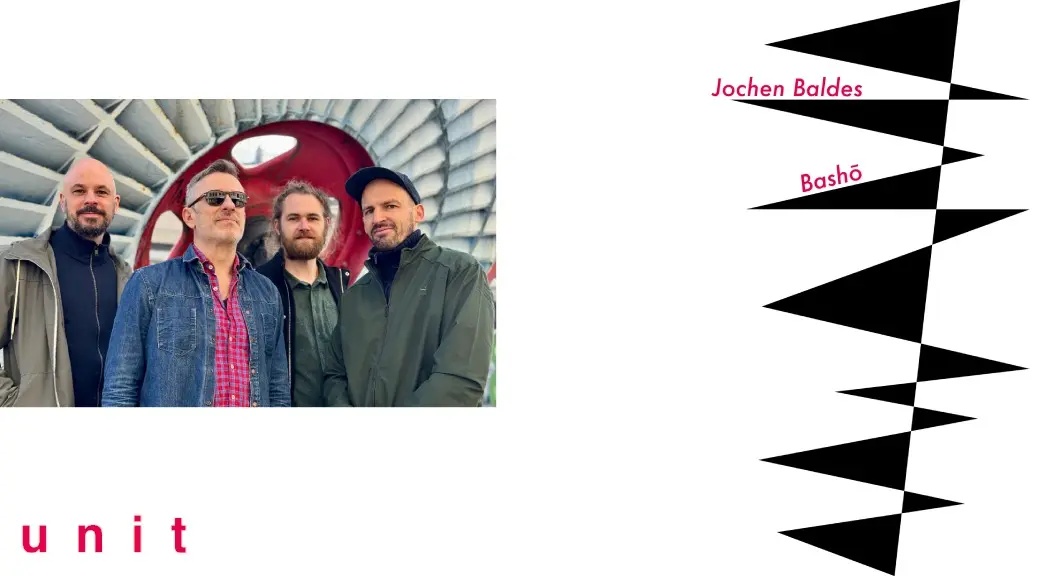
Swiss saxophonist and composer Jochen Baldes has carved out a distinct and uncompromising path across European jazz. Born in Zurich in 1964, Baldes initially pursued a career as a freelance painter and sculptor before discovering his passion for the horn in his early twenties. This late-blooming transition into music—commencing formal studies in 1986 under the tutelage of Nat Su and Omri Ziegele—infused his artistic perspective with a rare visual and structural awareness. Baldes later graduated from the prestigious Swiss Jazz School in Bern in 1995, studying under luminaries such as Andy Scherrer, Joe Haider, Bert Joris, and Frank Sikora. Over the subsequent decades, his restless creativity has taken him from local Zurich studios to international stages in Montreux, Willisau, and South Africa’s Grahamstown and Splashy Fen festivals.
Baldes’s latest artistic statement arrives in the form of Bashō, an album released on the stalwart Swiss imprint Unit Records. Recorded at Jazzhaus Zürich in June 2025 and engineered by Andy Neresheimer, the album represents a conceptual peak in Baldes’s career. Rooted in the profound stillness of the COVID-19 pandemic—during which Baldes immersed himself deeply in Japanese literature, art, and film—the project draws direct inspiration from the life and haiku of master Edo-period poet Matsuo Bashō (1644–1694).
Executed by a chordless quartet featuring Christoph Irniger on tenor saxophone and bass clarinet, Raphael Walser on double bass, and Lukas Mantel on drums, Bashō translates the minimalist, juxtaposed imagery of classical Japanese verse into an innovative modern jazz idiom. Across both vinyl and compact disc formats, the album weaves through the changing seasons, offering listeners an intellectually rigorous yet deeply emotional auditory experience.
Detailed Chronology
From the Canvas to the Bandstand: The Early Years and Subnoder
Baldes’s entry into music was unconventional. While many contemporary jazz artists undergo rigorous institutional training from early adolescence, Baldes spent his formative young adult years navigating the Zurich fine art world as a painter and sculptor. This background in spatial composition and textural layering ultimately bled into his approach to the saxophone when he picked up the instrument in 1986. Following his studies with Nat Su and Omri Ziegele, and his eventual graduation from the Swiss Jazz School in 1995, Baldes rapidly integrated himself into the European studio and touring circuits.
In 1997, he established his longest-running primary vehicle, Subnoder. Over nearly three decades, Subnoder evolved through multiple line-ups, yielding four defining albums:
- Niniland (1999)
- Osmotic Jazz (2003)
- The Moholo Songs (2007)
- Here (2013)
Literary Intersections and Cross-Disciplinary Collaborations
Baldes’s career has consistently intersected with poetry, theater, and multimedia performance. His project Kobal translated an entire evening-length poetry cycle, Ach Anna, by Hamburg-based writer Nicolai Kobus, into a cohesive musical suite. Alongside singer and electronics artist Johanna Jellicí, Baldes co-led Jellicí/Baldes Soundfields and Jellicí Baldes Spacetracker, producing critically acclaimed works like Invisible Door (2016) and The Journey (2019). Furthermore, his ensemble Bloom Effect released Slider on the legendary Leo Records in 2024.
That same year, Baldes achieved a major milestone as an improvising soloist with the Tonhalle-Orchester Zürich, performing Howard Shore’s complex score for David Cronenberg’s Naked Lunch. Stepping into the shoes of Ornette Coleman—who recorded the original parts with the London Philharmonic Orchestra—demonstrated Baldes’s technical mastery and comfort in avant-garde contexts.
The Genesis of Bashō
The conceptual foundation of Bashō was laid during the global lockdowns of the pandemic years. Confined to his studio, Baldes turned his focus toward Japanese aesthetics, finding a profound kinship between the economy of jazz improvisation and the sparse, evocative structure of the haiku. He chose Matsuo Bashō as his central muse. Bashō derived his pen name from a banana plant (bashō) gifted to him by his students.
Baldes composed all the music for the quartet while mapping the album’s emotional and thematic arc directly to Bashō’s most famous haiku, each containing a kigo (season word). To bring this music to life, Baldes assembled a tightly knit quartet drawn from the upper echelons of the Zurich modern jazz community, combining generational experience with adventurous spontaneity.

Supporting Context & Metrics
The Ensemble and Interlocking Zurich Networks
The quartet assembled for Bashō is a masterclass in musical synergy, born from decades of overlapping collaborations within Zurich’s vibrant creative music ecosystem:
- Christoph Irniger: Fifteen years Baldes’s junior, Irniger has achieved international acclaim via his Intakt Records releases with Pilgrim and his eponymous trio. Like Baldes, Irniger studied under Nat Su before spending seven years in the Lucerne Jazz Orchestra—an institution where both Baldes and drummer Lukas Mantel have also held chairs. Irniger is also the founder of the influential Jazz im Seefeld concert series.
- Lukas Mantel: A versatile percussionist whose collaborative web connects deeply with both Irniger and bassist Raphael Walser. Mantel earned recognition early on through the Jazz thing Next Generation series on Double Moon, appearing on tré’s Fundamental Music in 2006.
- Raphael Walser: The youngest member of the quartet, Walser graduated from the Zurich University of the Arts under Christoph Grab (another of Irniger’s mentors). Walser previously led the ensemble GangArt on their Double Moon release, Wolfgang.
Notably, three of the four quartet members (Baldes, Mantel, and Walser) have passed through the prestigious Jazz thing Next Generation platform, highlighting their sustained importance to the trajectory of modern Swiss jazz.
Instrumentation and Format Mechanics
Bashō is performed by a chordless quartet: two tenor saxophones (with both players doubling on bass clarinet), double bass, and drums. The absence of a polyphonic anchor like a piano or guitar forces the two reed instruments to negotiate the harmonic space dynamically. This configuration mirrors the poetic structure of a haiku, which relies on two contrasting images placed side-by-side to spark an imaginative leap in the reader’s mind.
The physical releases of the album introduce fascinating structural differences between the CD and LP formats:
- Spoken Introductions: Every piece on both formats opens with Sonoe Kato reciting the respective haiku in Japanese. On the vinyl LP, these recitations are seamlessly folded into the beginning of each track, anchoring the spoken word directly to the musical performance. On the compact disc, however, the spoken verses are indexed as separate intro tracks.
- Track Sequences and Side Division: The vinyl version is meticulously sequenced across two sides. Side A journeys from autumn nightfall (“Aki no kure”) to the warmth of a winter fire (“Kimi hi o take”). Side B travels from summer travel (“Natsugoromo”) to the scent of spring plum blossoms (“Mume ga ka ni”). The CD version adds an exclusive final track, “Meigetsu” (The Harvest Moon), which circles back to autumn to close the disc.
Official Statements & Critical Analysis
Label Lineage: Unit Records
The release of Bashō on Unit Records marks a continuation of Baldes’s relationship with the label, which previously issued The Journey in 2019. Founded in 1983 by Swiss musicians Jürg Solothurnmann, Hans Kennel, Paul Haag, and Urs Blöchlinger, Unit Records was created explicitly as an autonomous platform for adventurous players within the Swiss-German creative music scene.
Over the decades, the label’s stewardship has passed through influential hands: Pius Knüsel (later director of Pro Helvetia), drummer Lucas Niggli (1996–2005), and guitarist Harald Haerter, who ran the label for nearly two decades. Since 2023, bassists Andreas Waelti and Luca Sisera have held the reins, operating out of Willisau. This unbroken chain of musician-led administration has ensured that Unit Records remains a gold standard for contemporary European jazz.
Track-by-Track Musical Breakdown
Side A: Autumn to Winter
- “Aki no kure” (Autumn Nightfall): Inspired by Bashō’s famous poem about a crow settling on a leafless branch at dusk. The writing carries an unmistakable elegiac weight, propelled by a leading tenor saxophone voice and underpinned by Walser’s resonant bass and Mantel’s crisp percussion.
- “Sakura kana” (Cherry Blossoms): Drawing on the sigh of wonder (kana) that accompanies memories stirred by cherry blossoms, this piece walks with a proud, upright posture. Tenor saxophone again dominates the front line, supported by intricate interplay from the rhythm section.
- “Kimi hi o take” (Light the Fire): Arguably the emotional apex of the album. Set on a snowy night, the music captures Bashō urging his disciple Sora to stoke the fire while he reveals a magnificent snowball. The piece opens with extraordinary depth and sustains its emotional resonance flawlessly.
Side B: Summer to Spring
- “Natsugoromo” (Summer Robes): Opening Side B, this piece reflects a weary traveler poking fun at himself over lice lingering in his summer garments. Mantel delivers his most frantic, high-energy drumming here. The piece shifts directions abruptly mid-flow, capturing the unpredictable momentum of live performance.
- “Shizukasa” (Stillness): Evoking Bashō’s 1689 visit to the mountain temple of Yamadera, where the voice of a cicada seems to sink into the ancient rock. Here, the instrumentation pivots: the bass clarinet steps forward, supported by Walser’s deep, anchoring double bass work.
- “Sazaregani” (Little Crab): A playful, miniature portrait of a tiny crab creeping up the poet’s leg in clear water, returning the tenor saxophone to the sonic forefront.
- “Mume ga ka ni” (Plum Blossom Scent): Closing the vinyl edition, this piece captures the sudden sunrise over a mountain path perfumed by plum blossoms in 1694—the final spring of Bashō’s life. The two saxophones carve out a magnificent, three-dimensional soundstage, easily surpassing the earlier tenor pieces in sheer sonic scope.
- “Meigetsu” (The Harvest Moon – CD Exclusive): A tightly wound closing statement for the compact disc, utilizing the bass clarinet once more to lead the listener through a quiet night walk around a pond until dawn. As the track fades out amid subtle triangle taps, it provides a tranquil and definitive conclusion.
Future Outlook
As Jochen Baldes and his quartet prepare to bring Bashō to live audiences across Switzerland, the project stands as a testament to the enduring vitality of European chamber jazz. By fusing the historical weight of Japanese literature with the spontaneous vitality of modern improvisation, Baldes has constructed a transatlantic bridge of sound and silence.
Upcoming Live Dates
Audiences eager to experience the chordless interplay and poetic conceptualization of Bashō live can catch the quartet on their upcoming tour dates:
- November 12, 2026: Esse, Winterthur
- November 25, 2026: unerhört! Festival, Jazz im Seefeld, Zurich
- January 24, 2027: Jazzclub Moods, Zurich
- November 18, 2027: Jazzclub Aarau
With its rigorous compositional framework, exceptional instrumental execution, and profound emotional depth, Bashō is not merely an album to be casually consumed; it is an immersive artistic statement destined to cement Baldes’s legacy as one of Switzerland’s most visionary musical thinkers.