Executive Overview
Imagine a world where your household dog could not only solve complex calculus problems by tapping a paw, but also casually articulate its religious convictions to a local clergyman. Picture a draft horse with a penchant for stock market predictions, or a German stallion captivating massive European crowds with its astonishing mastery of arithmetic.
To the modern reader, these scenarios sound like the setup for a whimsical fantasy novel or a satirical cartoon. Yet, at the turn of the 20th century, these exact phenomena were treated with deadly seriousness by some of the most formidable intellectual figures of the era. Elite scientists, pioneer psychologists, and titan philosophers—including Nobel laureates and the architects of modern philosophical frameworks—grappled deeply with the possibility of "psychic phenomena" in animals.
This deep dive explores a turbulent, fascinating crossroads in human history: a brief, intense window when rapid technological marvels like the telephone and X-rays blurred the line between the plausible and the impossible. During this era, brilliant thinkers investigated equine mathematicians and telepathic hounds. Far from being a mere historical footnote or an embarrassing intellectual detour, this eccentric pursuit of animal parapsychology accidentally laid the foundational stones for modern experimental design, rigorous statistical analysis, and our understanding of unconscious human bias.
Detailed Chronology: From Seances to "Thinking Dogs"
The Fin-de-Siècle Fascination with the Unseen (Late 19th to Early 20th Century)
At the turn of the 20th century, the boundary between hard science and metaphysical speculation was remarkably porous. The rapid, bewildering pace of the Industrial Revolution had brought forth invisible forces that previous generations would have deemed outright magical. Heinrich Hertz proved the existence of invisible electromagnetic waves; Wilhelm Röntgen discovered X-rays, allowing doctors to peer directly through living human flesh; and Alexander Graham Bell’s telephone allowed human voices to traverse vast continents instantaneously.
In this climate of profound wonder, many of the greatest minds of the Western world became captivated by "psychic phenomena"—telepathy, clairvoyance, precognition, and communication with the dead.
Prominent figures threw themselves into psychical research with academic zeal:
- J.J. Thomson, the brilliant physicist who won the 1906 Nobel Prize in Physics for discovering the electron, actively performed controlled experiments to test the validity of human mediums.
- C.D. Broad, a towering figure in twentieth-century philosophy, regularly attended seances and seriously analyzed the mechanics of precognition—the theoretical ability to foresee future events.
Significantly, these figures were not marginal charlatans operating on the fringes of society. Their theoretical explorations shaped foundational philosophical concepts still debated today. For instance, C.D. Broad introduced the "growing block theory" of time—the prominent philosophical view asserting that the past and present are fundamentally real, while the future does not yet exist.
Enter the Equine Mathematicians and Rolf, the Dog of Mannheim
While the vast majority of psychical research focused on human subjects, a zealous faction of researchers wondered whether these supernormal abilities extended to the animal kingdom.
Chief among them was Friedrich Canning Scott Schiller (1864–1937), a prominent philosopher who spent the bulk of his distinguished career at the University of Oxford. Schiller was an active, vocal member of the prestigious Society for Psychical Research (SPR) and a founding father of pragmatism—the philosophical doctrine asserting that the ultimate truth of any theory is judged entirely by its practical application and consequences in the real world.
Schiller engaged in fierce, highly publicized intellectual debates regarding the purported psychic capacities of animals. His definitive entry on "psychical research" for the Encyclopedia Britannica included a dedicated section on "equine mathematicians"—horses supposedly gifted with paranormal mathematical genius, demonstrating their prowess by tapping out correct solutions to complex arithmetic equations with their hooves.
By 1914, Schiller’s focus shifted dramatically toward a canine subject: Rolf, "the thinking dog of Mannheim," residing in southwestern Germany. According to breathless contemporary accounts published in the Proceedings of the Society for Psychical Research, Rolf could tap out precise answers to complicated mathematical problems using a coded system with his paw. Utilizing a meticulously devised spelling code for letters and syllables, Schiller and other observers claimed the dog successfully produced entire, coherent sentences.
In one particularly astonishing, highly controversial instance, Schiller alleged that Rolf used his spelling code to explicitly profess his Catholic faith to a visiting local priest.
The Rise of Lady Wonder and Clever Hans
The sensational case of Rolf—along with a sudden, global crop of similarly "thinking" and mathematically inclined animals—triggered a major theoretical dilemma for psychical researchers.
Two primary schools of thought emerged:
- The Innate Intelligence Hypothesis: One faction argued that these remarkable displays proved animals possessed hidden, deeply sophisticated intellectual and spiritual powers entirely parallel to those of humans.
- The Telepathic Hypothesis: Another camp argued that animals could not possess abstract mathematical or linguistic knowledge natively; instead, they were acting as living antennae, picking up answers telepathically from their human handlers.
Among the proponents of the telepathic explanation was Vladimir Bechtereev, a pioneering Russian scientist who made monumental, lasting discoveries regarding memory retention, reflexology, and brain structure. Bechtereev insisted that Rolf’s human owner was subconsciously or telepathically broadcasting all necessary information directly into the dog’s mind.
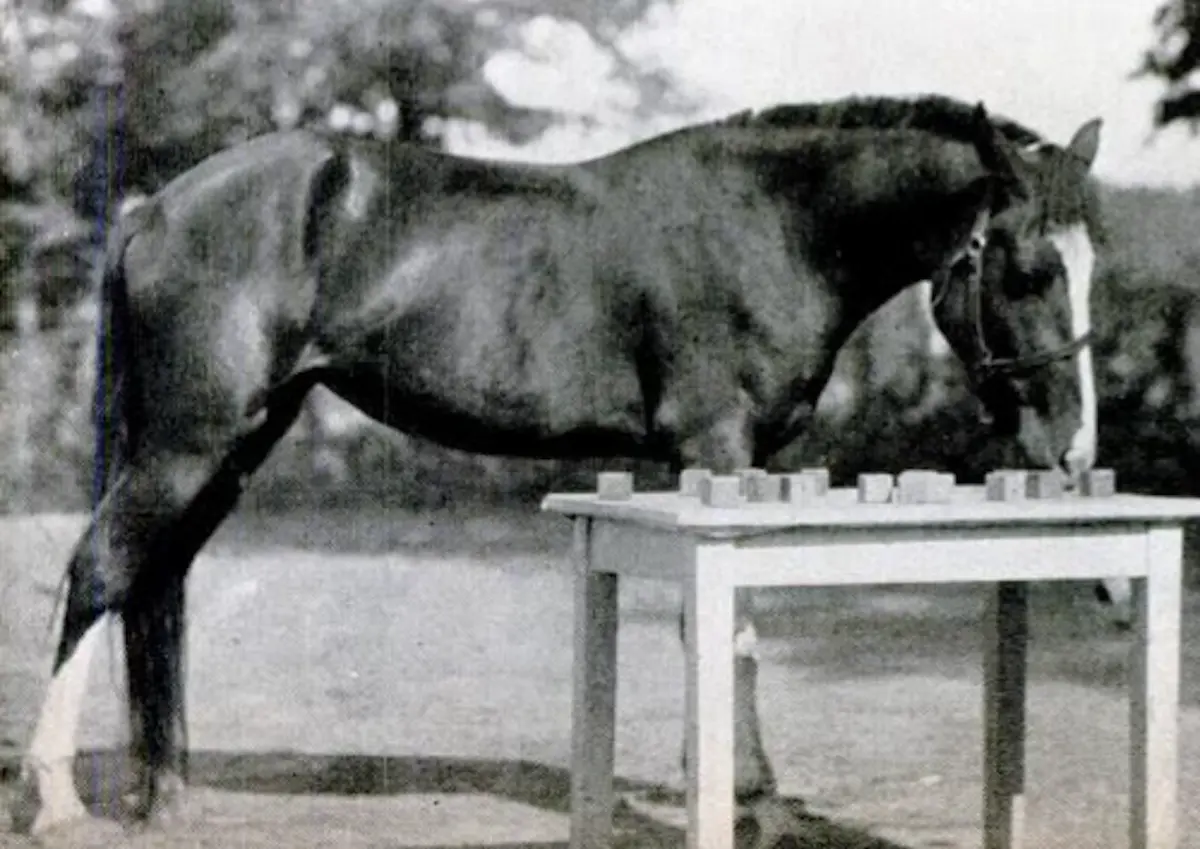
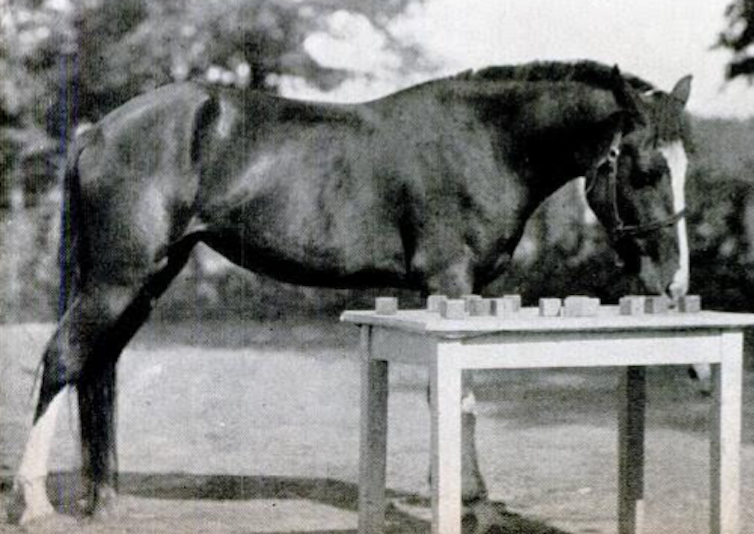
Across the Atlantic, a similar media circus surrounded Lady Wonder, a remarkable horse popularized in 1929 by Joseph Banks Rhine (1895–1980) and his wife Louisa (1890–1983)—the figures widely credited with establishing the controversial field of parapsychology. Lady Wonder seemingly possessed the ability to make accurate predictions, solve arithmetic equations, and tell precise time by nudging lettered and numbered wooden blocks with her sensitive nose.
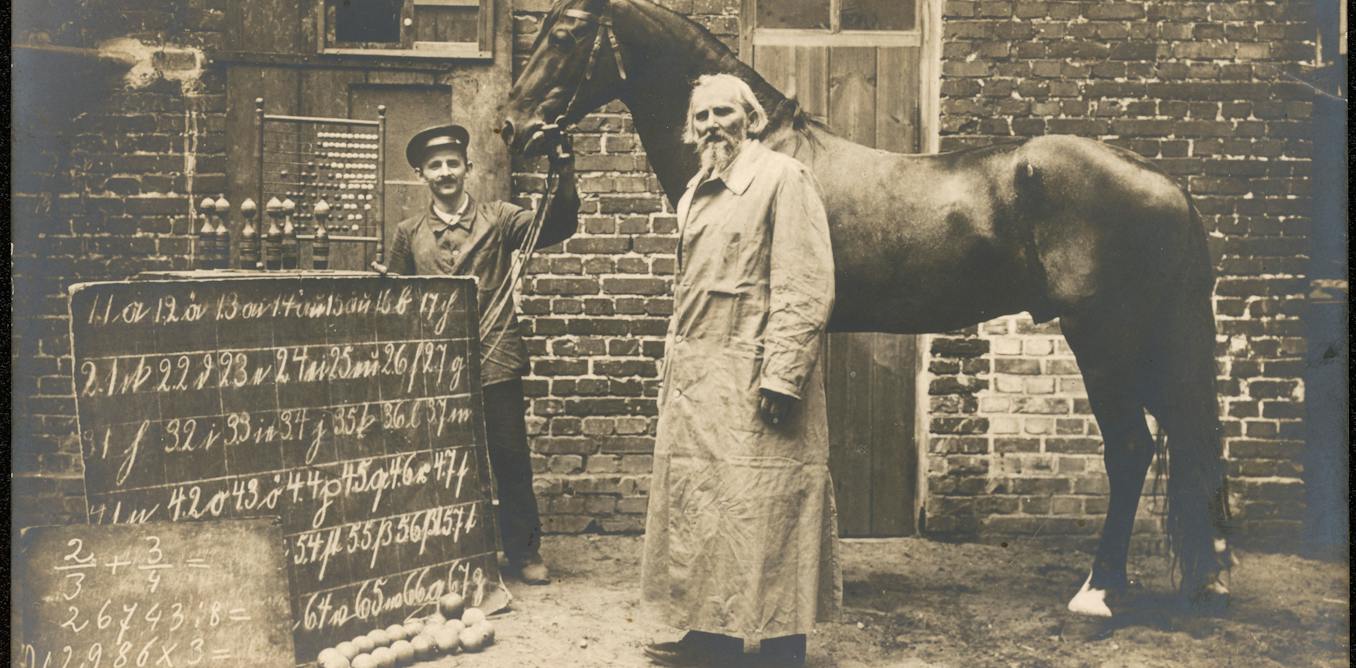
Yet, the most famous and culturally impactful case of an apparent "genius animal" was undoubtedly Clever Hans (Der Kluge Hans). Owned by German mathematics teacher and former circus act manager Wilhelm von Osten, Hans was a magnificent Orlov Trotter horse who toured Germany demonstrating an uncanny ability to add, subtract, multiply, divide, read, spell, and tell time.
Hans drew massive, hysterical crowds, including everyday citizens, curious psychical researchers hoping to document supernormal animal powers, and Carl Stumpf (1848–1936), one of the founding fathers of modern experimental psychology.
Supporting Context & Metrics: Deconstructing the Phenomenon
The collective hysteria over calculating animals eventually forced the scientific community to systematically investigate the claims. The turning point arrived through a meticulous, rigorous investigation led by Oskar Pfungst, a research assistant to Carl Stumpf.
Unmasking Clever Hans: The Birth of the "Clever Hans Effect"
Pfungst approached the phenomenon of Clever Hans with profound skepticism, refusing to accept either the animal genius theory or the prevailing telepathic explanations. Through exhaustive, carefully controlled behavioral experiments, Pfungst systematically isolated the horse’s sensory inputs to determine precisely under what conditions Hans could—and could not—provide correct answers.
Pfungst’s breakthrough discoveries revealed:
- Hans could only provide the correct answer to a math problem when his owner (or handler) stood nearby and already knew the answer to the question being asked.
- Crucially, Hans could only succeed when he had an unobstructed, direct line of sight to his human handler.
When Pfungst blinded the horse, or when the questioner did not know the answer, Hans’s "mathematical genius" evaporated instantly.
The horse was not performing arithmetic; rather, he was a master reader of micro-expressions. As Wilhelm von Osten asked a question and Hans began tapping his hoof, von Osten would unconsciously tense his posture, lean forward slightly, and alter his breathing pattern in eager anticipation of the correct number. The moment Hans struck the final, correct count, von Osten would visibly relax his muscles or straighten his posture.
Sensing this microscopic, wholly involuntary postural shift, Hans would instantly stop tapping, receiving a treat as a reward.
Pfungst had formally discovered what is now universally known as the Clever Hans effect (or observer-expectancy effect). This pivotal psychological concept describes any situation where an experimenter or observer unintentionally, through subtle behavioral cues, shapes, biases, or influences the subjects they are studying to produce a desired outcome.
The Pragmatic Critique
Even within philosophical circles, the telepathic animal hypothesis faced swift, rigorous backlash grounded in practical philosophy.
Friedrich Schiller, despite his deep fascination with the SPR, eventually turned his own pragmatic framework against the wilder claims surrounding Rolf and other psychic animals. Schiller argued that abstract debates regarding telepathy were fundamentally useless unless they yielded observable, practical consequences for animal behavior.
In a critique that cut to the heart of the matter, Schiller pointed out the glaring absurdity of the animals’ alleged traits: If Rolf was genuinely a mathematical savant capable of advanced arithmetic, why did he not use mathematics in everyday canine life? If the dog was a confessed, practicing Catholic, why did he persistently refuse to attend church services?
By applying pragmatism, Schiller helped dismantle the intellectual viability of these grandiose animal claims, steering the academic community back toward empirical reality.
Official Statements & Historical Perspectives
The transition from mystical credulity to hard-nosed scientific skepticism marked a defining maturation period for modern psychology and experimental science.
Reflecting on the turbulent intellectual atmosphere of the early 20th century, science historians emphasize that the investigations into animal telepathy were not merely embarrassing errors, but necessary growing pains for a nascent scientific discipline.
"When new technologies like the telephone and X-rays fundamentally transformed human perception of what was physically possible, it was entirely rational for thinkers of the era to widen the aperture of inquiry. If invisible waves could carry human speech across oceans, the notion that minds—or animal instincts—might operate on hidden frequencies did not sound as absurd then as it does today."
— Historical Analysis of Early 20th-Century Psychical Research
Similarly, the methodological fallout from the Clever Hans investigation permanently altered how laboratories worldwide structured their protocols. The realization that human expectations could unconsciously corrupt animal behavior paved the way for critical methodological safeguards.
+--------------------------------------------------------------------------+
|                       EVOLUTION OF EXPERIMENTAL DESIGN                   |
+--------------------------------------------------------------------------+
|  ERA 1: ANECDOTAL OBSERVATION                                            |
|  - Reliance on unverified spectator accounts.                            |
|  - Lack of baseline controls for human-animal interaction.               |
+--------------------------------------------------------------------------+
|                                    |                                     |
|                                    v                                     |
+--------------------------------------------------------------------------+
|  ERA 2: THE CLEVER HANS DISCOVERY (Pfungst, 1907)                        |
|  - Identification of unconscious cueing (Observer-Expectancy Effect).    |
|  - Introduction of sensory isolation and blind testing conditions.       |
+--------------------------------------------------------------------------+
|                                    |                                     |
|                                    v                                     |
+--------------------------------------------------------------------------+
|  ERA 3: MODERN RIGOROUS RANDOMIZATION                                    |
|  - Double-blind protocols to eliminate experimenter bias.                |
|  - Statistical validation and mathematical randomization in trial design.|
+--------------------------------------------------------------------------+
As highlighted in historical reviews of scientific methodology, attempts to test telepathy and investigate anomalous animal claims directly drove the formal development of randomization in experimental design.
Researchers realized that if human expectations, micro-expressions, and unconscious cues could trick observers into believing a horse could do calculus, human bias could corrupt any scientific experiment. Consequently, science adopted randomized trial allocations—ensuring that neither researchers nor participants could consciously or unconsciously influence experimental outcomes.
Future Outlook: The Legacy of Animal Telepathy in Modern Science
Though the era of equine mathematicians and telepathic hounds quickly faded from academic halls—relegated to the history books as parapsychology fractured away from mainstream neuroscience and animal cognition studies—its legacy remains deeply embedded in modern science.
Today, the study of animal cognition has evolved into a highly respected, data-driven discipline. Researchers at top global institutions routinely demonstrate astonishing feats of animal intelligence—from New Caledonian crows crafting sophisticated multi-tool systems to cetaceans utilizing complex linguistic syntax, and border collies learning hundreds of distinct object nouns.
However, contemporary ethologists and comparative psychologists operate with a level of methodological rigor forged directly in the fires of the Clever Hans debacle. Modern researchers routinely employ double-blind experimental designs, automated computer-controlled testing interfaces, and automated video-tracking software to ensure that human experimenters never accidentally cue, bias, or project their own expectations onto animal subjects.
Furthermore, the philosophical frameworks established during this turbulent era continue to guide modern debates surrounding machine learning, artificial intelligence, and human-computer interaction. When algorithms appear to possess human-like reasoning or emotional intelligence, computer scientists and cognitive researchers must still ask the timeless question posed by Oskar Pfungst and Friedrich Schiller over a century ago:
Is the system truly exhibiting autonomous intelligence, or is it merely reflecting the hidden biases, expectations, and inputs of its human creators?
Ultimately, the forgotten history of philosophy’s brief romance with psychic pets stands as a powerful testament to the self-correcting nature of science. Out of the most absurd credulity, rigorous skepticism emerged—transforming a cultural fascination with talking horses into the gold standard of modern experimental design.