Executive Overview
For decades, the trajectory of modern music production has been anchored by the digital domain. Software plugins and virtual studio technologies (VSTs) offer undeniable allure: infinite polyphony, total recall, pristine audio processing, and zero physical footprint. Yet, a fundamental truth persists across generations of creators—software lacks tactile engagement. Sooner or later, the glass screen of a laptop breeds creative fatigue, prompting musicians to seek the visceral, hands-on feedback of physical hardware.
Historically, entering the world of analog and digital synthesis meant committing to eye-watering, four-figure investments. Iconic instruments like the Minimoog, Roland TB-303, and Prophet series were traditionally locked behind financial barriers reserved for professional studios. However, a seismic shift has taken place within the musical instrument market. Today, manufacturers have engineered a staggering array of hardware synthesizers priced under $250. Far from being cheap toys, these instruments offer sophisticated sound-shaping tools, robust ecosystems, and genre-defining sonic capabilities.
This comprehensive market analysis explores the finest hardware synthesizers available under $250, breaking down their architectural merits, workflow philosophies, and why they deserve a place in your studio setup.
Detailed Chronology: The Evolution of Affordable Hardware
To understand how high-powered hardware became available for the price of a modest software bundle, one must examine the timeline of miniaturization and manufacturing democratization that reshaped the music tech industry over the past decade.

- 2013 – The Micro-Ecosystem Revolution: Korg disrupts the market with the launch of the Volca series. By proving that battery-powered, highly specialized mini-synths could deliver authentic analog and digital workflows at a sub-$200 price point, Korg establishes a brand-new product category.
- 2015-2017 – The Micro-Controller Era: Teenage Engineering introduces the Pocket Operator series. Utilizing bare-bones circuit boards and hyper-portable designs, these pocket-sized units redefine mobile sequencing and sampling, bringing serious music production to commuters and hobbyists alike.
- 2019 – The Analog Clone Invasion: Capitalizing on advanced surface-mount technology and mass-production efficiency, companies like Behringer flood the market with sub-$150 reinterpretations of vintage heavyweights, effectively democratizing legendary analog architectures.
- 2021-2023 – Semi-Modular and Open-Source Expansion: Brands like Cre8audio, Bastl Instruments, and Korg push the envelope further. DIY kits, open-source processors like the Raspberry Pi, and affordable semi-modular patching systems bring complex sound design paradigms to entry-level buyers.
- 2024-Present – The Mature Budget Market: Today, sub-$250 synthesizers are no longer defined by compromises in sound quality. Instead, they represent hyper-focused design choices, giving producers specialized tools that rival plugins in sonic depth while retaining the joy of physical manipulation.
Supporting Context & Metrics: Navigating the Sub-$250 Landscape
Before diving into individual instrument reviews, it is helpful to establish the economic and technical parameters governing this price tier. While $250 represents a strict ceiling for this guide, stretching the budget by a mere $50 unlocks cult-classic instruments such as the Korg Monologue, Arturia MicroFreak, Moog Mavis DIY kit, and Sonicware Liven grooveboxes.
However, if you remain steadfast under the $250 threshold, the market offers staggering diversity. To assist in your purchasing decision, the following metrics highlight the primary contenders across various synthesis categories, categorized by their distinct workflows.
1. Behringer Mini Range: Vintage Icons in Miniature
- Price Range: $99 – $129
- Core Architecture: Condensed vintage emulations (Minimoog, Casio CZ-1, Prophet VS, Oberheim-style architecture)
- Key Features: Two-octave touch-sensitive keyboards, ultra-portable footprints, classic filter designs.
For maximum financial leverage, the Behringer Mini range offers an unmatched historical tour of synthesis. By condensing legendary multi-oscillator architectures and phase distortion systems into compact, highly mobile enclosures, these units serve as instant gateways to historical timbres. Whether you are chasing the thick, ladder-filtered bass of a Minimoog or the vector-synthesized pads of early digital workstations, these instruments pack immense sonic pedigree into minimal desk space.
2. Korg Volca Series: The Gold Standard of Budget Ecosystems
- Price Range: $129 – $179
- Core Architecture: Varies by model (Analog, FM, Modular, PCM Sampling)
- Key Features: Built-in speakers, battery operation, 16-step sequencers, sync/MIDI connectivity.
Launched over a decade ago, the Korg Volca ecosystem remains the most robust hardware ecosystem for beginners and live performers. Models range from the acid-drenched Volca NuBass and West Coast-inspired Volca Modular to the powerhouse six-operator Volca FM2. Their standardized footprint and sync capabilities allow producers to chain multiple units together, building a formidable tabletop live performance rig incrementally.

3. Teenage Engineering Pocket Operators: Pocket-Sized Powerhouses
- Price Range: $59 – $99
- Core Architecture: Digital synthesis, drum synthesis, and micro-sampling
- Key Features: Animated LCD screens, 16-step sequencers, parameter locking, punch-in effects.
Discarding traditional plastic chassis in favor of exposed circuit boards, Teenage Engineering’s Pocket Operators prove that elite industrial design can coexist with budget pricing. The PO-32 drum synthesizer seamlessly integrates with Sonic Charge’s microTonic plugin, while the PO-33 acts as a phenomenal pocket sampler. Though small enough to fit inside a shirt pocket, their parameter-locking sequencers allow for surprisingly complex, evolving patterns.
4. Stylophone Gen X-2: Quirky Monophonic Sound Design
- Price: ~$77
- Core Architecture: Analog monophonic synthesis
- Key Features: Stylus-operated keyboard, resonant filter, LFO, CV/trigger connectivity.
Evolving far beyond its 1967 novelty roots (famously utilized by David Bowie and Kraftwerk), the Stylophone Gen X-2 is a legitimate analog instrument. Featuring an attack/decay envelope, pulse-width control, and a resonant filter, its stylus-driven interface encourages spontaneous, hands-on melodic exploration while providing modern CV integration for modular setups.
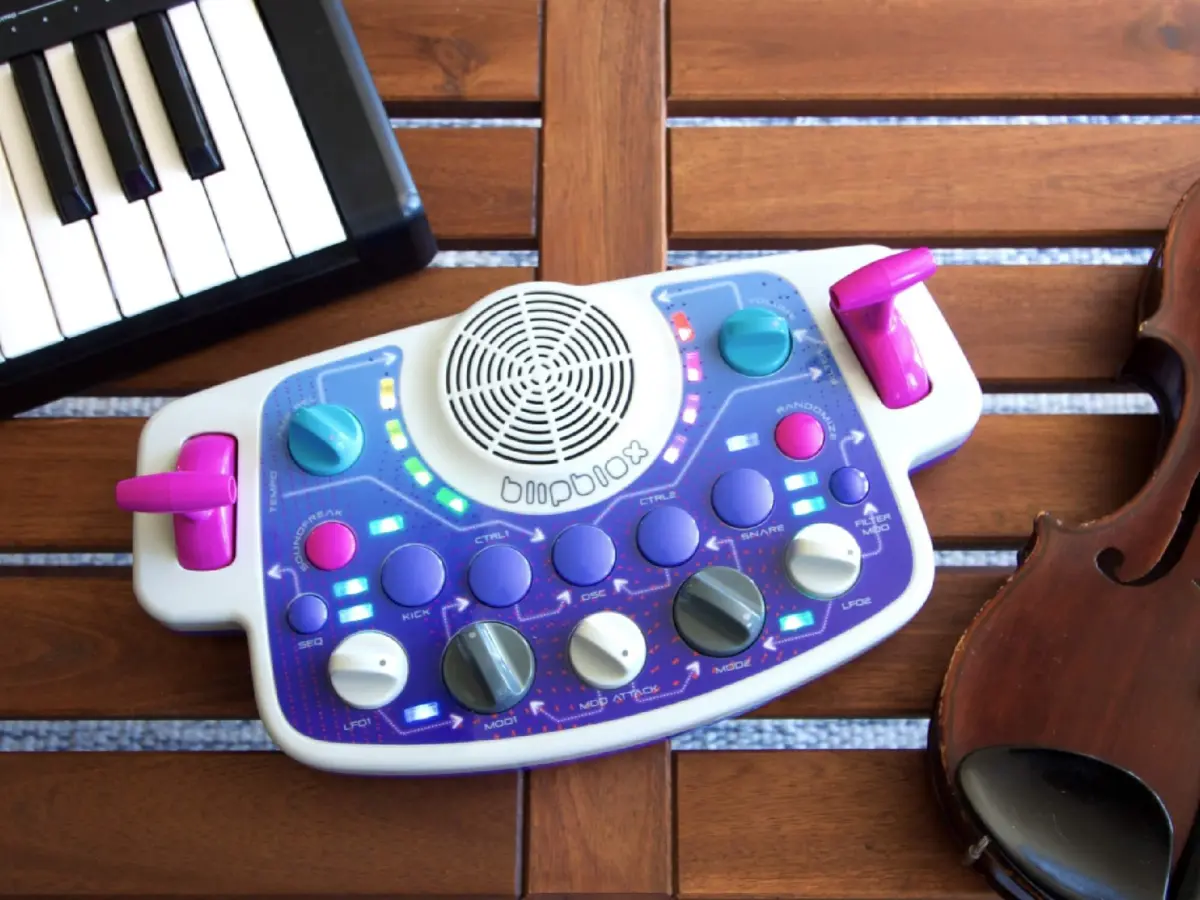
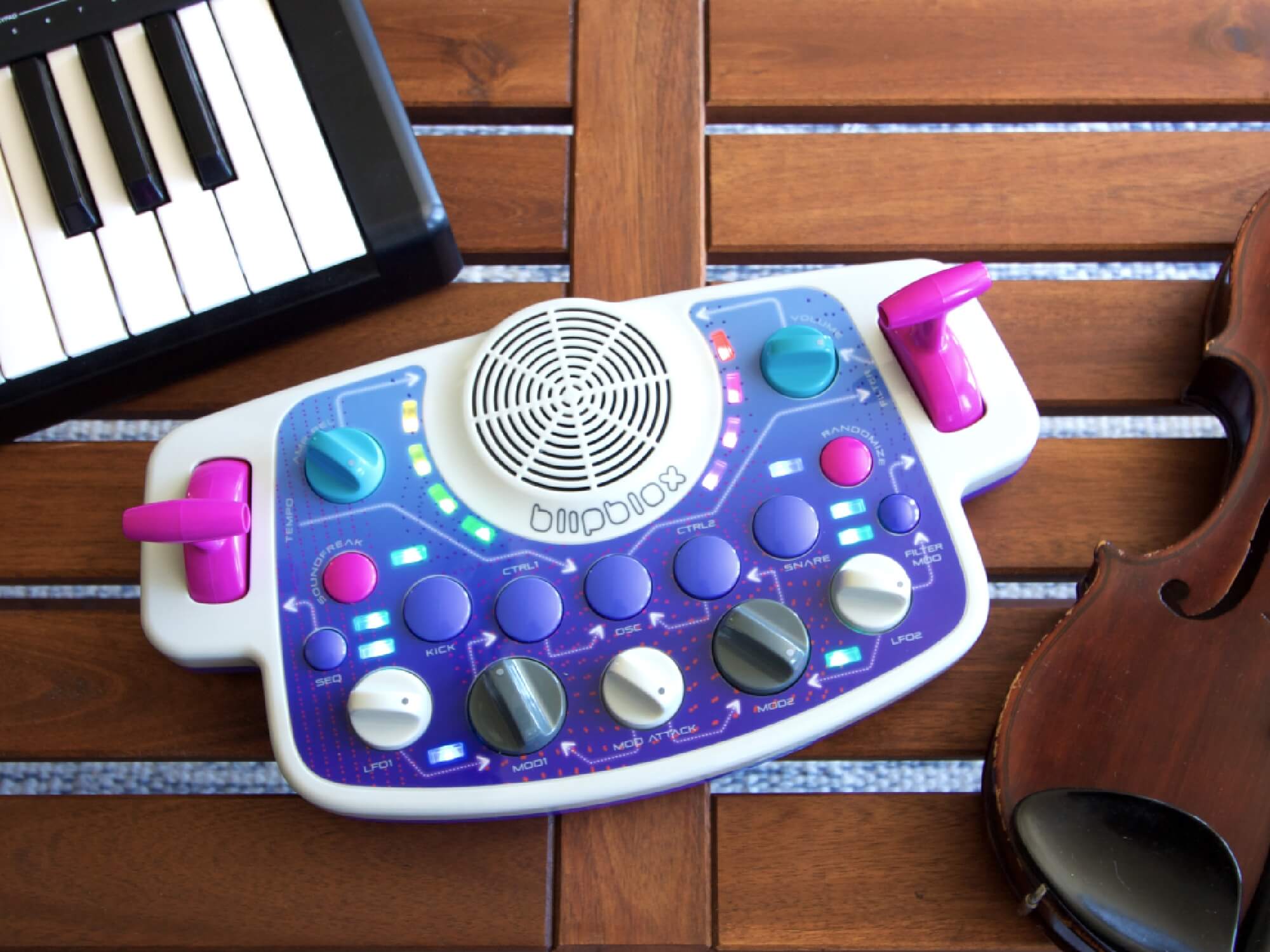
5. Playtime Engineering Blipblox SK2: Playful Sound Exploration
- Price: ~$219
- Core Architecture: Dual digital oscillators, multi-mode filter, dual LFOs
- Key Features: Child-friendly interface, 300+ onboard melodies, built-in drum machine and delay.
Do not let its colorful, toy-like appearance deceive you: the Blipblox SK2 is a surprisingly deep sound design engine featuring 16 oscillator modes, flexible modulation routing, and hardware effects. Designed for intuitive, tactile learning, it bypasses traditional preset menus in favor of immediate, joyful acoustic experimentation.
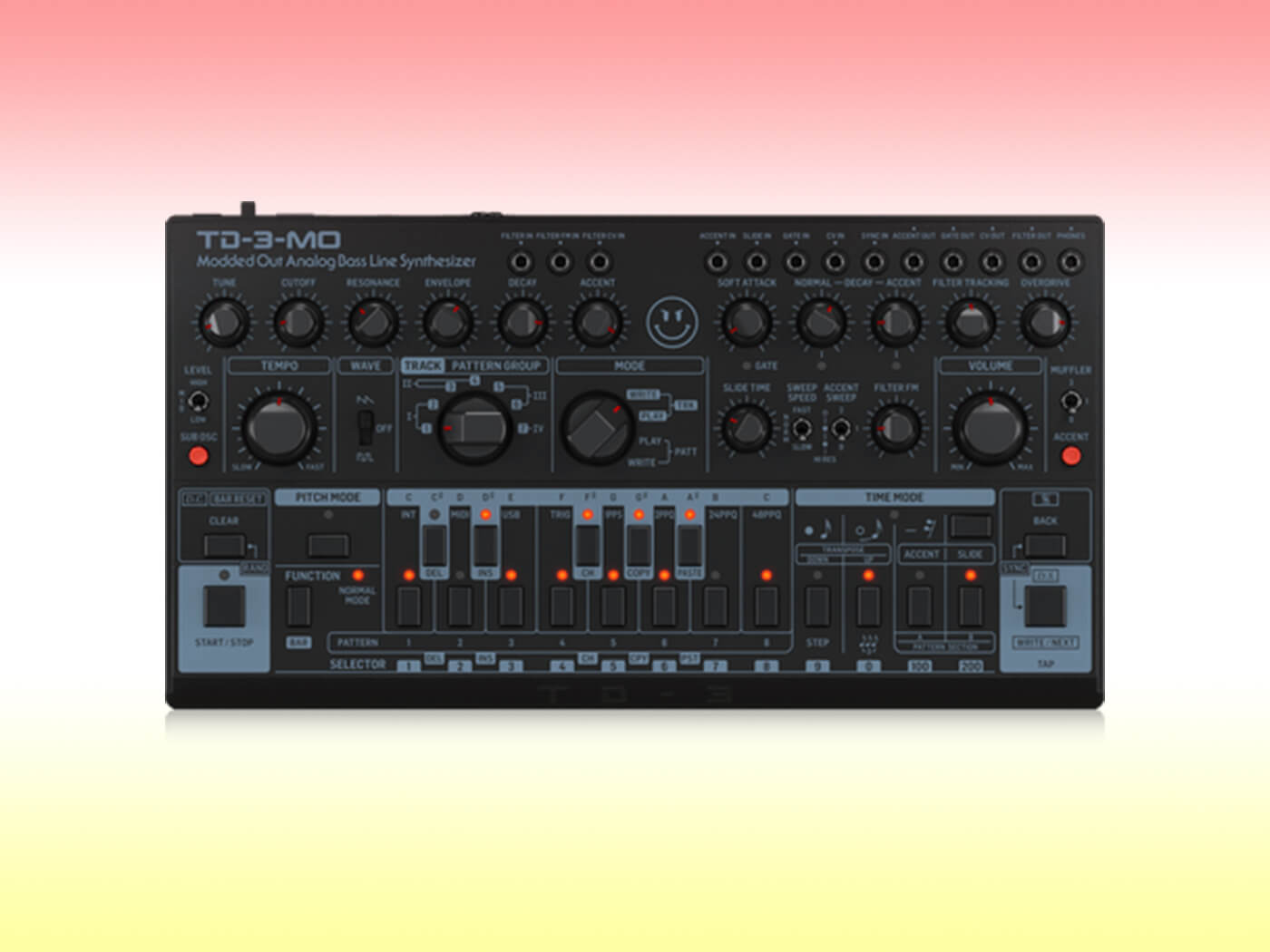
6. Behringer TD-3 & TD-3-MO: Squelchy Acid Basslines
- Price: $149 (Standard) – $199 (Modded Out)
- Core Architecture: Analog bassline synthesis with sawtooth/square oscillators
- Key Features: Four-pole low-pass filter, integrated distortion, modern MIDI/USB connectivity, custom mod options.
With vintage Roland TB-303 units commanding astronomical sums, the Behringer TD-3 reigns supreme as the most cost-effective solution for authentic acid house and techno basslines. The standard model delivers the unmistakable squelch of the original, while the TD-3-MO ("Modded Out") variant introduces sub-oscillators, adjustable slide times, and expanded patch points for deep sonic warping.
7. Cre8audio East Beast and West Pest: Affordable Semi-Modular Routing
- Price: $249 each
- Core Architecture: Semi-modular analog (East Coast subtractive vs. West Coast additive/wavefolding)
- Key Features: 4×5 patchbays, standalone playability, deep expandability.
Bridging the gap between fixed-architecture synths and chaotic modular systems, Cre8audio offers two distinct entry points. The East Beast embraces Bob Moog’s subtractive synthesis principles for warm, classic tones, while the West Pest utilizes Buchla-inspired wavefolding to generate wild, harmonic textures. Both function out-of-the-box without patch cables, yet offer robust patchbays for future modular expansion.
8. Korg NTS-1 Digital mkII: The Expandable DIY Powerhouse
- Price: ~$169
- Core Architecture: Programmable digital oscillator with advanced effects engine
- Key Features: Logue SDK support for custom wavetables, 8-step sequencer, stereo audio input for external processing.
The Korg Nu:Tekt NTS-1 mkII is an ingenious DIY digital kit that punches well above its weight class. Beyond its onboard synthesis capabilities, its true superpower lies in Korg’s Logue SDK support, allowing users to load third-party custom oscillators, reverbs, and delays. Thanks to its stereo audio input, it frequently doubles as a dedicated hardware effects processor long after producers have upgraded their primary synth setups.
9. Bastl Instruments Kastle 2 Range: Experimental Micro-Modulars
- Price: ~$194 each
- Core Architecture: Raspberry Pi-powered digital hybrid synthesis and sampling
- Key Features: Jumper-wire patching, specialized algorithms (Alchemist, Wave Bard, FX Wizard).
For adventurous sound designers, Bastl Instruments’ Kastle 2 series offers an eccentric, hackable playground. Powered by Raspberry Pi processors, units like the Alchemist (hybrid synthesis), Wave Bard (experimental sampling), and FX Wizard (audio processing) utilize jumper-wire patching to generate erratic, organic, and truly unique audio textures.
Official Statements and Industry Insights
The democratization of hardware synthesis is widely viewed by audio engineers and industry analysts as a vital counterweight to the software saturation of the modern studio.
Uli Behringer, founder of Behringer, has frequently underscored the mission behind his company’s budget-conscious product lines: "Music production should never be restricted by socioeconomic status. By leveraging modern manufacturing efficiencies, our goal is to put professional-grade analog and digital sound generation into the hands of every aspiring artist, student, and bedroom producer globally."
Similarly, product developers at Korg have noted that the enduring success of lines like the Volca and Nu:Tekt series stems from a fundamental industry craving for tactile workflows. In a statement regarding the philosophy of hardware development, Korg’s engineering division highlighted: "When an artist physically interacts with a filter cutoff knob, a step sequencer, or a patch cable, the connection to the music changes. Software is brilliant for arrangement and mixing, but hardware provides an immediate emotional feedback loop that digital screens simply cannot replicate."
Future Outlook: Where Budget Synthesis is Headed
As semiconductor manufacturing advances and open-source development kits become increasingly powerful, the boundaries of budget hardware synthesis will continue to blur. We are rapidly approaching an era where the distinction between "entry-level" and "professional studio gear" is defined less by raw audio fidelity and more by input/output routing and polyphony limits.
Over the coming years, industry analysts predict several key trends in the sub-$250 market:

- Deep Integration with DAWs: Budget hardware will increasingly feature seamless bi-directional USB-MIDI and audio streaming, allowing producers to integrate pocket-sized synths directly into modern computer-based workflows without complex audio interfaces.
- Open-Source and User-Modifiable Firmware: Following the success of platforms like the Korg NTS-1 and Bastl Kastle, consumer hardware will increasingly ship as open canvases, allowing developer-musicians to write custom digital algorithms and share them within online communities.
- Expanded Connectivity Standards: Expect widespread adoption of mini-jack CV/Gate and advanced clock-sync protocols, ensuring that even sub-$100 devices can act as reliable master clocks for complex, multi-instrument setups.
Ultimately, the modern producer no longer needs to break the bank to experience the magic of hardware synthesis. Whether you are seeking the squelch of an analog bassline, the ethereal wash of custom digital effects, or the chaotic joy of modular patching, the sub-$250 marketplace proves that the most inspiring tools are often the most accessible.
Why You Can Trust MusicTech
MusicTech reviews hundreds of new products every year, from powerful synthesizers, DAWs, and pro plugins through to everyday headphones and portable speakers. Our expert reviewers are producers, engineers, and enthusiasts with hundreds of years of collective experience, keeping a keen ear to the ground on new trends and technologies.
Every guide on MusicTech is created by a producer, musician, and tech enthusiast just like you. We understand what you’re looking for when searching for a new audio interface or synth, and we want to ensure you purchase genuinely useful products for your craft. You can guarantee that every product MusicTech recommends is a product we would be genuinely proud to have in our own studios.