Executive Overview
The landscape of modern music production has undergone a seismic shift over the last three decades, transitioning from hardware-heavy tape machines to fully digital, software-reliant Digital Audio Workstations (DAWs). Yet, for all the democratization of music creation—where high-powered synthesizers, channel strips, and orchestral libraries are available to anyone with a laptop—certain foundational studio processes have remained firmly entrenched behind heavy paywalls. Chief among these has been advanced, note-level pitch and timing editing, particularly when dealing with polyphonic material (chords and simultaneous notes).
For years, dominating industry standards like Celemony’s Melodyne or Antares’ Auto-Tune have acted as exclusive gatekeepers, demanding hundreds—sometimes thousands—of dollars for licensing fees. While budget-friendly or stock solutions have occasionally trickled down to the masses, they have historically been crippled by functional limitations: restricted to monophonic inputs (single vocal or melodic lines), plagued by artifact-heavy processing, or locked behind proprietary, expensive ecosystem upgrades.
Enter Bubblegum, a revolutionary new free audio plugin developed by electronic music producer M Fusina under the moniker Your Smile is Art. Designed from the ground up to offer a graphical, note-based editing workflow heavily inspired by industry giants, Bubblegum shatters the traditional economic barriers of professional-grade audio manipulation. It enables music producers, hobbyists, and professional engineers alike to adjust the pitch, timing, and duration of individual notes within recorded audio—including complex polyphonic chords—entirely free of charge.
Available for Windows and macOS in VST3 and AU formats (with a Linux version currently maturing in beta), Bubblegum represents much more than just another freeware utility. It is part of a broader, industry-wide democratization wave that is redefining what creators can expect from zero-cost software. This article provides an in-depth exploration of Bubblegum, analyzing its underlying mechanics, workflow features, developmental origins, and its broader implications for the future of music production technology.
Detailed Chronology: From Frustration to Freeware
The genesis of Bubblegum is a classic tale of DIY software engineering born out of professional necessity. To understand how a sophisticated, polyphonic pitch-editing plugin could be released to the public for free, one must trace the timeline of its development and the motivations of its creator.
The Catalyst: Software Incompatibility
The project began when electronic music producer M Fusina encountered a frustrating roadblock familiar to many independent artists: software instability and licensing friction. Facing technical issues with their legally owned copy of Celemony’s Melodyne, Fusina found themselves temporarily locked out of an essential part of their production workflow. Rather than immediately caving to the high costs of upgrading, cross-grading, or purchasing alternative commercial suites, Fusina made a pivotal decision: to build a streamlined, reliable alternative from scratch.
Working under the independent software banner Your Smile is Art, Fusina embarked on an ambitious programming journey. The goal was not necessarily to replicate every single complex feature of Melodyne—such as ultra-advanced multi-track polyphonic audio DNA mapping or intricate macro-quantization suites—but rather to distill the core, most essential workflows of graphical pitch and time manipulation into a lightweight, accessible package.
The Beta Phase and Public Release
Development progressed quietly as Fusina coded, tested, and refined the digital signal processing (DSP) algorithms required to accurately parse, analyze, and manipulate audio frequencies. Recognizing the steep hurdles faced by bedroom producers and cash-strapped independent artists, Fusina committed early on to a freeware release model.
The culmination of this effort is Bubblegum. Released officially for Windows and macOS (supporting VST3 and AU plugin architectures), the plugin immediately captured the attention of the wider audio engineering community. Concurrently, a Linux version was rolled out into a public beta state, ensuring that open-source operating system users—who are historically underserved by major commercial audio plugin manufacturers—could also partake in the ecosystem. Today, Bubblegum is available directly via the Your Smile is Art web portal on a pay-what-you-want or free-download basis, signaling a refreshing return to the community-driven ethos that characterized the early days of VST development.
Technical Deep-Dive: How Bubblegum Works Under the Hood
To truly appreciate what Bubblegum achieves as a free tool, one must examine its underlying architecture, user interface, and operational workflow. Pitch and time correction at the individual note level is computationally intensive; it requires real-time Fast Fourier Transform (FFT) analysis, transient detection, frequency tracking, and time-stretching algorithms that avoid inducing excessive phase cancellation or metallic digital artifacts.
1. Analysis and the Piano-Roll Interface
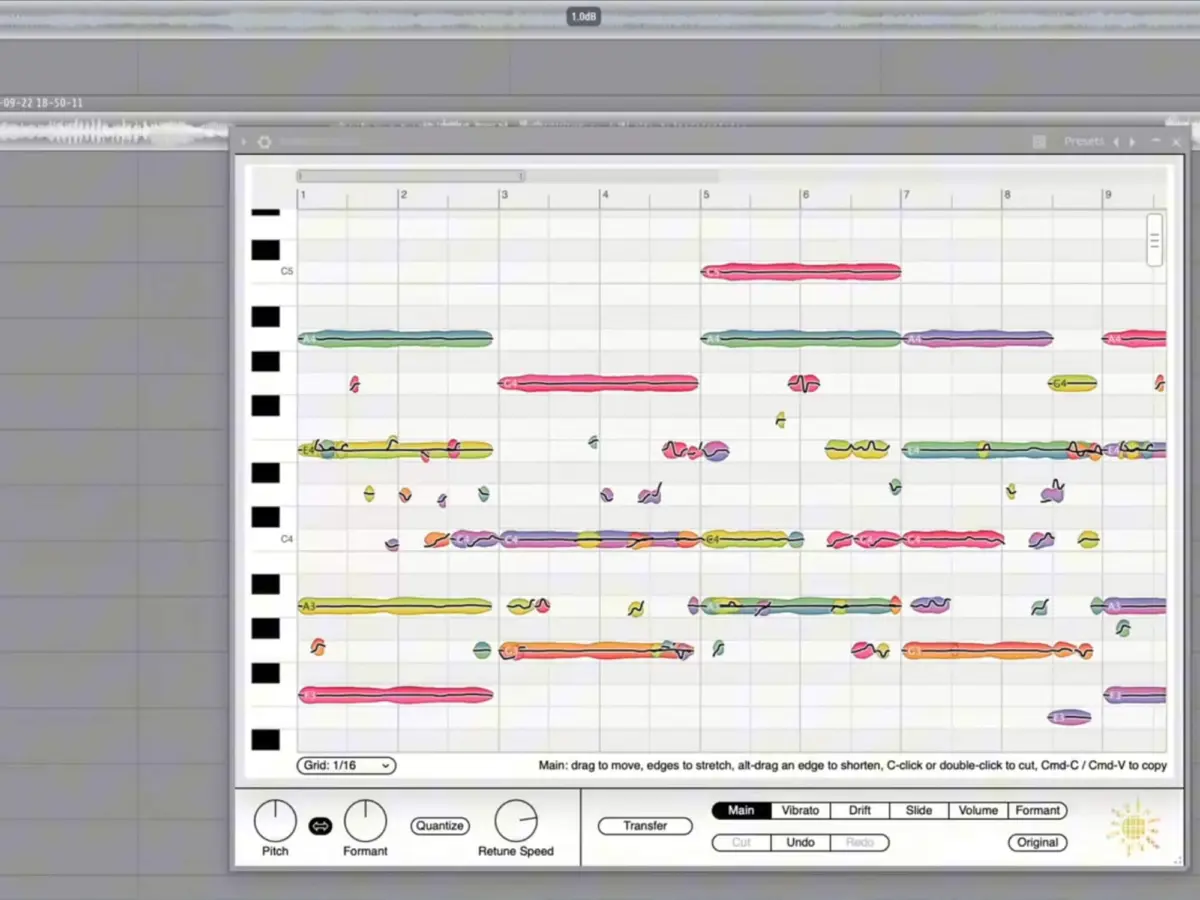
When Bubblegum is instantiated on an audio track within a DAW, it does not immediately display editable data. Instead, users must utilize the plugin’s integrated Transfer function. By playing back the DAW project in real-time, Bubblegum records and analyzes the incoming audio stream, breaking it down into distinct spectral components.
Once captured, the audio is displayed graphically on a familiar piano-roll-style interface. Here, detected notes appear as discrete, movable blocks or shapes superimposed over a vertical pitch grid and horizontal time axis. This visual paradigm—pioneered by Melodyne—instantly demystifies audio editing. Producers do not need to rely solely on their ears or destructive cut-and-paste editing; they can literally see the notes they played or sang, allowing for surgical visual precision.
2. Polyphonic Note Manipulation
The crown jewel of Bubblegum’s feature set is its polyphonic capability. While many entry-level or free pitch-shifters are strictly monophonic—meaning they break down completely or generate horrific digital glitches when fed chords, polyphonic synthesizers, or multi-voiced acoustic guitar recordings—Bubblegum can analyze and separate simultaneous frequencies within a single audio file.
This means a producer can take a recorded chord progression (e.g., a complex jazz guitar voicing or a polyphonic synth pad), drop it into Bubblegum, and isolate an individual internal note within a chord. Users can drag that specific note upward or downward to alter the chord’s harmony (e.g., turning a major triad into a minor one or adding a chromatic tension), reposition it earlier or later in time, or extend its duration, all without re-recording the performance.
3. Comprehensive Editing Modes and Global Controls
Beyond basic note-dragging, Bubblegum provides a robust suite of tools designed to refine performances down to the micro-level. The plugin organizes its advanced parameters into six distinct editing modes:
- Main Mode: Used for standard note repositioning, pitch-shifting, and duration stretching.
- Vibrato Mode: Allows producers to modulate or tame the natural pitch oscillation of a performance.
- Drift Mode: Controls subtle, gradual pitch deviations that occur naturally over the sustained lifespan of a note.
- Slide Mode: Manages the pitch transitions and portamento between disconnected notes.
- Volume Mode: Grants independent gain control over individual notes, effectively functioning as a built-in clip-gain or automated volume shaper for specific audio segments.
- Formant Mode: Adjusts the spectral envelope (formants) of the audio independently of its pitch, preventing the infamous "chipmunk effect" when shifting vocals or instruments upward.
In addition to these granular controls, Bubblegum features global utility functions. A Quantize button snaps detected pitches instantly to the nearest musical semitone, providing an immediate starting point for aggressive pitch correction. Furthermore, global Pitch and Formant knobs allow producers to shift the entire recorded performance collectively, bypassing the need to select individual notes for macro-transpositions.
Supporting Context & Market Metrics: The Democratization of Pitch Correction
Bubblegum does not exist in a vacuum. Its arrival coincides with a broader, unmistakable industry trend: the dismantling of high-cost barriers for essential production utilities. To understand the significance of Bubblegum’s release, one must examine the current economic climate of the audio software market and recent moves by major commercial competitors.
The Shifting Economics of Audio Software
For over two decades, professional pitch correction carried a heavy financial tax. Studios routinely invested hundreds of dollars into software licenses, hardware iLok dongles, and recurring upgrade plans. For bedroom producers, lo-fi beatmakers, and teenage creators operating on zero budgets, accessing these tools legally meant either saving for months or resorting to compromised alternatives.
However, market forces have begun to pivot. The rise of subscription models (such as Avid’s Pro Tools pricing tiers, Splice rent-to-own, and Plugin Alliance bundles) has changed cash flow dynamics, but subscriptions also introduce subscription fatigue among consumers. Consequently, the freeware market has experienced a Renaissance. Independent developers, empowered by modern programming frameworks and compiled audio libraries (like JUCE), are increasingly capable of building professional-grade tools that rival commercial offerings.
The Industry Response: Auto-Tune Go and FL Studio
The pressure to democratize pitch correction is further evidenced by moves from industry heavyweights. Recently, Antares partnered with Image-Line to integrate AutoTune Go directly into FL Studio, making real-time vocal tuning accessible even to users on the free tier of FL Cloud.
While this move illustrates a parallel push toward accessibility, it is crucial to note the fundamental workflow difference between tools like AutoTune Go and Bubblegum:
- AutoTune Go is primarily optimized for real-time, automated, or latency-free pitch correction, traditionally favored for transparent tuning or stylized robotic effects (the classic "T-Pain" sound).
- Bubblegum, conversely, mirrors the offline, graphical, note-by-note editing paradigm of Melodyne. It is designed for forensic, surgical manipulation of audio after it has been recorded.
By offering a free graphical polyphonic editor, Bubblegum fills a specific niche that automated real-time pitch correction simply cannot address. It hands the producer a virtual scalpel rather than a paintbrush.
Future Outlook: What Bubblegum Means for Independent Development
As Bubblegum gains traction across global music production forums, YouTube creator channels, and Reddit communities, it prompts critical questions about the future of music software development.
The Rise of the Solo Developer
In an industry historically dominated by massive corporations with extensive marketing budgets and bureaucratic development cycles, the success of Your Smile is Art highlights the incredible power of the solo developer. Armed with deep domain knowledge, a clear understanding of user frustrations, and modern software libraries, individual creators can ship products that challenge established corporate paradigms.
As AI-assisted coding, improved open-source DSP frameworks, and community-funded models continue to evolve, we can expect to see more boutique developers releasing specialized, high-end plugins for free or nominal donations. This decentralization of software engineering forces legacy companies to reconsider their pricing strategies, update stagnant user interfaces, and justify their high price tags.
Limitations and Room for Growth
While Bubblegum is a technological triumph for a free plugin, it is important to maintain realistic expectations regarding its feature set compared to commercial flagships like Melodyne Studio. Bubblegum does not feature ultra-advanced multi-track polyphonic editing (where multiple tracks interact contextually), nor does it possess the deep algorithmic machine-learning separation tools found in modern stem-separation software.
Furthermore, because the Linux version remains in beta, and minor edge cases in transient detection can occasionally require manual cleanup, users transitioning from high-end commercial suites may notice occasional workflow friction. However, these minor drawbacks pale in comparison to the plugin’s core value proposition. For ninety percent of bedroom producers, indie rock bands, and electronic musicians looking to fix a bum note in a vocal harmony or tweak a complex chord inversion, Bubblegum delivers ninety percent of the utility of a multi-hundred-dollar plugin for exactly zero dollars.
Conclusion
Bubblegum by Your Smile is Art is much more than a clever pun or a temporary novelty. It is a milestone in the ongoing democratization of music production technology. By successfully engineering a graphical, polyphonic, note-level pitch and time editor and distributing it entirely for free, M Fusina has lowered the barrier to entry for professional-grade audio editing.
In a market where aspiring producers are constantly bombarded with expensive subscriptions, upgrade fees, and restrictive digital rights management (DRM) schemes, Bubblegum serves as a breath of fresh air. It proves that innovation, utility, and generosity can still intersect within the audio software community. Whether you are an established mixing engineer looking for a lightweight note editor or a beginner experimenting with vocal tuning and chord manipulation for the very first time, Bubblegum is an indispensable addition to your plugin folder.
Bubblegum is available for immediate download as a VST3 and AU plugin for Windows and macOS (with a Linux beta available) via the official Your Smile is Art website, operating on a free-to-download model with optional user donations.