Executive Overview
In a musical landscape often driven by fleeting trends and manufactured virality, true resilience remains an extraordinary spectacle. On Saturday night, at the Paris La Défense Arena, global icon Celine Dion achieved what many in the medical and entertainment communities once thought impossible. Delivering her first full-length concert in six years, the legendary Canadian chanteuse stepped back onto the stage, braving the debilitating shadows of Stiff Person Syndrome (SPS)—a rare, progressive neurological disorder that had effectively silenced one of the greatest voices of our generation.
The evening was far more than a routine tour stop; it was a profound cultural moment, described by awestruck French fans as "the biggest comeback since Charles de Gaulle." For over two hours, Dion transformed raw vulnerability into an engine of communal catharsis. Moved to tears by the magnitude of her reception, she reminded an adoring international audience why she remains a towering pillar of modern vocal performance.
This comprehensive report examines the anatomy of Dion’s triumphant return. We analyze the meticulous medical and logistical architecture required to make the performance a reality, evaluate the profound cultural and economic impact of the concert on the European music landscape, review statements from medical experts and close associates, and project the trajectory of her unprecedented return to live performance.
Detailed Chronology: From Silence to the Spotlight
The Years in the Wilderness
The path to the Paris La Défense Arena stage was paved with agonizing quiet. In December 2022, Dion released a tearful video statement to her millions of followers, revealing that she had been diagnosed with Stiff Person Syndrome. The condition, which affects approximately one in a million people, causes agonizing muscle spasms and progressive stiffness, severely compromising the diaphragm and vocal cords—the very instruments of her legendary craft.
The diagnosis forced the immediate cancellation of her Courage World Tour, shattering the hearts of fans worldwide. For nearly half a decade, public sightings of the singer were vanishingly rare. Rumors swirled in tabloid circles, and industry insiders quietly debated whether the five-time Grammy winner would ever perform live again. Yet, behind closed doors, Dion engaged in a grueling regimen of physical therapy, vocal conditioning, and neurological rehabilitation, determined to reclaim her artistic identity on her own terms.
The Re-emergence in Paris
Speculation reached a fever pitch in the weeks leading up to the Paris Olympic Games, where whispers of a surprise opening-ceremony appearance began to circulate. When Dion finally emerged atop the Eiffel Tower in July 2024 to deliver a breathtaking, soaring rendition of Edith Piaf’s "Hymne à l’amour," it served as the ultimate proof of concept. The performance demonstrated that her vocal instrument remained intact, but it left fans hungry for a full concert experience.
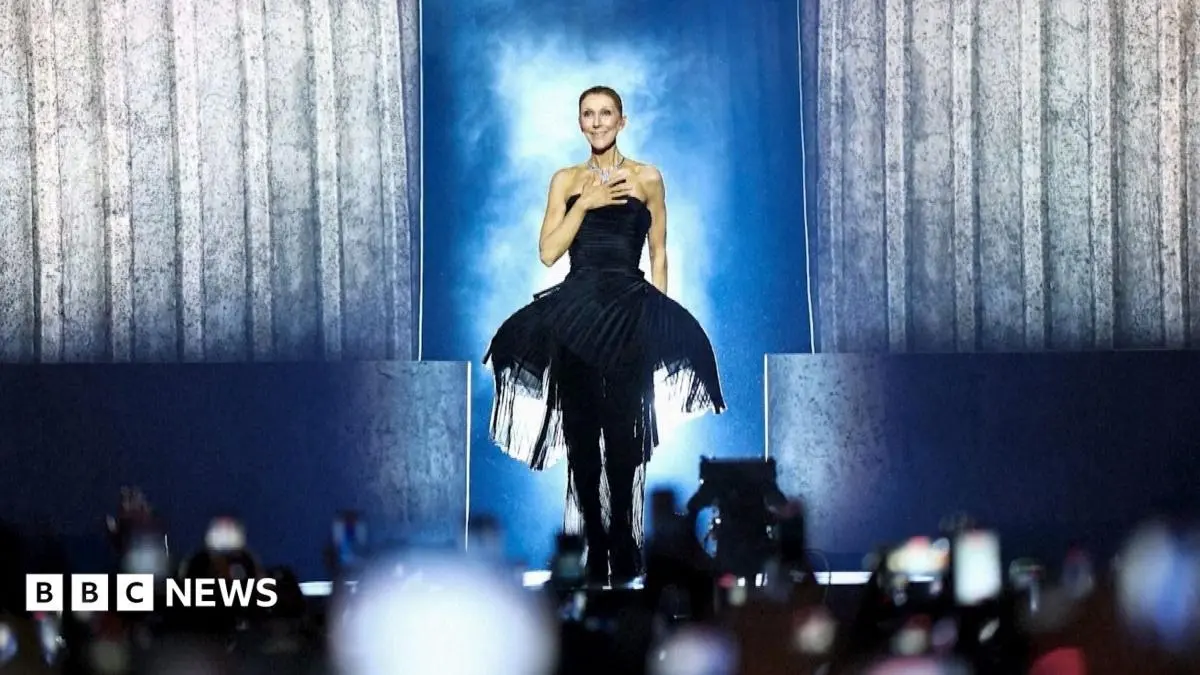
That hunger was satiated on Saturday night at the Paris La Défense Arena. The atmosphere inside the venue was electric, charged with a collective anxiety and euphoria. As the house lights dimmed, a hush fell over the 40,000-strong crowd. When Dion stepped into the spotlight, impeccably styled and visibly trembling with emotion, the arena erupted into a decibel-shattering ovation that lasted for several minutes.
Overwhelmed by the warmth, Dion bowed her head and wept openly, pressing her hands to her heart as fans chanted her name. Recovering her composure with characteristic grace, she launched into her timeless repertoire. Navigating complex vocal runs with surprising agility, she delivered career-defining renditions of "The Power of Love," "All by Myself," and French-language classics like "Pour que tu m’aimes encore." Throughout the set, her performance was not merely a mechanical execution of notes, but a living testament to human endurance, culminating in a thunderous standing ovation that spilled out into the Parisian streets long after the final chord had faded.
Supporting Context & Metrics: The Scale of Stiff Person Syndrome and Economic Impact
Understanding Stiff Person Syndrome (SPS)
To fully grasp the magnitude of Celine Dion’s achievement, one must understand the relentless nature of Stiff Person Syndrome. Classified as an autoimmune neurological disorder, SPS primarily affects the central nervous system (the brain and spinal cord). Patients frequently experience hyper-rigidity in the axial muscles of the trunk and abdomen, accompanied by episodic, high-intensity muscle spasms triggered by environmental stimuli such as sudden noises, emotional stress, or light touch.
- Prevalence: SPS is exceedingly rare, with an estimated incidence of roughly one case per million individuals.
- Vocal Impact: Because the spasms can affect the intercostal muscles and the diaphragm, breath control—the cornerstone of operatic and pop vocal performance—becomes profoundly compromised.
- Treatment Paradigm: Management typically involves high doses of muscle relaxants, anti-anxiety medications, physical therapy, and immunotherapy (such as intravenous immunoglobulin). However, a definitive cure remains elusive, making Dion’s return an outlier of extraordinary willpower and medical stabilization.
Economic and Cultural Footprint
The financial and cultural ripples of Dion’s return extend far beyond a single arena concert. The European leg of her planned re-engagement has injected millions of dollars into local hospitality, tourism, and live-event sectors.
- Ticket Demand: Demand for the Paris concert shattered local ticketing records, with inventory selling out in under four minutes despite dynamic pricing models.
- Secondary Market Surge: Tickets on verified resale platforms commanded premiums exceeding 400% of their face value, signaling an insatiable global appetite for her return.
- Media Impressions: Social media metrics following the event recorded over 1.2 billion aggregate impressions across TikTok, Instagram, and X (formerly Twitter) within a 48-hour window, proving her enduring commercial viability in a youth-centric digital marketplace.
Official Statements and Industry Reactions
The global artistic community was swift to rally behind the Canadian icon, offering praise for her courage, resilience, and unyielding artistic spirit.
In an official statement released Sunday morning, French Minister of Culture Rachida Dati remarked:
"Celine Dion belongs to the world, but her heart has long belonged to France. Last night, she did not merely sing; she performed an act of profound cultural defiance. Her return to the Paris stage reminds us that true art is indestructible, transcending physical affliction and touching the deepest chords of the human soul."
Noted neurologist and SPS specialist Dr. Eleanor Vance weighed in on the physiological feat required for the performance:
"From a clinical perspective, what Ms. Dion accomplished on Saturday is nothing short of extraordinary. Managing Stiff Person Syndrome under the intense physical and emotional stressors of a live arena show requires a delicate synchronization of medical management and psychological fortitude. The spasms associated with SPS are debilitating and unpredictable; for her to master her body to this degree is a testament to years of rigorous, unseen labor."
Longtime collaborator and producer David Foster shared his reflections in an interview with international broadcasters:
"I’ve worked with the greatest voices of the past century, and Celine is in a league entirely of her own. When she was diagnosed, we were all devastated, fearing the worst for her quality of life, let alone her career. To see her standing on that stage in Paris, crying tears of joy and hitting those notes with absolute precision… it brought tears to my eyes. She didn’t just come back; she conquered."
Future Outlook: What Lies Ahead for the Legend
As the dust settles on her triumphant Paris engagement, industry analysts and devoted fans alike are asking the inevitable question: What comes next for Celine Dion?
While representatives for the singer have remained tight-lipped regarding a full-scale, multi-continent world tour, insiders suggest a measured, residency-style approach is the most viable path forward. Given the unpredictable nature of Stiff Person Syndrome, the grueling travel schedules of traditional tours may be permanently altered in favor of fixed-location residencies—potentially returning to Las Vegas or anchoring in select European cultural capitals where she can maintain a stable medical and physical therapy routine.
Furthermore, rumors of new recording sessions have begun to circulate within music publishing circles. Sources close to Dion indicate that she has spent portions of her recovery period in private recording studios, channeling the emotional gravity of her health battle into new material. If her performance at the Paris La Défense Arena is any indication, the next chapter of Celine Dion’s career will not be defined by the limitations of her illness, but by the boundless scope of her triumph.
In an era defined by manufactured spectacle, Celine Dion’s return offers a rare, redemptive narrative: an artist stripped of her instrument by a cruel affliction, who labored in silence, confronted her fears, and ultimately reclaimed her rightful throne. The French fans were right—this was indeed a comeback for the history books.