The resurgence of 1980s aesthetics in contemporary music production shows no sign of slowing down. For the third consecutive month, sound designers and electronic music producers are looking back to the golden era of synthetic sound—not out of tired imitation, but because modern software developers are continually finding fresh ways to bridge vintage nostalgia with forward-thinking design. In this edition of Synth Secrets, we investigate Zebra 3, the latest long-awaited incarnation of u-he’s legendary modular synthesizer.
Long celebrated among professional sound designers for its bottomless depth, flexible architecture, and unmistakable sonic character, Zebra 3 elevates the platform’s legacy. Among its most revolutionary additions are the new Modal modules, which introduce true physical modeling into a synth framework historically dominated by additive, subtractive, and phase distortion methods.
To demonstrate the sheer power of this physical modeling engine, this guide walks through a step-by-step masterclass on turning a simple, uninspiring burst of white noise into a dancefloor-ready, percussive tech-house arpeggio. Currently available in public beta, Zebra 3 offers producers a glimpse into the future of sound design. Here is an exhaustive breakdown of how its physical modeling engine works, how to harness the Multi-Step Envelope Generator (MSEG), and how to layer models to build rich, organic rhythms.
Detailed Chronology: Tracing the Evolution of Tuned Percussion
The 1980s Explosion of Tuned Percussion
To truly appreciate what u-he has achieved with Zebra 3’s Modal modules, we must look backward to the sonic landscape of the 1980s. From the pristine pop arrangements of Madonna and Gloria Estefan to iconic cinematic soundscapes like Predator and Romancing the Stone, the decade was defined by a sudden, massive explosion of marimba-esque, tuned percussive sounds.
The catalyst for this shift was straightforward: the mainstream commercial adoption of Frequency Modulation (FM) synthesis and digital sampling. While analog subtractive synthesizers excel at generating warm, fat pads, aggressive basslines, and sweeping leads, they are historically poor at replicating real-world acoustic phenomena. Striking a solid object—such as a hollow piece of wood, a metal pipe, or a glass bell—produces a dense, cascading web of resonant frequencies, comprising both harmonic and complex inharmonic overtones.
The Technological Leap: From FM to Physical Modeling
FM synthesis brought producers significantly closer to these metallic and wooden timbres by allowing complex carrier-modulator relationships to build intricate overtone structures. Similarly, digital sampling provided a static, playable snapshot of acoustic instruments.
However, both approaches have limitations. Sampling lacks organic variation, while FM programming can quickly become an exercise in mathematical trial and error.
Enter u-he’s Zebra 3 and its brand-new Modal modules. Rather than relying on simple sample playback or standard wavetable synthesis, these modules employ genuine physical modeling to calculate the acoustic resonances of real-world materials in real time. The results are nothing short of breathtaking, bridging the gap between synthesized electronica and acoustic realism.
To showcase the power of Zebra 3, we constructed a minimal tech-house percussive arpeggio entirely from a basic noise source. (Note: Zebra 3 is currently in a public beta phase; producers can access the installer and beta license via the official KVR Audio community forums).
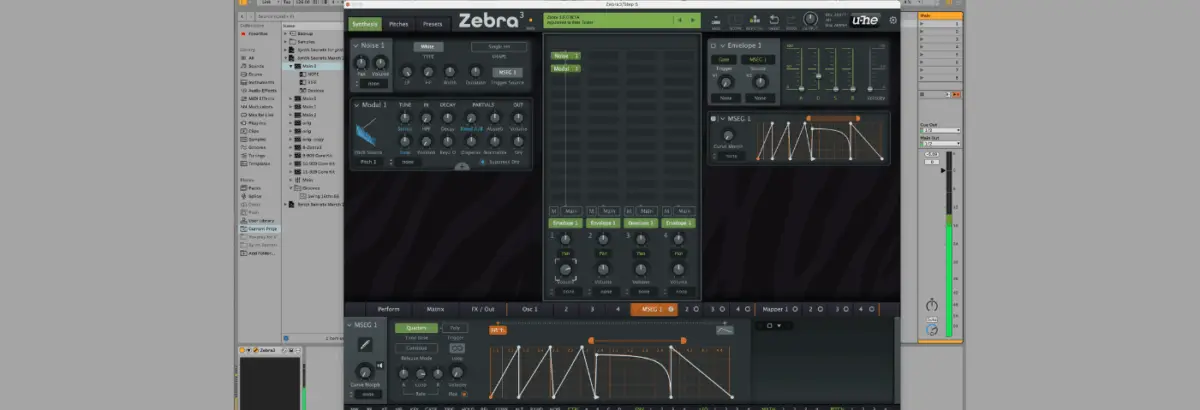
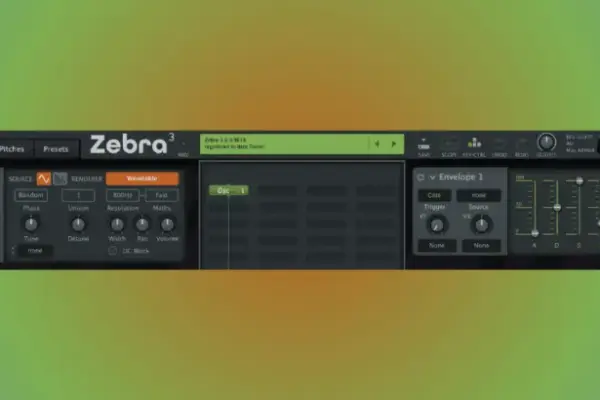
Fire up Zebra 3 inside your DAW, initialize an empty patch (INIT preset), and navigate to the centre routing panel. Remove the default oscillator and replace it with a Noise 1 module.
Configure your amplitude envelope (Envelope 1) with the following parameters:
Attack: 0 ms
Decay: ~400 ms
Sustain: 0
Release: 0 ms
Draw in a single, one-bar MIDI note on C2 in your piano roll. Change the Noise Shape parameter to Single Hit. When you trigger the note, you will hear a tight, aggressive volume envelope profile that mimics a drumstick striking a hard physical surface.
Step 2: Introducing the Modal 1 Module
Directly downstream from your noise source, insert a Modal 1 module. This processing block calculates realistic physical resonances using the dynamic volume profile generated by the white noise.
Activate the Suppress Dry toggle to strip away the raw noise signal, leaving only the generated physical resonances. Upon playback, the output immediately transforms into a tuned percussion drum. Listen closely, and you will notice subtle, organic micro-variations between successive hits—a hallmark advantage of physical modeling over static sampling.
Step 3: Applying Physical Models ("Punched Can")
While the sound at this stage resembles a tuned synthetic drum, it lacks the tactile realism of a physical object. To infuse genuine acoustic properties, click the small + symbol to reveal the two modeling slots: A and B.
Zebra 3 allows producers to load distinct physical models into both slots and continuously crossfade or modulate between them. For this patch, load the "Punched Can" model into Slot A. Instantly, the patch transforms from a sterile synthetic hit into a convincing, metallic physical object.
Step 4: Deconstructing Envelope and Source Relationships
To fully grasp the relationship between the noise oscillator and the Modal module, temporarily switch the Noise Shape back to Constant.
This comparison reveals a vital design principle: while the harmonic tonality and resonances are governed entirely by the Modal module, the rhythmic volume envelope and transient characteristics are dictated by the source sound. While a constant noise source can sound hyper-realistic in certain contexts, it strips away direct control over the percussive envelope. Switch the noise shape back to Single Hit to retain precise rhythmic control.
Step 5: Constructing Rhythmic Patterns with the MSEG
Zebra 3’s deep modulation architecture shines brightest when paired with its Multi-Step Envelope Generator (MSEG).
Set your project tempo to 126 BPM.
For timing and mixing reference, drop standard 909 kick and hat audio files into your session (909_Kick.wav and 909_Hat.wav).
Open the MSEG window inside Zebra 3.
Change the Trigger Source for both the Noise and Envelope modules from standard Gate to MSEG to lock them to the step generator.
Draw in a skippy, forward-driving rhythmic pattern, incorporating a looping section at the end of the phrase for added kinetic energy.
Acoustic Note: Setting a release time of 0 introduces a deliberate click at the tail-end of the pattern. When auditioned solo, this may sound harsh, but when contextualized alongside a heavy four-on-the-floor kick drum, the click acts as an organic transient transient-layer, sharpening the overall groove.
Step 6: Crafting Melodic Riffs via the Mapper Module
To elevate our static rhythm into a melodic hook, we utilize Zebra 3’s Mapper module:
Duplicate your synth channel so you have two independent tracks.
On the primary channel, right-click (or Ctrl-click) the Modal 1 Tuning parameter and assign Mapper 1 as the modulation source.
Access the Mapper settings within the Modal module and set the tune modulation depth to 16.
The Mapper now dictates the pitch relationships of the physical model across the sequence, instantly generating a complex melodic motif from a single white noise source.
Step 7: Adding Industrial Weight with Layering ("Metal Bowl")
To give the patch professional weight and width, duplicate your track once more, giving you a total of three parallel channels. On this third copy, focus exclusively on the Modal module settings:
Select the Metal Bowl physical modeling preset.
Disable Suppress Dry.
Set Tune to +12, and configure the tuning range to -24.
Push Position to 100, reduce Decay to 19, and pull Dispersal down to 0.
Apply a Stereo Tune value of 32 cents.
The resulting patch delivers a clackety, aggressive, and powerfully driving sonic character that cuts straight through a dense mix.
Step 8: Complex MIDI Interplay and Final Assembly
To maximize the patch’s potential, load a complex MIDI file—such as a busier rhythmic pattern featuring layered notes and varied durations—across all three Zebra channels.
Varying the note lengths actively triggers the loop points within the physical modeling architecture in unique ways. Panning the three parallel layers across the stereo field and automating the Sustain and Release parameters yields a rich, evolving percussive landscape. The transformation from an unshaped burst of white noise into an intricate, polyrhythmic masterclass underscores the immense power packed into Zebra 3’s public beta.
Official Statements & Industry Impact
The announcement and subsequent public beta rollout of Zebra 3 have sent ripples through the electronic music production community. Speaking on the integration of physical modeling, u-he’s development team emphasized a commitment to breaking away from digital emulation toward true acoustic generation:
"With Zebra 3, our goal was never simply to recreate the past. Synthesizers like Zebra have always been defined by their limitless modular architecture. By introducing the Modal modules, we are offering sound designers a canvas where physical properties behave with organic unpredictability—turning mathematics into tangible, striking materials."
Industry early adopters have similarly praised the synth’s CPU efficiency and the seamless bridge it builds between sound design experimentation and functional production utility.
Future Outlook
As Zebra 3 moves through its public beta lifecycle toward a commercial release, its impact on film scoring, electronic music production, and sound design is expected to be profound. By lowering the barrier to entry for complex physical modeling—traditionally an esoteric and computationally heavy branch of synthesis—u-he has democratized the creation of hyper-realistic acoustic textures.
Producers looking to inject organic life, vintage character, and forward-thinking sound design into their DAW templates would do well to download the Zebra 3 public beta, grab a license card via KVR Audio, and start experimenting with noise and physical models today.