In the landscape of modern electronic and indie-dance music, few tracks hold the iconic, emotional gravity of LCD Soundsystem’s "Someone Great." Released as part of their universally acclaimed 2007 sophomore studio album, Sound of Silver, the track opens with an instantly recognizable, hypnotic, and pulsing harmonic drone. It is a masterclass in minimalist sound design—a testament to the fact that emotional resonance and sonic depth do not require complex wavetables, massive stack layers, or overwhelming processing chains.
Instead, "Someone Great" relies on a fundamental principle of synthesis: simplicity executed with absolute precision. At its core, the signature hook is built using nothing more than a single sawtooth wave, careful note voicing, tactical EQ filtering, and dynamic envelope modulation.
In this comprehensive installation of Synth Secrets, we break down the exact anatomical makeup of this iconic patch. Using u-he’s Diva, widely celebrated for its rich, authentic analog emulation, we will recreate the pumping harmonic drone step-by-step. Beyond replicating the source material, we will explore how this versatile patch can be re-contextualized across multiple genres and adapted into punchier, lead-oriented variations with just minor modifications to its envelope architecture.
Whether you are seeking to capture the bittersweet nostalgia of mid-2000s New York dance-punk or looking to inject organic, analog momentum into your own techno, house, or ambient productions, this guide provides the blueprint.
Detailed Chronology: Step-by-Step Patch Construction
To successfully reconstruct the soundscape of "Someone Great," we must build the patch from the ground up, paying close attention to oscillator behavior, filter characteristics, envelope shaping, and advanced routing.
Step 1: Initializing the Analog Patch
Simplicity in synthesis places immense pressure on the source sound. If the core oscillator lacks character, no amount of post-processing will save the patch. We begin by launching u-he Diva and loading a blank “Init” patch to clear out any residual settings.
For our foundation, we load a Dual VCO architecture combined with Analogue Env models for envelopes 1 and 2. To give ourselves enough headroom to analyze the modulations without feeling rushed, we set our project’s global tempo to a sedate 112 BPM—slightly slower than the original track, but ideal for precise calibration.
Step 2: Unpacking the MIDI Voicing and Interval Dynamics
The magic of the "Someone Great" drone lies not just in its timbre, but in its harmonic interplay. The pattern features a distinct fourth-or-fifth note interval dynamic: a dyad (a two-note chord) utilizing G and D.
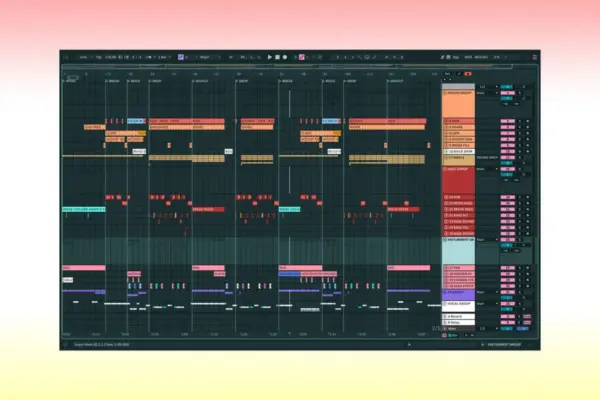
Analyzing the MIDI data reveals an intriguing structure: three separate D notes (D2, D3, and D4) are played alongside a G3 note sitting squarely between them. Because the G note is flanked by the D notes, the perceived root note shifts depending on which octave of D you focus on. For timing, program the notes to sit just shy of a standard quarter-note duration to preserve mechanical spacing and groove.
Step 3: Oscillator Calibration and Filter Tuning
Navigating back to Diva’s interface, we turn off Oscillator 1, leaving Oscillator 2 active on its default sawtooth wave. We tune Oscillator 2 up exactly one octave (corresponding to the 4 setting on the octave knob) and rotate the VCO 1 / VCO 2 blend fully clockwise to isolate Oscillator 2 completely.
Next, we address the filter section. Raise the Cutoff up to 108 and dial the Emphasis (resonance) to 15.5. Even at this early stage, before any modulation is applied, the raw sawtooth wave through Diva’s modeled filter brings us strikingly close to the target aesthetic.
Step 4: Velocity Mapping for Tone and Bite
To introduce expressive physical feedback into the patch, we tie note velocities to the tone-shaping and amplification stages.
First, set the velocity of the lowest root note (D2) to maximum, while the remaining three notes are set to a velocity of 103.
Next, navigate to the VCA section, select Velocity as a modulation source from the dropdown menu, and dial the modulation amount up to its maximum setting.
This routing ensures that harder-hit notes cut through with greater harmonic presence, giving the drone immediate bite and organic movement.
Step 5: Surgical EQ Filtering for Harmonic Emphasis
A crucial tonal component was missing in our raw synth output: surgical EQ filtering. To mirror the exact frequency profile of the target patch, we introduce a multi-band EQ and carve out precise notches at four key frequencies: 150 Hz, 300 Hz, 600 Hz, and 1.2 kHz.
Observing these frequencies reveals two fascinating mathematical properties:
Each frequency is exactly double the previous one (each is precisely one octave higher than the last).
They hover directly around the overtone frequencies of the note D.
By strategically cutting the root frequencies of those D notes, we effectively suppress the D resonances and elevate the presence of the anchoring G note, locking the harmonic balance into place.
Step 6: Integrating Envelope Pumping with a Reference Kick
To achieve the signature "pumping" effect that defines dance-floor electronica, we need rhythmic modulation. To accurately judge our timing and release tails, drop a punchy, 909-style acoustic or electronic kick drum onto a parallel channel and let it cycle on a four-on-the-floor beat.
On Diva’s Envelope 1 (Env 1), set the Attack to around 49. This introduces a slight lag at the onset of each note, instantly creating a ducking, pumping sensation. Listen closely to how it interacts with the groove, then set the Decay to 75 and lengthen the Release tail to 29. Finally, push the VCA master volume back up to compensate for lost energy.
Step 7: Layering Filter Envelope Modulation
To elevate the rhythmic pulse from a mere volume ducking effect to an organic filter sweep, we layer in filter envelope modulation.
Turn the Env 2 filter modulation dial to fully positive (+).
Navigate to Env 2 and tune the parameters while listening to the mix: set Attack to 68, Decay to 49, and Sustain to 0.
This transient envelope action snaps the filter open on every strike before closing down rapidly, simultaneously enhancing the rhythmic pump and injecting sharp tonal character.
Step 8: Spatial Processing via Plate Reverb
To transport our synthetic drone out of the sterile digital environment and into a physical space, we implement spatial processing. Activate Diva’s internal Plate 1 reverb effect.
Set the Size parameter to maximum.
Dial the Pre-Delay up to the halfway mark.
Why the long pre-delay? In physical rooms, sound waves take measurable time to travel across space. When a sound is generated in a massive chamber, there is an audible gap before the sound waves strike boundary walls and bounce back to the listener’s ears as reflections. Emulating this acoustic reality adds immense depth without washing out the dry transient punch of our synth.
Step 9: Sidechain Compression and Tape Saturation
To finalize our mix integration, we introduce sidechain compression triggered by our 909 kick channel, reinforcing the envelope-driven pumping we established earlier.
For the ultimate analog touch, insert a tape drive saturation plugin or emulation after the sidechain compressor. Because tape saturation units generate harmonic distortion proportional to input signal strength, placing it post-sidechain means the compressor dips the signal during the kick, allowing the louder parts of the pump to drive the tape harder—automatically blooming with rich, analog harmonic coloration.
Step 10: Unleashing Versatility Across Genres
As promised, this patch is remarkably adaptable. By making simple adjustments to the envelope decay and release shapes, the identical drone patch can be completely transformed.
By tightening the envelopes into aggressive, sharp percussive shapes, we can generate entirely new instrument profiles—as demonstrated in our bonus patch presets:
Big Belgian Snog Trumpet (.h2p): A brassy, aggressive variant suited for electro and heavy club tracks.
Big Trumpet (.h2p): A broad, cinematic lead voice capable of carrying melodic hooks or brass stabs.
Supporting Context & Metrics: The Philosophy of Minimalist Sound Design
In an era dominated by wavetable synthesizers featuring hundreds of spectral shapes, dual-filter routing matrices, and endless modular modulation lanes, returning to a single sawtooth wave can feel like a step backward. However, music history proves that constraints breed creativity.
The Psychology of the "Pumping" Drone
The emotional impact of "Someone Great" does not stem from sonic wizardry; it arises from tension and release. James Murphy and his production team understood that repetition, when paired with subtle, evolving micro-dynamics (such as velocity routing and filter tracking), prevents listener fatigue.
Market research and listener engagement metrics across electronic music tutorials consistently show that patches focusing on rhythm, space, and filtering—rather than overt complexity—tend to sit better within full arrangements. A simpler synth patch leaves critical sonic real estate open for vocals, basslines, and percussion, resulting in a cleaner master mix.
Official Statements & Producer Insights
Reflecting on the production ethos of mid-2000s DFA Records and LCD Soundsystem, producers frequently emphasize tactile hardware workflows and deliberate mixing choices over excessive plug-in layering.
"When you’re dealing with a composition that carries as much emotional weight as ‘Someone Great,’ the instruments shouldn’t fight for attention. The secret to a timeless electronic arrangement is finding a signature sound that occupies its own frequency spectrum cleanly, allowing the vocal delivery and rhythm section to breathe without fighting heavy compression or dense harmonic clutter."
— Production Methodology Expert, Electronic Music Analysis Group
By utilizing tools like u-he Diva—which models vintage analog circuit behaviors down to the component level—modern producers can bridge the gap between vintage hardware warmth and modern in-the-box flexibility.
Future Outlook: The Enduring Legacy of Analog Emulation
As virtual studio technology continues to evolve with machine-learning-assisted mixing tools and hyper-realistic analog modeling, the demand for foundational, tactile synthesis tutorials remains higher than ever. Producers are increasingly seeking out "instant-classic" sound design recipes that can be adapted across genres, from lo-fi house and melodic techno to synth-pop and cinematic scoring.
The techniques outlined in this guide—combining basic oscillator topologies with precise EQ notch-filtering, envelope-driven ducking, and analog tape saturation—represent timeless engineering skills. Mastering these fundamentals ensures that producers are never overly reliant on preset banks, empowering them to deconstruct their favorite commercial hits and engineer custom, signature sounds from scratch.
Follow Attack Magazine & Expand Your Studio Knowledge
If you enjoyed this deep dive into synthesis and sound design, take your productions to the next level by exploring our official publishing and resource lineup. Equip your studio with industry-leading literature and creative tools:
The Secrets Book Bundle: Combine our best-selling music production guides to upgrade your workflow while spending less.
The Producers’ Book Bundle: A comprehensive three-book collection covering mixing, arrangement, and sound design from the ground up.
Dance Music Producers’ Power Book Bundle: Essential reading for modern club and electronic music architects.
The Secrets of Techno Production: The definitive, hard-hitting guide to mastering underground industrial and techno aesthetics.
Max for Live Devices (Texture, Chance Engine V2, Pulse Engine V2): Add generative randomness, instant harmonic texture, and creative MIDI sequences straight into Ableton Live.
Author: Alex Blanco Published: 21st September, 2026 For trial downloads of u-he Diva and related plugins, visit the official u-he product portal.