Executive Overview
Few cinematic equations are as fraught with peril as the sci-fi sequel. To follow a masterclass in claustrophobic terror like Ridley Scott’s 1979 masterpiece, Alien, is a formidable undertaking. Yet, when James Cameron unleashed Aliens in the summer of 1986—seven years after the original film’s debut—he did not simply attempt to replicate lightning in a bottle. Instead, he forged an entirely new atmospheric pressure.
Rather than chasing the low-grade industrial dread and solitary monster-movie pacing of Scott’s original vision, Cameron pivoted outward. He transformed the intimate haunted-house-in-space premise into a high-octane, militarized epic of survival, introducing audiences to a terrifying swarm of extraterrestrial horrors.
Now, nearly four decades later, Aliens securely maintains its rank among that rare echelon of cinematic follow-ups—such as The Godfather Part II, The Empire Strikes Back, and Terminator 2: Judgment Day—that not only stand shoulder-to-shoulder with their predecessors but, in the eyes of many critics and fans, occasionally surpass them. By shifting the generic framework from atmospheric horror to a visceral, high-tech war film, Cameron redefined what a franchise could achieve, blending pulse-pounding action with scathing corporate satire, feminist action iconography, and acute socio-political commentary that remains strikingly relevant today.
Detailed Chronology: From ‘Perfect Movie’ Hesitation to Blockbuster Triumph
To understand the monumental achievement of Aliens, one must trace the trajectory of its creation, marked by early hesitation, bold creative pivots, and a calculated collision of contrasting directorial styles.
The Reluctant Auteur
When 20th Century Fox first approached James Cameron about helming a follow-up to Alien, the young director was initially hesitant. Fresh off the production of The Terminator, Cameron regarded Scott’s 1979 film as a "perfect movie." He understood the profound risk of stepping into such massive shoes; attempting a direct stylistic carbon-copy would inevitably invite unfavorable comparisons and diminish the singular magic of the original.
However, recognizing the commercial potential and creative latitude the studio was willing to offer, Cameron eventually pitched a bold concept: he would not duplicate Alien, but rather create a "stylistic hybrid" between the atmospheric dread of Scott’s universe and the relentless, technological paranoia of his own The Terminator. This vision secured the green light, simultaneously cementing Cameron’s ascent as a premiere blockbuster director and solidifying the producing clout of Gale Anne Hurd.
Shifting the Paradigm: From Horror to Warfare
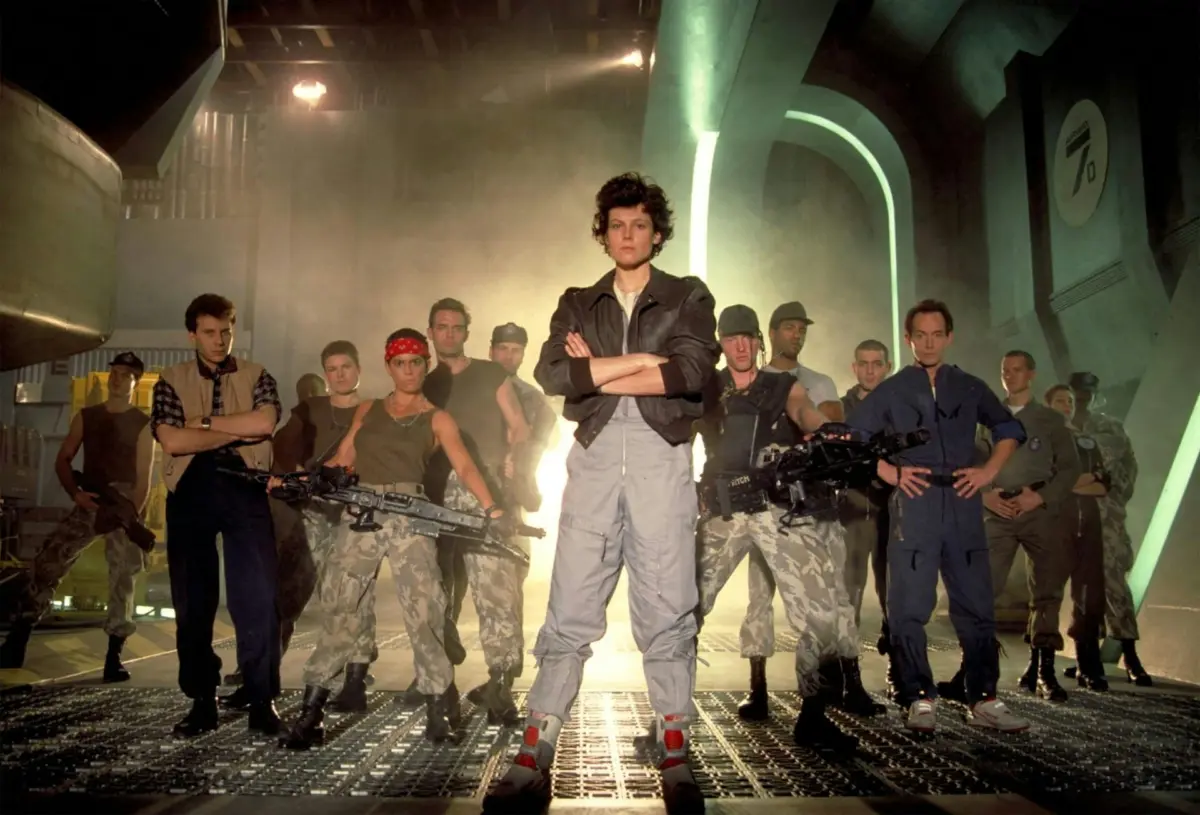
Cameron recognized early on that trying to top iconic sequences like John Hurt’s chestburster scene through sheer mimicry was a fool’s errand. Instead, he altered every foundational variable of the cinematic equation:
- The Genre: Transitioning from a slow-burn horror film in space to an all-out space-marine war movie.
- The Aesthetic: Moving away from low-grade, grimy industrial corridors toward high-tech, utilitarian military-grade equipment.
- The Threat: Trading a singular, elusive, biomechanical predator for a terrifying, relentless swarm of aliens.
This conceptual pivot allowed Aliens to breathe on its own terms. By the time the film hit theaters in July 1986, it had shattered expectations, proving that sequels could successfully expand a universe rather than merely retreading familiar narrative ground.
Supporting Context & Metrics: Sociopolitical Subtext and Cultural Impact
Beneath the pulse-pounding action sequences, pulse rifles, and acid-bleeding xenomorphs lies a rich tapestry of social, psychological, and political subtext that elevates Aliens from mere popcorn entertainment to high art.
The Reagan Era in Space
Released during the presidency of Ronald Reagan, Aliens mirrors the geopolitical anxieties and cultural shifts of 1980s America. The United States of the late 1970s—under Democrat Jimmy Carter—was still processing the psychological fallout of the Vietnam War and economic stagflation. By the mid-1980s, however, the Reagan administration had ushered in an era defined by free-market capitalism, aggressive deregulation, the Strategic Defense Initiative (Star Wars), and a renewed projection of American military might abroad.
Cameron channeled this cultural zeitgeist directly into the film’s narrative. The Colonial Marines—heavily armed, swaggering, and supremely confident in their technological superiority—act as an explicit proxy for American interventionist foreign policy. Their initial arrogance when touching down on LV-426 reflects an imperialist overconfidence, where terms like "colonialism" are treated not as dirty words, but as standard operational directives. Furthermore, the era’s obsession with hard-bodied, hyper-masculine action icons—typified by Sylvester Stallone’s Rambo—is cleverly subverted. When the elite, heavily armed marines are systematically dismantled by the swarm, it is Ellen Ripley—a civilian survivor driven by maternal instinct and tactical pragmatism—who steps up to defeat the alien queen. Cameron effectively turned Ripley into a female Rambo, succeeding precisely where hyper-masculine military posturing failed.
Corporations as the True Monster
While the xenomorphs provide the film’s visceral body horror, Aliens delivers a biting critique of corporate greed that resonates with terrifying clarity today. The Weyland-Yutani Corporation ("The Company") operates as an amoral juggernaut that views human lives as entirely expendable commodities balanced against profit margins.
Carter Burke, the corporate representative masquerading as an ally, is willing to sacrifice the lives of the survivors—including the orphaned child Newt—merely to smuggle a biological weapon back to Earth for research and bioweapons development. Ripley’s famous rebuke to Burke encapsulates the film’s moral core:
"I don’t know which species is worse. You don’t see them fucking each other over for a goddamn percentage."
Forty years on, this critique of unchecked corporate capitalism, institutional negligence, and the commodification of human safety remains as poignant and recognizable as ever.
Gender, Motherhood, and the Body
Academic film critics have long analyzed the rich psychological undercurrents of the Alien franchise, noting its fixation on sex, reproduction, motherhood, and bodily autonomy. The xenomorph itself draws heavily upon anthropological anxieties surrounding the vagina dentata (the Latin phrase for "toothed vagina"), a cross-cultural myth symbolizing male castration anxiety and the terrifying aspects of female reproductive power.
In Aliens, these themes are literalized and complicated through motherhood. Ellen Ripley (Sigourney Weaver), returning 57 years after her harrowing ordeal in the first film, is no longer merely a resourceful survivor; she is a surrogate mother. Her protective bond with Newt forms the emotional beating heart of the movie, drawing a direct parallel between her maternal instincts and the protective ferocity of the Alien Queen guarding her eggs. This thematic duality culminates in one of the most iconic clashes in cinematic history: two mothers fighting to the death for the survival of their offspring, punctuated by Ripley’s immortal battle cry:
"Get away from her, you bitch."
Official Statements and Critical Reception
Upon its release, Aliens was met with widespread critical acclaim, a rare feat for a sci-fi sequel of that scale. Reviewers praised its breakneck pacing, seamless special effects, and Sigourney Weaver’s powerhouse performance, which earned her a historic Academy Award nomination for Best Actress—a virtually unprecedented nod for a sci-fi action hero at the time.
Reflecting on the film’s enduring legacy, retrospective analyses from major film publications have continually underscored its influence on modern filmmaking. In an oral history feature with Empire, industry veterans noted how Cameron’s meticulous world-building established a new visual template for cinematic science fiction.
Cameron himself has often remarked on the delicate balance required to honor Scott’s original creation while asserting his own distinct directorial voice:
"Ridley made a haunted house movie in space. I couldn’t do that again without feeling like I was just copying his homework. So, I turned it into a war movie. I wanted to see what happens when you send a platoon of arrogant grunts into the dark against something they are entirely unprepared for."
Film historians and cultural critics have also celebrated the film’s progressive gender politics. By populating the Colonial Marines with capable men and women who treat each other as professional equals—highlighted by witty, barrier-breaking banter between characters like Hudson and Vasquez—Aliens broke free from archaic Hollywood tropes. The women in Cameron’s universe are neither damsels in distress nor hyper-sexualized window dressing; they are soldiers, engineers, pilots, and unyielding survivors.
Future Outlook: A Franchise That Refused to Die
The true test of a masterpiece is its staying power across generations. Decades after its initial theatrical run, the influence of Aliens can be felt across virtually every corner of modern popular culture.
- Cinematic Legacy: The film’s blueprint directly inspired a generation of subsequent sci-fi action hits, most notably Paul Verhoeven’s satirical masterpiece Starship Troopers (1997), which adopted the template of sarcastic space-marine grunts battling overwhelming insectoid swarms.
- Technological Prophecy: Beyond its narrative achievements, Aliens anticipated real-world technological evolution. From wearable tactical cameras and Heads-Up Displays (HUDs) to the heavy robotic loader exoskeletons utilized by Ripley in the film’s climax, Cameron’s dystopian future predicted the trajectory of modern military hardware and industrial robotics.
- The Expanding Universe: By proving that the Alien universe could be successfully expanded, mutated, and re-contextualized across different genres, Cameron laid the groundwork for an expansive multimedia franchise that now spans seven official feature films, alongside countless novels, comic books, and video games like Alien: Isolation.
As the franchise continues to evolve with fresh installments and new directorial voices attempting to capture the magic of the cosmos, the standard set by James Cameron in 1986 remains towering and untouchable. Aliens endures not merely as a masterclass in 1980s blockbuster filmmaking, but as an eternal monument to tension, action, and the indomitable will of the human spirit when pushed to the absolute edge of extinction.