Executive Overview
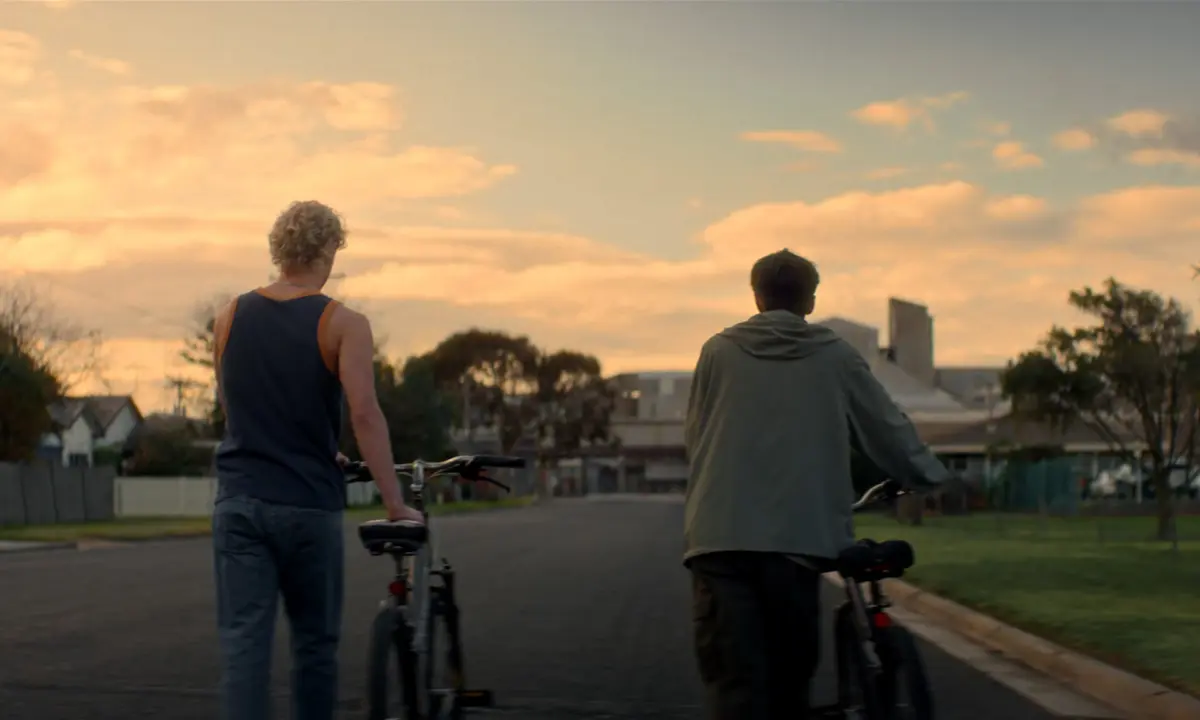
Navigating adolescence as a queer youth within a Christian fundamentalist community is an inherently isolating and high-stakes experience. In his striking feature-length directorial debut, Leviticus, writer and director Adrian Chiarella amplifies this real-world alienation by introducing a lethal supernatural dimension. Set against the sun-bleached, desolate backdrop of rural Australia, the film chronicles the blossoming romance between seventeen-year-old Naim—portrayed by rising talent Joe Bird, widely recognized for his standout performance in the celebrated Australian horror hit Talk to Me (2012)—and Ryan, played by Stacy Clausen.
The narrative thrust of Leviticus hinges on a sinister intervention: Naim and Ryan are forced to endure a brutal, fire-and-brimstone sexual conversion therapy program led by a charismatic and enigmatic "healer" whose explicit mission is to purge the local community of its gay and lesbian youth. Following these harrowing sessions, which culminate in Exorcist-style convulsions and violent bouts of physical expulsion, the teenage participants find themselves stalked by an inescapable entity. This malevolent force manifests as a precise physical duplicate of the person the victim desires most. In a clever inversion of classic cinematic tropes, if a teen yields to their romantic or sexual impulses and embraces their lookalike, they are violently torn to shreds mid-intimacy.
For Naim and Ryan, every stolen glance and shared touch becomes a literal dance with death. They are caught in an unbearable crossfire between their authentic desires for one another and the terrifying realization that intimacy is a death sentence. Rather than relying solely on traditional jumpscares or conventional horror spectacles, Leviticus establishes its power through a deeply atmospheric, emotionally resonant, and superbly acted exploration of forbidden youth romance under the boot heel of institutional oppression. Supported by an exceptional ensemble—including Mia Wasikowska in a profoundly moving turn as Naim’s conflicted mother—Leviticus cements Chiarella’s status as a formidable new voice in genre filmmaking while contributing significantly to the rich lineage of Australian Gothic cinema.
Detailed Chronology: The Genesis and Cinematic Journey of Leviticus
Conception and Autobiographical Roots
The foundational DNA of Leviticus traces back to the formative years of its creator, Adrian Chiarella. Drawing directly from his lived experiences as a gay man growing up in Sydney, Australia, Chiarella sought to translate the psychological weight of internalized shame, societal exclusion, and cultural conservatism into cinematic form. While the film’s narrative is entirely fictional, its emotional authenticity is deeply rooted in real-world observations of how religious dogma intersects with identity formation.
Adapting these deeply personal themes into a supernatural thriller required a delicate balancing act. Chiarella deliberately eschewed the neon-lit urban settings typical of many contemporary queer dramas, choosing instead to transplant his narrative into the stark, unforgiving expanses of rural Victoria. Filmed on location in townships west of Melbourne, the production utilized the geographical isolation of the Australian countryside to mirror the emotional isolation of its protagonists.
Production and Aesthetic Design
Principal photography for Leviticus captured the unique visual vocabulary of the Australian interior, transforming small-town communities into landscapes reminiscent of an oppressive Southern Gothic American backwater. Eschewing the conventional safety of brightly lit interiors, the production design leans heavily into liminal spaces. Romantic and clandestine encounters between Naim and Ryan occur in hauntingly atmospheric locations: dilapidated barns framed by skeletal, rusted farm machinery, and vast, blanched grasslands that stretch toward an indifferent horizon.
The casting process brought together a mix of rising international stars and seasoned Australian royalty. Joe Bird, fresh off his critically acclaimed work in Talk to Me, delivers a grounded, emotionally raw performance as Naim. Opposite him, Stacy Clausen brings vulnerability and resilience to the role of Ryan. Meanwhile, the inclusion of Mia Wasikowska as Arlene, Naim’s mother, elevates the dramatic stakes. Arlene’s character arc—shifting from a grieving widow to a defensive adherent of Christian fundamentalism—is rendered with complex nuance, capturing the agonizing friction between maternal love and dogmatic indoctrination.
Supporting Context & Metrics: The Mechanics of Queer Horror
The Transgressive Metaphor of It Follows and the Genre Lineage
To fully understand the cinematic framework of Leviticus, one must examine its dialogue with modern horror precursors. Chiarella has openly cited David Robert Mitchell’s influential 2014 masterpiece It Follows as a primary artistic inspiration. Both films utilize a central conceit where transgressive sexual activity invites relentless, supernatural persecution. In It Follows, the shifting, relentless entity serves as a multifaceted metaphor for the anxieties of youth, mortality, and the complex emotional landscape of intimacy.
In Leviticus, however, this metaphorical framework is sharply focused through a distinctly queer lens. While It Follows operates within a suburban American milieu, Chiarella’s film repurposes the mechanic to interrogate the specific traumas of queer youth. The entity that stalks Naim and Ryan—taking the shape of their deepest romantic desires—literalizes the internal civil war fought by queer adolescents in repressive environments. Longing, self-acceptance, and internalized homophobia do not merely clash in the mind; they manifest as physical predators.
The Australian Gothic Tradition
Leviticus joins a distinguished lineage of Australian cinema that weaponizes the vast, ancient landscape to evoke dread and melancholy. From Peter Weir’s seminal Picnic at Hanging Rock (1975) to the brutal realism of Greg McLean’s Wolf Creek (2005) and Wayne Blair and Ian Darling’s cinematic landscape explorations, Australian horror has long recognized the uncanny potential of the bush.
The film also arrives during a cultural moment deeply attuned to spatial dread. Following the viral and critical success of projects like Backrooms (2026)—which capitalizes on horror lurking within infinite, mundane, interconnected environments—audiences and filmmakers alike are fascinated by liminality. Leviticus capitalizes on this zeitgeist, utilizing the empty spaces of rural Australia not merely as a backdrop, but as an active participant in the characters’ psychological imprisonment.
Academic Frameworks: Queer Readings of Horror
The intersection of horror cinema and LGBTQ+ subtext has long occupied film scholars. Renowned academic Harry Benshoff, in his foundational work on the subject, explored the paradox at the heart of the horror genre: its immense popularity among queer audiences coupled with its historical reliance on marginalized identities as figures of monstrosity or aberration.
Throughout horror history, iconic antagonists—from the boundary-violating dream-stalker Freddy Krueger in A Nightmare on Elm Street (1984) to the grotesque spectacle of Art the Clown in Terrifier (2016)—have frequently been analyzed as physical manifestations of repressed, transgressive sexual desires feared by heteronormative society. Conversely, queer audiences have historically reclaimed these monsters as misunderstood icons who shatter the hypocritical norms of polite society.
Leviticus collapses this distinction by making the subtext explicitly text. Rather than leaving the queer reading to academic analysis or subtextual interpretation, the film places the queer experience directly at the center of the narrative architecture. While some critics have argued that the film occasionally leans too heavily into didacticism—ensuring audiences grasp its allegorical intent at the expense of subtle ambiguity—its willingness to engage with these complex theoretical concepts elevates it far above standard genre fare.
Official Statements and Industry Reception
The release of Leviticus has generated substantial dialogue across both independent film circuits and academic horror communities. Speaking on his creative motivations, director Adrian Chiarella emphasized the necessity of using genre conventions to explore authentic emotional truths:
"Horror has always been uniquely equipped to deal with the things society refuses to name out loud," Chiarella noted in press statements regarding the film’s international rollout. "When you grow up queer in a rigidly dogmatic environment, the world literally feels like it is conspiring against your right to exist. We wanted to take that internal, psychological terror and give it physical form—not just to scare audiences, but to honor the resilience of kids who have to fight for their own affections."
Industry analysts have similarly praised the film’s casting strategy, particularly noting Mia Wasikowska’s continued commitment to challenging independent cinema following her deliberate distancing from major Hollywood machinery. Wasikowska’s choice to anchor an independent Australian horror-drama speaks to a broader industry shift where established prestige actors increasingly gravitate toward high-concept regional projects that offer genuine artistic risk.
Critical reception has highlighted the film’s atmospheric strengths. Reviewers have universally lauded the chemistry between lead actors Joe Bird and Stacy Clausen, whose portrayals anchor the high-concept premise in genuine emotional stakes. While minor criticisms have been leveled at the occasional reliance on standard jump scares—which contrast with the film’s otherwise patient, dread-soaked pacing—the consensus remains overwhelmingly positive regarding the film’s visual poetry and thematic ambition.
Future Outlook: The Legacy of Leviticus and the Evolution of Queer Cinema
As the independent horror landscape continues to evolve, Leviticus stands as a watershed moment for Australian genre filmmaking. By fusing the stark, melancholic aesthetic of the Australian Gothic with biting socio-political commentary, Adrian Chiarella has charted a new path for how queer narratives can be successfully integrated into traditional horror structures.
The film’s trajectory points toward a promising future for its key creative personnel. Joe Bird’s continuation of strong genre work following Talk to Me signals a burgeoning career as one of contemporary horror’s most reliable young leads, while Stacy Clausen’s nuanced performance establishes him as a talent to watch. Furthermore, Chiarella’s assured, visually confident direction marks him as an exciting new voice whose future projects will undoubtedly be monitored closely by international curators and genre enthusiasts alike.
Ultimately, Leviticus transcends the limitations of standard monster-movie tropes. By reframing the timeless struggle for self-acceptance as a literal battle for survival against supernatural forces, the film delivers a message that is as poignant as it is terrifying: that while the world may conspire to suppress love, the human instinct to connect remains the most powerful force in the universe—worth fighting, and even dying, to protect.