Executive Overview
In the modern landscape of music production, engineering, and digital distribution, precision is everything. While artists and producers spend countless hours agonizing over EQ curves, compression ratios, and harmonic saturation, the final hurdle that determines how a track hits the listener’s ear is governed by a single, critical acronym: LUFS.
Standing for Loudness Units Full Scale, LUFS has revolutionized how audio is measured, mixed, and mastered. It is the gold standard for quantifying human perception of volume, bridging the gap between raw mathematical data and the subjective experience of listening to music.
Gone are the days of the indiscriminate "Loudness Wars" of the late 1990s and 2000s, where tracks were ruthlessly compressed and maximized to hit the highest possible peak volumes at the expense of dynamic range and sonic clarity. Today, LUFS provides a standardized, universally adopted language used by mixing engineers, mastering suites, and global streaming giants alike.
This deep-dive investigative guide explores the mechanics of LUFS, why traditional peak meters failed human ears, the various types of loudness measurements used in professional workflows, how streaming services enforce these metrics, and the top-tier tools engineers rely on to hit their targets. Whether you are an independent bedroom producer or a seasoned mixing veteran, mastering the nuances of LUFS is no longer optional—it is essential to safeguarding the integrity of your art in a digital-first world.
Detailed Chronology: The Evolution from Peak Meters to Human-Centric Loudness
To truly understand why LUFS holds such dominance in contemporary audio engineering, one must look back at the historical evolution of how sound was measured and managed.
The Era of VU and Peak Meters
In the early days of analog recording, engineers relied heavily on Volume Unit (VU) meters and simple peak program meters (PPM). VU meters were designed to approximate the response of the human ear to average levels, moving sluggishly to reflect the overall energy of a performance. However, they were utterly blind to fast, transient peaks—such as the sharp crack of a snare drum or the initial pick-attack of an acoustic guitar.
As audio transitioned into the digital realm, engineers gained access to digital peak meters that could register every single sample of audio. While this prevented digital clipping (distortion caused by exceeding the maximum limit of 0dBFS), it introduced a psychological trap: music creators began viewing the absolute ceiling of digital audio as a target rather than a limit.
The Loudness Wars
Throughout the late 1990s and well into the 2000s, the music industry fell victim to the "Loudness Wars." Driven by the assumption that "louder sounds better," record labels and artists pushed mixing and mastering engineers to maximize the apparent volume of songs.
Engineers achieved this by using heavy limiting and brickwall compression to smash the dynamic range of tracks. Quieter passages were forced upward, and sudden peaks were chopped off, allowing the overall average volume of the track to sit dangerously close to the digital ceiling.
While these hyper-compressed tracks sounded undeniably punchy and aggressive on first listen, they came at a catastrophic cost. Listening fatigue set in rapidly; tracks lost their emotional depth, dynamic contrast, and breathing room. Subtleties were buried under a wall of digital distortion.
The Standardization of LUFS
Recognizing the unsustainable nature of the Loudness Wars—and facing listener complaints about wildly fluctuating volumes when shuffling between older dynamic tracks and modern compressed masters—standardization bodies stepped in.
Organizations like the International Telecommunication Union (ITU) and the European Broadcasting Union (EBU) developed algorithms designed to measure loudness in a way that mirrored human psychoacoustics. This resulted in ITU-R BS.1770 and, subsequently, EBU R128 standards, giving birth to the modern LUFS measurement system. Streaming platforms quickly adopted these metrics, changing the game forever by automatically adjusting track volumes to a unified standard.
Supporting Context & Metrics: Decoding How LUFS Works
To work effectively with LUFS, producers must unlearn traditional notions of "volume." In the lexicon of audio engineering, loudness and volume level are distinct entities.
Volume vs. Perceived Loudness
- Volume Level: Refers to the raw electrical or digital amplitude of a signal. A digital peak meter measures this precisely, showing how close a signal is to 0dBFS (Decibels Full Scale)—the absolute maximum limit a digital system can reproduce without clipping.
- Perceived Loudness: Refers to how the human brain interprets acoustic energy over time. Our ears do not process sound linearly. We are far less sensitive to extremely low and extremely high frequencies, and our brains naturally average out sound over short windows rather than reacting to instantaneous electrical peaks.
The Scale of LUFS
LUFS is expressed in negative numbers, relative to 0 LUFS, which represents the maximum possible digital limit (0dBFS). Every measurement indicates how many Loudness Units (LU) a signal sits below that maximum threshold.

- If a track measures -14 LUFS, its perceived integrated loudness is 14 Loudness Units below the 0 LUFS maximum.
Why Human Hearing Defeats Peak Meters
Human hearing is complex. Because our ears possess built-in psychoacoustic filtering and integration times, a sudden, sharp transient (like a gunshot or a tight rimshot) registers high on a peak meter but contributes very little to our sensation of overall loudness.
Furthermore, human frequency sensitivity changes depending on overall volume levels—a phenomenon mapped out by the famous equal-loudness contours (Fletcher-Munson curves). LUFS algorithms incorporate K-weighting, a specialized frequency-weighting filter that mimics the human ear’s reduced sensitivity to low frequencies. By combining K-weighting with a sliding-window average, LUFS successfully predicts how loud a human will actually perceive a piece of audio to be.
Breaking Down the Four Types of Loudness Measurements
A single numerical reading can never capture the dynamic journey of a complete musical composition. Even the most relentless, high-intensity metal track or electronic banger contains shifts in energy, arrangement, and mood. To manage these variations, professional audio engineers monitor four distinct types of LUFS measurements:
1. Momentary Loudness
- Time Window: 400 milliseconds (0.4 seconds)
- Purpose: Measures the loudness at any exact micro-moment in time. It behaves similarly to traditional RMS (Root Mean Square) meters, reacting quickly to shifts in the audio. It is useful for spotting sudden spikes in energy, though it can jump around too quickly to guide broader mixing decisions.
2. Short-Term Loudness
- Time Window: 3 seconds
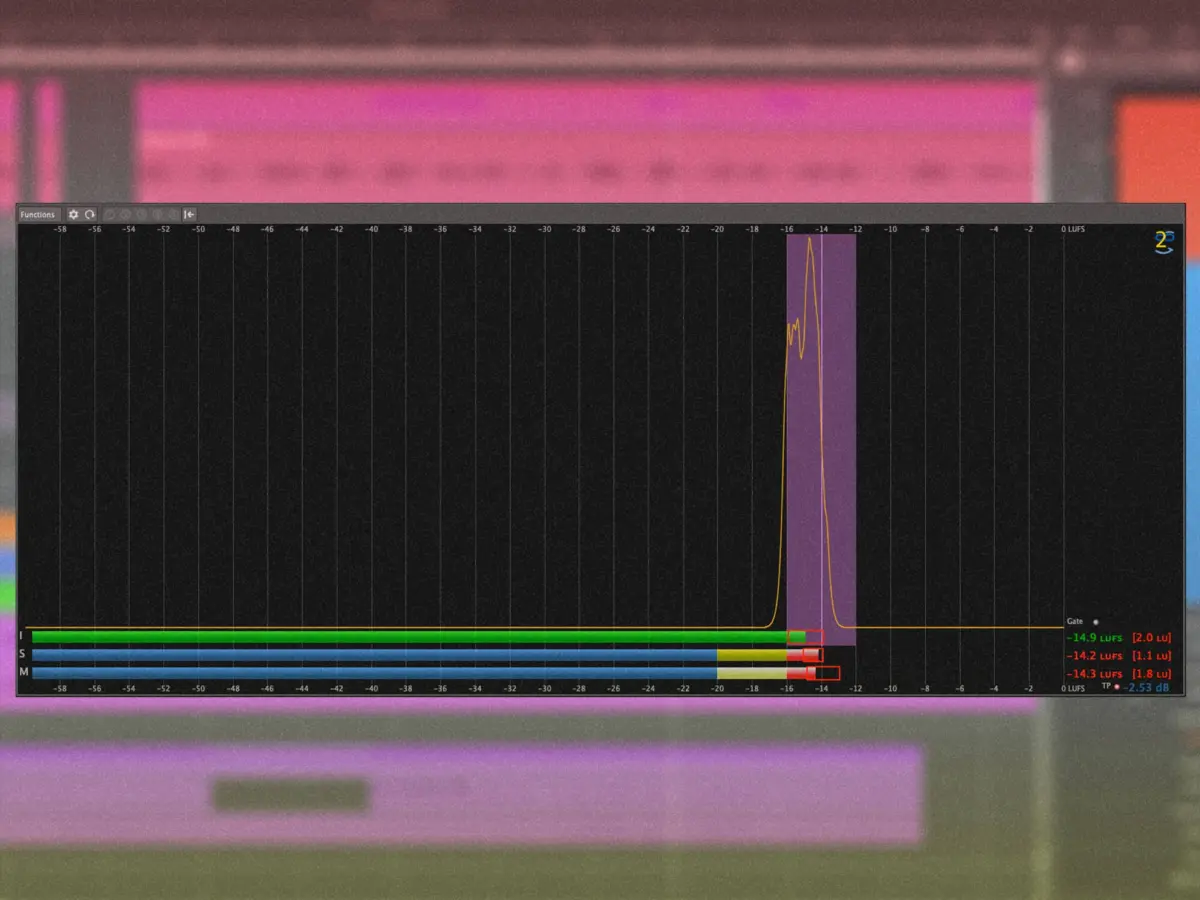
- Purpose: Averages the measured loudness over a slightly broader, three-second window. This is widely considered the most practical and intuitive readout for music producers. When you are actively mixing a track and want to see how loud a chorus feels compared to a verse, watching your DAW’s short-term LUFS meter provides immediate, meaningful feedback.
3. Integrated Loudness
- Time Window: The entire duration of a mix or a designated passage of audio.
- Purpose: This is the ultimate metric for compliance and mastering. Integrated loudness looks at the entire track from start to finish—incorporating gating algorithms to ignore silent passages—and gives you a single, definitive score representing the overall loudness of the song. This is the exact metric streaming platforms evaluate to determine if your track complies with their playback standards.
4. True Peak Level
- Time Window: Instantaneous (Inter-sample peaks)
- Purpose: While not strictly a LUFS measurement, True Peak is measured alongside loudness units. It calculates the actual peak signal level after the digital audio stream has been converted back into an analog waveform (such as through a DAC in a phone, car stereo, or pair of headphones). Digital peak meters can miss inter-sample peaks that occur between samples when digital-to-analog conversion happens, potentially causing harsh, unwanted clipping. Monitoring True Peak ensures your audio remains pristine across all hardware.
Official Standards: Navigating Streaming Platform Specifications
If you have ever uploaded a master to Spotify, Apple Music, YouTube, or Tidal and noticed that it sounded surprisingly quieter than a commercial release, you have encountered platform normalisation.
To protect listeners from sudden volume jumps when transitioning between heavily compressed pop tracks and spacious acoustic recordings, modern streaming services enforce strict normalization targets.
Platform Targets at a Glance
- Spotify: Targets an integrated loudness of around -14 LUFS (with a recommended True Peak maximum of -1 dBTP).
- Apple Music: Targets an integrated loudness of -16 LUFS (utilizing Sound Check to ensure consistent playback).
- YouTube: Normalizes content down to approximately -14 LUFS.
- Tidal: Offers options for loudness normalization, typically aligning around -14 LUFS.
The Normalization Process: What Happens If You Don’t Comply?
When you submit a master that exceeds a platform’s target—for instance, a heavily limited track mastering in at -8 LUFS—the platform’s automated processing system will simply turn your track down by 6 decibels to match its target loudness.
Crucially, streaming platforms do not turn quieter tracks up if they fall below their target (unless specifically requested via user settings in some apps). Therefore, crushing your mix to -8 LUFS in an attempt to make it "louder than the competition" is entirely counterproductive. You sacrifice your track’s dynamic range, push your limiters into distortion, and the streaming algorithm simply dials your volume down anyway, leaving your track sounding quieter, thinner, and less dynamic than a properly balanced -14 LUFS master.
Essential Loudness Meters and Industry Tools
To hit your targets with surgical precision, modern producers have access to a suite of advanced software meters and utilities. Here are the premier tools dominating professional studios today:
1. Built-In DAW Metering
Virtually every modern Digital Audio Workstation (DAW)—including Ableton Live, Logic Pro, Pro Tools, and Reaper—now features native loudness meters. For many producers, dropping a stock loudness plugin onto the master bus is all that is required to monitor integrated and short-term LUFS in real-time.
2. Steinberg WaveLab 12
For dedicated mastering engineers, Steinberg WaveLab 12 stands as an industry powerhouse. Its comprehensive audio editing and mastering suite features an intuitive, highly visual loudness meter. WaveLab allows engineers to analyze entire passages of audio offline, generating detailed visual loudness traces overlaying the waveform so you can instantly identify where a mix is over-compressing or losing energy.
3. iZotope RX 12
iZotope RX 12 is legendary for audio restoration, but its utility extends deep into the mastering phase. Its specialized Loudness Control and Loudness Optimise modules provide exhaustive readouts of audio loudness metrics. Furthermore, RX 12 features a revolutionary Streaming Preview module, allowing engineers to simulate how their master will sound after being processed and normalized by various streaming platforms, all before exporting a single file.
4. Process Audio Decibel
For engineers seeking hardware-like flexibility, Process Audio Decibel is a cutting-edge loudness and level meter that operates either as a standalone application or as a plugin inside your DAW. One of its most innovative features is its ability to link directly to a companion app running on a smartphone or tablet. This allows engineers to monitor critical loudness readouts on secondary devices anywhere in the studio environment.
Future Outlook: The Next Frontier of Audio Standardization
As audio technology continues to evolve, the methodologies governing loudness measurement are far from static. Looking toward the future, several emerging trends are reshaping how creators think about LUFS and distribution:
- Immersive Audio and Spatial Formats: With the rapid expansion of Dolby Atmos and spatial audio formats for music, traditional stereo LUFS measurement is expanding. Mixing in three dimensions requires new multi-channel loudness measurement standards (such as ITU-R BS.1770-4 extensions) to ensure consistent playback across binaural headphone mixes and complex multi-speaker home theater arrays.
- AI-Driven Adaptive Mastering: Artificial intelligence is rapidly infiltrating the mastering chain. Future workflows will likely see real-time, context-aware AI tools that dynamically adjust mix elements to hit exact streaming targets while preserving maximum transient punch and emotional resonance, democratizing professional-grade mastering for independent creators.
- Dynamic Range Restoration: As listeners and streaming services push back against the remnants of hyper-compressed mastering, a cultural shift toward more dynamic, breathable mixes is underway. Audiophile communities and platforms are increasingly celebrating masters with wider dynamic ranges, signaling a healthy future where music is valued for its emotional depth rather than its sheer, unyielding output volume.
By understanding the science of LUFS, embracing proper measurement tools, and tailoring your masters to the specific demands of modern digital platforms, you can ensure that your music translates powerfully, accurately, and dynamically across every speaker on earth.