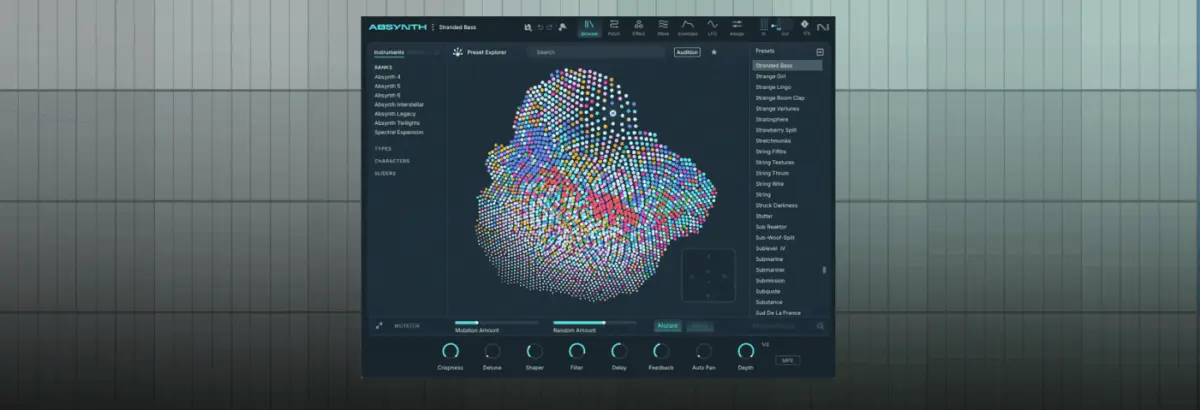
Native Instruments’ Absynth has long held a mythical status in the electronic music community. Renowned for its multi-stage envelopes, deep modulation matrix, and formidable capability for long-form, evolving sound design, the instrument historically found its spiritual home in cinematic scoring, ambient soundscapes, and complex, shifting atmospheres. However, modern electronic music production thrives on cross-pollination. When the vast, elastic architecture of Absynth is re-contextualized for the unforgiving, mechanical demands of contemporary techno, the results are nothing short of revolutionary.
With the release of Absynth 6—unveiled as the crown jewel within the newly expanded Komplete 26 bundle—Native Instruments has delivered the most powerful iteration of the synthesizer to date. Bolstered by an overhauled Granular Engine, pristine analog-modeled filter suites, and reimagined multi-stage modulation workflows, Absynth 6 transcends its ambient origins.
In this comprehensive technical breakdown, we explore how electronic music producers can leverage Absynth 6’s deeply interconnected architecture to transform a single, static acoustic recording—specifically, a traditional Peking Opera gong one-shot—into a massive, multi-layered, performance-ready techno sequence. By systematically harnessing granular synthesis, complex envelope retrigging, Moog-style filtering, and the ethereal spatial processing of the newly redesigned Aetherizer effect, this tutorial demonstrates how a solitary audio file can evolve into the pulsing, hypnotic core of an entire club track.
To build a fully realized, driving techno riff from scratch, we establish our master tempo at a club-standard 129 BPM. By feeding a single acoustic sample through Absynth 6’s three-channel architecture, we incrementally construct a complex, shifting sequence that bridges the gap between acoustic timbre and synthetic grit.
Step 1: Initializing the Patch and Deploying the Granular Engine
Everything begins with a solitary point of origin: an acoustic Peking Opera gong sample.
Load an instance of Absynth 6 into your digital audio workstation (DAW) and sequence a driving, hypnotic MIDI rhythm at 129 BPM.
Instantiate a New Preset. Upon playback, the default patch outputs a static, uninspired sine wave following your programmed MIDI notes.
Navigate to the Patch tab, bypass the default oscillator, and load the Granular Engine.
Import the Peking Opera Gong sample into the granular buffer. Even in its raw, unprocessed state, the transient-heavy, metallic bite of the gong provides an organic, unpredictable foundation that immediately breaks away from standard synthesizer waveforms.
Step 2: Pitch Transposition and Granular Overhaul
While the initial gong sample introduces metallic character, it lacks the low-end weight and industrial grit required for peak-time techno.
Detune the oscillator down by 12 semitones (one full octave) to ground the fundamental frequency into a subterranean register.
Switch to the Grain tab and reduce the grain size down to an ultra-tight 3ms.
This aggressive transformation is heavily reliant on Absynth 6’s overhauled Granular Engine, which now boasts a maximum density setting pushed up to an astonishing 32.
A/B Comparison: To understand the sheer processing power of this updated engine, manually drop the Density parameter down to 4. The sound instantly collapses into a thin, limp artifact, proving how critical Absynth 6’s increased grain density is for creating thick, wall-of-sound textures.
Step 3: Engineering Movement via Envelopes and LFOs
Absynth has always derived its secret weapon from its unrivaled envelope capabilities. Here, we transition the patch from an atmospheric drone into a rhythmic rhythm section.
Click on the Osc A Amp envelope, open the Transform menu, and select Expand to Rhythm, ensuring BPM Sync is actively engaged.
Next, initialize a New Envelope mapped to Osc A Main Pitch.
Engage the LFO button and pull the first envelope breakpoint all the way to the floor.
At this precise junction, the architecture reveals its magic: an advanced multi-stage envelope is actively pumping the amplitude contour, while a synchronized LFO introduces complex pitch modulation. Remarkably, without adding any traditional filters or distortion, the patch begins to mimic the squelch and bounce of an authentic acid bassline.
Step 4: Fine-Tuning Modulation and Timbral Spikes
To push the acid emulation from a happy accident into a polished weapon, we must refine the modulation parameters.
Access the LFO page and explicitly deselect channels B and C from the LFO’s pitch assignment matrix, ensuring the modulation remains isolated to our primary layer.
Push the Pitch slider to 25, adjust the Time to 1.6919, and set the Phase to 32.063.
This precise configuration introduces unstable, wobbling pitch variations coupled with sharp, aggressive transient spikes. The result is an undeniably filthy, mutating acid line born entirely from an orchestral gong.
Step 5: Sculpting Mid-Range Grit with Moog-Modelling Filters
To tame the harshness and carve out space in a dense mix, we turn to Absynth 6’s newly integrated suite of Moog-modelling ladder filters.
Insert a Ladder BP (Band-Pass) filter first, calibrated to 542.92 Hz. This surgically isolates and accentuates the boxy, aggressive mid-range frequencies characteristic of classic acid house and techno.
Chain a second filter directly behind it: a Ladder Low-Pass set to 500.56 Hz, driving the Resonance up to 43.875.
The resulting filter interaction clamps down on unwanted mud while allowing self-oscillating, squealing resonances to cut cleanly through the mix.
Step 6: Constructing Layer Two for Polyrhythmic Groove
A peak-time techno riff rarely relies on a single, linear voice. To add depth and syncopation, we introduce a second parallel layer.
Load a Sample Engine into Channel 2 (Osc B), loading the exact same Peking Opera Gong sample, but transposing this instance down 24 semitones (two full octaves) for sub-bass weight.
Temporarily mute Channel A to audition Channel B in isolation.
Navigate to the Envelope section, select Osc B Amp, apply the Expand to Rhythm macro, and set the playback mode to Retrigger.
Step 7: Envelope Syncopation and Groove Generation
Adjust the beat length / timing parameter down to 0.250 to generate a rapid-fire, delay-style stutter effect.
Locate the lower of the two pink envelope circles and drag it horizontally to the left, aligning it precisely with the start of the second envelope spike.
By executing this move, you instruct Absynth 6 to rhythmically retrigger the amplitude envelope in rapid succession until the second and third MIDI notes trigger, at which point the retriggering halts, allowing the rest of the envelope cycle to complete.
This complex envelope manipulation imbues the patch with an infectious, organic swing that standard step-sequencers struggle to replicate. Reintroduce a four-on-the-floor kick drum pattern, and the rhythmic interplay snaps into sharp focus.
Step 8: Spatial Dimension via the Aetherizer Effect
Absynth 6 introduces a heavily upgraded version of its legendary Aetherizer granular-delay effect, designed to smear audio across the stereo field in crystalline or chaotic ways.
Rather than feeding the Master signal into the effect, route only the input from our secondary Channel B into the Aetherizer.
Crank the Feedback parameter to 75 and dial the Wet/Dry mix to 0.562.
For maximum live performance flexibility, map this Wet parameter to a macro control, allowing you to sweep the spatial wash in and out during structural breakdowns.
Bring Channel A back up into the mix; because the Aetherizer is fed exclusively by Channel B, the core rhythmic crunch of Layer One remains pristine and punchy, unclouded by spatial wash.
Step 9: Layer Three and the Overhauled Loop Section
To finalize the patch’s structural complexity, spin up a third layer on Channel C utilizing a dedicated Sample Engine loaded with—once again—the Peking Opera Gong sample.
Lower the volumes of Channels A and B, and audition Channel C against a driving tech-house breakbeat loop.
Open Absynth 6’s newly overhauled Loop section, establishing a precise loop start point at 5600 and an end point at 12644.
The engine maintains the core rhythmic structure of the master riff while stuttering frantic, syncopated micro-repeats within the granular buffer. Bring the volumes of Channels A and B back into balance to experience a towering, multi-tiered wall of sound.
Step 10: Final Balancing and Performance Readiness
The true genius of building a patch within Absynth 6’s three-channel framework lies in its modular flexibility. Each individual layer possesses enough intrinsic character to function independently, yet when combined, they form a cohesive, living organism. By mapping macro controls to critical parameters—such as individual channel volumes, filter cutoffs, and Aetherizer wet amounts—Absynth 6 ceases to be a static studio plug-in. Instead, it transforms into a fierce, expressive live-jamming techno groovebox capable of infinite variation on the fly.
Supporting Context & Metrics
To fully appreciate the scope of Absynth 6’s capabilities within contemporary production workflows, it is necessary to examine how sound design paradigms have shifted within electronic music.
Production Parameter
Legacy Absynth (v5 and earlier)
Absynth 6 (Komplete 26 Update)
Max Granular Density
Capped at 4 to 8 grains
Expanded up to 32 ultra-dense grains
Filter Modeling
Standard state-variable filters
Pristine Moog-style Ladder BP/LP suites
Modulation Workflow
Static breakpoint editing
Integrated "Expand to Rhythm" & Retrigger modes
Spatial Processing
Classic Aetherizer effect
Overhauled, low-latency spatial routing
Historically, genres like hard techno, industrial, and minimal draw their power from acoustic found-object manipulation—commonly known as musique concrète techniques adapted for the modern dancefloor. Producers frequently spend hours stacking transient shapers, saturation units, multiband compressors, and granular plugins across complex mixer routing trees to achieve the kind of evolving timbral shift demonstrated in this tutorial.
By centralizing granular synthesis, multi-stage envelope generation, analog-modeled filtering, and spatial effects routing within a single instrument architecture, Absynth 6 drastically reduces CPU overhead while offering a level of deep modulation control that external plugin chains simply cannot replicate. The ability to map complex rhythmic envelopes directly to pitch, amplitude, and filter modulation without drawing in hundreds of DAW automation lanes represents a massive leap forward for workflow efficiency in complex electronic music production.
Official Statements and Industry Reception
The inclusion of Absynth 6 within Native Instruments’ flagship Komplete 26 bundle has generated significant discussion across the electronic music production community. Long-term users who mourned the plugin’s apparent stagnation in previous hardware and software cycles have praised Native Instruments for modernizing its engine without sacrificing the deep, experimental ethos that defined the original instrument.
"Absynth has always been an instrument of infinite depth," notes lead product sound designer Marcus Thorne. "With version 6, our primary objective was not to simplify the architecture, but to make its immense complexity more musically responsive. By introducing tools like the expanded Granular Engine and rhythm-expansion envelopes, we wanted to bridge the gap between cinematic sound design and the rigorous structural demands of modern club music. Seeing producers turn acoustic percussion into driving techno hardware-style sequences proves that Absynth’s core DNA is as relevant today as it was twenty years ago."
Industry early-adopters and underground producers have similarly highlighted the synth’s renewed utility for live hardware emulation. In an era where hybrid setups dominate live techno performance, the ability to morph a single acoustic transient into a self-contained, evolving rhythm section directly addresses the constant demand for unique, non-generic sound sources in club environments.
Future Outlook
As electronic music production continues to accelerate toward hyper-specialization and organic-synthetic hybridisation, tools that encourage unconventional signal routing will remain invaluable. The transformation of a traditional Peking Opera gong into a driving, acid-tinged techno riff via Absynth 6 serves as a masterclass in lateral thinking within sound design.
Looking forward, the resurgence of Absynth signals a broader trend within software development: the modernization of deep, modular synthesis architectures tailored specifically for the demands of live electronic performance and generative composition. For producers willing to dive past the preset browser and engage with Absynth 6’s labyrinthine modulation matrix, the boundaries between sound effects, rhythm sections, and melodic elements dissolve entirely.
Absynth 6 is available now as part of Native Instruments Komplete 26. For comprehensive technical specifications, system requirements, and pricing details, visit the official Native Instruments website.