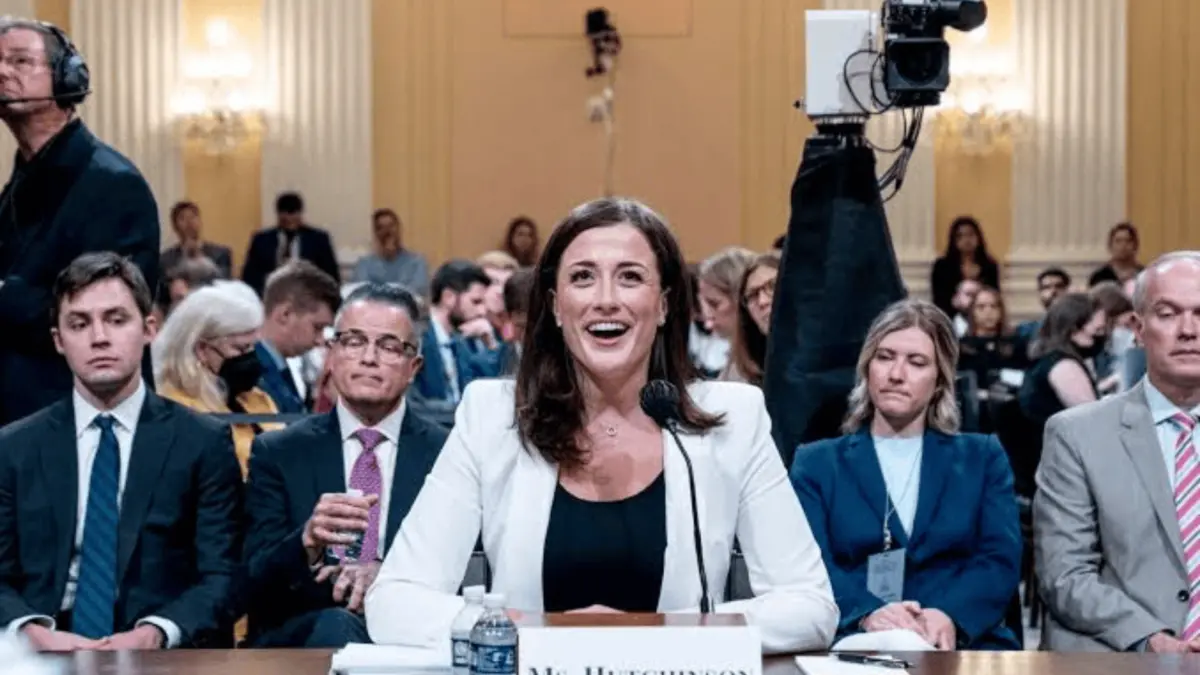
When Cassidy Hutchinson stepped to the witness table before the House January 6 Select Committee in June 2022, her testimony sent shockwaves through the American political landscape. Within hours, her name dominated global headlines, trending across every major social media platform and sparking a secondary wave of digital curiosity: What is Cassidy Hutchinson’s net worth?
In the modern media ecosystem, public interest in prominent figures is immediately commodified into numerical valuations. For Hollywood celebrities, tech executives, and professional athletes, algorithms usually generate a tidy, albeit often inaccurate, sum. But for political figures, whistleblowers, and transition-figure memoirists like Hutchinson, the digital ledger dissolves into smoke. Online estimates for Hutchinson’s net worth range wildly—from under $1.5 million to as high as $16 million—with virtually zero empirical backing at either extreme.
This investigative analysis looks beyond the algorithmic guesswork to examine the intersection of public transparency, modern publishing, and political notoriety. By separating verifiable government disclosures and commercial publishing milestones from internet speculation, we can understand why some fortunes remain impossible to audit—and what Hutchinson’s financial footprint actually reveals about the economics of modern political commentary.
Executive Overview: The Anatomy of a Missing Ledger
To understand why estimates of Cassidy Hutchinson’s wealth fluctuate so erratically, one must first understand how true net worth is calculated. Net worth is not simply gross income; it is the total of all assets (real estate, liquid savings, investment portfolios, intellectual property rights) minus liabilities (mortgages, legal fees, personal debt).
For private citizens who transiently occupy high-profile government roles, the vast majority of these variables are shielded by privacy laws. No financial institution, tax authority, or personal accountant has publicly released Hutchinson’s balance sheets. Consequently, digital aggregator sites build their estimates on a flimsy foundation: a matter-of-fact reading of her public government salary history, combined with wildly speculative assumptions regarding her literary earnings.
| Financial Metric | Status | Verified / Estimated Value |
|---|---|---|
| 2020 White House Salary | Verified | $72,700 annualized |
| 2021 Coordinator Role | Verified (Rate) | $90,000 annualized (approx. 9 weeks) |
| Simon & Schuster Book Deal | Commercial Success | Undisclosed advance/royalty terms (Enough hit #1 NYT) |
| Paid Speaking Engagements | Unconfirmed | Unverified rumors ($50,000+ per event) |
| Total Estimated Net Worth | Speculative | Widely disputed ($1.5M – $16M range) |
As this breakdown demonstrates, the documented streams of income represent only a fraction of the multi-million-dollar figures circulating online. This disparity highlights a broader phenomenon in digital journalism: the systematic inflation of a public figure’s wealth based on celebrity status rather than audited financial disclosures.
Detailed Chronology: From Junior Staffer to Bestselling Author
Hutchinson’s public career accelerated at an unprecedented velocity. In the span of just three years, she transformed from a junior congressional aide into a central historical witness and a commercially successful author. Tracing this timeline clarifies the exact moments wealth could realistically have been accumulated.
[2020] White House Special Assistant ($72,700/yr)
   │
   ▼
[Early 2021] Post-Presidential Coordinator Role ($90,000 annualized rate)
   │
   ▼
[June 2022] Historic Testimony Before January 6 House Committee
   │
   ▼
[September 2023] Memoir "Enough" Published by Simon & Schuster
   │
   ▼
[Late 2023] "Enough" Reaches #1 on New York Times Bestseller List
1. The White House Tenure (2020)
Official White House personnel records definitively capture Hutchinson’s government compensation. In 2020, she served as Special Assistant to the President and Coordinator for Legislative Affairs, earning an annual salary of $72,700. Because this figure is derived directly from federal transparency disclosures, it remains one of the few indisputable benchmarks in her financial history.
2. The Post-Presidential Transition (Early 2021)
Financial trackers frequently misinterpret a subsequent $90,000 salary figure, folding it into her cumulative government earnings. In reality, this sum belonged to a short-lived post-presidential coordinator role she held for approximately nine weeks in early 2021. Crucially, this was an annualized rate, meaning she collected only a fraction of that amount during her brief tenure, and it was never part of her White House payroll.
3. The Literary Breakthrough: Enough (2023)
The financial game shifted in September 2023 with the publication of her memoir, Enough, released through Simon & Schuster. The book achieved immediate commercial success, claiming the #1 spot on the New York Times bestseller list. While the publisher confirmed acquiring world rights, the financial terms—including the author’s advance and royalty percentage—were never publicly disclosed. Consequently, book-related income remains an educated guess, echoing a pattern seen whenever a high-profile political memoir enters the market without transparent disclosures.
4. Media Appearances and the Speaking Circuit
In the wake of her book’s release, speculation mounted regarding lucrative speaking fees and paid television contracts. Rumors place her speaking fees at upwards of $50,000 per engagement. However, no verified booking agency listings, public contracts, or tax documents corroborate these claims. In the media landscape, standard news interviews and promotional appearances are typically unpaid, leaving this category firmly in the realm of unverified rumor.
Supporting Context & Metrics: Why Net Worth Estimators Fail
The persistent variance in Cassidy Hutchinson’s net worth estimates exposes systemic flaws in how internet data aggregators operate. When primary financial records are inaccessible, these platforms rely on flawed heuristics.
The Fallacy of Bestseller Status
A common misconception is that hitting the top of the New York Times bestseller list equates to an immediate, multi-million-dollar windfall for the author. In reality, book publishing is a complex financial ecosystem. An author’s advance must often cover research, legal reviews, and personal expenses before royalties kick in. Furthermore, literary agents typically claim a 15% commission, and federal and state taxes claim up to half of the remaining balance. Thus, a book selling hundreds of thousands of copies generates significant gross revenue, but the net profit retained by a first-time author is significantly lower than online estimators calculate.
The Echo Chamber of Digital Aggregators
Net worth websites rarely conduct independent investigative accounting. Instead, they operate on a content-scraping model:
- Site A publishes an arbitrary, inflated estimate (e.g., $5 million) to capture search traffic.
- Site B and Site C scrape Site A via automated scripts, treating the fabricated figure as a secondary source.
- Within weeks, the estimate appears across dozens of domains, achieving an illusion of consensus that masks its complete lack of empirical grounding.
This documentation gap is not unique to Hutchinson. Similar discrepancies plague public figures across the political spectrum, from conservative media figures like Mike Lindell to former administration officials turned commentators.
Comparative Analysis: Political Memoirists and Murky Wealth
To contextualize Hutchinson’s financial ambiguity, it is instructive to examine how other political figures and memoirists are evaluated by public market analysts.
[John Bolton]       ████████████████████  ~$15M - $20M (Estimated)
[Alyssa F. Griffin] ██████████          ~$1M - $3M (Estimated)
[Cassidy Hutchinson]████████            Disputed / Unconfirmed
[Michael Cohen]     ████                < $1M (Estimated / Complicated by Legal Debt)
1. John Bolton
As a veteran diplomat, National Security Advisor, and long-serving government official, John Bolton possesses decades of accumulated assets, consulting fees, and high-level book deals (such as The Room Where It Happened). Public estimates commonly place his net worth in the low eight figures ($15 million to $20 million). Yet, even for a career bureaucrat of Bolton’s stature, these figures are derived from general macroeconomic assumptions rather than public asset declarations.
2. Michael Cohen
Following his tenure as personal attorney to Donald Trump, Michael Cohen published Disloyal: A True Memoir. Like Hutchinson, his post-White House trajectory involved legal turbulence, public testimony, and publishing deals. Estimates of Cohen’s net worth vary wildly—often hovering under $1 million—largely because ongoing legal fees, civil judgments, and restitution complicate any outside calculation of his true liabilities.
3. Alyssa Farah Griffin
As a former Trump administration official who successfully transitioned into mainstream media commentary (co-hosting The View), Farah Griffin’s income derives primarily from recurring broadcast contracts rather than a single explosive book advance. Industry analysts estimate her net worth between $1 million and $3 million, though, once again, these figures remain speculative estimates unverified by audited personal financial statements.
The takeaway from these comparisons is clear: political memoirist net worth estimates are universally unreliable. The presence of a bestselling book or a high-profile television platform does not automatically grant the public a window into an individual’s personal balance sheet.
Future Outlook: Transparency, Privacy, and the Media Landscape
As Cassidy Hutchinson continues her post-government career—balancing public speaking, writing, and potential future legal or civic endeavors—the question of her personal finances will likely remain opaque.
Will Her Financial Status Ever Be Verified?
Unless Hutchinson enters elected office or accepts a presidential appointment that triggers mandatory federal financial disclosures under the Ethics in Government Act, her private wealth will remain entirely outside the public record. Government employment required her to disclose a modest base salary in 2020, but her current private-sector earnings are protected by the same privacy rights afforded to any private citizen.
Lessons for the Consumer of Digital Media
The obsession with quantifying the net worth of public figures reflects a broader cultural desire for absolute transparency in an increasingly complex world. However, Hutchinson’s story serves as a valuable exercise in media literacy:
- Government transparency has strict boundaries: Public payroll records are accurate, but they do not capture private-sector wealth accumulation.
- Commercial success does not equal net worth: Bestselling books and media contracts generate gross revenues, but legal costs, agent fees, taxes, and living expenses drastically reduce net liquid assets.
- Absence of evidence is not evidence of concealment: When a net worth figure is missing, it usually means the data was never disclosed, not that an enormous fortune is being actively hidden.
Ultimately, anyone searching for a neat, definitive number regarding Cassidy Hutchinson’s net worth will find that none exists. In the absence of audited disclosures, the wisest approach is to reject unverified digital estimates and embrace the reality that some stories cannot—and should not—be reduced to a single dollar sign.
Frequently Asked Questions
Does Cassidy Hutchinson have to publicly disclose her finances now?
No. Unless she assumes a public office or government role that legally mandates financial disclosures, her personal finances remain private. Her previous government salary records were public solely because federal law requires transparency for active federal employees.
Does hitting the New York Times bestseller list reveal an author’s exact earnings?
Not directly. Bestseller lists reflect copies sold, not net profit. An author’s take-home pay is determined by negotiated advance amounts, royalty percentages, literary agent commissions (typically 10% to 15%), legal fees, and federal and state taxes.
Are television and news interviews considered paid appearances?
Typically, no. Standard news interviews, political commentary segments, and morning show appearances are unpaid promotional opportunities for the guest and the publisher. Formal paid speaking engagements are distinct events governed by private contracts and booking agencies.
Why do political memoirist net worth estimates vary so wildly online?
Because the vast majority of a private citizen’s income sources—such as book royalties, private consulting fees, investments, real estate holdings, and personal debts—are entirely outside the public record. Consequently, third-party biographical websites rely on speculation and recycled assumptions rather than verified financial statements.