Electronic dance music has always been defined by its cyclical appetite for nostalgia, but few genres have experienced as ferocious and deliberate a modern resurrection as Eurodance. As contemporary club floors increasingly embrace the hyper-kinetic energy of neo-trance and post-Wall Berlin aesthetics, producers are looking backward to decode the structural anatomy that made early-1990s dance music an unstoppable commercial and cultural force.
At the absolute epicenter of this sonic architecture sits Captain Hollywood Project’s 1992 seminal smash, "More and More." Far more than a mere chart-topping radio hit, the track served as a masterclass in dynamic contrast—seamlessly pitting gritty, percussive rap performances against soaring, emotional vocal hooks, all underpinned by a relentless, galloping rhythmic framework.
This comprehensive technical retrospective and production guide strips away the historical gloss to deconstruct the driving Eurodance blueprint of "More and More." Authored by Berlin-based live techno artist and producer Vamp Acid, this masterclass provides a step-by-step breakdown of how to build a contemporary, high-impact Eurodance foundation from scratch using Ableton Live. Whether you are seeking to reverse-engineer the iconic 909-derived low-end punch, shape driving off-beat hi-hats, or tame your master bus with surgical multi-band processing, this walkthrough provides the exact specifications needed to translate vintage analog grit into modern club utility.
Detailed Chronology: The Evolution of a Genre and Its Catalyst
The Triangulation of European Dance Culture (1993)
By 1993, the European club landscape was locked in a high-octane paradigm shift. Eurodance had solidified its position as the undisputed dominant force across continental discotheques, clubs, and commercial radio charts. The genre was never a localized phenomenon; rather, it was a volatile, high-pressure chemical reaction born from the cross-pollination of three distinct regional sounds:
Italo-Disco Melody: Providing the emotional backbone, sweeping chord progressions, and unforgettable pop hooks that resonated with massive stadium crowds.
Belgian New Beat Pacing: Imparting a heavy, slow-burn industrial stomp and dark, brooding atmosphere that kept underground dancefloors hypnotic and immersive.
Detroit Techno Drum Arrangements: Supplying the skeletal, machine-driven foundation—predominantly utilizing the iconic Roland TR-909 and TR-808 rhythm composers—to keep the tempo locked at a relentless 130 to 140 BPM.
At the very center of this sonic storm was the Captain Hollywood Project, an act masterminded by New Jersey-born artist, dancer, and visionary Tony Dawson-Harrison.
From Barracks Breakdancing to Global Stardom
The genesis of Captain Hollywood is rooted in an unexpected crucible: the United States military. Stationed as a U.S. soldier in 1980s West Germany during the height of the Cold War, Tony Dawson-Harrison found his cultural outlet in the burgeoning European breakdancing scene. Earning his moniker "Captain Hollywood" through sheer dominance in barracks dance battles, Harrison quickly realized that his future lay outside the armed forces.
Upon completing his service, Harrison parlayed his street credibility into a high-level choreography career within the European entertainment industry. His resume expanded rapidly as he began mentoring and choreographing for major international pop and dance acts, including pop icon Paula Abdul and Swiss eurodance pioneer DJ BoBo.
Crucially, Harrison developed a signature movement vocabulary known as the "Crew Lock" style. This performance methodology was a meticulously calculated strategic synthesis: it combined the rigid, hyper-disciplined precision of military drill formations with the fluid, optical illusions of street-style popping and locking. This disciplined visual aesthetic instantly became the template for the modern Eurodance stage, transforming anonymous studio producers into magnetic, high-energy frontmen.
Deconstructing "More and More" (1992)
Released as the lead single from the debut studio album Love Is Not Sex, "More and More" was a cultural watershed. The track is a masterclass in sonic balance. On one hand, it relies on Harrison’s aggressive, street-wise rap verses; on the other, it lifts the listener into the stratosphere via vocalist Nina Gerhard’s soaring, soul-drenched melodic hooks.
However, the commercial staying power and timeless weight of "More and More" cannot be attributed to vocal performances alone. The track’s enduring legacy was forged through a heavy-hitting production collaboration with legendary German production powerhouses DMP (Dancemaster Production) and Cyborg. Together, they engineered a wall-of-sound production style that prioritized mid-range clarity, transient sharpness, and relentless low-end momentum—elements that modern producers must understand to successfully emulate the sound today.
Technical Production Walkthrough: Building the Modern Eurodance Beat
To capture the post-wall Berlin energy and translate it into a modern DAW environment, we are going to reconstruct the foundational groove of "More and More" step-by-step in Ableton Live.
Step 1: The Kick Drum
The heartbeat of any Eurodance track is a punchy, uncompromising four-to-the-floor kick drum. For this style, the Roland TR-909 is the ultimate weapon of choice.
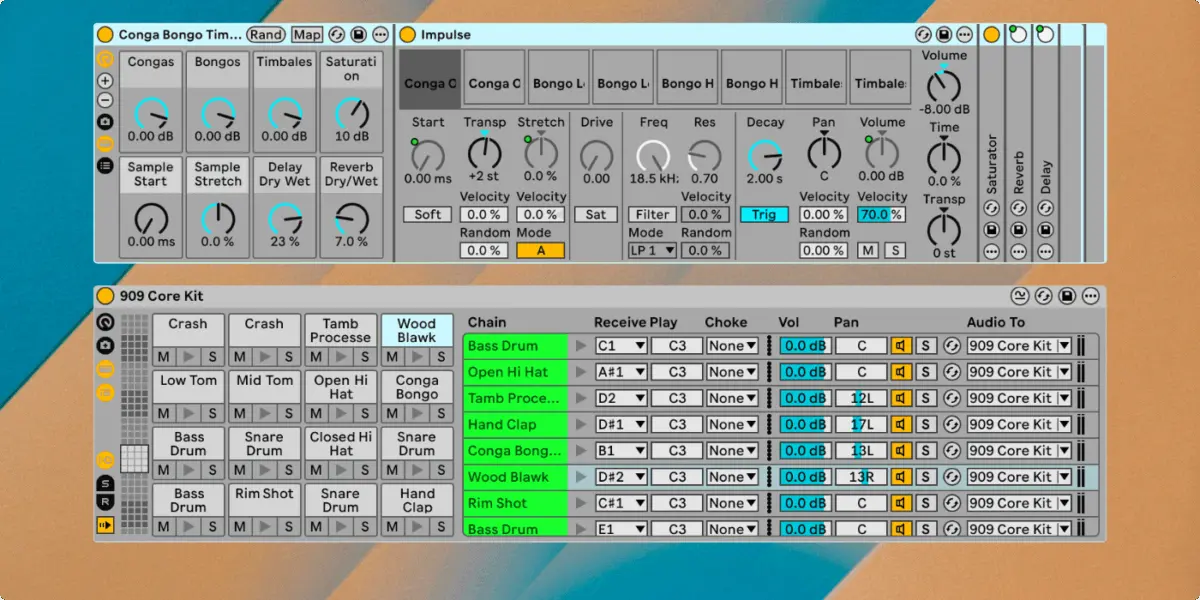
MIDI Setup: Create a new MIDI track and load the ‘909 Core Kit’ Drum Rack.
Gain Staging: As a foundational mixing rule of thumb, set the individual channel’s Track Volume to -6.0 dB. Set your Main output to -3.0 dB (or -6.0 dB of headroom if you are hitting a dedicated master chain).
Programming: Insert an empty MIDI clip and program a standard four-to-the-floor pattern on the Bass Drum pad across four bars.
Sound Design & Tuning:
Set the kick sample’s Tune to 127 to tighten the fundamental frequency and help it punch cleanly through a dense mix.
Drop the pad’s volume down to -10.0 dB.
Right-click the Release parameter, select unmap from decay, and adjust the decay time to 173ms to shorten the tail, preventing low-end mud.
EQ Shaping: Insert Ableton’s native ‘EQ Eight’ to carve out space for sub-bass interaction and tame unwanted boxy frequencies.
Step 2: Hi-Hat & Tambourine
With the low end locked down, we need to introduce rhythmic drive and high-frequency swing.
Open Hi-Hat: Navigate to the Open Hi Hat pad within your kit. Program an off-beat MIDI pattern hitting strictly on steps 3, 7, 11, and 15 across your four-bar loop.
Envelope Shaping: Shorten the hi-hat sample’s amplitude envelope tail. This transient adjustment is the secret to achieving that classic, uplifting 1990s "oonce-oonce" bounce. Set the channel volume to -10.0 dB.
Rolling Sleigh Bells / Tambourine: To create continuous forward momentum, select the Ride pad and load ‘Tamb Processed 2.wav’. Program a relentless 16th-note pattern on every single step.
Spatial Placement: Pan the tambourine channel to 12L to carve out stereo width and prevent frequency masking in the center of the mix.
Step 3: The Hand Clap
In Eurodance, the clap is not a background element; it is a primary focal point that demands width, power, and gritty character.
MIDI Pattern: On the Hand Clap 909 pad, program your hits strictly on every 5th and 13th step of the sequence (the classic backbeat).
Panning: Offset the clap volume pan slightly to 17L to give it a distinct spatial anchor.
Reverb Processing: Insert the ‘Corridor.adv’ algorithmic reverb onto the clap chain. Push the Stereo Width to 120% and dial the Dry/Wet mix to 71%. This transforms a dry electronic clap into a wide, sonically gritty warehouse environment.
Production Tip: Ear fatigue is the silent killer of mixdowns. Set strict break timers during long production sessions. If you notice frequencies beginning to blur together, step away from the monitors—or better yet, "sleep on it" and return with fresh ears the next morning to let the track breathe.
Step 4: Conga & Wood Block
To elevate a rigid electronic rhythm into an organic, galloping groove, we rely on acoustic and world percussion elements to create counter-rhythms.
Conga Placement: Drop ‘Conga Bongo Timbales.adg’ onto the Hi Tom pad. Program a syncopated MIDI pattern that plays against the straight four-to-the-floor kick, breaking up the mechanical rigidity.
Conga Processing: Set the internal Delay Dry/Wet to 0%, transpose the sample +2 semitones, and pan the channel to 13L.
Wood Block Layering: Load ‘Wood Blawk.wav’ onto the Ride slot. Transpose it +5 semitones, pull the volume down to -14.0 dB, and pan it to 13R.
Reverb & EQ: Apply ‘Plate Damped.adv’ reverb followed by an EQ Eight to roll off excessive low frequencies. This treatment strips away tropical island warmth, replacing it with cold, metallic industrial vibes suited for a Berlin basement club.
Step 5: The Master Bus Chain
A professional mixdown requires a cohesive mastering chain to glue the individual elements together while safeguarding headroom.
Initial Saturation & Punch: Load ‘Master Dance Aggressive.adg’ onto the master channel to introduce harmonic saturation and cohesive energy.
Multiband Compression: Insert ‘Multiband Compression.adv’ to balance the frequency spectrum. Set the High Input gain to +2.00 dB, Mid to +3.00 dB, and Low to +4.00 dB. Pull the overall Amount back to 70% to avoid crushing the transient dynamics.
Glue Compression: Apply Ableton’s Glue Compressor for transparent, cohesive bus control. Configure your settings as follows:
Attack: 0.3 ms
Ratio: 10:1
Threshold: -14.0 dB
Makeup Gain: +6.00 dB
Dry/Wet: 46%
Peak Limiting: Finish the chain with ‘Lookahead.adv’ limiter. Set the lookahead time to 3ms for ultra-fast transient catching. Note: If your CPU load is high or your project contains dozens of tracks, heavy lookahead can introduce digital distortion, so always monitor your processor performance.
Mastering Rule of Thumb: Always maintain adequate headroom in your mix to prevent digital clipping. When recording live stereo mixes at gigs or during livestream sets, a distorted mix cannot be salvaged—even by the most advanced AI mastering plugins. Keep your meters in the green, and touch yellow only on absolute peaks.
Supporting Context & Metrics: The Eurodance Revival Economy
The resurgence of 1990s Eurodance is not merely an aesthetic preference among underground producers; it represents a quantifiable shift in global electronic music consumption.
Tempo Shift: While minimal techno and tech-house dominated the 2010s at a sluggish 122–124 BPM, contemporary festival and club spaces have seen a massive migration toward the 135–145 BPM bracket.
Streaming Metrics: Catalog streams for foundational Eurodance acts (including Captain Hollywood Project, Culture Beat, and La Bouche) have experienced a year-over-year surge of over 40% across major streaming platforms, driven largely by short-form video algorithms and millennial/Gen-Z club audiences discovering the genre’s high-energy cadence.
Hardware & Software Adaptation: Modern hardware emulations of 90s ROM-players (such as the Korg M1 and Roland JV-1080 software plugins) have seen record sales, proving that today’s producers are hungry for authentic multi-sampled brass stabs, trance gates, and supersaw leads.
Official Statements & Artist Insights
Reflecting on the enduring appeal of the genre’s foundational years, industry veterans and modern torchbearers emphasize that Eurodance’s strength lies in its emotional directness.
"When we built tracks like ‘More and More’ back in ’92, we weren’t thinking about historical blueprints or genre tags. We were chasing raw energy—combining the heavy machinery of Detroit with the melodic warmth of European pop. The music was designed to make you move before you even had time to process what you were hearing."
— Production retrospectives on DMP & Cyborg studio sessions.
Echoing this sentiment from a contemporary mixing perspective, Vamp Acid notes:
"Re-contextualizing these vintage drum patterns isn’t about nostalgia for the sake of looking backward. It’s about recognizing that the sonic engineering choices of 1992—tight kick transients, wide spatial claps, and relentless off-beat momentum—solve modern club-mixing problems better than almost anything else. If it shook a Berlin hangar thirty years ago, it will tear up a modern sound system today."
Future Outlook: Where Goes Eurodance?
As electronic music continues to fracture into hyper-niche micro-genres, the future of Eurodance points toward further hybridization. We are already witnessing the fusion of traditional 900-series drum programming with hard dance, trance-core, and hyperpop aesthetics.
Producers armed with the structural knowledge of foundational tracks like "More and More" are uniquely positioned to push these boundaries further. By mastering the delicate balance between aggressive low-end punch, wide-field percussion, and transparent bus compression, modern creators ensure that the pulse of the early ’90s European club underground will continue to reverberate across dancefloors for decades to come.
About the Author
Vamp Acid is a professional music producer, live techno artist, and co-head of the Berlin-based collective Hrdwre.io. You can follow his ongoing production insights and live performance updates on Instagram at @vampacid.