By Aimee Dexter and Alice Whaley
Enriched and Expanded Journalistic Feature
Executive Overview
For more than six decades, the iconic British science-fiction institution Doctor Who has traversed the boundless vistas of time and space, captivating generations of viewers with its blend of eccentric British charm, terrifying alien adversaries, and imaginative storytelling. Yet, nestled deep within the vast archives of the show’s rich history lies a ghost story: an ambitious, highly anticipated six-part serial that was meticulously filmed on location, only to be abruptly halted, locked away, and transformed into a piece of television folklore.
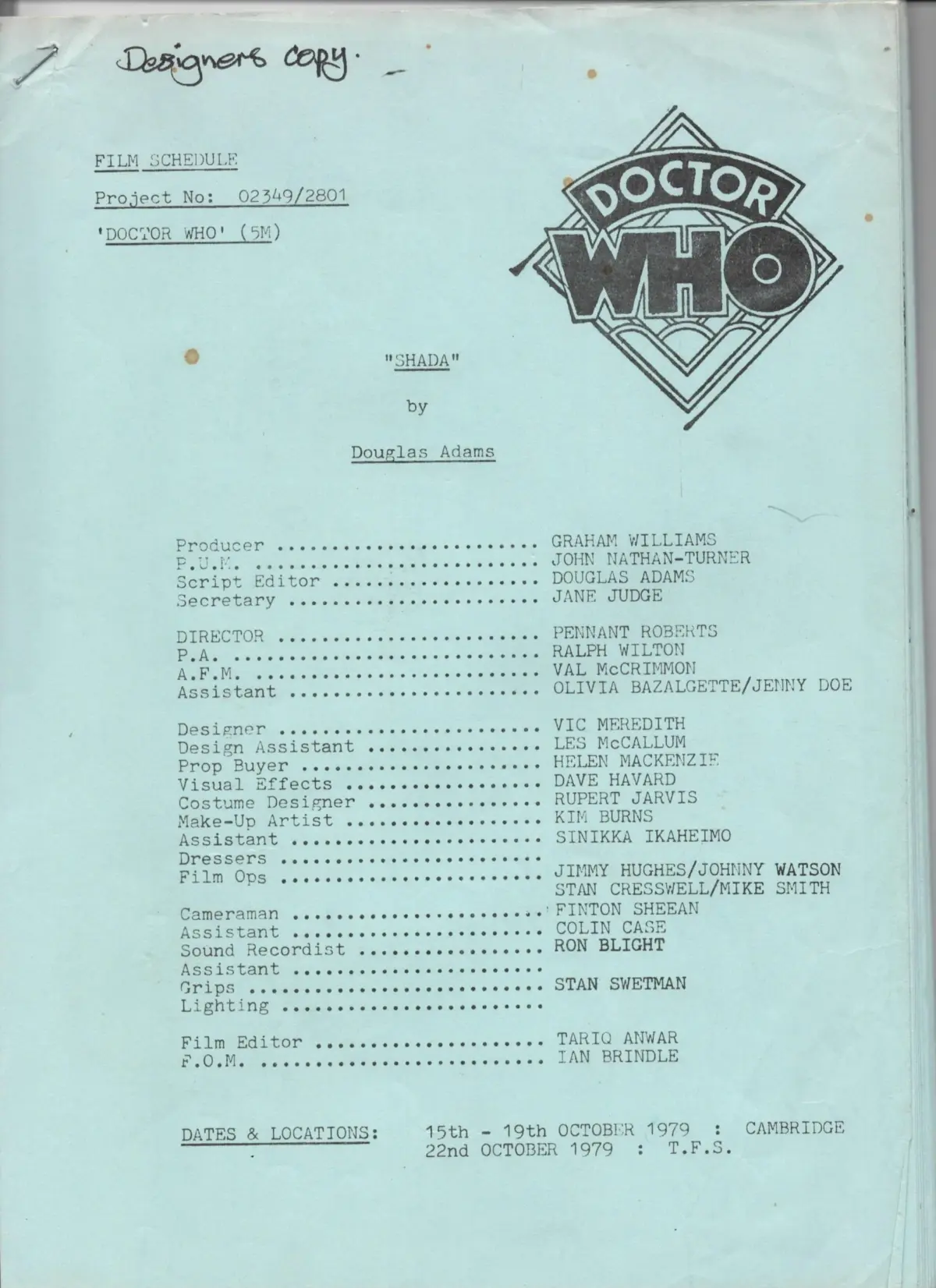
In the autumn of 1979, the production machinery of the BBC descended upon the historic, cobbled streets and serene waterways of Cambridge to capture a storyline appropriately titled Shada. Written by the visionary local author Douglas Adams—then rapidly ascending toward global literary fame—the serial featured Tom Baker in his iconic tenure as the fourth Doctor, alongside his companion Romana (played by Lalla Ward) and a retired Time Lord known as Professor Chronotis. The narrative was designed to be a comedic, cerebral tour-de-force, combining the academic quirks of university life with high-stakes cosmic villainy.
However, fate—and labor disputes—intervened. While location filming along the River Cam and amidst the storied courtyards of the University of Cambridge proceeded with its own unique trials and tribulations, industrial action back in London dealt a fatal blow to the production. Studio doors were chained shut, contracts expired, and Shada was left stranded in an unfinished state, destined to become the most famous unbroadcast serial in the history of science-fiction television.

A new BBC Sounds documentary, Doctor Who: Lost in Cambridge, sheds fresh light on these historic events, drawing upon eyewitness accounts, production schedules, and behind-the-scenes recollections. This comprehensive report explores the genesis of Shada, the chaotic reality of its location shoot, the logistical nightmares that prevented its completion, and its astonishing 36-year journey from archival myth to animated reality.
Detailed Chronology: From Concept to Catastrophe
The Genesis of a Cosmic Comedy
The story of Shada begins with its celebrated writer, Douglas Adams. Born in Cambridge in 1952, Adams attended St John’s College during the early 1970s, immersing himself in the unique theatrical and intellectual culture of the university—an experience heavily channeled into his writing. Even before he became a professional scribe, Adams was conceptualizing Doctor Who adventures within the hallowed halls of St John’s. By the late 1970s, having already contributed heavily to the show’s 17th series—including serving as script editor—Adams was commissioned to pen a multi-episode serial that would bring the Doctor into his old academic stomping grounds.
The premise of Shada was quintessentially Adams: whimsical yet intellectually robust. The narrative finds the fourth Doctor visiting an old friend and colleague, Professor Chronotis, who is living in retirement at Cambridge. Chronotis is unwittingly harboring a dangerous artifact: a stolen volume containing the secrets of Shada, a forgotten, maximum-security prison planet established by the Time Lords to hold the galaxy’s most dangerous criminals. Enter the villainous alien Skagra, who seeks to harness the secrets of Shada to impose his totalitarian will upon the entire universe.
The Cambridge Location Shoot: October–November 1979
Production on Shada commenced with high ambitions. The production team secured permission to shoot extensive location sequences across Cambridge, capturing the quintessential academic aesthetic required for the script.

Yet, translating a science-fiction television script into reality on the banks of the River Cam proved remarkably difficult. Among the most enduring anecdotes from the shoot is the ordeal faced by series lead Tom Baker, who was tasked with navigating a traditional wooden punt across the River Cam while in full costume.
According to Marcus Hearn—editor of Doctor Who Magazine, whose father worked as a porter at Clare College during the production—Baker found the mechanics of punting exceptionally challenging.
"Tom Baker had been struggling to learn how to punt and he kept falling into the Cam," Hearn recalls in the Doctor Who: Lost in Cambridge documentary. "It was my dad’s job to provide him with blankets and brandy, and to basically try to calm him down because apparently he was in a very bad mood."
Despite the maritime mishaps on the river, the production pressed forward. Richard Bignell, author of Doctor Who on Location, notes that the crew utilized various picturesque spots around the university town, including Grantchester Meadow. In a classic touch of on-the-spot improvisation that suited the irreverent tone of Adams’ writing, the script was tweaked to fit the environment. When the TARDIS materializes in the Cambridgeshire countryside, the Doctor steps out and immediately cautions his companions: "Mind that cow pat."

The Strike That Stopped Time
Despite the successful completion of location work, the production schedule hit an insurmountable wall upon returning to London for interior studio recording. Les McCallum, a design assistant on Shada, vividly remembers the sudden halt that transformed a routine television shoot into an industrial tragedy.
"We did the recording in the morning and then come lunchtime we all went off. We came back and all the studio doors were locked and chained because of the strike," McCallum explained.
The industrial action crippled the BBC’s production capabilities for weeks. By the time the strikes were resolved and studio facilities reopened, the intricate logistical web of television production had collapsed. The actors, bound by strict contractual obligations for other theatrical and television projects, could not return to complete their roles. The sets were dismantled, the tapes were shelved, and Shada was officially abandoned, leaving the series’ 17th season short of its grand finale.
Supporting Context & Metrics
To fully appreciate the magnitude of Shada’s abandonment, one must examine the operational scale of Doctor Who production during the late 1970s.

- Series Context: Shada was slated to be the final serial of the show’s 17th production block, broadcast at the tail end of 1979 or early 1980. Its loss left a permanent gap in the broadcast run of the Fourth Doctor era.
- Archival Footprint: Approximately 50% of the serial—specifically all the location footage shot in Cambridge—existed on master tapes, while the studio-bound second half remained entirely unrecorded.
- The Anniversary Rescue (1983): When the BBC prepared for the show’s landmark 20th anniversary special, The Five Doctors, producers sought to reunite all living actors who had played the title role. Following Tom Baker’s polite refusal to participate, production staff scoured the archives and discovered the orphaned Shada fragments, eventually weaving elements of the unbroadcast footage into wider franchise lore and fan consciousness.
- The 2017 Restoration: Thirty-six years after cameras first rolled in Cambridge, Big Finish Productions and BBC Worldwide actualized a complete adaptation. Tom Baker and Lalla Ward returned to a recording studio in 2017 to re-record their dialogue, while traditional hand-drawn and digital animation filled in the missing narrative gaps, allowing the definitive version of Adams’ script to finally reach screens.
Official Statements and Reflections
The legacy of Shada continues to resonate deeply within the British broadcasting community and among international fandoms. Industry veterans and researchers emphasize that the project represents a unique crossroads of British comedy and science fiction.
Marcus Hearn reflects on the personal and cultural mythology that grew around the unfinished episodes:
"I eagerly awaited the episodes arriving on my television after hearing of my father’s adventures. I waited and I waited and it just never happened, so it became something of a myth and something of a legend amongst Doctor Who fans from that point onwards."
Reflecting on Douglas Adams’ relationship with the university town, Hearn adds:

"This was Douglas Adams’ world, of course, because he’d been a student at St John’s in the early 70s. You can still go to St John’s and look at his archive, and you could see even when he was a student and before that, he was actually writing Doctor Who stories, even before he was a professional writer."
Ironically, despite Adams’ deep historical ties to St John’s College, institutional bureaucracy intervened during the planning stages. According to historical production notes, St John’s ultimately denied the BBC permission to film on its grounds, forcing location managers to pivot rapidly and utilize Emmanuel College and Clare College instead—unwittingly shaping the visual geography of the serial.
Future Outlook
Today, Shada occupies a singular, venerated position in television history. Far from being remembered merely as a casualty of 1970s labor disputes, it is celebrated as a testament to the resilience of creative visionaries and the passionate dedication of fandom preservationists.
With the release of the BBC Sounds documentary Doctor Who: Lost in Cambridge, new generations of viewers are granted unprecedented access to the oral histories, production logs, and behind-the-scenes anecdotes that defined one of the most tumultuous shoots in British television history. As Doctor Who continues to evolve into its modern eras under new showrunners and global streaming partnerships, the legend of Shada serves as a poignant reminder that even across time and space, some stories are simply too resilient to be left unfinished.