Executive Overview
In the upper echelons of contemporary classical music, certain instruments are frequently relegated to the museum of historical performance. Chief among them is the harpsichord—an instrument historically tethered to the ornate salons of the Baroque era, often viewed through the rigid lens of authenticism. Enter British-Polish harpsichordist Katarzyna Kowalik, an artist determined to shatter these acoustic boundaries. With her visionary new cross-cultural project, Meditations for Harpsichord, Kowalik is set to redefine how audiences perceive, experience, and listen to an instrument long misunderstood as a relic of the past.
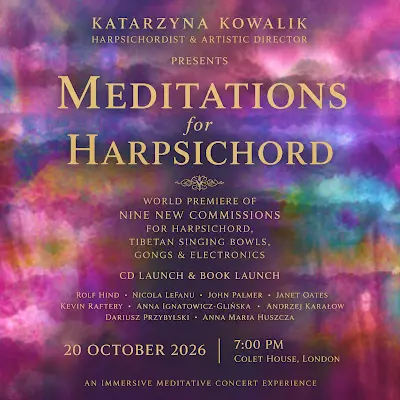
Scheduled for its world premiere on October 20, 2026, at London’s historic Colet House, Meditations for Harpsichord is far more than a simple recital series. It is a massive, binational collaborative undertaking that brings together nine newly commissioned works by five distinguished British and four acclaimed Polish composers. These modern compositions are not written for the harpsichord in isolation; rather, they place the instrument into a vibrant, meditative dialogue with Tibetan singing bowls, resonant gongs, and live electronics.
The initiative moves beyond standard concert programming. It represents an expansive artistic ecosystem comprising international live performances spanning the United Kingdom and Poland through the 2026–2027 season, a physical album release on the Prima Facie Records label, and a companion publication co-edited by Kowalik and composer John Palmer, published by Vision Edition. By weaving together contemporary extended techniques, the profound acoustics of silence, microtonal resonance, and improvisatory freedom, Kowalik and her collaborators are constructing a new sonic vocabulary. This report provides a comprehensive examination of the project, detailing its chronological rollout, the creative mechanics behind the compositions, the institutional partnerships anchoring its success, and its enduring impact on the contemporary classical landscape.
Detailed Chronology: From Concept to International Concert Halls
The genesis of Meditations for Harpsichord traces back several years, born from Kowalik’s artistic desire to push the harpsichord past its traditional comfort zone of Bach, Scarlatti, and Rameau. Recognizing a distinct gap in the contemporary repertoire—where the instrument is rarely afforded the experimental freedoms granted to the piano or electronic media—Kowalik curated a cohort of nine innovative compositional voices.
The Autumn 2026 Premiere Window
The culmination of this multi-year developmental phase arrives in October 2026 with a carefully orchestrated international launch sequence:
- October 20, 2026 (World Premiere): The project officially debuts at Colet House in London, a historic venue renowned for its commitment to the arts, philosophy, and cultural synthesis. This inaugural performance will showcase the full scope of the nine commissions alongside their historical framing pieces. Tickets for this landmark event have been made available via TicketTailor.
- October 24, 2026 (Polish Premiere): Just four days after the London unveiling, the production travels to Warsaw for its Polish premiere at Hashtag Lab, a dynamic contemporary music incubator and performance space known for championing avant-garde and boundary-pushing acoustic projects.
The 2026–2027 International Tour
Following the initial launch windows in London and Warsaw, Meditations for Harpsichord will embark on an extensive touring schedule across the United Kingdom and Poland. Key institutional stops during the 2026–2027 season include:
- New College, Oxford: Bringing contemporary harpsichord exploration into the heart of one of Britain’s most historic academic environments.
- National Centre for Early Music (NCEM): A poignant setting that juxtaposes early music history with the bleeding edge of modern composition.
- The Confraternity of Polish Artists in Great Britain & POSK (Polish Social and Cultural Association): Celebrating the deep bi-national artistic ties at the core of Kowalik’s identity and mission.
- Warsaw Music Encounters Festival: A prestigious platform for contemporary Polish music that will provide a major European festival showcase for the repertoire.
Concurrently with these live dates, October 2026 marks the commercial release of the project’s definitive studio recording on Prima Facie Records. This will be paired with the publication of the Vision Edition book, giving musicologists, performers, and enthusiasts a deep textual dive into the philosophies steering the project.
Supporting Context & Metrics: Repertoire, Instrumentation, and Collaboration
To understand the radical nature of Meditations for Harpsichord, one must examine its intricate architectural design. The project does not merely present nine new pieces; it creates a structural bridge between the historical DNA of the harpsichord and the radical explorations of twenty-first-century sound art.
Historical Anchors and Avant-Garde Explorations
Every performance in the Meditations series is carefully framed by two towering works from the seventeenth-century keyboard canon:
- Louis Couperin’s Unmeasured Prelude: A masterpiece of French Baroque indeterminacy where rhythm is left fluid, inviting the performer to interpret unbarred notation with improvisatory liberty.
- Johann Jakob Froberger’s Méditation sur ma mort future: A deeply philosophical, introspective work that deals directly with mortality, setting an emotionally gravitous tone for the evening.
Out of these historical anchors emerge the nine contemporary commissions. The participating composers—representing a diverse spectrum of aesthetics, generations, and geographical locations—include:
- British Contingent: Rolf Hind, Janet Oates, John Palmer, Kevin Raftery, and Nicola LeFanu.
- Polish Contingent: Anna Ignatowicz-Glińska, Andrzej Karałow, Dariusz Przybylski, and Anna Maria Huszcza.
Acoustic Ecosystems: Harpsichord Meets Metal and Machinery
The sonic profile of the harpsichord is traditionally defined by its plucking mechanism (the plectrum striking the string), resulting in a bright, immediate attack with rapid dynamic decay. In Meditations for Harpsichord, Kowalik and her nine composers manipulate and expand this acoustic reality through complementary instrumentation and technology:

- Tibetan Singing Bowls and Gongs: These percussion elements introduce rich overtones, sustained drone elements, and a meditative metallic wash that envelops the pointed, percussive transients of the harpsichord. The combination blurs the line between tuned and untuned percussion, creating a shimmering, immersive acoustic halo.
- Live Electronics: By integrating digital processing, amplification, and real-time spatialization, the composers stretch the harpsichord’s natural resonance. Sudden silences are magnified, microtonal inflections are highlighted, and the intimate mechanics of the instrument’s key-action become part of the macro-compositional fabric.
- Extended Techniques: Performers interact directly with the instrument’s strings, dampening them manually, exploring internal resonance, and utilizing unconventional articulation methods to transform the harpsichord into a multi-dimensional sound sculpture.
The Companion Volume: Vision Edition Publication
In a move that cements the project’s intellectual and academic rigor, Vision Edition will release an accompanying book co-edited by Katarzyna Kowalik and composer John Palmer. This volume features exhaustive contributions, analytical essays, and personal reflections from all nine participating composers. It serves as a transparent window into the collaborative mechanics of the project, detailing how performers and composers negotiated the physical limitations, microtonal adjustments, and extended demands of the modern harpsichord.
Official Statements & Artistic Vision
In artistic statements regarding the genesis and philosophy of Meditations for Harpsichord, Katarzyna Kowalik has consistently emphasized the need to rescue the instrument from historical ghettoization.
"For too long, the harpsichord has been treated as a museum piece—an instrument trapped behind glass, asked only to faithfully replicate the soundworlds of the seventeenth and eighteenth centuries," Kowalik notes. "With Meditations for Harpsichord, we are breaking the glass. By inviting these brilliant British and Polish composers to reimagine the instrument alongside Tibetan bowls, gongs, and electronics, we are not destroying its history; we are amplifying its future. The harpsichord possesses an incredible wealth of micro-textures, overtone resonances, and percussive nuances that are uniquely suited to meditative, contemporary exploration."
Co-editor and contributing composer John Palmer highlights the cross-cultural synergy of the project:
"This collaboration represents a rare convergence of British and Polish contemporary thought. The composers involved have approached the harpsichord not as a historical artifact, but as a living, breathing acoustic organism. The inclusion of silence, drone-based resonance, and electronics creates a listening environment that demands deep, contemplative attention from the audience—hence the title, Meditations."
Industry observers have praised the project’s multi-pronged approach. By simultaneously releasing a physical album on Prima Facie Records, launching an academic and analytical text through Vision Edition, and mounting a rigorous international tour, Kowalik has established a gold standard for contemporary classical commissioning initiatives. It demonstrates that niche instrumental projects can achieve both high artistic integrity and broad cultural resonance through strategic institutional partnerships.
Future Outlook: Legacy and the Evolution of Contemporary Keyboard Practice
As the classical music world looks toward the conclusion of the 2020s, initiatives like Meditations for Harpsichord offer a vital blueprint for artistic survival and relevance. By refusing to treat historical instruments as dead relics, artists like Katarzyna Kowalik inject new blood into traditional institutions, drawing younger, more diverse audiences who are drawn to ambient, immersive, and experimental sound art.
The international tour spanning the UK and Poland throughout 2026 and 2027 is expected to spark further conversations within academic and performance circles. Conservatory composition departments, historically hesitant to assign contemporary harpsichord works due to a lack of standard repertoire, will now have access to a rich, codified body of nine new works, supported by comprehensive analytical material in the Vision Edition publication.
Furthermore, the integration of non-Western acoustic elements—such as Tibetan singing bowls—with European early music hardware points toward a broader, more inclusive future for contemporary composition. It proves that cross-cultural fertilization does not dilute historical traditions; rather, it reveals hidden facets within them that previous generations could not have imagined.
For modern music enthusiasts, early music purists willing to expand their horizons, and fans of ambient and electroacoustic soundscapes, Meditations for Harpsichord stands out as a defining artistic event of the mid-2020s. Tickets for the world premiere at Colet House on October 20, 2026, are available now via TicketTailor, marking the first step in a journey that will forever change how we listen to the strings of the past.