Executive Overview
The evolution of modern hardware synthesis has been defined by a constant tug-of-war between space-saving portability and hands-on, ergonomic playability. When French music technology pioneer Arturia launched the original MiniFreak—a six-voice, dual-engine hybrid synthesizer boasting a 37-note slim-keybed—it struck a resounding chord with electronic music producers, sound designers, and live performers alike. It offered a volatile, high-character sonic palette that blended digital algorithmic grit with warm analog filtering.
However, a recurring critique from traditional keyboardists and performance-oriented musicians centered on its footprint. For players accustomed to traditional piano-style action or needing more physical range to map complex performance gestures, 37 keys occasionally felt restrictive.
Entering the market to bridge this gap, Arturia has officially pulled the curtain back on the MiniFreak 49. Building directly upon the acclaimed foundation of its predecessor—and hot on the heels of the massive 5.0 firmware update that introduced custom sample and wavetable import capabilities—this new hardware iteration expands the physical canvas.
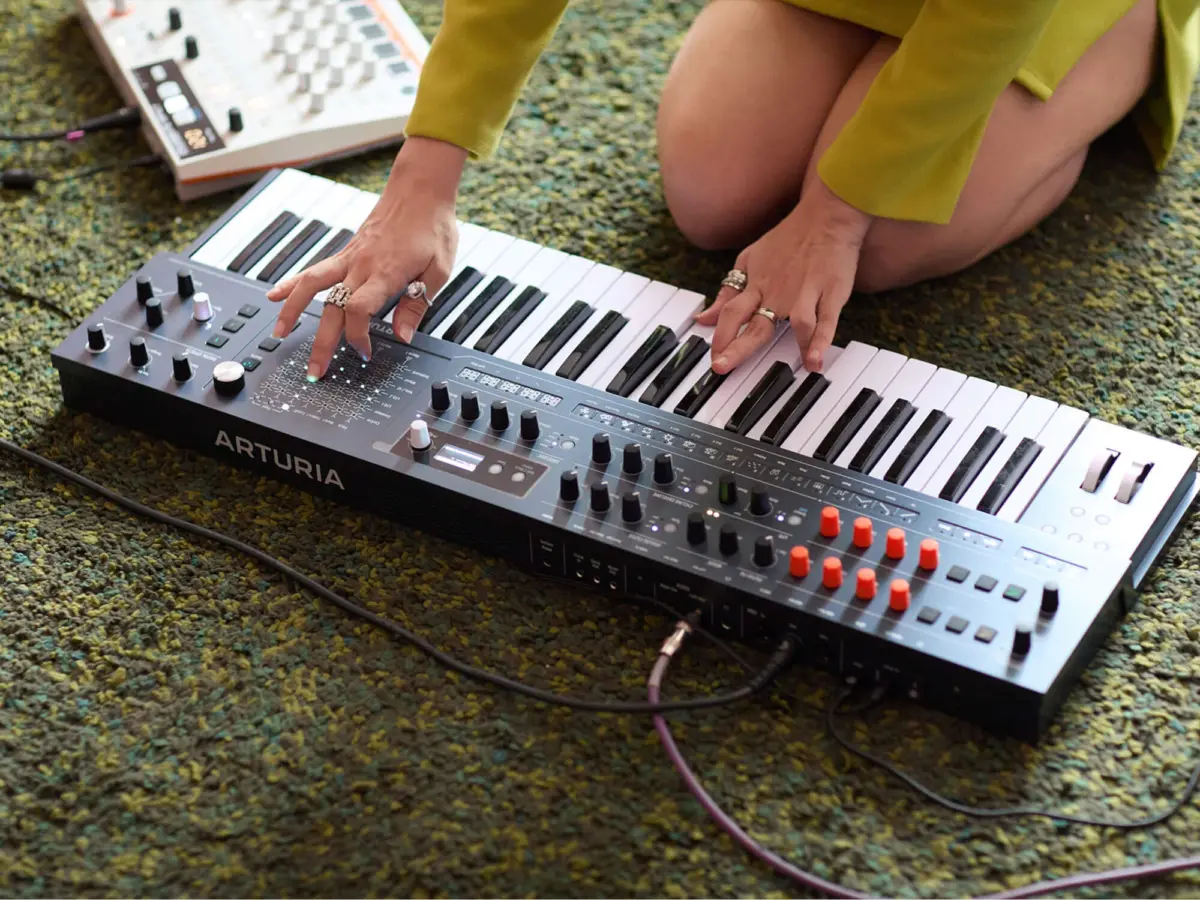
Featuring an expanded 49-note keybed, an all-new XYZ touch control matrix, upgraded panel controls, and a larger OLED display, the MiniFreak 49 retains the subversive, multi-engine architecture that made the original a modern classic while dramatically enhancing its performance ergonomics. Priced at €799, the MiniFreak 49 signals Arturia’s ongoing commitment to scaling its hardware lineup for both studio and stage environments.
Detailed Chronology: From the Original MiniFreak to the 49-Key Evolution
To fully understand the significance of the MiniFreak 49, it is essential to trace the arc of the "Freak" lineage, which began with the quirky, paraphonic MicroFreak and evolved into the sophisticated polyphonic hybrid architecture of the original MiniFreak.
The MicroFreak Genesis and MiniFreak Breakthrough
When Arturia introduced the MicroFreak, it upended the entry-level synthesizer market with its PCB touch keyboard, paraphonic operation, and diverse digital oscillator models developed in collaboration with Mutable Instruments. It proved that musicians craved unpredictability and experimental sound design capabilities at an accessible price point.

Realizing the demand for a fully polyphonic, deeper-engine successor, Arturia engineered the original MiniFreak. Released with a 37-note slim-keybed, it introduced a true six-voice polyphonic architecture spread across a flexible stereo field. Its dual-engine design allowed users to run two distinct sound sources per voice, complete with analog filters and VCAs. Over time, Arturia nurtured the platform with consistent firmware updates, culminating in the monumental Version 5.0 update. This software milestone transformed the instrument into an open-ended sonic laboratory by enabling users to import their own custom samples and wavetables directly into the hardware.
The Hardware Expansion: Introducing the MiniFreak 49
Recognizing that the engine’s depth deserved a broader physical interface, Arturia’s design and engineering teams went back to the drawing board. Rather than merely stretching the chassis, the development of the MiniFreak 49 involved a thoughtful redesign of the control surface, integration of new tactile sensors, and an optimization of the user workflow to match the expanded key real estate.
The resulting instrument addresses the ergonomic limitations of the 37-key version while capitalizing on the advanced capabilities unlocked by recent software iterations. By pairing the expansive sound design power of the 5.0 ecosystem with a larger form factor, Arturia has positioned the MiniFreak 49 not just as a studio tool, but as a premier performance-first hybrid synthesizer.
Supporting Context & Metrics: Architecture, Hardware Upgrades, and Specifications
At its core, the MiniFreak 49 retains the powerful DNA of its predecessor while introducing critical hardware enhancements designed to elevate tactile control and performance expression.
Under the Hood: Sound Engines and Oscillators
The MiniFreak 49 is built around a robust six-voice polyphonic, dual-engine architecture. Each voice features two independent sound engines that can be layered, split, or processed independently.
- Oscillator Algorithms: The synth boasts over 30 oscillator modes, incorporating native Arturia algorithms alongside iconic open-source code from Mutable Instruments and Noise Engineering. This gives users access to everything from classic virtual-analog waveforms and FM synthesis to chaotic West Coast-style wavefolding, granular textures, and speech synthesis.
- Analog Filtering: Every voice passes through a resonant analog filter, imparting warmth, bite, and organic saturation to otherwise pristine digital sources. Furthermore, the unit features Audio-rate Filter Frequency Modulation, allowing for extreme sonic shaping, metallic timbres, and aggressive industrial harmonics.
- Effects Section: Sound manipulation does not stop at the oscillator and filter stages. The MiniFreak 49 includes three dedicated FX slots, each equipped with its own access button and choice from 13 distinct algorithms. Producers can route their patches through lush choruses, sprawling reverbs, crushing distortions, or utilize the built-in vocoder processing for vocal-driven modulation.
Physical and Interface Enhancements
The most immediate differentiator of the MiniFreak 49 is, naturally, its physical size.

- The Keybed: Each of the 49 full-size semi-weighted keys features velocity sensitivity and mono aftertouch, offering a significantly more expressive and traditional playing experience than the slim-keybed found on the original model. Left-hand expression is further augmented by precision-machined aluminum pitch and modulation wheels.
- The XYZ Touch Control Matrix: Departing from traditional rotary knobs or static buttons for modulation routing, the MiniFreak 49 introduces an all-new XYZ touch control matrix. This versatile interface handles performance modulation, navigation, and preset browsing with fluid finger-sweeps. Notably, the matrix can also display reactive visualizers that respond dynamically in real-time to the user’s playing style.
- Display and Panel Layout: Accommodating the wider chassis allowed Arturia to integrate a larger OLED display, providing sharper visual feedback for patch editing, modulation routing, and parameter adjustments. The expanded top panel also features dedicated Type, Wave, Timbre, and Shape controls alongside three selection shortcuts per oscillator for rapid, menu-diving-free sound design.
Sequencing and Presets
For groove-box workflows and generative composition, the MiniFreak 49 includes a powerful 64-step sequencer featuring four independent modulation lanes and a flexible arpeggiator. Out of the box, the instrument ships with 350 factory presets mapped to showcase its vast sonic range, alongside 162 user slots for saving custom creations.
Software Integration: MiniFreak V
Bridging the gap between hardware and software production, every MiniFreak 49 unit includes a digital copy of MiniFreak V. This companion software synthesizer mirrors the exact sound and architecture of the hardware, enabling seamless recall and integration within any DAW environment (VST, AU, AAX) without missing a beat.
Official Statements and Industry Perspective
Arturia’s philosophy behind the design of the MiniFreak 49 centers on balancing structure with chaos—giving producers tools that are simultaneously predictable enough to write traditional melodies with and wild enough to generate unpredictable sonic accidents.
In an official statement accompanying the release, Arturia emphasized the instrument’s interactive nature:
"MiniFreak 49 puts the familiar and the unruly within reach, from rich polyphonic textures to fractured rhythms and abrasive harmonics. Play a chord, reach for a control, press into the matrix. Playing a patch is only the beginning."
Industry analysts and early gear reviewers have noted that the release of a 49-key variant represents a maturation of Arturia’s hardware strategy. By listening closely to consumer feedback regarding key count and physical layout, Arturia has effectively widened the demographic appeal of the Freak ecosystem. Traditional keyboardists who previously bypassed the 37-key model due to ergonomic constraints now have a fully realized, performance-ready workstation that respects standard keyboard real estate while retaining the esoteric, bleeding-edge synthesis capabilities that defined the brand.

Future Outlook: The Role of the MiniFreak 49 in Modern Production
As electronic music production continues to blur the lines between software flexibility and hardware tactility, instruments like the MiniFreak 49 occupy a crucial space in the modern studio ecosystem.
The inclusion of custom sample and wavetable import—introduced via the 5.0 firmware update—combined with the expanded physical controls of the 49-key chassis, ensures that this synthesizer will remain a relevant, evolving platform for years to come. Producers are no longer locked into a static ROMpler or a rigid analog architecture; instead, they have an open-ended, hybrid sound design workstation capable of evolving alongside their creative workflow.
Whether deployed as a primary master keyboard for hardware setups, a generative rhythm machine for IDM and ambient soundscapes, or a seamless DAW controller via its VST counterpart, the MiniFreak 49 establishes a new benchmark for accessible, high-performance hybrid synthesis.
The MiniFreak 49 is available now worldwide at an MSRP of €799. For full technical specifications, regional pricing, and dealer networks, visit the official Arturia website.