Executive Overview
Long before the advent of modern virtual reality, immersive cinema, or digital sound engineering, the master builders of antiquity understood a fundamental truth about human psychology: sound, light, and space shape how we experience reality. Recent breakthroughs in archaeoacoustics, neuroscience, and artificial intelligence (AI) are overturning long-held archaeological assumptions, revealing that the subterranean tombs of the ancient pre-Roman Etruscan civilization were not merely quiet vaults for the dead. Instead, they were engineered as dynamic, theatrical spaces designed to profoundly manipulate the senses of the living.
Focusing on two prominent 5th-century BCE painted tombs in central Italy—the Tomba dei Demoni Azzurri (Tomb of the Blue Demons) and the Tomba del Gallo (Tomb of the Rooster) in Tarquinia—an international team of researchers has mapped out how these spaces operated. Combining data from the University of Oxford-led Sounds of Silence project and Duke University’s Neuroartifact initiative, scientists have recreated the authentic sensory worlds of antiquity.
Far from static galleries of two-dimensional art, these underground burial chambers functioned as high-impact transitional zones between life and death. By expertly manipulating acoustic reverberations, flickering torchlight, spatial architecture, and aromatic incense, Etruscan architects crafted a metaphysical, immersive experience that left an indelible mark on mourners, reinforcing the sociopolitical dominance and enduring legacy of elite families.
Detailed Chronology
Understanding the sensory architecture of Etruria requires a chronological view of how these subterranean monuments were built, experienced, and eventually re-evaluated by modern science.
- 1st Millennium BCE (The Rise of Etruria): The Etruscan civilization flourishes in central Italy, establishing a rich culture deeply attuned to the natural soundscapes of their environment. They maintain ritual calendars dedicated to natural phenomena, such as thunder, and emerge as early innovators of musical performance in the southern Mediterranean.
- 5th Century BCE (Construction of the Elite Tombs): High-status political and socioeconomic leaders in towns such as Tarquinia, Chiusi, and Orvieto commission elaborate subterranean painted tombs. Among these are the Tomba dei Demoni Azzurri and the Tomba del Gallo, designed not just for interment, but for recurring memorial rituals.
- Modern Archaeological Discovery: Over the 19th and 20th centuries, archaeologists discover and excavate these painted tombs. For decades, scholarship primarily treats the vibrant frescoes as flat, two-dimensional artwork to be visually cataloged and studied independently of their architectural and environmental context.
- The AI and Archaeoacoustics Revolution (Late 2010s–Present): Interdisciplinary research groups begin applying cutting-edge technology to ancient structures. The Sounds of Silence project at Oxford utilizes modern acoustic mapping to record how sound travels through ancient spaces, while Duke University’s Neuroartifact program investigates the cognitive impact of ancient artifacts using neuroscience and artificial intelligence.
- The 2026 Breakthrough Study: Researchers publish findings that synthesize acoustic, visual, and AI technologies to evaluate the "performing power" of Etruscan tombs. For the first time, subterranean funerary spaces are comprehensively analyzed as multisensory, transitional environments engineered to manipulate human psychology and emotion.
Supporting Context & Metrics
To truly grasp the sophistication of Etruscan funerary architecture, one must examine the specific sensory levers pulled by their designers. The recent studies underscore several key elements that elevated these tombs from simple resting places to sophisticated experiential engines.
1. Acoustic Engineering and Reverberation
Sound guides human perception, often subconsciously. Inside the Tomba dei Demoni Azzurri, researchers discovered exceptional acoustic properties, including unusually long reverberation times and distinct echoes. In a subterranean chamber carved from solid rock, vocalizations, ritual wailing, or musical instruments would produce a haunting, lingering auditory landscape. This intense acoustic feedback transformed the physical act of mourning into a dramatic sonic performance.
2. The Manipulation of Light and Shadow
Modern visitors often experience these tombs under the harsh, uniform glare of modern LED fixtures or electric lights. However, ancient mourners navigated these spaces by the erratic, warm glow of beeswax and tallow candles, torches, and smoking incense burners.
This low-intensity, flickering illumination fundamentally altered visual perception:
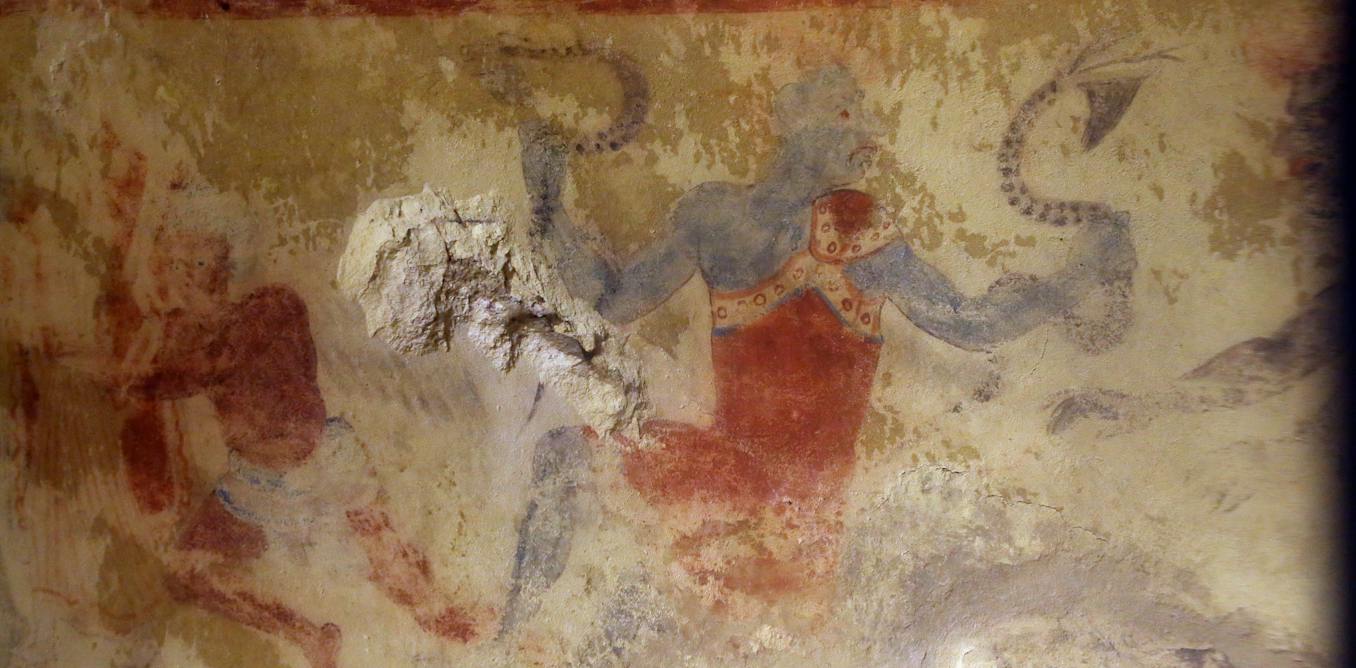
- Dynamic Movement: Shadows cast by torches made static painted figures appear to writhe and shift across the walls.
- Restricted Navigation: Dim lighting constrained movement, forcing mourners to slow their pace, heightening anticipation, and focusing their attention intensely on specific narrative focal points within the frescoes.
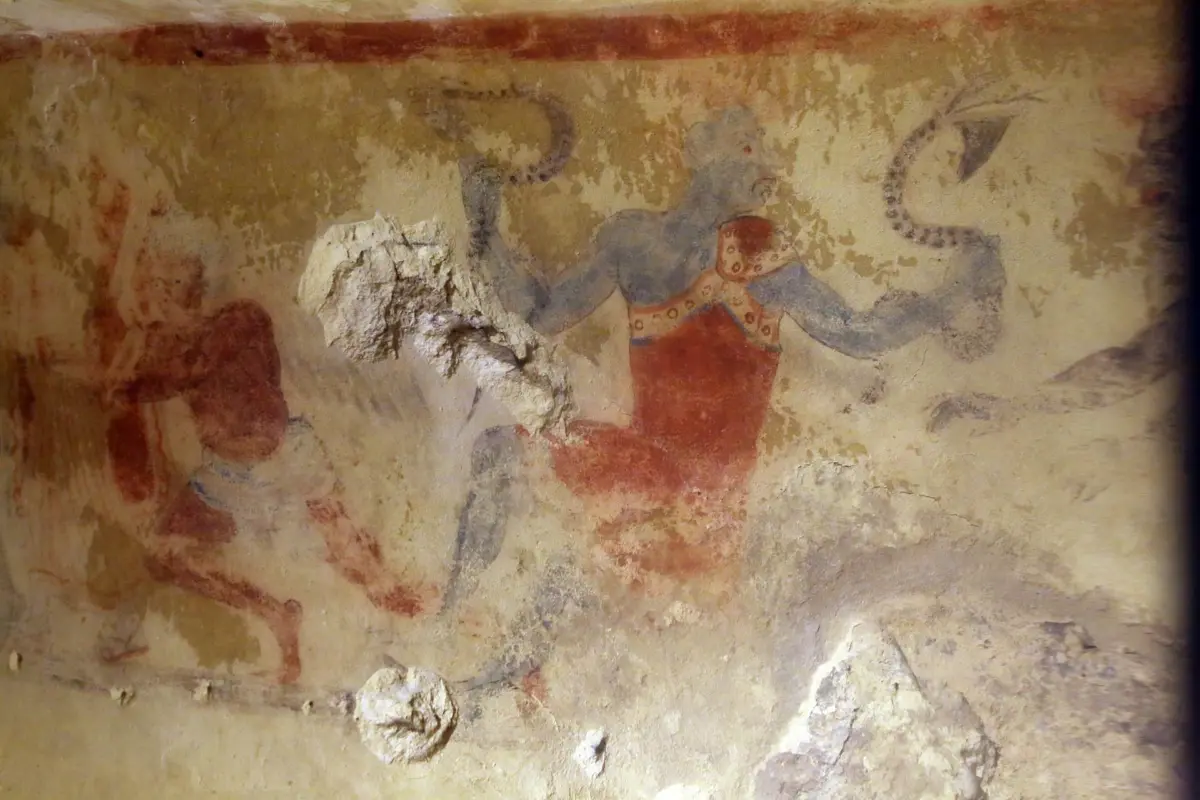
- Psychological Disorientation: In the Tomba dei Demoni Azzurri, merry banqueters depicted on the rear wall contrast sharply with terrifying blue demons crawling up the side walls. In flickering candlelight, these demons appeared as though they were actively breaching the chamber, threatening to step out of the paintings and into the room with the living.
3. Architectural Liminality and Gaze
While the Blue Demon tomb induces perceptual disorientation, other tombs—such as the Tomba del Gallo—prioritize visual attention and spatial discipline. The entrance corridors (dromos) feature narrowing walls and a steeply descending axis. This architectural funneling intentionally disorients and re-orients the physical body, acting as a liminal stage that prepares the visitor’s psyche before they cross the threshold into the main burial chamber. Once inside, benches, carved trenches, and wall niches focus the visitor’s gaze, orchestrating a controlled visual narrative.
Official Statements & Research Perspectives
The integration of advanced digital tools with classical archaeology has opened fresh dialogues among leading researchers in the field. Dr. Jacqueline K. Ortoleva of the University of Oxford, reflecting on her initial fieldwork inside the Blue Demon tomb, noted the startling immediacy of the artwork:
"Upon walking into the Blue Demon tomb for the first time, I was immediately struck by how the paintings seemed to confront me wherever I turned. Merry banqueters on the rear wall appeared unaware of the demons crawling up the side wall, as though ready to burst into the chamber itself."
Dr. Ortoleva and her colleagues emphasize that these spaces operated as theatrical stages built to perpetuate a metaphysical human experience. Rather than serving as static repositories sealed away forever, archaeological evidence suggests these tombs were actively maintained and periodically reopened. Families and clans reused the spaces throughout the year to commemorate vital dates, celebrate seasonal festivals, and worship their ancestors, using the immersive environment to assert their ongoing socioeconomic lineage and political power.
Furthermore, leading academic institutions stress that the classification of "funerary architecture" requires a radical global overhaul. The synthesis of spatial engineering, acoustic resonance, and visual psychology demonstrated by the Etruscans indicates that ancient Mediterranean cultures possessed an advanced, holistic understanding of human neuroaesthetics—an appreciation that modern architectural theory is only beginning to catch up with.
Future Outlook
The revelations emerging from the painted tombs of Tarquinia represent merely the tip of the iceberg for archaeoacoustics and cognitive archaeology. As artificial intelligence models become more adept at simulating historical environments based on incomplete archaeological data, researchers are expanding their horizons beyond interior chambers.
Future research initiatives are already turning their attention to exterior landscapes across the southern Mediterranean and beyond. Open-air sanctuaries, natural amphitheatres, and processional routes used for ancient public rituals are now prime targets for acoustic and AI-driven spatial analysis. By mapping how sound carries across ancient valleys, hillsides, and ceremonial squares, scientists hope to reconstruct the full acoustic ecology of antiquity.
Ultimately, this interdisciplinary wave of research bridges the gap between hard data and human emotion. By unlocking the sensory worlds of the Etruscans, contemporary scholars are proving that the ancient desire to manipulate space, sound, and light to move the human soul is a timeless, universal architectural pursuit.