Executive Overview
Charlotte Brontë’s 1847 masterpiece, Jane Eyre, has long defied tidy theatrical categorization. The novel’s titular heroine may famously describe herself as “plain, and little,” yet the literary world she inhabits looms gargantuan over any stage that attempts to contain it. This tension between intimate interiority and sweeping, elemental grandeur lies squarely at the heart of Jane Eyre: A Musical, a chamber production currently running at London’s Southwark Playhouse until October 24.
Adapted by John Caird and Paul Gordon, the production undergoes a process of radical theatrical reduction. Where once a lavish 1996 Broadway staging boasted a 30-member cast in a cavernous venue, the Southwark Playhouse iteration strips the narrative down to a streamlined “chamber” format. Co-creator John Caird has defended this scaling-down by pointing to the deeply personal nature of Brontë’s text, arguing that the novel is fundamentally an intimate, emotional, and small-scale work driven by first-person narration.
However, this critical assessment overlooks the structural and thematic breadth of Brontë’s original creation. While Jane’s physical journey is largely confined to a handful of northern English settings—Gateshead, Lowood, Thornfield, Moor House, and Ferndean—Brontë’s imagination repeatedly shatters these domestic boundaries. The novel conjures supernatural forces, untamed landscapes, sweeping moorlands, and a visceral gothic terror that pulses just beneath the veneer of Victorian realism.
While Southwark Playhouse’s production delivers powerhouse vocal performances and striking stagecraft, it struggles to reconcile Brontë’s twin impulses: domestic realism and gothic horror. By downplaying the novel’s darker, supernatural undercurrents and sanitizing the complex, combustible figure of Bertha Mason, the musical sacrifices the critical mirror between its protagonist and its “madwoman in the attic.” The result is a touching, beautifully sung love story that ultimately misses the dangerous, subversive shadow narrative that gives Brontë’s novel its enduring power.
Detailed Chronology: From Page to Stage
The 1996 Genesis
The theatrical history of Jane Eyre: A Musical stretches back nearly three decades. Conceived by master adaptor John Caird (best known for his work on Les Misérables) and composer-lyricist Paul Gordon, the musical originally premiered in a lavish, big-budget format in the United States during the mid-1990s. At the time, the production utilized a sprawling 30-member cast, expansive orchestrations, and grand set pieces designed to capture the epic scope of Jane’s life.
The Chamber Reduction
Recognizing that the bloated scale sometimes obfuscated the deeply personal core of Jane’s journey, Caird later spearheaded a dramatic shrinking of the material. This chamber version recalibrates the musical for intimate spaces, reducing the ensemble and instrumentation to focus intently on the psychological evolution of its central character.
The Southwark Playhouse Run
The current iteration at London’s Southwark Playhouse represents the culmination of this minimalist philosophy. Playing to packed houses through October 24, the production relies on a streamlined aesthetic, clever multimedia backdrops, and an ensemble cast that doubles as chorus, household staff, and spectral presences. Yet, as critics and audiences have noted, this transition from epic to chamber piece has necessitated significant dramaturgical omissions—most notably concerning the narrative and thematic weight of Bertha Mason.
Supporting Context & Metrics: Deconstructing Brontë’s Dual Worlds
The Illusion of Small Scale
To understand why shrinking Jane Eyre into a conventional musical romance presents artistic challenges, one must examine the architecture of Brontë’s text. Caird’s justification for a chamber musical rests on Jane’s first-person perspective. The novel opens with a child reading behind a red curtain, moves through the claustrophobic schoolroom at Lowood, and settles into the daily domestic routines of Thornfield Hall.
Yet, to label the novel “small-scale” is to ignore how Brontë weaponizes space. The Yorkshire landscapes are not mere backdrops; they convey an uncanny, almost supernatural agency. The moors represent existential freedom, psychological peril, and spiritual testing. The weather mirrors Jane’s internal volatility: the lightning-split chestnut tree at Thornfield is as emotionally seismic as any traditional romantic plot device.
The Gothic and the Mundane
Brontë masterfully merges two disparate literary traditions: the domestic novel of manners and the gothic horror genre. The narrative dwells meticulously on the prosaic details of Victorian life—clothes, food, weather, sewing, teaching, and the gentle ennui of Thornfield before Edward Rochester’s arrival.
Beneath this domestic realism, however, lurks a dangerous emotional intensity. Dreams, premonitions, mysterious midnight laughter, fires, and ghostly visitations puncture the calm. The novel’s gothic mode is not window dressing; it is the psychological language through which Brontë explores female rage, entrapment, and repression.
Scenography at Southwark Playhouse
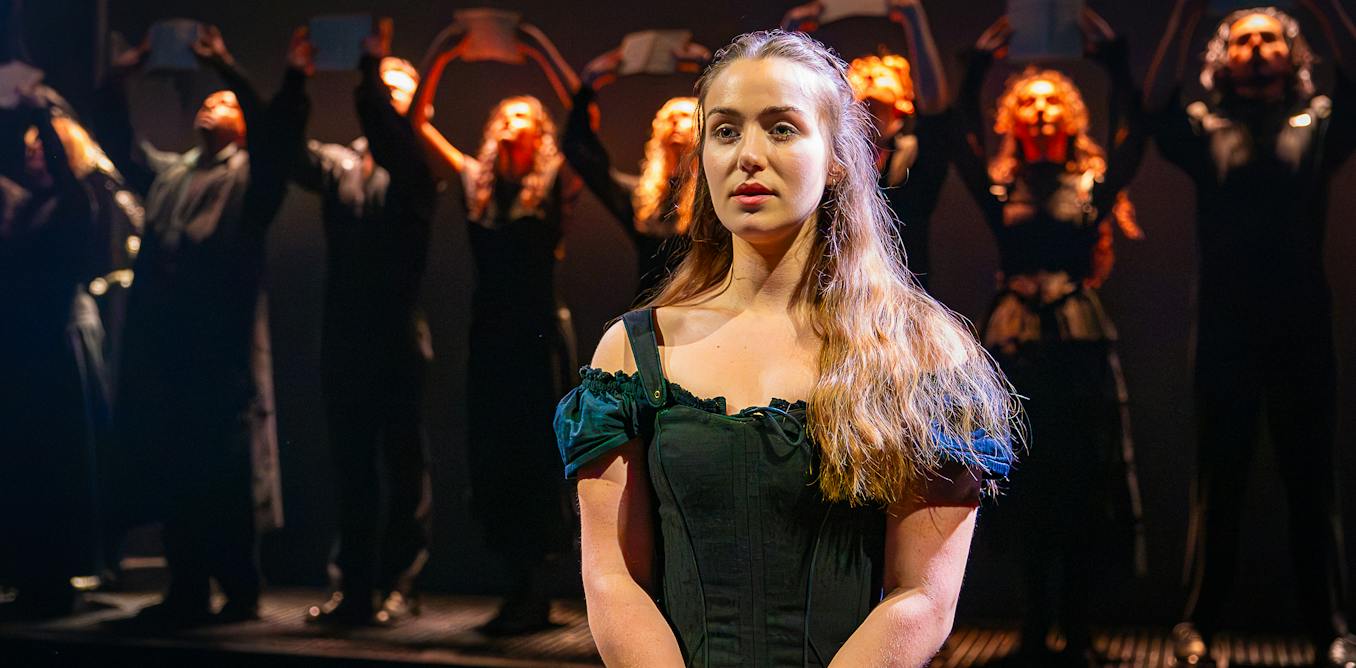
Stepping into the Southwark Playhouse, theatregoers are immediately confronted with the production’s design philosophy. Set designer Morgan Large achieves a striking visual balance between intimacy and gothic chill.
- The Palette: Dominated by stark blacks and pristine whites.
- The Backdrop: A continuous video screen projects a slowly shifting, wintry landscape of low-hanging clouds, barren trees, and mist-shrouded moors.
- The Metaphor: Stage right and left feature clothes horses draped with everyday cloaks, white nightshirts, and caps. While these garments anchor the production in domestic realism, their detachment from human bodies under harsh, clinical lighting renders them ghostly. It is a masterclass in staging the Freudian uncanny—making the familiar strange and unsettling.
Despite these brilliant atmospheric touches, the production struggles when translating the novel’s terror into musical form. Despite the vocal crescendos and polished orchestration, the audience’s heart rarely skips a beat in genuine gothic fear.
Official Statements & Critical Perspectives
The Problem of Bertha Mason
The primary friction point in adapting Jane Eyre for modern audiences lies in the representation of Bertha Mason, Rochester’s institutionalized, Creole wife. In Brontë’s original text, Bertha is depicted in deeply racialized and dehumanizing terms—a violent, swollen-featured, monstrous figure associated with bestial fury and colonial decay.
In the Southwark Playhouse production, played by Hannah Lindsay, Bertha is sanitized into a tragic, almost childish figure. Veiled in pale lace wedding garments with her face obscured by long blonde curls, she attacks Rochester without conveying true menace. At one point, Bertha is even depicted carrying a doll, reframing her as an innocent victim of patriarchal cruelty.
While this directorial choice attempts to avoid staging outdated, racist tropes of the 19th century, it creates a severe dramaturgical disconnect. By softening Bertha into a sympathetic, silent innocent, the production defangs the gothic threat she represents. Yet, having removed her terror, the directors still utilize her as a convenient narrative obstacle, removing her from the plot through the traditional fiery destruction of Thornfield without ever granting her an authentic voice or musical expression.
The Missing Shadow Narrative: Jane and Bertha as Mirrors
Literary scholars have long recognized that Bertha Mason serves as Jane Eyre’s psychological double—the shadow self that harbors the unbridled rage, sexual passion, and wild rebellion that Jane must repress to survive Victorian society. This structural mirroring is established through pervasive bird imagery across the novel.
- Jane as a Bird: Rochester repeatedly likens Jane to “a wild, frantic bird.” In response, Jane makes her famous declaration: “I am no bird; and no net ensnares me: I am a free human being with an independent will.” Notably, this exact declaration is inscribed on a plinth running along three sides of the Southwark Playhouse stage.
- Bertha as a Bird: Bertha is likewise aligned with wildness, fierce captivity, and flight, culminating in her escape onto the roof of Thornfield before her fatal plunge through fire.
In the musical, however, this crucial parallel is completely severed. In the musical number Sweet Liberty, Jane (portrayed with remarkable vocal clarity and emotional depth by Charlie Burn) sings rapturously of “boundless skies” and declares, “I will fly.” Yet, the production fails to draw any thematic line between Jane’s soaring ambitions and Bertha—the woman literally imprisoned within the walls of Thornfield who ultimately attempts to fly from its burning roof. Because Bertha has no voice and no song, the shadow narrative evaporates, reducing the musical to a straightforward romance rather than a complex exploration of female confinement.
Future Outlook: The Evolution of Adaptation
As classical literature continues to face reinterpretation on contemporary stages, productions like Jane Eyre: a Musical highlight the perils and potentials of adaptation. The push toward chamber theatre—driven by economic realities and an aesthetic desire for psychological intimacy—offers exciting opportunities to dissect character motivation in real time.
However, the Southwark Playhouse production serves as a cautionary tale for future adaptors: scaling down a gothic narrative cannot simply mean excising the darkness. When a text as psychologically layered as Brontë’s is stripped of its monstrous elements and its uncomfortable racial and historical undercurrents, the resulting work risks sacrificing its core vitality.
Future stagings of 19th-century classics will need to find courageous dramaturgical frameworks that do not shy away from the grotesque, the uncanny, and the politically complex. Until then, Jane Eyre: a Musical remains a brilliant, vocally soaring testament to what can be achieved within an intimate theatrical space—while simultaneously standing as a reminder of the vast, howling moors of meaning left unmapped outside its doors.