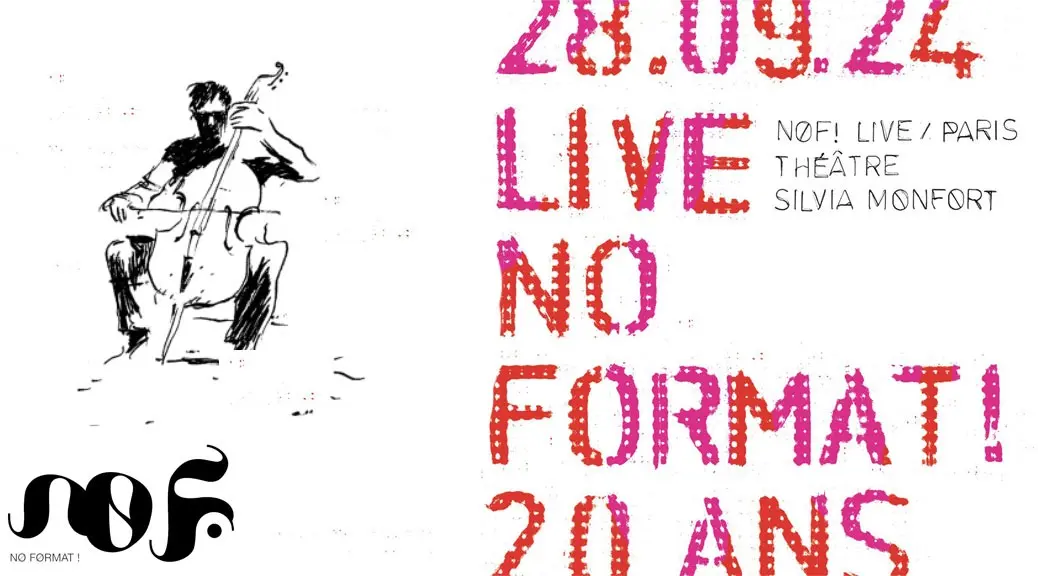
In the heart of Paris, at the Théâtre Silvia Monfort and its surrounding parklands, an empty chair spoke volumes. It was September 28, 2024, and the independent French label No Format! was celebrating its twentieth anniversary with carte blanche given to virtuoso cellist Vincent Segal. The conceptual blueprint for the day was ambitious: a sprawling, day-long series of surprise performances culminating in an ensemble concert uniting the label’s eclectic roster around Segal’s cello and the ethereal kora of Ballaké Sissoko.
Tragedy, however, intervened. In the hours leading up to the performance, Sissoko’s mother passed away, rendering his travel impossible. Rather than cancel or fundamentally alter the evening’s emotional architecture, the assembled musicians chose to leave Sissoko’s seat conspicuously vacant on the stage. They dedicated the night to him, transforming a celebratory showcase into a profound act of musical communion and collective mourning.
Now, that historic evening has been immortalized across a two-sided vinyl release. Comprising eight distinct pieces captured live—with the raw, unfiltered applause meticulously preserved at the close of each track—the album is a testament to the unpredictable, genre-defying ethos that has defined No Format! since its inception in April 2004.
Founded by Laurent Bizot as an antidote to corporate uniformity and the rigid confines of major-label thinking, No Format! operates on a simple, subscription-driven model: subscribers pay upfront for an annual pass, funding an artistic journey whose destination remains unknown, much like a community-supported agriculture veg-box scheme. This review-analysis examines the vinyl recording of that twentieth-anniversary concert, tracing the intricate performances of Segal, Piers Faccini, ALA.NI, Lucas Santtana, Emile Parisien, and Vincent Peirani, while placing the milestone within the broader historical and cultural tapestry of contemporary improvised music.
Detailed Chronology
Side A: Chamber Intimacies and Intercontinental Dialogue
The record opens with "Chamber Music," the titular composition from Sissoko and Segal’s landmark 2009 debut—a record that firmly established No Format!’s penchant for cross-cultural acoustic dialogues. Originally penned for kora and cello, the piece is performed here entirely solo by Segal. Stripped of its traditional counterpart, the performance leverages the natural acoustic resonance of the Théâtre Silvia Monfort in a manner no recording studio could replicate. Segal’s bow navigates the subtle interplay of classical chamber sensibilities, yet the performance pulses with an untamed, visceral energy that instantly commands the listener’s attention.
The atmosphere shifts seamlessly as singer-songwriter Piers Faccini joins Segal for the next four tracks. Born in London to an Italian father and an English mother before relocating to France at age five, Faccini shares a long-standing creative rapport with Segal dating back to their late-1980s encounters in Paris. Together, they revisit Pino Daniele’s "Cammina Cammina," originally a late addition to Daniele’s 1977 debut, Terra mia. The song paints a vivid portrait of an aging man walking by a moonlit harbor, speaking to a world that refuses to pause. Stripped down to a stark combination of weeping cello and impassioned Neapolitan vocalization, the performance achieves staggering emotional depth.
The collaboration expands with "If Nothing Is Real," which marries Faccini’s English lyricism with Sissoko’s melodic architecture. Hailing from their acclaimed duo album Our Calling (released in February 2025), this performance offered the Parisian audience an exclusive, months-early preview of the material. Faccini’s guitar-playing mirrors the rhythmic and textural fluidity of a kora, entering into a fascinating dialogue with Segal’s cello. This pairing evokes comparisons to Sissoko’s legendary duets with South African guitarist Derek Gripper, underscoring the label’s fascination with the conversational interplay of dual string instruments.
The sequence continues with "No Reply," which originally opened Faccini’s 2011 release My Wilderness. Maintaining the string-and-vocal format, the track settles into a rhythmic, saddle-ride gait before fluidly transitioning from English to Italian midway through the performance.
Side A concludes with ALA.NI, an artist whose west London roots and Grenadian heritage deeply inform her artistic identity. Having previously lent her soaring backing vocals to luminaries such as Blur, Mary J. Blige, and Andrea Bocelli before settling in Paris, ALA.NI brings a breathtaking vintage cabaret sensibility to the stage. Her rendition of "Darkness at Noon"—drawn from her 2006 label debut, You & I—carries historical weight; as the great-niece of the legendary Grenada-born cabaret star Leslie Hutchinson ("Hutch"), the sophisticated, bygone era of cabaret music appears to run effortlessly in her blood, supported by minimal, highly evocative instrumental accompaniment.
Side B: Tropicália Resonance and Balkan Winds
Side B opens with what can only be described as the emotional and artistic masterstroke of the evening: a breathtaking rendition of "Para Lennon e McCartney." Originally opening Milton Nascimento’s seminal 1970 album Milton, the song features music by Lô Borges and lyrics by Márcio Borges and Fernando Brant, written during the twilight years of The Beatles. It stands as a poignant message from the cultural heart of Minas Gerais to two transatlantic icons who would never hear it.
Here, the track is interpreted by Brazilian singer-songwriter Lucas Santtana. Born in Salvador in 1970 to Tropicália producer Roberto Sant’Ana and nephew of avant-garde icon Tom Zé, Santtana’s pedigree runs deep; by his early twenties, he was contributing to Caetano Veloso and Gilberto Gil’s milestone 1993 album, Tropicália 2. Santtana’s vocal delivery, underpinned by Segal’s rich cello, burns with quiet intensity.
Adding an eerie, poignant footnote to the performance, production notes reveal that the mixing process for the album began on November 2, 2025—the exact evening that co-writer Lô Borges passed away in Belo Horizonte, cementing this live recording as an unintended, sacred eulogy.
The final movement of the evening belongs to the quartet born out of an unscripted jam session at the 2019 Les Nuits de Fourvière festival above Lyon—a session that ultimately birthed the celebrated collaborative album Les Égarés. While the quartet was intended to feature Segal, Sissoko, soprano saxophonist Emile Parisien, and accordionist Vincent Peirani, the absence of Sissoko transformed the ensemble into a trio.

Peirani’s composition "Izao," the longest track on the vinyl, opens Side B’s closing suite. Peirani anchors the piece with his accordion, holding a sustained drone with one hand while weaving intricate melodies with the other. The acoustic purity of the theatre elevates the performance, soon joined by Parisien’s soprano saxophone. Together, they evoke a sweeping Balkan windstorm, underscored by Segal’s dramatic, rhythmic cello and subtle, spectral wordless vocalizations drifting from the stage.
The evening draws to a close with Marc Perrone’s "Esperanza," a cherished standard in the diatonic accordion canon. Infused with theatricality and participatory audience clapping, the track captures the unmistakable euphoria of an encore, leaving listeners wondering if the audience rose to their feet—a standing ovation that this vital, culturally transcendent release richly deserves.
Supporting Context & Metrics
The Genesis and Economics of No Format!
To fully appreciate the significance of the twentieth-anniversary concert, one must examine the institutional framework that made it possible. No Format! was established in April 2004 by Laurent Bizot, a veteran of the music industry who grew increasingly disillusioned by the corporate homogenization and bureaucratic suffocation he witnessed within major record labels. The breaking point, famously, was the constant repetition of the word "format" in corporate corridors—a term that prioritized marketing demographics over artistic expression.
Bizot’s response was to build a sanctuary for unclassifiable, boundary-pushing artists. The label adopted a defiantly counter-intuitive motto: “You never know in advance what you desire.” This philosophy manifested not only in its eclectic artist roster—spanning classical composition, West African kora traditions, Brazilian Tropicália, and contemporary European jazz—but also in its economic model.
Borrowing inspiration from Community Supported Agriculture (CSA) schemes—specifically organic vegetable box delivery services—No Format! introduced an annual subscription pass. Subscribers pay an upfront fee each year, effectively bankrolling the label’s operational costs and artistic risks without knowing precisely which albums or projects their money will fund. This direct-to-consumer patronage model has insulated the label from shifting industry tides, streaming revenue crashes, and algorithmic curation, ensuring complete creative autonomy for its artists.
Collaborative Milestones: A Data Snapshot
| Milestone / Project | Key Artists Involved | Year | Significance to the Label |
|---|---|---|---|
| Label Foundation | Laurent Bizot | 2004 | Establishment of the anti-format ethos and CSA funding model. |
| Solo Piano | Chilly Gonzales | 2004 | The breakout critical and commercial success that put No Format! on the global map. |
| Chamber Music | Ballaké Sissoko & Vincent Segal | 2009 | Defined the label’s acoustic, cross-cultural dialogue aesthetic. |
| Songs of Time Lost | Piers Faccini & Vincent Segal | 2014 | Cemented ongoing inter-artist collaborations and Mediterranean roots exploration. |
| Les Égarés | Segal, Sissoko, Parisien, Peirani | 2023 | Born from an unscripted jam session at Les Nuits de Fourvière (2019). |
| 20th Anniversary Live LP | Segal, Faccini, ALA.NI, Santtana, et al. | 2024 (Rel. 2025/2026) | Commemorative live recording honoring Ballaké Sissoko in absentia. |
Official Statements
While No Format! has historically eschewed corporate press releases in favor of direct, artist-led narratives, the overarching philosophy of the label and its key architects has been articulated consistently across its two-decade lifespan.
Reflecting on the founding principles of the label, Laurent Bizot noted in retrospective interviews:
"The music industry spends its time trying to fit square pegs into round holes, demanding that artists declare their genre before they have even played a note. We wanted to build a space where the destination is entirely unknown—both to us and to the listener. If you trust the process and support the community of artists directly, the music will always find a path that no focus group could ever predict."
In discussing the spontaneous nature of collaborations like those witnessed at the Théâtre Silvia Monfort and the previous gathering at Les Nuits de Fourvière, Vincent Segal emphasized the necessity of risk in modern performance:
"When you remove the safety net of endless rehearsals, you force the musicians to listen with absolute intensity. You aren’t playing a chart; you are having a conversation in real-time. The empty chair on stage for Ballaké [Sissoko] reminded us that music is never just notes on a page—it is life, loss, and community happening in the exact same room, at the exact same second."
Future Outlook
As No Format! moves past its twentieth-year milestone, the label faces both the enduring structural challenges of the modern independent music sector and the unique opportunities afforded by its fiercely loyal subscriber base.
The success of the twentieth-anniversary vinyl release—punctuated by unexpected historical echoes, such as the passing of Lô Borges on the very evening mixing commenced—underscores the label’s uncanny ability to capture cultural moments that transcend standard commercial parameters. Moving forward, the label intends to double down on its subscription model, exploring new avenues for direct artist-fan engagement that bypass traditional streaming intermediaries.
Furthermore, the organic evolution of ensembles born from spontaneous festival jams—such as the quartet configuration featuring Segal, Parisien, and Peirani (alongside Sissoko)—demonstrates that No Format!’s catalog is not a static collection of discrete albums, but an interconnected, living ecosystem. As long as Laurent Bizot and his collaborators continue to champion the unformatted, the unexpected, and the acoustically daring, No Format! will remain an essential beacon for independent music in Europe and beyond.