Executive Overview
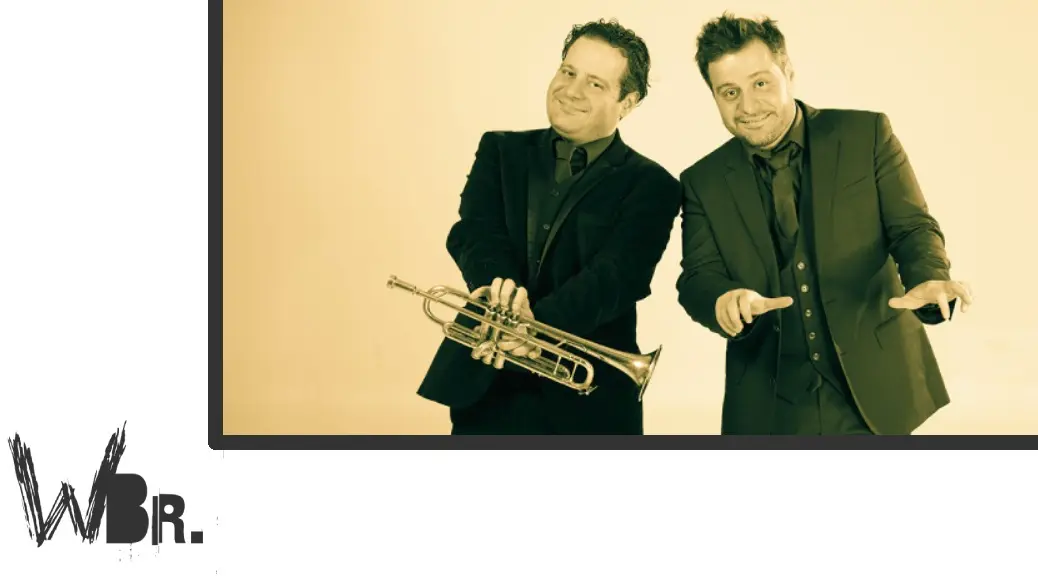
The release of Inspired Songs, the seventh studio album by twin brothers Konstantin and Alexander Wladigeroff, marks far more than a routine milestone in contemporary European jazz. Issued under the Germanized spelling of their ancestral surname—Wladigeroff, distinguished from their grandfather’s cataloged identity as Pancho Vladigerov—this fourteen-track, seventy-minute opus functions as a sprawling theatrical revue. It brings together an eclectic ensemble of international collaborators from Vienna and Sofia, seamlessly merging big-band swing, Brazilian MPB, contemporary jazz, hip-hop, and avant-garde cabaret.
Yet, beneath its rich sonic tapestry lies a profound historical gravity. Born in Sofia on August 17, 1978, to conductor and composer Alexander Vladigerov, the twins arrived into the world just three weeks before the death of their legendary grandfather, Pancho. As the scions of a towering Bulgarian musical dynasty, the Wladigeroff brothers do not merely inherit a legacy; they actively interrogate, recontextualize, and project it into the 21st century.
Lavishly produced with the backing of SKE—the cultural fund of the Austrian mechanical-rights society Austro Mechana—Inspired Songs showcases an unflagging artistic ambition. From the sweeping, cinematic overture of "Ode To Joy" to the madcap, German-declaimed operatic chase of "Tom Darf Nicht Jerry Werden," the record defies rigid genre classification. Simultaneously, the brothers maintain an active footprint in live-scoring silent cinema, most notably performing their original score to F.W. Murnau’s 1925 masterpiece Tartuffe. This performance loop directly connects their contemporary European base in Vienna back to the intellectual and artistic epicenters of Weimar-era Berlin, where their grandfather once shaped the soundscapes of Max Reinhardt’s legendary Deutsches Theater.
Detailed Chronology: A Century of Musical Inheritance
To understand the intricate architecture of Inspired Songs, one must trace a transatlantic and intergenerational lineage that spans over a century of European cultural history.
The Patriarchs: Pancho and Lyuben Vladigerov (1912–1932)
The genesis of the Vladigerov musical dynasty traces back to 1912, a watershed year when twin brothers Pancho and Lyuben Vladigerov—Pancho a prodigious composer and pianist, Lyuben a gifted violinist—left Bulgaria for Berlin on prestigious state scholarships. They immersed themselves in the city’s hyper-creative pre-war and Weimar-era cultural milieu.
In January 1923, the duo achieved a major artistic breakthrough by premiering the Bulgarian Rhapsody ‘Vardar’ in Berlin. To this day, Vardar remains Pancho Vladigerov’s most frequently performed and celebrated work, serving as a cornerstone of Bulgarian classical nationalist music. During the same era, Pancho established a lucrative and creatively fertile association with theatrical impresario Max Reinhardt at the Deutsches Theater. Writing incidental and atmospheric music for Reinhardt’s productions, Pancho remained rooted in Berlin until 1932, absorbing the theatricality, structural discipline, and emotional intensity that would permanently characterize the family’s creative DNA.
The Intermediary Generation: Alexander Vladigerov
The torch was passed to the next generation through Alexander Vladigerov, a respected conductor and composer based in Sofia. It was under his roof on August 17, 1978, that the current generation of twins—Konstantin and Alexander Wladigeroff—was born. Poignantly, just three weeks after their birth, patriarch Pancho Vladigerov passed away in the same city, cementing a temporal and metaphysical bridge between the founding era of modern Bulgarian composition and its contemporary vanguard.
The Modern Heirs: Konstantin and Alexander Wladigeroff (1978–Present)
The modern Wladigeroff brothers inherited not only the family’s musical aptitude but also a remarkably symmetrical distribution of its instrumental tradition. Konstantin took up the piano at the age of five, while his twin, Alexander, picked up the trumpet at nine—occupying the exact sonic space once commanded by their great-uncle Lyuben’s violin.
After foundational studies in Sofia, the brothers relocated to Vienna, which continues to serve as their primary creative base. Alexander further burnished his classical and contemporary credentials at the prestigious Royal Academy of Music in London. Embracing the Germanized spelling of their surname (Wladigeroff), the twins have steadily built an extensive discography. Inspired Songs represents their seventh outing under their own names, arriving on the heels of their critically acclaimed 2022 release, Magie (Aparté), which set Rainer Maria Rilke’s poetry for singers, a chamber choir, and a full ensemble.

Supporting Context & Metrics: The Anatomy of a Revue
Inspired Songs breaks away from the traditional, streamlined jazz trio or quartet format. Instead, it operates on a grand scale, throwing open the doors of the studio to an international cast of musical friends and virtuosos.
Ensemble Metrics and Instrumentation
Across fourteen tracks, the Wladigeroff brothers weave together a massive constellation of performers without adhering to a rigid track-by-track breakdown. The sheer scale of the production is reflected in its roster:
- The Brass and Woodwind Section: Trombonists Velislav Stoyanov and Vladislav Michev provide rich, resonant harmonies, complemented by tenor saxophonists Arnau Garrofé Farràs and Vladimir Karparov. The lower registers are anchored by baritone saxophonist Kiril Chobanoff and bassoonist Gueorgui Chachikov.
- Textural and Harmonic Colorists: Flip Philipp contributes bell-like vibraphone textures, Bertl Mayer injects earthy harmonica lines, and Boki Radenkovic provides multifaceted guitar work.
- The Rhythm Section: Low-end duties are shared fluidly between bassists Navid Djawadi and Vasil Hajigrudev, working in tandem with a powerhouse rotation of five drummers, most notably veteran percussionist Stoyan Yankulov.
- Vocal Ensembles and Special Guests: The record features prominent appearances by the Sofia-based a cappella quintet Spectrum Vocal Band and the Vienna Morphing Quartet. Venturing far beyond conventional jazz parameters, the album also incorporates the turntable artistry of DJ Stanchika and the agile rhymes of MC Florian Tavernier.
Structural Breakdown of the Tracklist
Played from end to end, Inspired Songs functions as a theatrical variety bill, where every track introduces a completely new stylistic turn:
- The Theatrical Overture: The album curtain rises with "Ode To Joy," blending uplifting, massed vocal arrangements with full band and orchestral forces to achieve a thrilling crescendo. This is immediately followed by "The Best Things For You," a high-energy big-band swing number highlighted by winking vocal deliveries and Philipp’s buoyant vibraphone.
- Cabaret and Rap Fusion: "Lyutenichka" stands as a compositional high-water mark. Infused with the bones of European cabaret, the track organically absorbs a modern rap cadence toward its conclusion, proving the ensemble’s dexterity in bridging historical and contemporary idioms.
- Global Excursions: The record pivots effortlessly across cultural and geographical borders. "Lost In Thoughts" shifts into the relaxed, sun-drenched grooves of Brazilian MPB, sung in authentic Portuguese. "The Little White Horse with the Yellow Scarf" deploys precise handclaps, complex scat singing, and a blistering saxophone solo, treating human voices as an integrated horn section. Meanwhile, "Love In July" and "Invisible Truly Things" pare down the arrangement to soul-drenched English jazz vocals.
- Contemporary High Points: "Like You" represents a moment of exquisite minimalism, thinning the cast to allow contemporary jazz harmonies room to breathe. Conversely, "R.Hargroove’s Blues" serves as a poignant, high-stepping tribute to the late trumpeter Roy Hargrove, pairing muted trumpet lines with manouche-style gypsy jazz guitar before opening up into clarinet and scat improvisations.
- Wild Comedic Interludes and Closure: "Culture Shock" rides a relentless, gutsy bassline beneath Florian Tavernier’s rapid-fire delivery, which DJ Stanchika’s vinyl scratching pulls firmly into R&B territory. The comedic zenith arrives with "Tom Darf Nicht Jerry Werden" (Tom Must Not Become Jerry), a chaotic, operatic kitchen-chase scene declaimed in German. The album finally brings up the house lights with "In Christ Alone," a modern hymn by Keith Getty and Stuart Townend whose folk-rooted melody effortlessly mirrors traditional Irish air.
Official Statements & Artistic Vision
While the Wladigeroff brothers let their expansive arrangements and genre-defying compositions speak largely for themselves, their institutional and promotional framework clearly articulates a mission of cultural synthesis.
In public disclosures regarding the funding and realization of Inspired Songs, representatives for the project emphasize the intentionality behind blending classical European structural discipline with spontaneous, global vernaculars. The integration of SKE (the cultural fund of Austro Mechana) highlights an institutional recognition of the brothers’ work as a vital contribution to contemporary Austrian and European cultural heritage.
Furthermore, the brothers’ parallel work in live-scoring silent cinema provides a clarifying lens on their artistic philosophy. By re-scoring F.W. Murnau’s Tartuffe for festivals such as CinEast in Luxembourg, the Wladigeroffs explicitly connect their contemporary improvisational ethos to the golden age of Weimar cinema. This interdisciplinary approach—doubling down on clarinet (Konstantin) and percussion (Stoil Ivanov) to converse frame-by-frame with a 1925 silent film—demonstrates their belief that historical art forms are not museum artifacts, but living, breathing catalysts for new creative expressions. As Murnau himself served his apprenticeship as an actor at Max Reinhardt’s Deutsches Theater during the exact years Pancho Vladigerov was composing music there, the circle of artistic lineage is inextricably and beautifully closed.
Future Outlook
As Konstantin and Alexander Wladigeroff look beyond the release of Inspired Songs, their trajectory points toward an increasingly borderless and interdisciplinary future. The critical and commercial reception of their seventh studio album proves that there is a thriving, sophisticated audience for music that refuses to choose between high-art classical composition, theatrical revue, and grassroots global groove.
Looking ahead, the brothers show no signs of slowing their relentless creative output. Their ability to pivot fluidly from lush, multi-national studio productions featuring over a dozen guest artists to intimate, high-wire live cinematic accompaniments—such as their ongoing Tartuffe project—positions them as uniquely versatile cultural ambassadors.
For the contemporary European music scene, the Wladigeroff brothers offer a vital blueprint: how to honor a monumental family dynasty without being crushed beneath its weight. By treating their grandfather Pancho’s legacy not as a fixed monument, but as a dynamic springboard for jazz improvisation, electronic scratching, Brazilian rhythms, and cabaret satire, Konstantin and Alexander Wladigeroff ensure that the Vladigerov name will resonate vibrantly across the musical landscape for decades to come.