Executive Overview
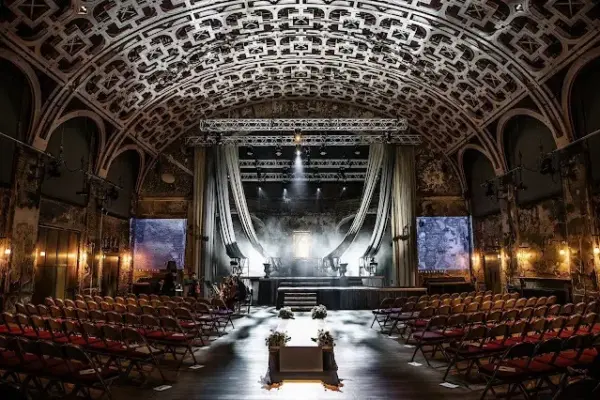
Oxford, England — In the crisp twilight of October 10, 2026, the Olivier Hall at St Edward’s School bore witness to an artistic triumph that will long echo through the annals of classical vocal performance. Gathering for the opening weekend of the prestigious Oxford International Song Festival, a capacity audience assembled to experience one of the towering monuments of the Romantic song repertoire: Franz Schubert’s Winterreise (D. 911).
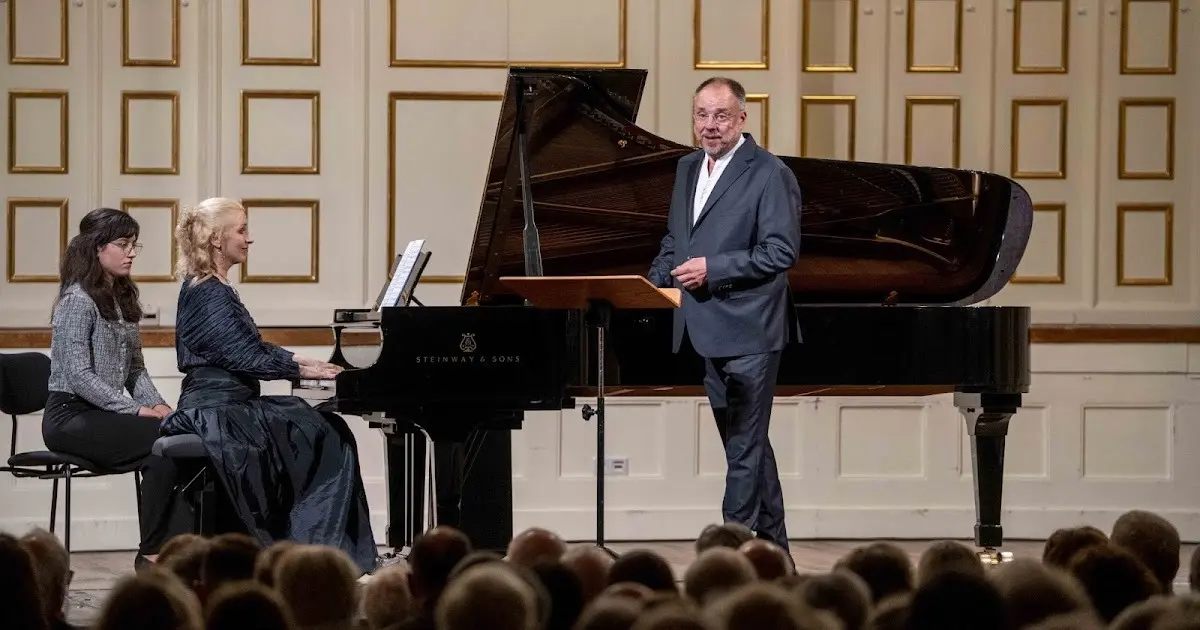
The event marked a historic milestone on multiple fronts. It served as the long-overdue festival debut for renowned German baritone Matthias Goerne, an artist whose career spans nearly three decades of iconic interpretations across the globe. Partnering with him was the visionary pianist Tamara Stefanovich, whose fearless, uncompromising musicianship provided the structural bedrock for an unforgettable evening.
Rather than treating Wilhelm Müller’s heart-wrenching poetry and Schubert’s melancholic score as a museum piece, Goerne and Stefanovich approached the 24-song cycle as a living, bleeding psychological document. Singing entirely from memory, Goerne bypassed conventional vocal polish to deliver a raw, physically embodied portrait of a man unravelling at the edges of reality. The performance challenged standard conventions—not least through the deployment of English subtitles, a novel innovation for the festival—and redefined what it means to age into a role. As the evening progressed, it became abundantly clear that the further the protagonist advanced into his wintry exile, the harder the going became, transforming Winterreise from a linear narrative into a deeply disturbing exploration of a fractured psyche.
Detailed Chronology: A Descent into the Winter Landscape
Part I: Departure, Deception, and Rising Panic
The evening opened with ‘Gute Nacht’, taken at a deliberate, measured pace that avoided sluggishness while remaining soaked in acute anxiety and bone-chilling melancholy. From the very first notes, observers noted a striking vocal profile: Goerne’s expressive legato, while occasionally limited by the natural ravages of time and a massive career workload, was superseded by a fragile, fluttering vibrato. This fragility, married to an intensely restless physical language, established the architecture of his performance.
Transitioning immediately into ‘Die Wetterfahne’, Tamara Stefanovich unleashed an uncompromising, crystalline piano tone that collided with Goerne’s dark, brooding baritone. Together, they conjured a visceral wave of anger, setting the tone for a protagonist whose emotional stability was already compromised. As the cycle wound its way through ‘Erstarrung’, the tension escalated to a razor’s edge. Goerne’s voice pushed toward its upper limits, capturing a poet completely beside himself, standing precariously on the precipice of a nervous breakdown.
Even moments traditionally marked by a temporary sense of solace offered no relief. In ‘Der Lindenbaum’, Stefanovich’s transparent, delicate keyboard work refused to function as a calm way-point. Instead, it highlighted the poet’s accelerating delusion. Goerne’s gaze remained perpetually averted from the audience, fixed inward, creating the eerie impression that the protagonist was occupying an entirely different plane of reality. This detachment bled seamlessly into ‘Auf dem Flusse’, which resonated with the unsettling intimacy of a fragmented folk tune sung purely to oneself.
As the first half deepened into the dark recesses of ‘Irrlicht’ and ‘Rast’, the emotional temperature dropped further, culminating in a ‘Frühlingstraum’ that existed entirely within the chaotic confines of a fevered imagination.
Part II: The Disturbed Destination
If the first half of Winterreise chronicled a physical and emotional journey away from society, the second half felt less like travel and more like the exploration of a terminal psychological destination. Narrative elements flickered past—such as the ominous flapping of wings in ‘Die Krähe’—but the primary focus shifted toward profound alienation.
In ‘Im Dorfe’, Goerne offered a remarkable physical enactment of the narrative, using posture and gesture to mirror the abandonment of the village. By the time the duo reached ‘Der Wegweiser’, the iconic line "travel a road from which no man returned" carried an unbearable weight, striking at the absolute core of the protagonist’s isolated doom.
One of the evening’s most staggering achievements was ‘Das Wirtshaus’. Taken remarkably slowly and performed with breath-holding quietude, it produced a surprising, almost supernatural magic. This stillness stood in stark, jarring contrast to the desperate, manic vigour of ‘Mut’.
As the performance neared its bleak conclusion, ‘Die Nebensonnen’ revealed a poet completely at the end of his tether. Goerne stretched out the final phrases with agonizing deliberation. Throughout the second half, both artists utilized rubato with devastating expressive intent. While individual tempos were not necessarily sluggish, the pacing incorporated vast expanses of space, resulting in a remarkably expansive, heavy reading of the cycle.

When the final notes of ‘Der Leiermann’ finally faded into the Oxford night, the audience was left with a profound sense of exhaustion and catharsis. Yet, Goerne’s final interpretation offered no comforting closure. In his hands, the organ-grinder was not a definitive end, but a terrifying symbol of eternal damnation—a man doomed to wander forever within the frozen labyrinths of his own delusion.
Supporting Context & Metrics: The Evolution of a Master
To fully appreciate the gravity of Goerne’s Oxford performance, one must examine the trajectory of his illustrious career. It has been nearly 30 years since Goerne made his landmark debut at the Salzburg Festival in 1997, enchanting audiences as Papageno in Mozart’s Die Zauberflöte. Half a decade later, in 2002, he cemented his reputation as a fearless theatrical force with his chilling, physically demanding portrayal of the title role in Alban Berg’s Wozzeck at the Royal Opera House, Covent Garden (famously performed amid glass tanks of water).
Over the decades, Goerne has scaled the heights of the German repertoire, mastering the demanding orchestral songs of Richard Strauss, Gustav Mahler, and, above all, Richard Wagner. That immense vocal and theatrical baggage—the "water and Wagner" that has flowed under the bridge of his career—was acutely felt in Oxford. Goerne no longer sings Winterreise as a youthful seeker; he sings it as an elder statesman of song who has lived through the psychological ruins the cycle depicts.
Festival Innovation: The Subtitle Debate
The inclusion of English subtitles at the Olivier Hall introduced a fascinating dynamic to the evening. Designed to liberate audience members from the traditional curse of keeping their eyes glued to printed translation booklets, the innovation largely succeeded in keeping gazes focused on the stage. However, purists noted a familiar paradox: in a song cycle where Schubert frequently repeats textual phrases and dynamically adjusts the musical flow to mimic psychological flux, fixed translations occasionally misaligned with the wider context of a specific poetic line. Nevertheless, the compromise highlighted the Oxford International Song Festival’s ongoing commitment to modernizing the concert-going experience without sacrificing artistic integrity.
Official Statements and Critical Reception
While formal press releases from the festival administration praised the opening weekend as a resounding triumph, the critical consensus among attending musicologists and reviewers focused heavily on the symbiotic partnership between Goerne and Stefanovich.
Festival organizers noted in pre-event briefings that securing Goerne for an opening-weekend slot was a cornerstone ambition for the 2026 programming. In post-concert reflections, critics singled out Tamara Stefanovich’s role in anchoring what could otherwise have been an overwhelmingly dark and disintegrating vocal performance. Stefanovich, celebrated worldwide for her advocacy of both contemporary music and standard masterworks, brought a clarity of touch that illuminated Schubert’s harmonic architecture even as Goerne pushed the boundaries of vocal tone.
One festival spokesperson remarked off the record:
"Matthias does not merely perform these songs; he occupies them. Partnered with Tamara’s fearless intelligence, this is Schubert stripped of all polite parlor conventions. It is raw, elemental art."
Future Outlook: The Legacy of a Landmark Performance
The success of Goerne and Stefanovich’s Winterreise sets a remarkably high benchmark for the remainder of the Oxford International Song Festival and signals a vibrant future for vocal performance that prioritizes lived experience over pristine vocalism.
As classical music audiences increasingly crave authenticity and deep emotional engagement over slick, mechanized perfection, performances of this caliber point the way forward. Goerne’s willingness to embrace vocal fragility—substituting sheer volume and seamless legato for raw expressive power and physical commitment—offers a masterclass for the next generation of Lieder singers.
For Tamara Stefanovich and Matthias Goerne, this collaboration reinforces their status as towering interpreters of the German Romantic canon. As they take this program on potential future international tour dates, listeners elsewhere are advised to prepare themselves not for a pleasant evening of classical music, but for an uncompromising, unforgettable journey into the darkest corners of the human soul.