Opera Holland Park has returned to Johann Strauss II’s immortal 1874 operetta, Die Fledermaus, exactly a decade after its last mounting of the work. Premiering on July 29, 2026, this bold new production is directed and choreographed by Liam Steel, conducted by George Jackson, and performed by the ever-reliable City of London Sinfonia.
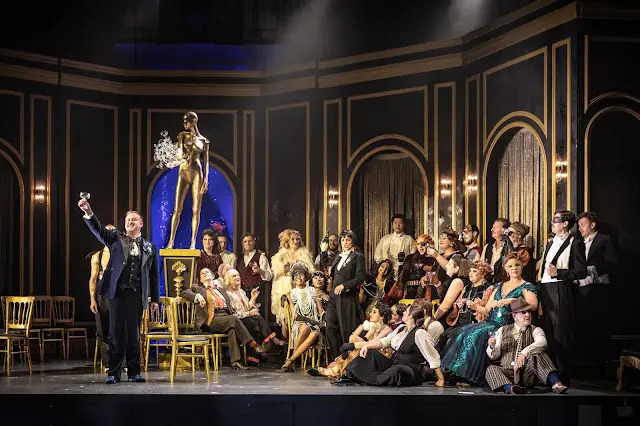
Transposing the action from nineteenth-century Vienna to the decadent, jazz-soaked twilight of London on New Year’s Eve, 1929, Steel’s vision captures the hedonistic energy of the "Bright Young Things." While the production benefits from sterling musical values, virtuosic orchestral phrasing under Jackson, and a brilliantly clear narrative arc that demystifies one of the genre’s most convoluted librettos, it occasionally stumbles in the translation of its spoken dialogue. Nevertheless, buoyed by a stellar cast featuring Thomas Atkins, Alison Langer, and Julien Van Mellaerts, Opera Holland Park has delivered a visually inventive and musically intoxicating evening that proves the enduring, effervescent appeal of Viennese operetta when handled with theatrical panache.
Detailed Chronology: A Night at the 1929 London Gala
Act I: The Domestic Prelude and the Shadow of the Bat
The production opens on the fore-stage, stripped of traditional operatic clutter to resemble a slick, upscale 1930s London hotel drawing-room, backed by a moody cityscape. Here, Eisenstein (Thomas Atkins) and his wife, Rosalinde (Alison Langer), find themselves mired in domestic friction. Atkins imbues Eisenstein with suave, effortless charm masking a profound and dim-witted vanity—a man quite literally impossible to trust, yet impossible to look away from.
Crucially, Steel introduces a physicalized manifestation of the backstory: dancer Harry Wilson appears as a human-sized bat, serving as an eerie, silent alter-ego for Dr. Falke (Julien Van Mellaerts). This physical framing device immediately grounds the plot’s inciting incident—Falke’s humiliation at the hands of Eisenstein years prior, left asleep in a public park dressed as a bat.
When Falke arrives to invite Eisenstein to Prince Orlofsky’s high-society New Year’s Eve gala, the gears of revenge begin to turn. The domestic scenes sparkle musically, particularly in the famous Act I trio where Rosalinde, Eisenstein, and Adele (Rebecca Bottone) balance on the knife-edge of compulsive dance. However, while the musical pacing under George Jackson is crisp, the spoken dialogue—utilizing Jeremy Sams’s text and Douglas Carter Beane’s adaptation—feels overly arch, leaning heavily on literary puns and local British references that weigh down the comedic momentum rather than making it fizz.
Act II: The Midnight Hour and the Peak of Decadence
The narrative shifts to Prince Orlofsky’s party, set against the stroke of midnight as 1929 bleeds into 1930. Here, the production hits its theatrical stride. Clare Presland plays Orlofsky (dropping the traditional "Prince" title) as a gender-fluid, languid aristocrat. Despite being saddled with an inconsistent Russian accent, Presland dominates the musical landscape, delivering Orlofsky’s solo with deep-rooted style and making the character a formidable, charismatic center of gravity.
Rebecca Bottone’s Adele is a masterclass in comic timing, playing the maid-turned-aspirational-socialite with a delicious Cockney edge while effortlessly nailing the stratospheric coloratura demands of the role. Meanwhile, Alison Langer’s Rosalinde simmers with discreet, justified rage, her voice ringing out brilliantly before culminating in a show-stopping Csardas. Though staging the Csardas on the main stage behind the orchestra creates a slight acoustic imbalance, Langer’s vocal commitment remains absolute.
Julien Van Mellaerts’s Falke is a dapper, campy mastermind, luxuriating in his malicious orchestration of the evening’s deceptions. Around them, Xavier Hetherington plays Alfred as an unapologetically over-the-top, luxury-toned tenor divo, while Matthew Siveter’s bluff, Yorkshire-accented Frank adds hearty comedic ballast. Notably, this production succeeds where many fail: for the first time in years, the bewildering mechanics of the grand ruse—why characters assume fake identities (such as the running gag of cod-French) and how the plots intersect—are rendered crystal clear.
The interval is brilliantly timed to coincide directly with the midnight chimes of Act Two, flanked by vibrant, intoxicating Strauss waltzes that prevent the scene changes from dragging.
Act III: The Prison Reckoning and Resolution
The final act relocates to a prison office on the fore-stage with holding cells visible on the main stage. Robert Burt delivers a wonderfully concise and effective turn as the drunken jailer Frosch, while Monwabisi Lindi’s befuddled lawyer, Blind, engages in sharp comedic interplay with Atkins’s imprisoned Eisenstein.
As the web of disguises unspools and the various infidelities and deceptions come to light, Falke’s grand revenge faces its reckoning. In a surprisingly tender late-act moment, Van Mellaerts’s Falke laments that his elaborate planning has resulted in universal forgiveness and a happy ending, leaving the audience feeling a twinge of sympathy for the mastermind whose malice was ultimately deflected by human folly. The production wraps up in a flurry of self-aware theatricality, celebrating the sheer, unadulterated joy of communal deception.
Supporting Context & Metrics
The Operetta Paradox: Why Die Fledermaus Stands Alone
Johann Strauss II’s legacy as the "Waltz King" is unassailable, yet his contributions to musical theatre suffer a strange paradox. While Die Fledermaus (1874) remains a global staple, works like Eine Nacht in Venedig and Der Zigeunerbaron have largely vanished from contemporary repertoires. Musicologists frequently attribute this to libretto deficiencies, as many nineteenth-century Viennese operettas relied on frantic boulevard comedies weighed down by excessive plot mechanics (as seen in Strauss’s lesser-known Blindekuh).
Die Fledermaus survives and thrives because it sidesteps this trap. By front-loading its inciting incident (the "bat" prank) before the curtain rises—a structural trick shared by Verdi’s Il trovatore and Wagner’s Parsifal—and utilizing the Act Two party as an engine for rapid-fire comic encounters, the work relies primarily on its infectious, life-affirming score.
UK Performance Frequency Metrics
In the United Kingdom, Die Fledermaus is a relatively rare visitor compared to standard core operatic repertoire:
Royal Opera House: Last staged the work in 1990.
English National Opera (ENO): Mounted Christopher Alden’s production for a single run in 2013.
Opera Holland Park: Previously produced the work in 2016 (marking a 10-year gap to this 2026 revival).
Fringe and Regional Houses: Intermittently kept alive by companies like Opera Integra (2017), St Paul’s Opera (2024), and The Grange Festival (2025).
Production Creative Team
Director & Choreographer: Liam Steel
Conductor: George Jackson
Orchestra: City of London Sinfonia
Set Designer: Neil Irish
Costume Designer: Laura Jane Stanfield
Translation/Adaptation: Jeremy Sams (lyrics) and Douglas Carter Beane (dialogue, originating from the 2013 Metropolitan Opera version)
Official Statements & Artistic Vision
Speaking on the conceptual framework of the production, director Liam Steel noted the decision to anchor the operetta in late-1920s London rather than fin-de-siècle Vienna:
"The world of the Bright Young Things—defined by a desperate, frantic need for distraction, hedonism, and reinvention—mirrors the exact psychological space of Strauss’s characters. They are running from their mundane realities into a masquerade of their own making. By moving the timeline to 1929, we unlock a natural vocabulary of physical theatre, jazz-age styling, and social satire that resonates sharply with modern audiences without losing the dizzying, champagne-fueled joy of the original score."
Conductor George Jackson emphasized the symbiotic relationship between pit and stage, praising the City of London Sinfonia’s agility:
"Strauss operetta requires absolute rhythmic precision combined with absolute rhythmic freedom—the rubato must feel like a heartbeat, not an afterthought. Working with the City of London Sinfonia and this exceptional vocal ensemble allowed us to find the genuine symphonic weight beneath the froth. The waltzes aren’t just background music; they are characters driving the narrative forward."
Future Outlook
Opera Holland Park’s 2026 mounting of Die Fledermaus serves as a masterclass in how to breathe theatrical vitality into a nineteenth-century masterpiece through bold design choices and rigorous musical direction. While the spoken dialogue occasionally labored under the weight of its own cleverness, the production’s success in clarifying a famously convoluted plot sets a high benchmark for future stagings of Viennese operetta in the UK.
As regional and mid-scale opera houses continually search for repertoire that bridges high art and accessible entertainment, Steel and Jackson’s collaborative triumph suggests a viable path forward: honor the structural genius of the score, commit fully to physical storytelling through an integrated ensemble, and never shy away from the dark, petty human impulses that drive comedic chaos. Following this critically acclaimed run, anticipation will undoubtedly be high for Opera Holland Park’s subsequent programming decisions as they continue to champion neglected or underperformed gems alongside the grand classics.