Executive Overview
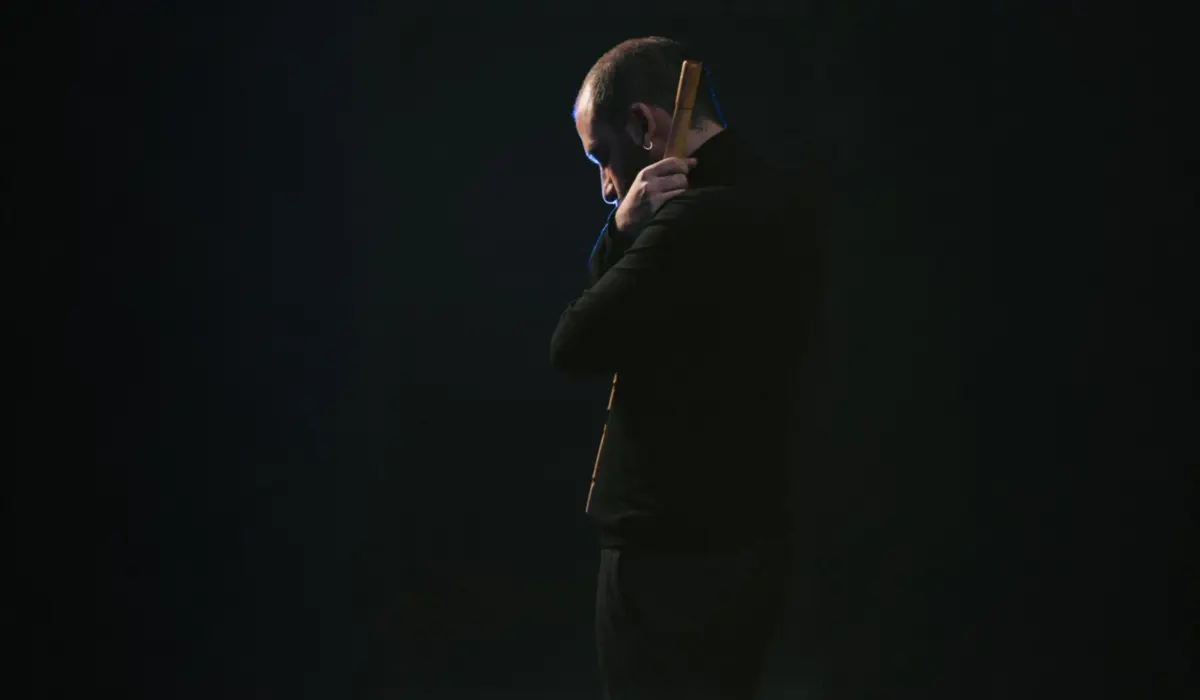
In an era dominated by hyper-production, digital quantization, and calculated commercial formulas, Palestinian multi-instrumentalist Faris Ishaq offers a masterclass in radical acoustic intimacy. Armed with nothing more than a 5,000-year-old Middle Eastern reed flute known as the nay and a leg-mounted frame drum, Ishaq creates an immersive, polyphonic sonic world entirely on the spot. His music bridges the ancient traditions of his homeland—specifically the percussive-melodic woodwind style known as tashbib—with the sophisticated improvisational architecture of global jazz.
As part of the Musical Road to WOMEX series, this profile explores Ishaq’s evolution from a teenager in Bethlehem tinkering with a discarded piece of Jericho reed cane to a globally recognized innovator. With a resume that includes a top-student distinction at Berklee College of Music, collaborations with Grammy-winning bassist John Patitucci, soundtrack work for the BAFTA-nominated Assassin’s Creed Mirage, and the premiere of his concerto A Wildscape at London’s Southwark Cathedral, Ishaq is redefining the boundaries of acoustic performance.
His latest release, JASAD (Arabic for "body"), strips away all studio wizardry. Recorded live with zero overdubs in his Bethlehem studio, the album is a physical manifestation of breath, muscle, and memory. Ahead of his showcase performance at WOMEX in Las Palmas de Gran Canaria, Ishaq discusses the philosophy of his craft, the intersections of movement and sound, his training as a music therapist, and how he keeps an ancient heritage defiantly alive.
Detailed Chronology: From a Bethlehem Bedroom to Global Stages
The Accidental Discovery
Faris Ishaq’s relationship with the nay began not through formal institutional instruction, but by sheer serendipity. At the age of twelve, he enrolled at the Edward Said National Conservatory of Music in Palestine, where he spent four years mastering the euphonium—a brass instrument worlds away from the earthy, breath-dependent reed flutes of the Middle East.
When Ishaq was sixteen, his uncle acquired a piece of raw reed cane from the historic oasis city of Jericho. Intrigued, the uncle asked Ishaq’s older brother to drill finger holes into the cane so he could attempt to play it. The brother obliged, crafting a rudimentary instrument. However, before the uncle ever had the chance to lay hands on the finished flute, young Faris intercepted it. He picked it up, played it, and refused to let it go.
While the euphonium taught him Western music theory and discipline, the homemade nay captured his soul. There were no keys, no mechanical valves, and no standardized mouthpiece to guide him—just a hollow tube of cane, human breath, and an endless expanse of trial and error.
The Epiphany of Dhafer Youssef
The turning point that illuminated the instrument’s vast, uncharted potential came when Ishaq witnessed Tunisian oud master and vocalist Dhafer Youssef perform live. Youssef’s commanding stage presence, emotional depth, and fearless exploration of the human voice profoundly impacted the young musician. Watching Youssef pushed Ishaq to imagine the nay not merely as a traditional folk artifact, but as a vehicle for profound, contemporary musical expression capable of conversing with any genre on earth.
Berklee and the Global Jazz Horizon
Armed with a full scholarship, Ishaq crossed the Atlantic to attend the prestigious Global Jazz programme at Berklee College of Music. Immersed in an environment that welcomed cross-cultural dialogue, Ishaq began fusing the microtonal intricacies of Arabic maqam with advanced Western jazz harmony. His unorthodox approach and virtuosic execution earned him top honors as the program’s leading student.
Since his time at Berklee, Ishaq’s trajectory has accelerated exponentially. He has released three critically acclaimed albums, collaborated with jazz royalty including Grammy-winning bassist John Patitucci, and expanded his compositional reach into gaming and classical spaces. Notably, his distinctive nay stylings echo through the BAFTA-nominated soundtrack of Assassin’s Creed Mirage, introducing millions of global gamers to the haunting resonance of Middle Eastern woodwinds. Furthermore, he crossed into classical orchestral territory by premiering his original concerto for the nay, A Wildscape, at London’s historic Southwark Cathedral.
Supporting Context & Metrics: Anatomy of the JASAD Project
The Sound of JASAD
Ishaq’s latest artistic statement, JASAD, represents a deliberate return to roots. Recorded entirely live in his studio in Bethlehem, the album features no band, no click tracks, and no digital overdubs. The instrumentation is aggressively minimal: a single nay and a frame drum strapped securely to his leg.
Despite the Spartan setup, the music is overwhelmingly dense. Ishaq channels the complex, driving improvisational runs of jazz icon John Coltrane through the modal framework of Arabic maqam. Simultaneously, he infuses the performance with the kinetic energy of Palestinian dabke, a traditional line dance he practiced professionally during his school years. The rhythmic footwork, stomps, and leaps of dabke are translated directly onto the leg-mounted frame drum, creating a symbiotic relationship between lower-body percussion and upper-body melodic wind execution.
The Philosophy of Tashbib
When critics or journalists describe Ishaq’s work as a "revival" of Palestinian tashbib—a traditional melodic-percussive woodwind practice—he is quick to correct them.
"I wouldn’t say I revived Palestinian tashbib," Ishaq insists. "It was always there."
Tashbib, a term that translates literally to "to become young," is characterized by its joy, earthiness, and unrelenting rhythmic drive. Rather than treating heritage as a museum piece to be preserved under glass, Ishaq views it as a living, breathing ecosystem. To him, the rhythmic urgency of tashbib and the physical stomping of dabke are physical embodiments of dignity, resilience, and an unbroken connection to the land.
Music Therapy as a Creative Foundation
Crucially, Ishaq’s formal training as a music therapist underpins his entire compositional and performance methodology. Music therapy taught him to look beyond technical flashiness and focus on the psychological and emotional utility of sound. This background influences how he builds a piece from the ground up: every microtonal bend, every breathy overblown harmonic, and every sustained drone is intentionally calculated to hold, ground, and heal the listener. In an era marked by societal exhaustion and collective trauma, Ishaq’s performances function as acoustic sanctuaries.
Official Statements & Artist Q&A
In an exclusive interview, Faris Ishaq delves deeper into the mechanics of his craft, his upcoming global itinerary, and the philosophy that guides his breath.
On Description and Setup
For a first-time listener, how would you describe the sound and the setup?
"My sound is rooted in Palestinian and the broader Arabic musical tradition, while also drawing from Global Jazz and cross-cultural musical dialogue. I play the Nay flute and a leg-mounted frame drum at the same time. I sometimes describe what I do as similar to what an electronic music producer does, except my only playground is the Nay and the frame drum. I use them to build a live, layered and immersive sound, combining melodies, rhythms and acoustic effects in real time.
I describe the frame drum as a natural extension of how I play the Nay, which involves a lot of percussive tonguing and playing with and around the rhythm. I also grew up dancing Palestinian Dabke professionally at school, which involves rhythmic stomping and movement. I translate some of the rhythmic footwork of Dabke onto the leg-mounted frame drum. It’s my own way of connecting movement to music."
On Shepherds, Open Spaces, and Silbo Gomero
The nay grows out of a shepherd’s music, and traditions like the Canaries’ silbo gomero share that open-air heritage. Is there anything in that shared root you are curious to explore?
"The Nay has a long history across many cultures and countries, and similar reed flutes have taken many different forms and roles. I’m not sure the Nay grew only from shepherds’ music. I can definitely imagine that they started from that human desire to resonate with the natural beauty around us, open spaces, rivers and mountains. It’s fascinating how we developed such technologies through sound and our connection to the land. As you mentioned, silbo gomero is a beautiful example of this.
In a similar way, Palestinian Tashbib is a melodic-percussive way of playing traditional woodwind instruments… In Palestine, we call it Tashbib, which literally means ‘to become young,’ and it’s full of joy, rhythm and earthiness. Musically, it leaves space for improvisation and percussive interplay with and around the rhythms of traditional Palestinian songs and Dabke dance stomps. Essentially, to me, the rhythmic energy of Tashbib and the Dabke stomps are a way of showing dignity and our connection to the land and its soil."
On the WOMEX Showcase and Immersive Worlds
In a WOMEX line-up full of the world’s traditions, what makes yours stand out, and what do you hope people take away?
"I was particularly drawn to combining Tashbib and jazz because they both share an improvisational spirit connected with identity, as well as the rhythmic interplay of playing in and around the beat. But my album is not only about bringing Tashbib and jazz together. It’s about creating an immersive experience with the Nay that honours its roots and expansive musical potential, while also offering a grounding and healing space after the madness humanity has experienced in the past years.
What stands out musically is that I create a complete world of musical expressions and sounds on the spot, using only the Nay and a leg-mounted frame drum. From that place, I combine Tashbib and Global Jazz influences with rich Arabic maqam modalities, Dabke and other rhythms, together with my original acoustic nay effects that have taken years to develop. All of these elements come together to create a singular musical language."
On Intimacy and Audience Resonance
The nay responds only to breath and intention. How does playing to an attentive delegate and music professional audience shape your performance?
"It will be an honour to share my music with music professionals from around the world. The very first thing the audience hears is how I feel in that moment, rather than a planned musical sentence. I shape my repertoire, improvisations, and textures according to how I feel at the start of the show and throughout the performance. For example, playing in a cathedral is very different from playing in a seated concert hall or to a standing audience. I enjoy resonating with the type of venue, atmosphere, and, most importantly, the audience, who mostly shape the musical journey. Playing for delegates and music professionals is the same. In the end, I want to create an immersive sonic journey that honours the sound of the Nay."
Future Outlook: The Road Ahead
Far from resting on the international acclaim of JASAD, Ishaq’s calendar points toward an aggressively active future across multiple continents.
- Global Tour Schedule: The JASAD international tour hits major cultural hubs this autumn. Following stops at Arter in Istanbul on September 13th and the Melbourne Jazz Festival on October 18th, Ishaq will take the stage at WOMEX in Las Palmas de Gran Canaria on October 24th, before heading to the UK for a high-profile performance at the EFG London Jazz Festival on November 14th.
- Orchestral Ambitions: Beyond his solo setup, Ishaq is actively working to expand his ambitious orchestral concerto, A Wildscape, building upon its triumphant premiere at Southwark Cathedral.
- New Ensemble Explorations: Proving that his restless creative curiosity cannot be contained by a solo rig, Ishaq is simultaneously writing and recording material for an upcoming album featuring a traditional jazz quartet, further cementing the dialogue between Middle Eastern modalities and Western swing.
As Faris Ishaq steps onto the WOMEX stage on October 24th, he carries with him more than just a hollow reed cane from Jericho. He carries an unbroken lineage of breath, the kinetic memory of Palestinian dance floors, and a fierce artistic independence that proves that the simplest instruments are often capable of expressing the most complex human truths.