Executive Overview
In an era where musical cross-pollination often feels superficial—a fleeting collaboration engineered for streaming algorithms—Sydney-born multi-instrumentalist Julian Belbachir has achieved something profoundly rare. With his latest single, "M’Bara Meskin," released on September 11, Belbachir has taken a centuries-old devotional song from Morocco’s revered Gnawa tradition and seamlessly reconstructed it using the pulsating, deep-bass architecture of reggae and dub.
The track serves as the lead single for Belbachir’s highly anticipated upcoming studio album, The Golden Light, slated for a February 2027 release. Spanning recording sessions across Morocco, Mali, Australia, Canada, and Jamaica, "M’Bara Meskin" is more than a sonic experiment; it is a transnational dialogue built on shared histories of displacement, resilience, and spiritual expression.
At its core, the song tells the poignant story of M’Bara, an impoverished figure left outside a shrine in tattered clothes, forced to brew his tea from discarded leaves while elites inside sip comfortably in their slippers. For Belbachir, this historic Moroccan lyric transcends its literal origins to become a universal metaphor for the precarity and daily hardships faced by working musicians worldwide.
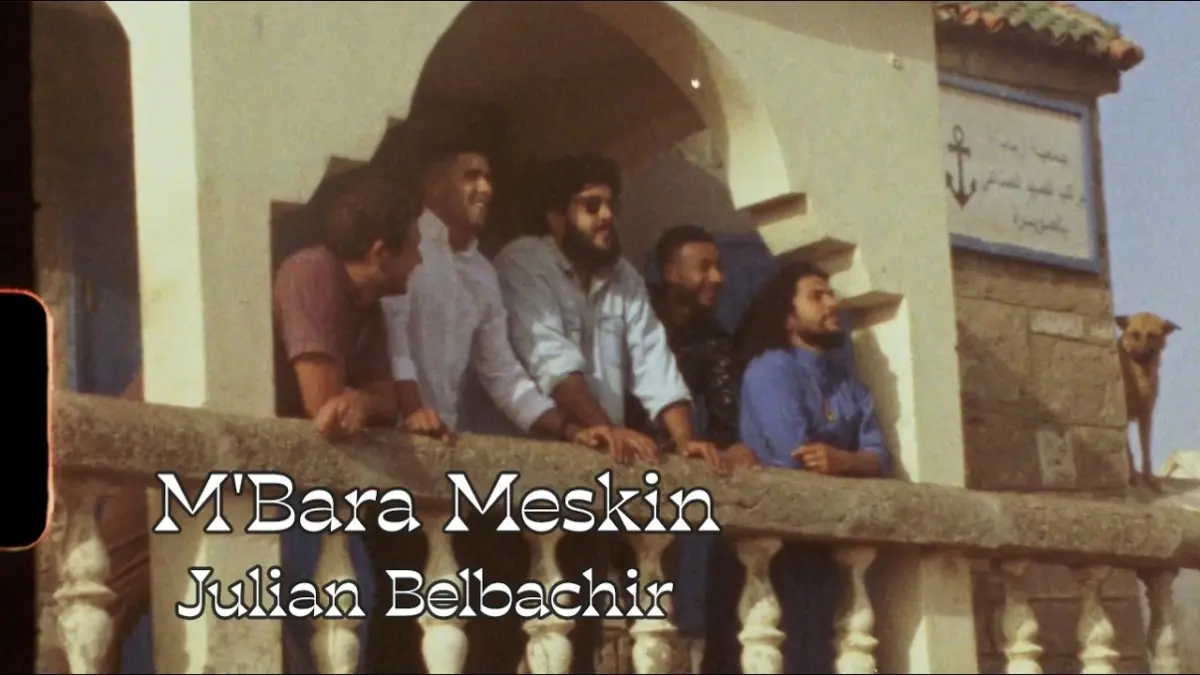
Backed by a stellar ensemble of over 30 musicians—including legendary Malian lead guitarist Moussa Diakite (known for his work with Salif Keita)—Belbachir’s work traces the historic trans-Saharan routes that originally birthed Gnawa music. Accompanied by a poignant Super 8 music video filmed across multiple years in the Atlantic port city of Essaouira, "M’Bara Meskin" establishes Julian Belbachir not merely as a preservationist of world music, but as a visionary architect charting the future of global roots music.
Detailed Chronology: From the Inner West of Sydney to the Trans-Saharan Diaspora
Formative Years in Sydney’s Cultural Melting Pot
Julian Belbachir’s journey into the heart of global percussion began far from the North African shrines of his ancestry. Born to a Moroccan father and an Australian mother, Belbachir grew up in the culturally vibrant inner-city Sydney neighborhoods of Surry Hills and Redfern. In these creative hubs, he was exposed early on to diverse diasporic communities.
By the age of five, Belbachir was already taking his first formal steps into rhythm, studying West African drumming under the guidance of traditional griots and master drummers embedded within Sydney’s African diaspora. This early immersion laid a foundational discipline that would define his artistic trajectory: a deep respect for traditional oral lineages coupled with an open-minded approach to cross-cultural collaboration.
Apprenticeships Across West Africa and North Africa
Determined to move beyond surface-level appreciation, Belbachir spent years traveling across West Africa and North Africa. He immersed himself in intensive studies of percussion and instrument-making in Guinea, Senegal, Mali, and Morocco.
During these field studies, he mastered the kamele n’goni, the traditional harp-lute originating from Mali’s legendary Wassoulou region. This instrument, with its hypnotic, cyclical phrasing, would later become a vital textural bridge in his musical arrangements, effortlessly harmonizing the acoustic warmth of West African string traditions with the heavy, electronic sub-bass of Jamaican dub.
The OKA Years and Solo Emergence
From 2013 to 2022, Belbachir’s career entered a high-velocity touring and recording phase when he joined OKA, an acclaimed Australian Indigenous dub band known for their potent fusion of electronic dance beats, didgeridoo, and world percussion. Touring extensively with OKA honed Belbachir’s understanding of how ancient acoustic traditions could be integrated into contemporary soundscapes without losing their spiritual core.
The trajectory shifted abruptly following the untimely death of OKA founder Stuart “Boga” Fergie. Stepping out from the collective framework, Belbachir stepped boldly into solo territory with his critically acclaimed 2022 debut solo album, Babdoukkala. The album signaled his arrival as a singular voice capable of steering complex, multi-continental recording projects.
This momentum culminated in the sprawling, multi-year sessions for his upcoming sophomore project, The Golden Light, which expands his collaborative network to more than 30 artists spanning Mali, Morocco, Canada, Jamaica, and Australia.
Supporting Context & Metrics: The History and Evolution of Gnawa Music
The Trans-Saharan Roots of Gnawa
To understand the profound weight of "M’Bara Meskin," one must examine the origins of Gnawa music itself. Historically, Gnawa music was carried into Morocco by West Africans who were forcibly brought north across the Sahara Desert, many of them subjected to slavery. Despite the immense trauma of displacement, these communities preserved their ancestral spiritual practices, syncretizing them over centuries with Islamic Sufi traditions in North Africa.
The result was a deeply therapeutic, trance-inducing musical style characterized by the rhythmic metallic clinking of qraqeb (castanets), the low, driving thrum of the guembri (a three-stringed lute covered in camel skin), and call-and-response chants designed to invoke healing spirits (mluk).
Remarkably, the personnel contributing to Belbachir’s The Golden Light follow this exact historical route in reverse and in expansion, uniting contemporary African masters to honor and evolve the lineage. Among the heavy-hitters featured on the album is Moussa Diakite, the celebrated lead guitarist for Salif Keita, whose intricate fretwork bridges Malian Afro-pop sensibilities with North African modal structures.
The Anatomy of "M’Bara Meskin"
The focal track of this transnational exchange, "M’Bara Meskin," centers on a centuries-old narrative from the Moroccan Gnawa repertoire. The lyrics tell the story of poor M’Bara:
- Left outside the sacred shrine in tattered clothes.
- Reduced to brewing his daily tea from leaves discarded by more fortunate passersby.
- Contrasted sharply with the Sidi and the Lalla (traditional Moroccan honorifics denoting a gentleman and a lady) who sip their tea in comfort inside the shrine, wearing their slippers.
Rather than updating the track with sterile electronic production, Belbachir chooses the vehicle of reggae and dub. The genre choice is far from arbitrary; both Gnawa and dub music share a foundational obsession with hypnotic bass frequencies, cyclical rhythms, and spiritual release from socio-economic hardship. By anchoring the Moroccan Arabic vocal performance in a deep-dub soundscape, Belbachir highlights the universal resonance of the lyric.
Visualizing Resilience: The Super 8 Documentation
To accompany the single release, Belbachir crafted a visually striking music video shot entirely on Super 8 film. Captured over two separate trips to Essaouira—the Atlantic port city celebrated globally for its annual Gnawa Festival—spaced three years apart, the visual artifact feels both intimate and timeless.
The footage documents Belbachir’s collaborators through raw, unvarnished moments: behind-the-scenes rehearsals, late-night recording sessions, and quiet fellowship within their local community. By avoiding high-definition digital gloss in favor of the warm, tactile grain of Super 8, the video mirrors the sonic warmth of the audio recording, anchoring the project firmly in human connection rather than commercial artifice.
Official Statements and Artistic Philosophy
Unpacking the Metaphor of the Outsider
Julian Belbachir’s artistic vision for "M’Bara Meskin" extends far beyond historical reenactment or musical fusion for its own sake. In interviews surrounding the release, the multi-instrumentalist has articulated a clear socio-political and personal interpretation of the song’s core narrative.
"I hear the song as a portrait of the hardships musicians face in their daily lives," Belbachir explains, drawing a direct line between the marginalized figure of M’Bara sitting outside the shrine and the precarious economic realities endured by independent artists in the modern global music economy.
Despite dedicating their lives to cultural preservation, community healing, and artistic creation, musicians frequently find themselves on the outside looking in—dependent on the scraps left behind by institutional and commercial gatekeepers. By centering M’Bara’s story, Belbachir transforms a piece of folklore into an anthem for creative perseverance.
A Global Studio Paradigm
The creation of The Golden Light represents an ambitious departure from traditional localized studio recording. By pulling together musicians from Morocco, Mali, Australia, Canada, and Jamaica, Belbachir has constructed a borderless audio ecosystem.
Industry analysts tracking world music and roots fusion have noted that projects of this scale often risk sounding disjointed due to the perils of file-sharing and remote overdubbing. However, Belbachir’s hands-on fieldwork—living, playing, and recording face-to-face with his collaborators across continents—ensures that every organic groove, plucked string, and vocal cadence carries the weight of shared physical presence.
Future Outlook: The Golden Light and the Horizon of Global Roots
Anticipation for the February 2027 Album Release
With the release of "M’Bara Meskin" on September 11, the global music community has been handed a compelling preview of what promises to be one of the most significant world-roots releases of the decade. As listeners digest the single, anticipation is rapidly building for the arrival of The Golden Light in February 2027.
The forthcoming album is expected to dive deeper into the intersections between West African Wassoulou traditions, North African Gnawa spirituality, and Caribbean dub production. Given the sheer volume of personnel involved—surpassing 30 master musicians across international divides—the record is poised to redefine expectations of what contemporary cross-cultural collaboration can achieve.
Redefining World Music for the Modern Era
As streaming platforms increasingly flatten regional music cultures into generic genre categories, artists like Julian Belbachir provide a vital corrective. By respecting the historical bloodlines of Gnawa and West African percussion while fearlessly applying the sonic weights and echoes of Jamaican dub, Belbachir demonstrates that tradition is not a museum artifact to be preserved under glass, but a living, breathing river.
"M’Bara Meskin" stands as proof that when artists honor history while embracing contemporary global connectivity, music can transcend geographic boundaries, socioeconomic divides, and centuries of history. As audiences await the full unspooling of The Golden Light in early 2027, Julian Belbachir has firmly established himself as a vital torchbearer for the future of global roots music—ensuring that the voices of the marginalized, both past and present, echo loudly through the bass bins of the world.