Executive Overview
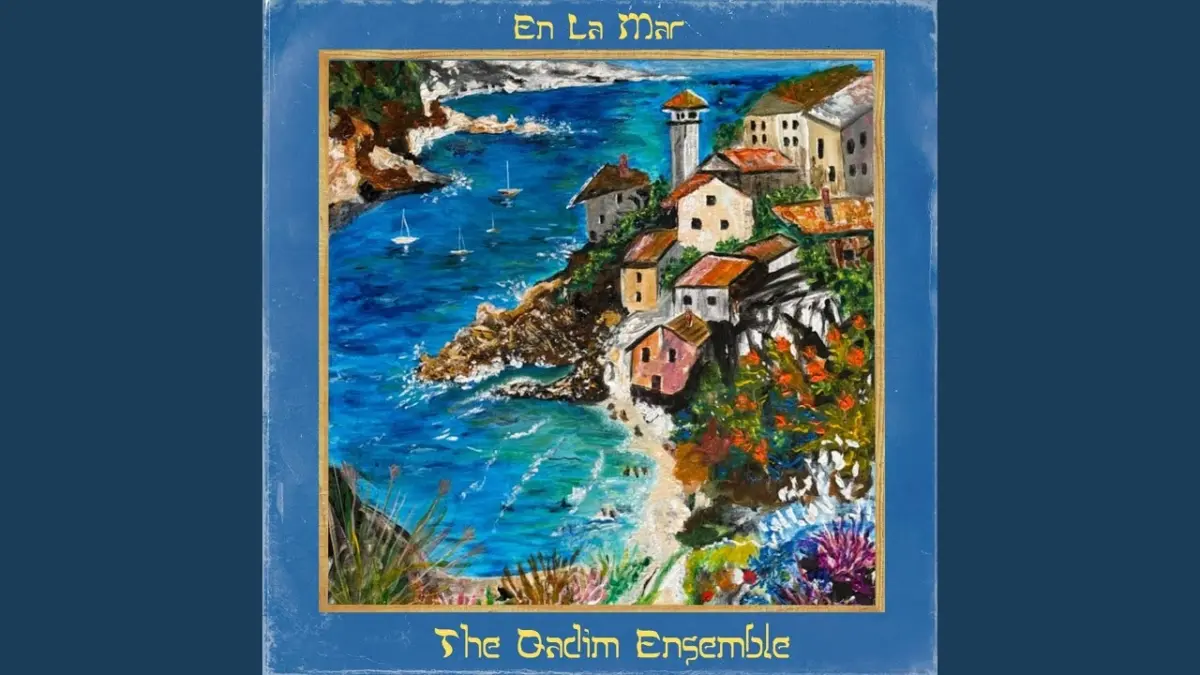
In an era dominated by hyper-processed digital singles and algorithmic pop, the Bay Area-based Qadim Ensemble has carved out a profoundly different path—one that bridges historical preservation with living, breathing musical innovation. Their landmark third studio album, Entre Las Huertas (released August 28), represents a major milestone in contemporary world music: it is the ensemble’s first record dedicated entirely to the vibrant, endangered Ladino (Judeo-Spanish) repertoire.
At the center of this cultural excavation is the album’s standout track, “En La Mar” (also known as “La Sirena”). A mesmerizing tale of isolation, longing, and maritime yearning, the song tells the story of a maiden trapped in a coastal tower, casting her voice out to passing sailors in search of connection and escape. Vocalist Rachel Valfer breathes life into the narrative using the distinct Judeo-Spanish dialect preserved by Sephardic communities following their expulsion from Spain in 1492.
Yet, “En La Mar” is far more than a museum piece; it is a geographic and cultural map. Supported by the evocative flamenco guitar of David Mac Lean, the accordion stylings of Dan Cantrell, the intricate Arabic percussion of Faisal Zedan, and the grounding upright bass and ethereal bansuri flute of co-founder Eliyahu Sills, the track traces the centuries-long migration of Sephardic culture across the Mediterranean, the Ottoman Empire, and into the modern American melting pot.
Running deep with historical resonance, Entre Las Huertas draws heavily upon kantigas—the domestic, intimate songs traditionally preserved and passed down by Sephardic women. From lullabies and high-spirited wedding tunes to candid laments sung over cradles, the album offers a rare window into the private worlds of historical women whose voices were largely kept out of formal historical archives. Recorded primarily live in the studio, the album showcases two decades of artistic maturation by Valfer and Sills, reinforcing Qadim Ensemble’s standing as vital custodians of multi-ethnic musical traditions.
Detailed Chronology
Roots in the East Bay: The Genesis of Qadim Ensemble
The story of Entre Las Huertas begins nearly two decades ago in Berkeley, California, where multi-instrumentalists and cultural researchers Rachel Valfer and Eliyahu Sills first joined forces. Driven by a shared fascination with the intersecting musical traditions of the Middle East, North Africa, and the Mediterranean, the duo founded Qadim Ensemble (derived from the Arabic word for "ancient" or "coming").
From the outset, the ensemble set itself apart by refusing to treat global music traditions as static relics. Instead, they approached them as living languages. Valfer spent years immersed in intensive studies of maqam (Arabic modal systems) and Persian dastgah across Israel and Palestine, eventually mastering vocal performance in seven distinct languages. Sills, meanwhile, developed a fluid mastery of instruments spanning the Middle Eastern ney (reed flute), the oud (short-necked lute), the bansuri (Indian bamboo flute), and the upright bass.
The Evolution Toward Ladino
During their first fifteen years, Qadim Ensemble’s repertoire was expansive, reflecting the mosaic of Jewish, Arabic, Turkish, and Greek musical heritage. However, the seeds for an all-Ladino project were sown slowly through years of performing individual Judeo-Spanish numbers in live settings.
Over time, Valfer and Sills noticed a profound, emotional response from audiences whenever the haunting melodies of Sephardic song filled the room. The urgency of preserving Ladino—a language recognized by UNESCO as critically endangered, spoken primarily by elderly communities scattered across Israel, Turkey, the Americas, and parts of Europe—became increasingly apparent.
By the time the ensemble began conceptualizing their third album, the decision was made to shift from a multi-regional mosaic to a deep, focused dive into the Sephardic canon. They turned their attention to the kantigas: folk songs traditionally sung by women during daily domestic chores, celebrations, and mourning rituals. Unlike the formal liturgical music preserved by male religious scholars, the kantigas were oral histories, capturing the vernacular, emotional reality, and resilience of Sephardic women over five centuries.
The Recording Process: Capturing Live Chemistry
To capture the intimate, conversational nature of the kantigas, Valfer and Sills deliberately chose a raw, organic recording methodology. Rather than layering tracks through digital isolation, the core ensemble entered the studio with a commitment to a live-band aesthetic.
Most of Entre Las Huertas was cut live on the studio floor, allowing the musicians to feed off each other’s improvisational instincts and dynamic shifts. This organic foundation was later enriched by carefully chosen guest artists who brought specific regional flavors to the tracks. Among them was flamenco guitarist David Mac Lean, whose instrument anchors “En La Mar” by re-establishing the foundational Andalusian roots of the Sephardic diaspora. Other guests introduced delicate textures from traditional instruments like the qanun (a plucked zither), ensuring that every song reflected the complex cross-cultural exchanges that characterized the Ottoman era, where Sephardic Jews lived alongside Muslims and Christians for centuries.
Supporting Context & Metrics
The Historical Weight of Ladino and the Sephardic Diaspora
To understand the cultural importance of Entre Las Huertas, one must examine the geopolitical upheavals of 1492. Following the Alhambra Decree issued by the Catholic Monarchs of Spain, Ferdinand and Isabella, hundreds of thousands of practicing Jews were expelled from the Iberian Peninsula.
Stripped of their homeland, these Sephardic communities carried with them the Spanish language of the 15th century—a linguistic time capsule that evolved over the centuries into Judeo-Spanish, or Ladino. Absorbing vocabulary from Hebrew, Arabic, Turkish, Greek, and various Romance languages, Ladino became a secret repository of identity. When the Ottoman Empire famously welcomed the refugees—recognizing their economic and cultural value—Sephardic communities established thriving intellectual and artistic centers in cities like Istanbul, Salonica (Thessaloniki), Sarajevo, and Jerusalem.
[1492: Iberian Expulsion]
       │
       ▼
[Ottoman Sanctuary & Mediterranean Dispersion]
       │
       ▼
[Oral Tradition: Preservation of "Kantigas" by Women]
       │
       ▼
[2024: Qadim Ensemble's "Entre Las Huertas" (Revival & Innovation)]
The Domestic Archive: The World of the Kantigas
While male scholars maintained Hebrew liturgical traditions, Sephardic women were the primary custodians of the secular Ladino canon. Singing while grinding wheat, rocking infants, or preparing wedding feasts, women used the kantigas to process the trials of domestic life, arranged marriages, unfaithful partners, and the bittersweet nature of displacement.
Tracks on Entre Las Huertas reflect this multifaceted domestic archive. The album traverses a wide emotional spectrum, juxtaposing gentle, hypnotic lullabies designed to soothe anxious children with sharp, witty social commentaries and high-energy wedding party anthems. In “En La Mar,” this domestic lens is projected outward onto a mythic scale: the maiden in the tower becomes a universal metaphor for the yearning for freedom and the pain of geographical and cultural estrangement.
Instrumental Cross-Pollination
The sonic architecture of Entre Las Huertas relies heavily on the cross-cultural fluency of its players. The inclusion of the Indian bansuri (played by Sills since the group’s 2009 debut album) alongside Arabic percussion (Faisal Zedan), Andalusian flamenco guitar (David Mac Lean), and European accordion (Dan Cantrell) might seem eclectic on paper, but it reflects a deep musicological truth: musical traditions have never existed in vacuum-sealed national borders. Throughout the Mediterranean and Middle East, musical instruments and modal concepts flowed freely across religious and political fault lines, a reality that Qadim Ensemble honors and mirrors in their arrangements.
Official Statements & Artist Perspectives
Reflecting on the philosophy driving Qadim Ensemble and their landmark release, co-founders Rachel Valfer and Eliyahu Sills have emphasized the delicate balance between historical reverence and creative freedom.
"Ladino is a language that carries the ghost of a lost geography," explains Rachel Valfer, whose vocal interpretations draw directly from her rigorous multi-year immersion in Middle Eastern modal systems. "When you sing these songs, you aren’t just reciting lyrics; you are inhabiting spaces carved out by women who survived exile by holding onto their poetry. Every lullaby and lament is an act of defiance and remembrance."
The transition to an entirely Ladino-focused project was both a natural evolution and a pressing cultural responsibility for the Berkeley-based artists.
"For nearly two decades, our mission has been to show how seemingly disparate musical traditions actually speak to one another," notes Eliyahu Sills. "With Entre Las Huertas, we wanted to honor a specific lineage that is rapidly vanishing. By cutting the tracks live in the studio, we wanted to ensure that the music retained its pulse. This isn’t museum preservation—it’s alive, it breathes, and it swings with the same vitality it did centuries ago."
Musicologists and world music critics have similarly lauded the ensemble’s approach, noting that records like Entre Las Huertas offer an essential counterweight to cultural homogenization. By placing traditional Judeo-Spanish melodies in dialogue with Arabic percussion, Turkish modal sensibilities, and Andalusian guitar, Qadim Ensemble demonstrates that the Sephardic musical heritage remains an open, evolving conversation rather than a closed chapter of history.
Future Outlook & Cultural Legacy
As Entre Las Huertas finds its audience globally through digital streaming platforms and physical releases via Bandcamp, its impact extends far beyond the confines of the world music charts. It arrives at a critical juncture for endangered languages and minority cultures worldwide. With the population of native Ladino speakers steadily declining due to aging demographics and assimilation, artistic interventions by ensembles like Qadim serve as vital conduits for cultural transmission to younger generations who may have no direct connection to the Sephardic diaspora.
Looking ahead, Valfer and Sills plan to bring the material from Entre Las Huertas to live stages across North America and internationally. These performances are designed not merely as concerts, but as interactive educational and cultural spaces where audiences can engage with the history of Judeo-Spanish poetry, Ottoman cross-cultural exchange, and the vital role of women in oral history preservation.
Ultimately, Entre Las Huertas and tracks like “En La Mar” ensure that the voice of the maiden in the tower—and the broader chorus of the Sephardic diaspora—will continue to echo across the seas, reminding modern listeners of the resilience embedded in song, memory, and shared cultural heritage.