Executive Overview
The modern European landscape is forged as much by the quiet movement of its working-class populations as it is by treaties, borders, and shifting geopolitical alliances. Nowhere is this truer than in the historical and contemporary ties binding the Balkans to Central and Western Europe. Enter Gordan, an adventurous, boundary-pushing musical ensemble known for taking traditional folk forms and dragging them kicking and screaming into the contemporary avant-garde. With their upcoming third studio album, Gastarbeiter—slated for release on November 20 via Glitterbeat Records—the group confronts this diaspora head-on.
The album’s lead single, "Mara," serves as a microcosm of economic aspiration, displacement, and the crushing realities of pan-European labor migration. The track traces the meteoric rise and devastating fall of Mara, a Balkan migrant worker who journeys to Germany, finds employment, purchases a luxury BMW, and revels in her newfound autonomy—only to see her American Dream (or rather, her German dream) disintegrate on a high-speed Autobahn outside Munich.
Rooted in a traditional two-line lyrical fragment from the Posavina farming region along the Sava River in northern Bosnia, "Mara" is far more than a localized cautionary tale. It is an exploration of the gastarbeiter (guest worker) phenomenon, a socioeconomic reality that has defined generations of Yugoslav and post-Yugoslav families since the mid-20th century. Through singer Svetlana Spajić’s visionary lyricism, the song adopts the structure of a bećarac—a traditional, ten-syllable rhyming couplet trade-off historically utilized at weddings and drinking sessions for humor or insults—and weaponizes it to tell a harrowing tale of hubris, economic vulnerability, and ultimate destitution.
This article investigates the genesis of "Mara," examines the rich historical tapestry of the gastarbeiter tradition, analyzes the musical and structural mechanics of Gordan’s latest work, and contextualizes the broader socio-economic implications of labor migration in the Balkans through an investigative lens.
Detailed Chronology: The Ballad of Mara and the Anatomy of a Modern Tragedy
To understand the narrative arc of "Mara," one must first examine the chronological descent of its protagonist—a descent meticulously mapped out across the verses constructed by Svetlana Spajić. The song’s narrative unfolds in distinct, rapid-fire stages that mirror the fragility of migrant economic stability.
Phase 1: Ascent and the Illusion of Permanence
The story begins with triumph. Mara arrives in Germany, navigates the bureaucratic and cultural hurdles of the diaspora, and secures employment. In the migrant narrative, financial liquidity is the ultimate validator of suffering. Mara earns, and with her earnings, she buys a BMW—the quintessential status symbol of the returning gastarbeiter.
Gordan captures a remarkably visceral, deeply human detail in these opening moments: Mara’s primary boast about her luxury vehicle is not its horsepower, its sleek German engineering, or its prestige, but its legroom. For a working-class woman whose life has long been dictated by cramped conditions, physical exhaustion, and the spatial indignities of labor, the ability to "spread her legs as far as she likes" represents the physical manifestation of freedom. It is the sensory translation of upward mobility.
Phase 2: The Cataclysm on the Autobahn
Yet, in the precarious world of the temporary migrant, prosperity is never more than a mechanical failure away from catastrophe. The turning point of the narrative occurs on the Autobahn outside Munich. The car dies.
Simultaneously, a broader macroeconomic or personal crisis strips away her savings. In the blink of an eye, the job vanishes, taking her visa with it. Mara transitions instantaneously from an empowered economic actor to an undocumented, stranded liability. She is left sitting in a luxury machine she can no longer afford to move, trapped on a high-speed arterial highway that symbolizes the relentless, unforgiving pace of Western European capitalism.
Phase 3: Linguistic Descent and Psychological Unravelling
Musically and poetically, Spajić mirrors Mara’s collapse through lyrical repetition and structural mutation. The song keeps the foundational couplet running through its entirety, but with a terrifying twist. Each verse repeats a line, then repeats it again with the words inverted, sliding Mara from the end of the line into the center.
This structural instability acts as an oral history being retold, warped, and worsened with every retelling. Halfway through the track, the linguistic shift becomes violent: the verb underlying the repetition morphs. Mara stops merely complaining or whining that she has been robbed; she begins screaming it. The song’s cadence transforms into a frantic panic attack, reflecting the psychological toll of sudden destitution in a foreign land.
Phase 4: The Return to Zero
By the final verse, the journey comes full circle, albeit in the worst possible way. Mara is back home in Bosnia. Her German adventure has evaporated. She returns with none of the Deutschmarks she set out to earn, relegated once again to the convertible mark (KM)—the currency introduced to Bosnia and Herzegovina in the post-war era, pegged artificially at a strict one-to-one ratio with the German mark to instill confidence in a shattered economy. She has traveled thousands of kilometers, endured the indignities of guest-worker status, and spent her youth chasing a mirage, only to find herself back at the exact financial and social starting line, minus the years she lost along the way.
Supporting Context & Metrics: The Gastarbeiter Phenomenon and Cultural Legacy
To fully appreciate the weight of "Mara," one must place Gordan’s work within the historical framework of the gastarbeiter generation—a demographic movement that reshaped the demographic and economic fabric of both Yugoslavia and Western Europe.
+---------------------------------------------------------------------------+
|                   THE GASTARBEITER LIFECYCLE & METRICS                    |
+---------------------------------------------------------------------------+
| 1960s: Yugoslavia breaks with Soviet bloc; labor treaties signed with West|
| Millions of workers migrate northward to fuel post-war economic booms.    |
|                                                                           |
| Core Realities:                                                           |
| • Spatial & Cultural Division: Families split across international borders|
| • Linguistic Adaptation: The birth of a distinct diaspora subculture      |
| • Economic Paradox: Reliance on foreign remittances (often 10%+ of GDP)   |
| • Post-Crisis Vulnerability: Visa revocations tied directly to employment |
+---------------------------------------------------------------------------+
The Geopolitical Genesis of the Guest Worker
The term gastarbeiter was coined in West Germany during the 1960s. Following the historic political split between Josip Broz Tito’s Yugoslavia and the rest of the Soviet bloc, the Yugoslav state faced persistent domestic unemployment coupled with rapid industrial expansion in Western Europe. To balance economic pressures, Belgrade signed bilateral labor agreements—most notably with West Germany—allowing hundreds of thousands of Yugoslav citizens to travel north to fill labor shortages in manufacturing, construction, and automotive industries.
While officially designated as "temporary residents" by both the host governments and the Yugoslav bureaucracy—a euphemism designed to soothe anxieties about permanent demographic shifts—these workers quickly became permanent fixtures of Western European urban centers. In the Balkans, however, the term gastarbeiter frequently took on a more complex, ambivalent connotation when uttered behind a man’s back. It implied a certain alienation: someone who had traded their homeland, culture, and social standing for foreign currency, often returning home only to find themselves culturally displaced in both directions.
The Music of Exile
Naturally, this massive demographic shift birthed its own rich, melancholic body of folk music. Generations of workers sang of missing their homes, the grueling nature of the shift work, families split by heavily policed borders, and elderly parents left behind in depopulated mountain and river villages.
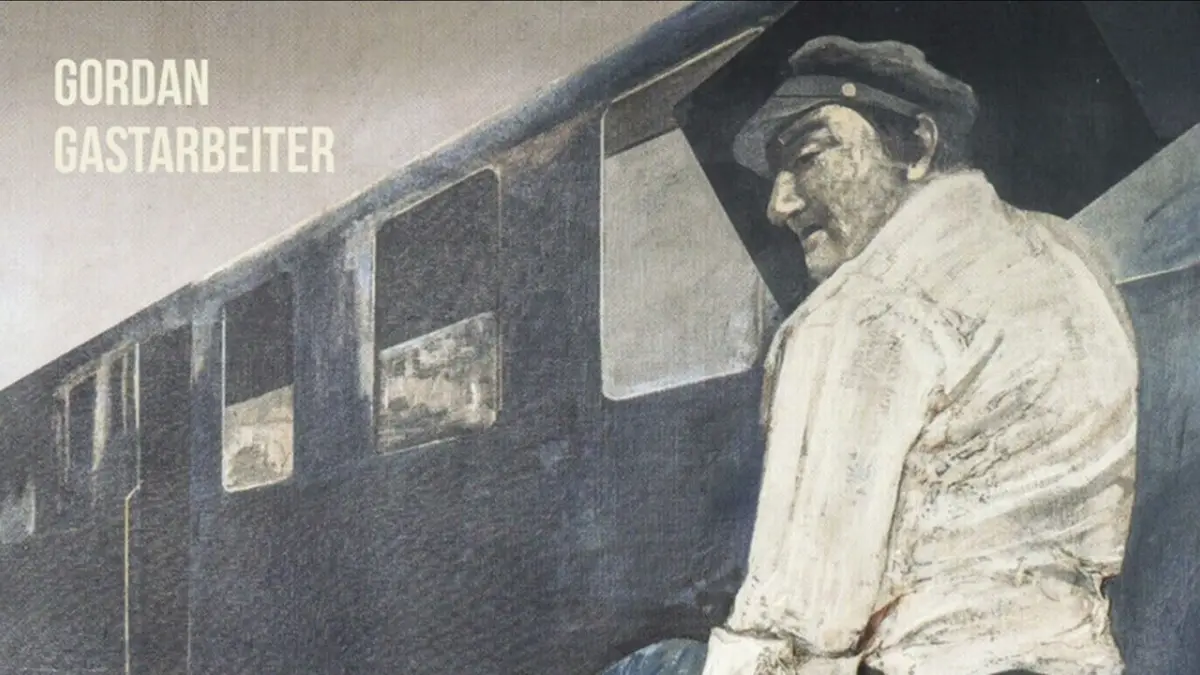
Gordan’s Gastarbeiter album draws directly from this sonic and thematic lineage, updating it for an era of renewed European migration crises, economic inequality, and precarious labor. The visual identity of the album further anchors this theme: the sleeve features Gvozden Leaves for Temporary Residence (1959), a striking painting by prominent Serbian modernist and dissident artist Mića Popović. Popović’s portrayal of an ordinary Yugoslav man captures the quiet dignity and quiet desperation of the migration experience. By utilizing the state’s own bureaucratic terminology—"temporary residence"—in the painting’s title, Popović subtly mocked the official fiction that these workers would simply vanish back to the Balkans once the West German economic miracle required fewer hands.
Official Statements and Artistic Vision
The creative minds behind Gordan have approached Gastarbeiter not merely as a historical retrospective, but as a living, breathing commentary on contemporary economic anxieties.
Svetlana Spajić, whose deep immersion in traditional Balkan vocal arts anchors the band’s distinctive sound, discovered the foundational seed of "Mara" in just two lines of regional folklore. In interviews surrounding the album’s rollout, Spajić and her collaborators have emphasized the improvisational yet deeply rigorous nature of their creative process.
"The traditional bećarac is a social weapon, a tool of banter, insult, and communal expression," notes a representative close to Glitterbeat Records. "By taking a form traditionally used for rural merriment and applying it to the modern capitalist tragedy of the migrant worker, Gordan bridges the gap between ancient oral history and twenty-first-century economic precarity."
The band’s musical philosophy—melding the raw, unfiltered power of traditional Balkan vocal techniques with avant-garde instrumentation, minimalist pulses, and drone-heavy soundscapes—serves as the ideal vehicle for Mara’s story. There is no triumphant resolution, no comforting orchestral swell. Instead, the music mirrors the mechanical relentless of the Autobahn and the circular trap of poverty: hypnotic, repetitive, and ultimately overwhelming.
Future Outlook: The Relevance of Gastarbeiter in Modern Europe
As Gordan prepares for the global release of Gastarbeiter on November 20, the themes embedded within "Mara" resonate with unsettling contemporary relevance. While the specific geopolitical contours of 1960s guest-worker programs have evolved, the underlying mechanics of labor migration in Europe remain largely unchanged.
Today, the migration streams have shifted. Workers from the post-Yugoslav space, Eastern Europe, and the Global South continue to travel west and north in search of economic stability, often finding themselves trapped in precarious legal statuses, gig economies, and high-inflation environments where a single crisis can wipe out years of savings. The "BMW and legroom" of Mara’s early success find their modern equivalents in consumer credit, rented apartments in overcrowded cities, and the digital facade of success projected back home to families in the Balkans.
Gordan’s Gastarbeiter challenges listeners to look past the shiny veneer of remittance-fuelled prosperity and confront the human cost of the European labor market. By immortalizing Mara’s disastrous trip down the Munich Autobahn, the band ensures that the uncelebrated trials of the economic migrant are given their due weight in the annals of contemporary music.
As the album drops on November 20, it stands as a monument to those who leave everything behind for the promise of a better life, only to discover that the road home is often the longest one of all. Listeners can stream "Mara" across digital platforms via Idol-io and pre-order Gastarbeiter directly through Gordan’s Bandcamp page, plunging headfirst into a sonic landscape where traditional folk roots meet the harsh realities of modern economic survival.