Executive Overview
In an era defined by hyper-personalized algorithmic feeds, the relentless acceleration of generative artificial intelligence, and a rapidly consolidating digital landscape, the BBC has positioned itself as an uncompromising antidote to the commercialized information ecosystem.
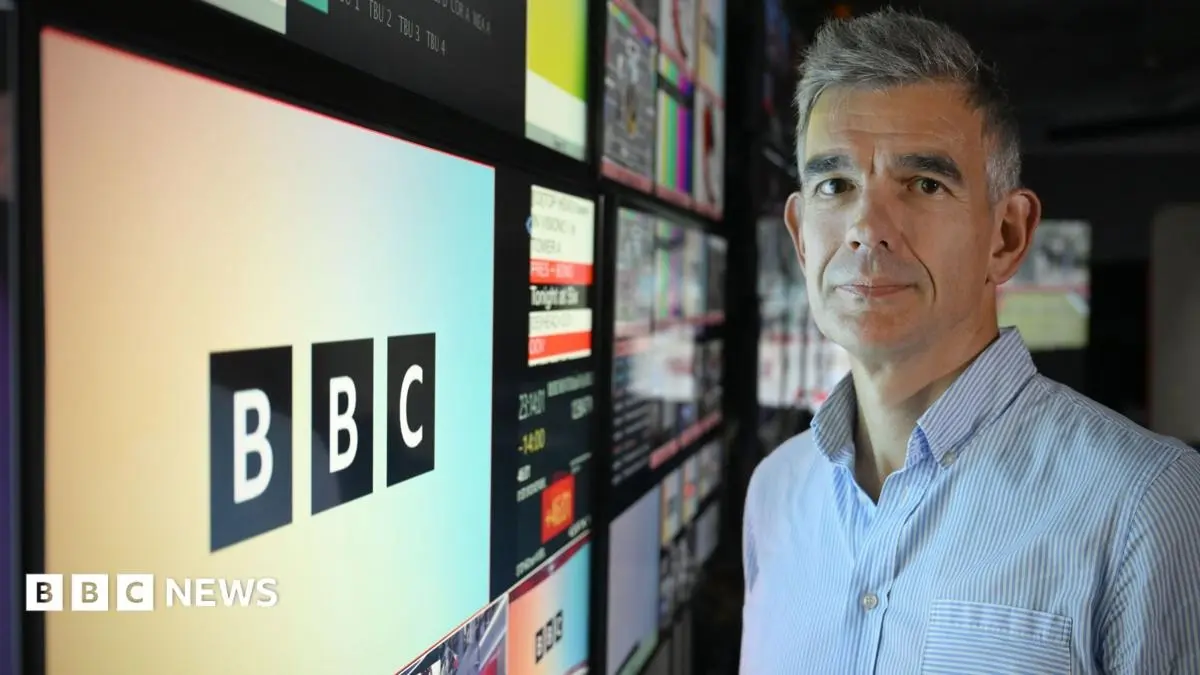
Matt Brittin, who assumed the role of BBC Director-General in May following a decade-long tenure as President of Google in Europe, the Middle East, and Africa (EMEA), has laid out a visionary yet cautious roadmap for the British public broadcaster. In a forthcoming, wide-ranging interview with veteran broadcaster Laura Kuenssberg, Brittin addressed the existential questions facing modern media: the integration of artificial intelligence into public broadcasting, the acute geopolitical risks of non-European tech monopolies controlling the global information pipeline, and the enduring necessity of human-driven creativity.
Brittin’s remarks signal a pivotal moment for the BBC. Straddling the worlds of Silicon Valley commercialism and British public service broadcasting (PSB), he brings a rare insider’s perspective to the table. His warning that a mere handful of foreign technology conglomerates could soon monopolize access to global information—and dictate the terms of truth and misinformation—strikes at the heart of democratic sovereignty.
At the same time, Brittin’s pragmatism regarding artificial intelligence demonstrates an institutional willingness to adapt. By declaring that he would greenlight an AI-generated and AI-presented program "within guardrails," the Director-General has initiated a critical conversation about the boundaries of automation in media. However, he remains steadfast: technology must serve the public good and amplify human ingenuity, never replace it. As the BBC navigates mounting financial pressures, shifting audience consumption habits, and the existential threat of deepfakes, Brittin’s leadership will define whether public service broadcasting can survive—and thrive—in the algorithmic age.
Detailed Chronology: A New Era for the BBC
May: A Silicon Valley Veteran Takes the Reins
The transition of power at the BBC in May marked a fascinating cultural and strategic pivot for the historic institution. Matt Brittin’s appointment as Director-General raised eyebrows across the media landscape. Having spent ten years spearheading Google’s operations across EMEA, Brittin was deeply embedded in the very ecosystem that traditional broadcasters often view as an existential threat. Yet, this background is precisely what supporters argued made him uniquely qualified to steer the corporation through the turbulent digital transition.
Tasked with modernizing the BBC’s digital infrastructure, optimizing the value of the licence fee, and protecting the corporation’s global brand integrity, Brittin stepped into the role with an acute awareness of the challenges ahead. His corporate pedigree meant he understood the mechanics of platform capitalism, search algorithms, and digital monetization strategies—knowledge that is proving invaluable as the BBC fights to remain visible on third-party devices and smart screens.
The Kuenssberg Interview: Confronting the Digital Reality
The contours of Brittin’s vision crystallized during his recent sit-down with Laura Kuenssberg. Scheduled for broadcast across multiple platforms—beginning with BBC Sounds and YouTube on Saturday, September 26, and followed by Sunday with Laura Kuenssberg on BBC One and BBC iPlayer on September 27—the interview captures a leader grappling with the dual pressures of technological disruption and institutional preservation.
During the conversation, Kuenssberg pressed Brittin on the taboos of public service broadcasting, specifically addressing whether the BBC would ever permit a broadcast to be entirely generated and presented by artificial intelligence. Brittin’s response was characteristically nuanced. While he firmly rejected the notion of AI as a wholesale substitute for human journalists and artists, he opened the door to calculated, carefully monitored experimentation.
The chronology of this interview underscores a rapidly shifting institutional mindset. Just a few years ago, the prospect of AI-driven broadcasting would have been treated as anathema within public service corridors. Today, under Brittin’s pragmatic stewardship, the conversation has shifted from avoidance to active, guarded engagement.
Supporting Context & Metrics: The Algorithmic Landscape and the Battle for Trust
To fully understand the gravity of Brittin’s warnings, one must examine the macro-level metrics governing the global media and technology ecosystems.
The Specter of the "Big Six"
Brittin’s stark warning that the world stands on the precipice of a dangerous consolidation—where access to information, its creation, and the proliferation of misinformation will be controlled by just six technology companies—reflects a sobering geopolitical reality. Notably, none of these six corporate giants are European, let alone British.
The dominance of US-based and Asian mega-corporations (spanning search engines, social media platforms, cloud infrastructure, and foundational AI models) has created an unprecedented asymmetry in global communication. These platforms operate on commercial imperatives designed to maximize user engagement through algorithmic amplification, often favoring sensationalism, outrage, and polarization over nuance and factual accuracy.
In stark contrast stands the BBC: an organization funded by a public licence fee, bound by strict Royal Charter obligations of impartiality and accuracy, and trusted by over half a billion people globally every week. In a fractured digital universe where trust is the ultimate scarce commodity, Brittin framed the BBC not merely as a broadcaster, but as a vital geopolitical and democratic counterweight.
The Economics of the Licence Fee and AI Efficiency
The BBC continues to face severe financial constraints, driven by inflation, political debates over the future and enforceability of the licence fee, and changing consumer habits among younger demographics who have largely abandoned linear television.
Brittin pointed to artificial intelligence as a necessary tool to help "make the licence fee go further." In practical terms, this includes leveraging machine learning and AI-driven automation for back-end operations, archival cataloging, subtitle generation, localization, and data analysis. By streamlining these administrative and technical workflows, the BBC can redirect precious public funds toward frontline journalism, investigative reporting, and high-end creative programming.
However, Brittin drew a hard administrative and philosophical line: efficiency is not a proxy for creativity. While AI can assist in decision-making and operational logistics, it cannot replicate the lived experiences, moral compass, and emotional resonance of human creators.
Skepticism Toward Big Tech Platforms
When Kuenssberg asked Brittin whether he trusted big tech companies, his response was diplomatic yet uncompromisingly clear-eyed:
"There’s a lot of platforms out there, so I wouldn’t trust any platform innately."
This skepticism is well-founded. News organizations globally have found themselves at the mercy of opaque algorithmic changes made by social media platforms and search engines, which can abruptly decimate referral traffic or de-prioritize trusted journalism in favor of user-generated content and sponsored posts. Brittin emphasized that the BBC must continuously audit its relationship with third-party platforms to ensure its content remains accessible and fulfills its public service mission without compromising its editorial independence.
Official Statements and Transcript Analysis
A closer examination of Brittin’s commentary during the Kuenssberg interview reveals a carefully calibrated philosophy balancing innovation with institutional defense.
On Artificial Intelligence and Guardrails
Addressing the integration of AI within the broadcasting workflow, Brittin stated:
"I would do, within guardrails. We want to experiment with this technology and understand what it can and can’t do, but I’m here because I believe in human creativity."
He elaborated on the limitations and appropriate applications of the technology:
"I don’t think anything we do should be replaced by AI. I think there are lots of places where AI can help us make the licence fee go further, but also help us in our decision-making and creativity. But it’s not a substitute for humans."
This stance positions the BBC as an enlightened pragmatist. Rather than retreating into technophobic denial, the Director-General recognizes that refusing to engage with generative AI will render the public broadcaster obsolete. Yet, by insisting on stringent "guardrails," he reassures audiences, staff, and creative unions that the BBC’s core identity—rooted in human journalism, editorial oversight, and cultural storytelling—remains uncompromised.
On Geopolitical Risk and Information Monopolies
Turning to the broader structural risks of the digital age, Brittin issued a warning regarding platform concentration:
"We’re also in this moment where AI is in takeoff. So I think there’s a danger that six companies will control access to information in future and the creation of information and misinformation. Six companies, none of them European, let alone British. In that world, here’s the BBC. It’s the most trusted organisation by over half a billion people."
This statement underscores the unique value proposition of public service media in the twenty-first century. As generative AI makes the mass production of hyper-realistic deepfakes, synthetic text, and automated propaganda trivial and inexpensive, the provenance of information becomes paramount. Brittin is betting that audiences will increasingly seek out trusted, human-verified sanctuaries amidst the noise of the algorithmically driven web.
The BBC as the "Antidote to the Algorithm"
Perhaps the most potent soundbite from the upcoming interview is Brittin’s characterization of the corporation’s digital services:
"I think the BBC and our apps and services should be the antidote to the algorithm. Everywhere else you go is driven by some commercial interest."
This declaration serves as a rallying cry for public service media. Commercial platforms monetize attention by keeping users trapped in feedback loops designed to provoke emotional reactions. The BBC’s digital products—ranging from BBC News and BBC Weather to BBC Sounds and iPlayer—are mandated to inform, educate, and entertain without the corrupting influence of targeted advertising or engagement-baiting algorithms. By positioning the BBC as an algorithmic antidote, Brittin is redefining the corporation’s digital purpose for a generation exhausted by surveillance capitalism.
Future Outlook: Navigating the Next Decade
As Matt Brittin’s tenure unfolds, the BBC faces a series of critical inflection points that will test his leadership, strategic vision, and diplomatic acumen.
1. Establishing the Ethical Framework for AI in Public Media
The immediate challenge for the BBC will be defining what those "guardrails" for artificial intelligence actually look like. As the corporation experiments with AI tools in newsrooms, production houses, and digital delivery systems, it must establish transparent ethical standards. How will the BBC label AI-assisted content? How will it protect copyright and compensate human artists and journalists whose work trains foundational AI models? Brittin’s background in Big Tech places him in a prime position to negotiate these standards, but he will need to build deep trust with internal unions and creative guilds.
2. Securing Discoverability in a Closed Ecosystem
As smart televisions, voice assistants, and in-car entertainment systems increasingly consolidate around proprietary operating systems controlled by the aforementioned "Big Six" tech firms, the BBC faces the threat of digital invisibility. If public service broadcasters are buried beneath layers of commercial streaming apps and paywalled content, their democratic utility diminishes. Brittin will need to leverage regulatory frameworks—such as the UK’s Media Act—to ensure that BBC services maintain prominent, frictionless discoverability on all modern devices.
3. Re-engaging Younger Audiences Without Losing Core Identity
The existential question for any legacy broadcaster is generational renewal. Younger demographics consume information primarily through TikTok, YouTube, Instagram, and algorithmic feeds rather than linear broadcasts or dedicated news websites. Brittin’s vision of the BBC as an "antidote to the algorithm" must translate into digital formats that resonate with Gen Z and Millennial audiences without pandering to the toxic dynamics of attention-economy platforms. Utilizing AI intelligently to personalize delivery—while preserving editorial integrity—will be a tightrope walk.
4. Preserving Global Trust Amid Geopolitical Polarization
With over half a billion people relying on the BBC globally, the corporation serves as one of the UK’s most effective soft-power assets. However, in an era of intense geopolitical rivalry, state-sponsored disinformation, and domestic polarization, maintaining a reputation for rigorous impartiality is exceedingly difficult. Brittin’s defense of the BBC as a trusted, non-commercial anchor in a sea of misinformation will require fierce protection of its editorial independence from political interference, both at home and abroad.
Conclusion
Matt Brittin’s inaugural months as BBC Director-General have made one thing abundantly clear: the corporation is neither burying its head in the sand nor surrendering to the techno-optimism of Silicon Valley. By acknowledging the immense disruptive potential of artificial intelligence—while fiercely defending human creativity—Brittin is charting a pragmatic, eyes-wide-open course for public service broadcasting.
His warning about the monopolization of information by a handful of foreign tech giants serves as a vital wake-up call for policymakers, regulators, and citizens alike. In a world where reality itself is increasingly mediated by opaque commercial algorithms, the BBC’s mission to act as an independent, trusted "antidote" is more urgent than ever. Whether Brittin can successfully balance the books, harness AI responsibly, and keep the public broadcaster relevant in a hostile digital environment will be the definitive legacy of his directorship.