Executive Overview
In the upper echelons of personal audio, luxury consumerism and rigorous acoustic engineering rarely merge without compromise. Audiophile brands often lean too heavily into uncompromising sonic fidelity at the expense of everyday wireless utility, while mainstream consumer giants prioritize heavy-handed digital signal processing and aggressive marketing over raw driver performance. Into this high-stakes landscape steps Noble Audio with its new flagship active noise-cancelling (ANC) over-ear headphones: the FoKus Artemis.
Retailing at £799 / $899 / €949, the FoKus Artemis are not engineered for casual impulse buyers. Instead, Noble Audio has set its sights on the elite tier of high-end wireless headphones, taking direct aim at heavyweight contenders such as the Focal Bathys, Bowers & Wilkins Px8 S2, and Mark Levinson 5909.
Rather than relying on the standard single dynamic driver setup found in 99% of consumer over-ear headphones, Noble Audio has imported its renowned in-ear monitor (IEM) heritage into an over-ear chassis. The Artemis introduces an unprecedented hybrid triple-driver array: a 40mm dynamic driver for low-end weight, a 14.5mm planar magnetic driver for ultra-fast transient response, and a balanced-armature tweeter to handle high-frequency sparkle.
Combined with robust hardware features—including user-replaceable batteries, swappable magnetic cushions, comprehensive high-res codec support (including aptX Lossless and LDAC), Bluetooth 6.0 connectivity, and IP52 dust and water resistance—the FoKus Artemis represents a fascinating collision of studio-grade DNA and luxury lifestyle design. This review explores whether Noble’s ambitious driver configuration justifies its steep price tag, how it performs in real-world mixing and listening scenarios, and whether it succeeds in challenging the established high-end ANC hierarchy.
Detailed Chronology: From Thai Hearing Aids to Wireless Flagships
To understand the engineering philosophy behind the FoKus Artemis, it is necessary to trace the unconventional trajectory of Noble Audio’s founding and its evolution within the personal audio market.

The Origins of "The Wizard"
Long before Noble Audio became a household name among audiophiles, founder John Moulton—affectionately and universally known within the community as "The Wizard"—was laying the groundwork in unexpected environments. During a stint working at the largest Thai hearing aid manufacturer in the late 2000s, Moulton spent his off-hours experimenting with the delicate art of crafting custom in-ear monitors (CIEMs).
Working with exotic hardwoods and precise acoustic dampening, Moulton built custom monitors that quickly became the stuff of legend on enthusiast internet forums. For backpackers trekking through Southeast Asia during that era—perhaps attempting to recreate the cinematic wanderlust of Danny Boyle’s The Beach—early Noble-crafted or inspired multi-driver IEMs represented the absolute pinnacle of portable sound.
The Birth of Noble Audio (2013)
Having carved out an unassailable reputation for acoustic precision and bespoke physical design, Moulton officially established Noble Audio in 2013. Over the subsequent decade, the brand dedicated itself to producing some of the most sought-after, uncompromising multi-driver earbud systems in the industry.
Noble’s core secret weapon has always been its mastery of hybrid driver architectures. Rather than forcing a single transducer to handle the entire audible spectrum, Noble pioneered systems that intelligently divide frequencies, handing off lows, mids, and highs to whichever specialized driver type handles them best.
Transitioning from Ear to Head
For years, Noble remained strictly focused on the wired and wireless IEM space, catering primarily to musicians, audio engineers, and high-end portable enthusiasts. However, the market shift toward premium wireless over-ear noise-cancelling headphones proved too tempting to ignore.

Noble made its initial leap into the commuter over-ear market with the FoKus Apollo, its first-ever wireless ANC headphone. While the Apollo was well-received for its immense battery longevity, Noble was not content to rest on its laurels. With the rollout of the flagship FoKus Artemis, the company has pushed the envelope even further by miniaturizing and adapting a complex three-driver hybrid architecture—traditionally reserved for multi-thousand-dollar custom IEMs—into a closed-back over-ear form factor.
Supporting Context & Metrics: Architecture, Build, and Connectivity
Evaluating a £799 pair of headphones requires a granular look at the hardware specifications, build quality, and technological framework underpinning the daily user experience.
The Triple-Driver Array Explained
The defining engineering marvel of the FoKus Artemis is its tri-driver configuration per earcup. Noble’s acoustic theory is rooted in division of labor:
- The 40mm Dynamic Driver: Engineered to anchor the foundation of the mix, delivering substantial low-end weight, sub-bass extension, and physical impact without distorting.
- The 14.5mm Planar Magnetic Driver: Tasked with the critical midrange and fast transient delivery. Planar drivers are renowned for their ultra-thin diaphragms and rapid response times, ensuring that complex micro-details and transient shifts remain razor-sharp.
- The Balanced-Armature Tweeter: An uncommon sight in over-ear headphones, this dedicated high-frequency driver steps in to sprinkle top-end sparkle, air, and micro-detail without introducing harshness.
Industrial Design and Ergonomics
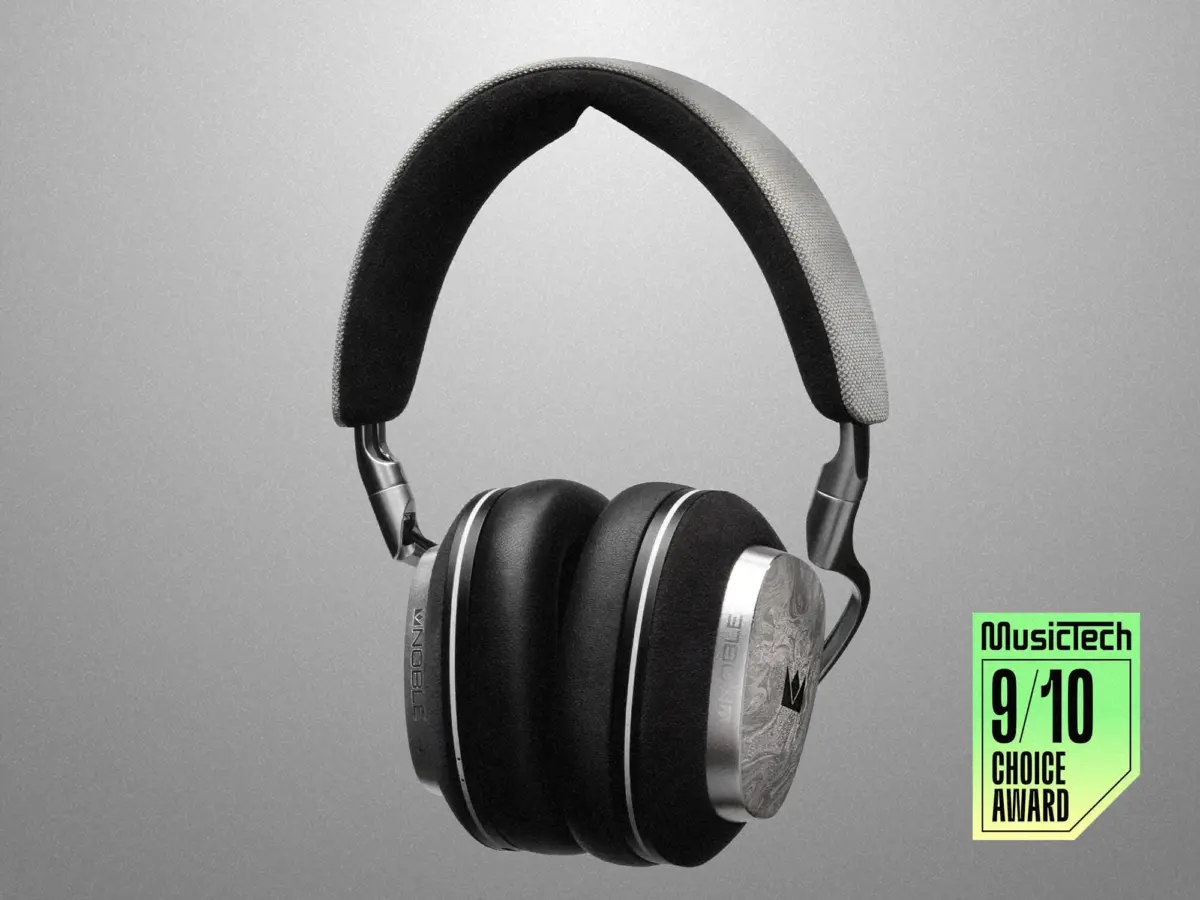
Noble has never shied away from making a visual statement. The Artemis features a milled aluminum body housing cups finished in a striking, swirling, Damascus-inspired pattern. This aesthetic is balanced and softened by luxurious Ultrasuede surrounds, striking a careful equilibrium between executive sophistication and audiophile flair—equally at home in a high-end hotel lobby or a professional tracking room.
- Weight: At 324 grams, the Artemis is not an ultra-lightweight design, but it undercuts many heavy metal-and-leather flagships—most notably Apple’s neck-straining AirPods Max.
- Fit & Comfort: The clamping force is snug without pinching, distributing weight evenly to ensure long-term comfort across multi-hour listening or mixing sessions.
- Durability & Repairability: At this price point, long-term sustainability is paramount. Noble has included a user-friendly, user-replaceable battery alongside swappable magnetic cushions—a rare and deeply commendable nod to right-to-repair principles. Furthermore, the unit features IP52 dust and water resistance, providing peace of mind during unpredictable commutes.
Control Scheme and Software Ecosystem
Rejecting the often-frustrating world of temperamental capacitive touch controls, Noble has wisely equipped the FoKus Artemis entirely with physical tactile buttons.

The companion Noble FoKus app expands functionality, offering:
- A comprehensive 10-band graphic EQ for precise tuning.
- An Audiosphere spatial mode for widened soundstage presentation.
- A built-in hearing test powered by Audiodo Personal Sound technology to calibrate the sound profile to your specific auditory capabilities.
- Wear detection sensors that rank among the most reliable and responsive in the industry.
Connectivity, Codecs, and Battery Metrics
- Wireless Codecs: Designed with creators and audiophiles in mind, the Artemis supports a comprehensive suite of high-resolution codecs, including the aptX family (aptX HD, aptX Adaptive), aptX Lossless, and LDAC, ensuring CD-quality (and better) transmission from compatible modern source devices.
- Wired Versatility: A USB-C connection allows the headphones to function as a pristine digital-to-analog converter (DAC) when plugged directly into a laptop. Additionally, a 3.5mm analog jack permits hardwired listening with the headphones powered completely off, bypassing all onboard digital processing.
- Bluetooth 6.0: Equipped with the latest Bluetooth standard, the Artemis ensures rock-solid connection stability in congested wireless environments (such as busy train stations or city centers), alongside enhanced power efficiency and future-proofing.
- Battery Performance: The Artemis yields 55 hours of total playback time, dropping to 35 hours with ANC enabled. A full recharge takes under 90 minutes via USB-C. Note on capacity: While 35–55 hours is robust by industry standards, it represents a step down from its predecessor, the Apollo (which boasts 60–80 hours). This is due to Noble outfitting the Artemis with a smaller 600 mAh battery compared to the Apollo’s 1000 mAh cell, despite both models sharing nearly identical physical weight.
- Active Noise Cancellation (ANC): Driven by an array of six external microphones, the hybrid ANC system aggressively swallows ambient low-frequency rumbles, passing traffic, and urban construction work with minimal artifacts.
Official Statements & Sonic Performance: In the Mix
To test whether Noble’s acoustic theories translate into real-world listening, the FoKus Artemis was subjected to critical evaluation across various genres, testing its spatial reproduction, transient speed, and analytical capabilities.
The Soundstage and Critical Listening
When diving into a critical playlist, the immediate standout characteristic is the sheer spaciousness of the FoKus Artemis soundstage. On layered tracks like Bonobo’s Kerala, the multi-tiered instrumentation is given ample room to breathe, preventing complex arrangements from muddying into a wall of sound. This wide, open presentation is remarkably unusual for closed-back, active noise-cancelling headphones.
Low-end delivery is both agile and authoritative. The pitch-bending sub-bass wobbles on James Blake’s Limit to Your Love are handled with absolute control; there is no woolly bleed into the midrange, keeping the low frequencies cleanly separated from crisp hi-hats and vocal lines. Vocals—such as Billie Eilish’s intimate phrasing or the sprawling acoustic ensemble on Snarky Puppy’s Lingus—sound remarkably organic and uncolored.
Studio Utility and the "Truth Test"
When plugged in via USB-C with software personalization disabled, the frequency response is flat, even, and clean enough to trust for rough-mix evaluations on the go. The high frequencies remain smooth and controlled, avoiding the aggressive sibilance or ear-fatiguing brightness that plagues many consumer-oriented flagships.

However, this commitment to neutrality introduces a distinct design trade-off: character over flat-out excitement. When playing dynamic, high-energy tracks like Tame Impala’s Let It Happen, the presentation is undeniably accurate, but occasionally feels somewhat restrained or lacking in theatrical punch. Similarly, certain vocal registers exhibit a slight hardness—not aggressive, but certainly not buttery smooth. For casual listeners seeking an euphonic, heavily colored sound profile, this might feel dry; for music producers and mixing engineers using them as a portable second opinion, this analytical honesty is an invaluable asset.
Future Outlook & Market Positioning
The personal audio landscape is currently saturated with consumer giants vying for dominance through convenience features, lifestyle branding, and aggressive price points. By positioning the FoKus Artemis at £799 / $899 / €949, Noble Audio has bypassed the mainstream noise-cancelling wars to target high-end luxury contenders directly.
The Verdict: A Noble Cause or Station Overreach?
The FoKus Artemis proves that Noble Audio’s transition from custom in-ear monitors to over-ear wireless headphones is more than just a passing commercial venture—it is a legitimate technical triumph.
By integrating a complex three-driver hybrid system into an over-ear chassis, Noble has successfully delivered an open, spacious, and highly detailed listening experience that shatters conventional closed-back limitations. Coupled with forward-thinking hardware choices like user-replaceable batteries, Bluetooth 6.0, robust high-res codec support, and a premium physical design, the Artemis justifies its lofty price tag for the right demographic.
Who Are They For?
- The Audiophile Commuter: Listeners who refuse to compromise on hi-res audio codecs (LDAC, aptX Lossless) while navigating noisy urban environments.
- The Mobile Creator / Producer: Engineers and musicians who require a reliable, analytical secondary reference pair with active noise cancellation and USB-C DAC functionality.
- The Repairability Advocate: Consumers frustrated by disposable electronics who value swappable magnetic ear cushions and user-replaceable batteries.
While they may not completely replace dedicated open-back studio monitors for final mastering decisions, the FoKus Artemis stands tall as a premier luxury flagship—a sophisticated, highly capable acoustic instrument disguised as an everyday wireless headphone.