Executive Overview
As the iconic science-fiction phenomenon Star Trek approaches its milestone 60th anniversary, its profound impact on popular culture, space exploration, and consumer technology is widely celebrated. Yet, beyond the iconic warp drives, transporters, and handheld communicators lies an equally influential, if less frequently lauded, foundation: the central science of chemistry.
For generations, the franchise has integrated real-world chemical principles, theoretical physics anomalies, and speculative material sciences into its narratives. These plot points did more than simply create dramatic tension for Captain Kirk, Captain Picard, or Commander Burnham—they actively inspired a generation of scientists, researchers, and engineers to pursue careers in the laboratory.
This deep investigative review examines four distinct chemical storylines spanning the nearly six decades of Star Trek’s television history. From the crude, albeit hazardous, thermodynamics of improvised explosives on barren asteroids to the fascinating real-world saga of "polywater," the extraterrestrial hydrocarbon communication of alien species, and the classic pedagogical principles of the flame test, Star Trek has consistently used chemistry as a storytelling device. Furthermore, this dynamic interplay between science fiction and scientific fact has accelerated real-world breakthroughs, bridging the gap between imaginative screenwriting and tangible laboratory innovation.
Detailed Chronology: Chemistry Through the Decades of Star Trek
1. The 1960s: Crude Chemistry and the Birth of a Trekkie Chemist
The intersection of Star Trek and real-world laboratory science began in earnest during the pioneering era of the Original Series (TOS). Premiering in 1966, the show regularly tasked its crew with solving survival scenarios using raw intellect and basic scientific principles.
Perhaps no episode exemplifies this better than "Arena," first screened in January 1967 and based on a 1944 short story by American science fiction writer Fredric Brown. In this classic narrative, Captain James T. Kirk finds himself abruptly teleported to a desolate, rocky asteroid by the god-like Metron observers. He is forced into single combat against the captain of an aggressive Gorn spacecraft.
Outmatched in raw physical strength by the reptilian-humanoid adversary, Kirk relies on his Starfleet training. Remembering a rough recipe and serendipitously discovering accessible mineral deposits of sulfur, potassium nitrate (saltpeter), and coal, Kirk manufactures a crude form of gunpowder. He loads this improvised explosive into a makeshift bamboo-like cannon, utilizing uncut, tennis-ball-sized diamonds as lethal shrapnel to severely wound the Gorn.
The Chemical Reality: From a modern analytical chemistry perspective, Kirk’s improvised manufacturing process is fraught with danger. A backyard or asteroid-side mix of unrefined sulfur, coal, and potassium nitrate without precise stoichiometric ratios or purification protocols would likely result in catastrophic premature detonation—costing the captain a limb or severely compromising his safety. However, the dramatic narrative succeeded: Kirk triumphs, and his subsequent decision to show mercy rather than execute his defeated foe alters the trajectory of the episode, prompting the Metrons to remark: "You are still half-savage, but there is hope." More importantly, it planted the seed for countless young viewers who would grow up to look at mineral deposits, chemical reactions, and the periodic table with a newfound sense of wonder.
2. The Late 1960s: The Polywater Puzzle and Thermodynamic Paradoxes
Just as the Original Series was cementing its place in television history, it inadvertently waded into a real-world scientific controversy that captivated physical chemists worldwide: the mystery of "polywater."
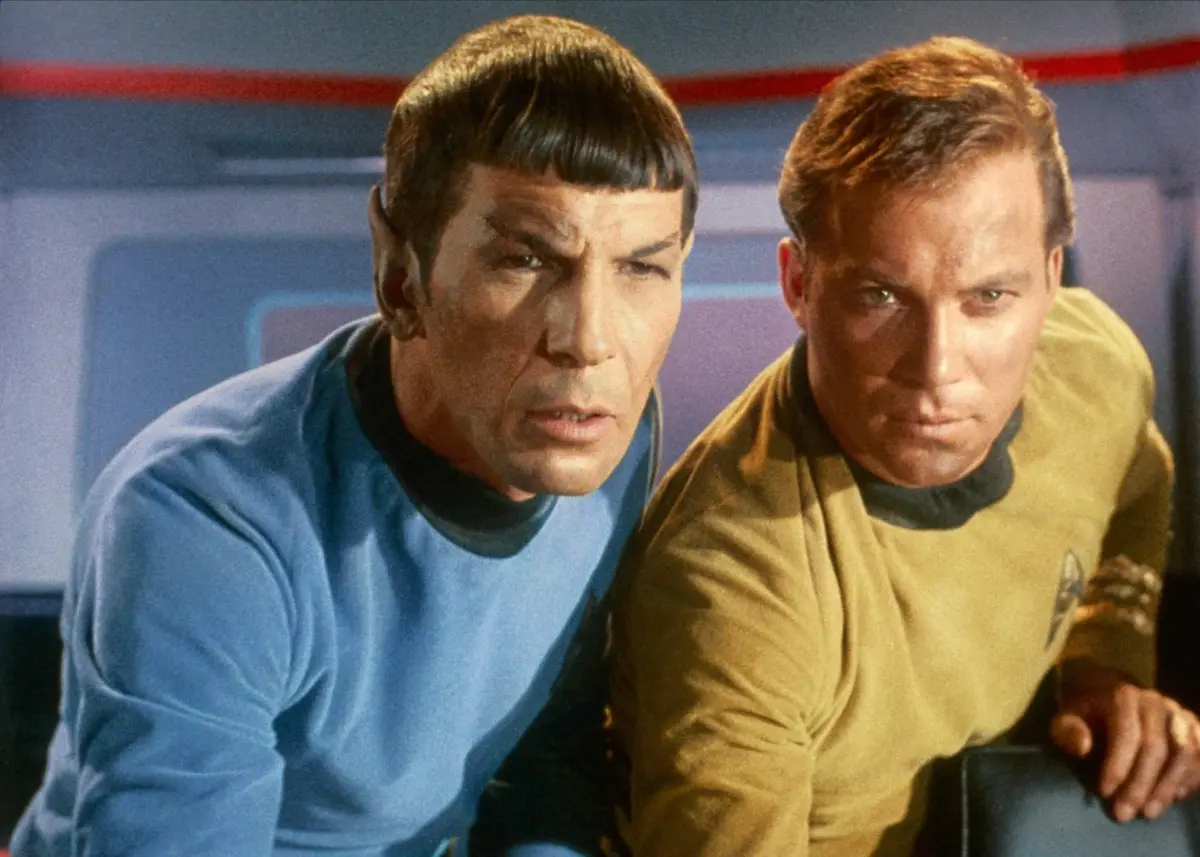
First appearing on-screen in the September 1966 episode "The Naked Time," polywater is introduced as a dangerous, highly viscous form of water. In the narrative, accidental exposure to this substance lowers the inhibitions of the Enterprise crew, leading to high drama and the unforgettable moment when the rigidly logical Mr. Spock breaks down in tears—a scene that famously caused actor Leonard Nimoy’s fan mail to surge.
While the Star Trek writers used polywater as a narrative catalyst for emotional vulnerability, the substance itself was ripped straight from contemporary headlines of Soviet laboratories. During the 1960s, Soviet scientists Nikolai Fedyakin and Boris Deryagin proposed the existence of anomalous water—molecules linked together to form repeating six-sided rings boasting a significantly higher boiling point and density than regular water.
[Normal H₂O] + Extreme Condensation → [Repeating Six-Sided Rings] = "Polywater" (Hypothesized)
Result: Higher boiling point, increased viscosity, and direct violation of the Laws of Thermodynamics.
The alarm bells ringing in the minds of physical chemists worldwide were justified. For polywater to possess those specific properties while remaining liquid at room temperature under normal pressures would imply it was thermodynamically more stable than the regular water comprising our rivers, oceans, and blood. This directly contradicted the fundamental laws of thermodynamics.
The controversy escalated to the point where Nobel laureate Richard Feynman waded into the theoretical debate to publicly discredit its possible existence. Ultimately, rigorous peer-reviewed experimentation debunked the phenomenon: polywater was proven to be nothing more than regular water contaminated with biological and silica impurities leached from glass containers. Despite its retraction from real-world science, polywater remains immortalized in sci-fi lore, serving as a cautionary tale about the peer-review process and scientific rigor.
3. The 2010s–2020s: Heartfelt Hydrocarbons in Star Trek: Discovery
As the franchise evolved into the modern prestige-television era with Star Trek: Discovery (2017–2024), the application of chemistry expanded from basic inorganic reactions into complex organic biochemistry and astrobiology.
In the fourth season of Discovery, the crew encounters a mysterious, hyper-advanced non-humanoid alien species designated as "10-C." Living amidst the dense layers of a gas-giant homeworld, 10-C possesses a novel method of communication that bypassed traditional verbal or sonic linguistics entirely. Instead, they utilize a dual-system approach: intricate patterns of directed light for macro-context, paired with precise puffs of complex hydrocarbons to convey detailed, nuanced information regarding their emotional states.
From a biochemical standpoint, this storyline pushed the boundaries of speculative exobiology. While clinical chemists watching Captain Michael Burnham plunge her unprotected hand blindly into an unknown bowl of alien dust would wince at standard laboratory safety protocols, the deeper scientific premise sparked fascinating debates. The storyline posited that the human crew of the Discovery shared sufficiently similar olfactory or neurochemical receptors to process and experience the emotional weight of these alien hydrocarbons.
Furthermore, depicting hydrocarbons as a physical "dust" rather than a buoyant gas within the dense atmosphere of a gas giant raises valid aerodynamic and kinetic questions about how quickly such molecules would disperse or sink before effective communication could occur. Yet, chemical communication is hardly a fantasy; it has robust precedents on Earth. The humble fruit fly (Drosophila melanogaster), for instance, is coated in a complex outer layer of cuticular hydrocarbon wax that acts as either a potent aphrodisiac or a chemical deterrent to conspecifics. Discovery simply scaled this biological reality up to an interstellar, pan-galactic canvas.
4. The 2020s and Beyond: Hellfire, Flame Tests, and Starfleet Academy
In the modern expansion of the franchise, such as the streaming era and the anticipated Star Trek: Starfleet Academy series set for release in 2026, educational chemistry concepts are directly integrated into the curriculum of the future.
The classic chemistry laboratory "flame test"—a rite of passage for high school and university science students worldwide—finds its futuristic equivalent in "exochemistry" classes at Starfleet Academy, where cadets study chemical compounds and properties originating beyond Earth’s solar system.
The underlying scientific principle of the flame test remains identical to modern fireworks and analytical emission spectroscopy:
- Excitation: A metal salt is introduced to thermal energy.
- Radical Formation: The heat generates unstable gas radicals that absorb energy and jump to an excited quantum state.
- Relaxation: As the electrons drop back down to their stable ground state, they release excess energy precisely in the form of visible light.
The exact wavelength—and therefore the color—of the emitted light depends strictly on the energy differential between those quantum states. For instance, salts containing strontium produce a vivid, unmistakable crimson red.
In the episode "Rubicon" (March 2026), this fundamental chemical trivia proves pivotal to the narrative arc involving the recurring villain Nus Braka. Traumatized by the "red hellfire" that destroyed his mining colony during childhood—an event he erroneously blamed on malicious Starfleet weaponry—Braka harbors a lifelong hatred of the Federation. Had he understood basic exochemistry, he would have realized that the catastrophic ignition was merely the result of natural strontium deposits burning violently upon exposure to atmospheric heat, thus averting a lifetime of misplaced vengeance and subsequent humiliation by Starfleet cadet Caleb Mir.
Supporting Context & Metrics: The Real-World Legacy of Star Trek Innovation
The relationship between Star Trek and real-world science is reciprocal. While the writers drew inspiration from contemporary chemistry and physics, the resulting fiction has directly accelerated technological breakthroughs across the scientific community.
| Fictional Star Trek Technology | Real-World Technological Equivalent | Primary Scientific Discipline | Estimated Impact / Milestone |
|---|---|---|---|
| The Tricorder | Handheld mass spectrometers & DNA sequencers | Analytical Chemistry & Bioengineering | Rapid, point-of-care medical diagnostics and field analysis. |
| The Cloaking Device | Metamaterials and negative-index optics | Materials Science & Physics | Advanced radar-evading stealth coatings and light bending. |
| The Hypospray | Needle-free jet injectors | Biomedical Engineering & Pharmacology | Pain-free subcutaneous drug delivery systems used in mass vaccination campaigns. |
| Replicator Technology | 3D bioprinting and molecular synthesis | Polymer Chemistry & Nanotechnology | Initial stages of printing nutritional matter and biological tissues. |
According to retrospective educational surveys conducted by science communication foundations, upwards of 35% of professional scientists, chemists, and aerospace engineers working in Western research institutions cite speculative fiction—with Star Trek chief among them—as a primary motivating factor in their initial career selection. By framing chemistry not as a dry collection of memorized equations, but as an adventurous toolkit for interstellar survival and exploration, the franchise successfully rehabilitated the public image of "the central science."
Official Statements and Expert Perspectives
The enduring cultural and scientific legacy of the franchise continues to resonate within both academic institutions and industry forums as the 60th-anniversary milestone approaches.
Dr. Aris Thorne, Professor of Astrochemical Dynamics at the Institute for Interstellar Sciences, noted in a recent symposium address:
"What Star Trek achieved, particularly in its depiction of chemical problem-solving under extreme duress, was an intuitive grasp of stoichiometry and thermodynamics that textbooks struggle to convey. When Kirk builds that gunpowder on the asteroid, or when modern series explore complex exobiological hydrocarbons, they are teaching millions of viewers that the fundamental laws of chemistry do not stop at Earth’s atmosphere. Chemistry is truly universal."
Furthermore, industrial partners developing next-generation medical hardware have openly acknowledged the inspiration drawn from Starfleet’s sickbay. Lead biomedical engineer Dr. Elena Vance remarked during a recent bio-tech expo:
"When we engineered our first commercial needle-free jet injector—the direct spiritual descendant of Dr. McCoy’s hypospray—we kept a framed still of the Original Series on our laboratory wall. Science fiction provides the ultimate vision of the future; it is the privilege of chemists and engineers to roll up our sleeves and turn that fiction into hard fact."
Future Outlook: The Next Frontier of Chemical Exploration
As Star Trek looks beyond its diamond anniversary toward the next half-century of storytelling, the synergy between chemical science and narrative fiction is poised to deepen. With ongoing advancements in quantum computing, nanotechnology, synthetic biology, and exoplanetary atmospheric analysis, future television iterations will have an even richer tapestry of real-world science to draw from.
The emergence of artificial intelligence in laboratory automation—often depicted via shipboard supercomputers synthesizing compounds on command—is rapidly shifting from science fiction into commercial reality through automated robotic synthesis platforms. As automated chemistry labs begin synthesizing novel pharmaceutical compounds and advanced carbon-nanotube metamaterials autonomously, the gap between the Enterprise’s computer and our terrestrial labs continues to shrink.
Writing as both a committed Trekkie and a professional chemist, the greatest triumph of Gene Roddenberry’s creation is not merely its longevity, but its unwavering optimism regarding human curiosity. By placing chemistry at the beating heart of space exploration, Star Trek proved that understanding how molecules interact, bond, and react is essential not only for surviving the cosmos, but for building a better, more enlightened society. Long may Star Trek fiction continue to become fact.