In an era defined by frictionless, algorithmic cloud streaming—where billions of tracks are accessible instantly via a tap on a smartphone—the physical record format is experiencing a staggering renaissance. According to the Recording Industry Association of America (RIAA), U.S. vinyl sales officially cleared the milestone $1 billion threshold in 2025, cementing a multi-year resurgence that has caught mainstream retail and tech sectors completely by surprise.
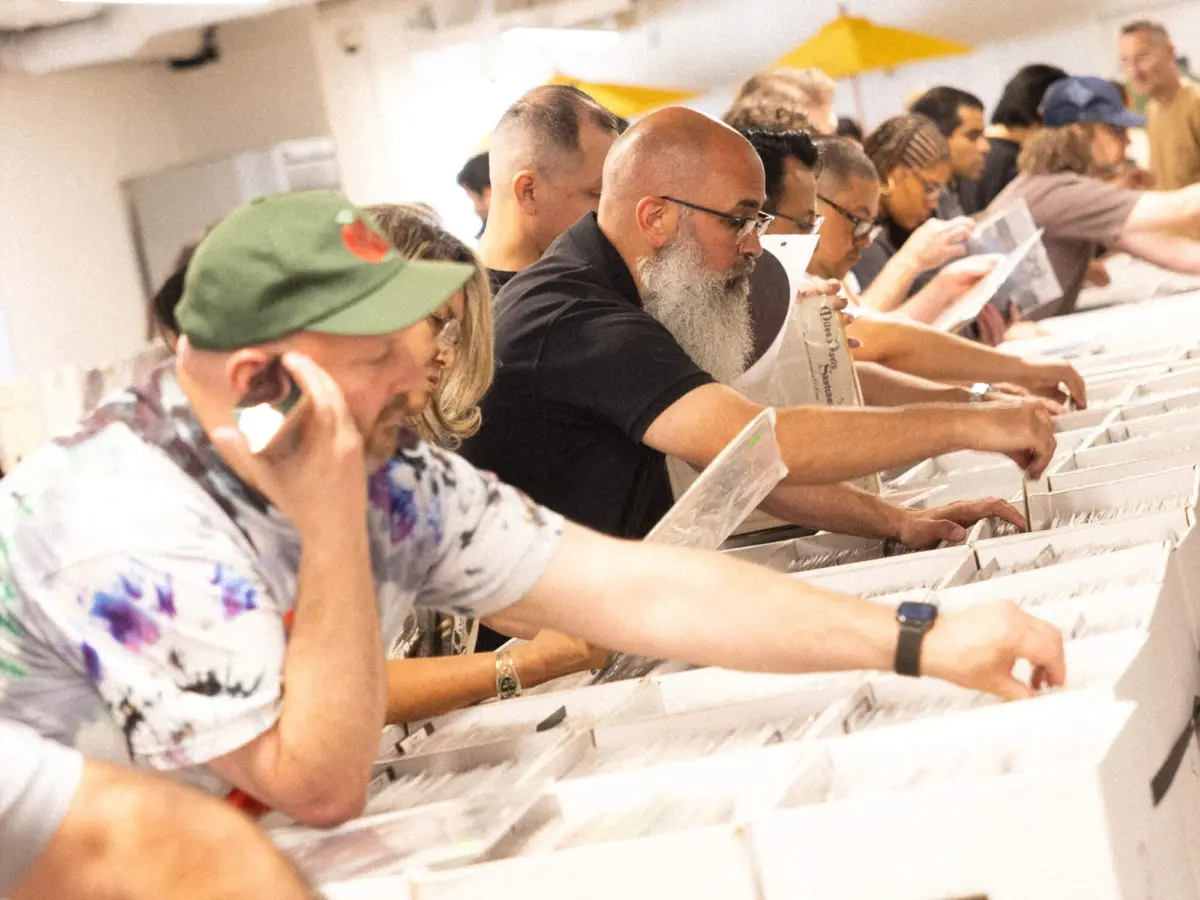
Yet, beneath this massive financial boom lies a fascinating cultural paradox. Walk the floor of a major convention like VinylCon, which drew massive crowds to Los Angeles in late August, and you will encounter a complex subculture that defies simple categorization. While high-end audio enthusiasts pore over vintage vacuum-tube amplifiers and bespoke Japanese cartridges, a surprising number of heavy-hitting buyers and collectors harbor zero intention of ever dropping a needle onto a groove.
For some, vinyl collecting is purely an extension of archival preservation and tactile ownership in an increasingly digitized world. For others, it is an entry point into musical history, deep-dive education, and community building. This feature explores the shifting ecosystem of modern physical media, examining how a billion-dollar market is sustained by an unlikely coalition of purists, casual decorators, high-end audiophiles, and collectors who don’t even own a plugged-in turntable.
Detailed Chronology: The Evolution of Vinyl Culture and the Rise of VinylCon
To understand how the modern vinyl landscape reached this fever pitch, one must trace the parallel tracks of technological disruption and cultural pushback.
The Pre-Digital Discovery Era (The 1990s)
Decades before the launch of Napster, The Pirate Bay, or Spotify, physical formats were the primary vehicle for mass musical exploration. In the mid-1990s, crate-digging was not a niche lifestyle choice or an aesthetic affectation; it was the most efficient, cost-effective way to ingest vast quantities of diverse music. Veteran record dealers like Alex Rodriguez—who has curated the official record store at the Coachella Valley Music and Arts Festival annually—began their journeys during this era. Without algorithmic recommendation engines, music lovers built encyclopedic mental databases through physical immersion, sifting through thrift store bins and dusty basement stocks.
The Death and Rebirth of Physical Retail (2000s–2010s)
As digital compression (MP3s) and peer-to-peer file sharing decimated the traditional music industry in the 2000s, brick-and-mortar record stores shuttered by the thousands. Major labels abandoned vinyl pressing plants, selling off or scrapping heavy metal stamping machinery. However, a resilient underground network of independent shops, niche labels, and die-hard crate-diggers kept the format on life support. By the early 2010s, this subterranean persistence sparked an unexpected spark among younger demographics.
The Dorm Room Aesthetic and the Suitcase Player Boom (Mid-2010s)
As generation-Z and younger millennials entered higher education, vinyl re-entered popular culture through visual aesthetics. Inexpensive "suitcase" record players flooded mainstream retail chains like Urban Outfitters and Target. Students began pinning or displaying five or ten iconic albums on their dorm room walls as decor.
Crucially, this superficial engagement often served as a gateway drug. For many collectors—such as Caneatra Wilson, who started her collection with dorm wall art before realizing her records were "taunting" her—the aesthetic step led directly to hardware purchases. Within a decade, those initial decorative purchases morphed into comprehensive collections spanning hundreds or thousands of LPs, triggering a massive downstream demand for proper audio equipment.
The Birth and Expansion of VinylCon (Present Day)
Recognizing a fracture in how physical media was being celebrated, entrepreneur Kobi Waldfogel founded VinylCon five years ago. Starting as a localized pop-up in Denver, the convention has steadily expanded its footprint across major American cultural hubs, including Philadelphia and, most recently, a massive late-August showcase in Los Angeles.
Today, VinylCon serves as a microcosm of the entire physical media economy. With over 150,000 records on sale across thousands of square feet of convention floor, the event illustrates how far the marketplace has traveled from its near-death experience at the turn of the millennium.
Supporting Context & Metrics: The Economics of the Billion-Dollar Resurgence
The cultural enthusiasm witnessed at conventions like VinylCon is heavily backed by hard macroeconomic data. The physical music market has undergone a dramatic structural transformation over the past decade.
The RIAA Milestone: In 2025, U.S. vinyl revenues officially breached $1 billion, continuing an uninterrupted multi-year growth streak that has routinely outperformed compact discs (CDs) and, in some quarters, even threatened digital download revenues.
Hardware Ecosystem Expansion: The hardware market has evolved to mirror this demand. Consumer-friendly and prosumer turntable manufacturers—including Technics, Pro-Ject, Rega, Audio-Technica, and Crosley—have scaled production to accommodate varied consumer brackets. Whether a buyer is spinning a newly minted 180-gram modern indie pop record, a rare vintage 1970s funk pressing, or a treasured family heirloom, the modern hi-fi market offers scalable solutions.
The High-End Tier: At the opposite end of the spectrum, ultra-luxury audio setups have found a robust secondary market. Premium systems—such as configurations featuring the Thorens TD 124 direct-drive turntable ($12,000), vintage H.H. Scott tube amplifiers ($2,500), and Klipsch Forte loudspeakers ($5,500)—demonstrate that the high-end audiophile sector is investing heavily to maximize the sonic capabilities of analog media. Total systems of this caliber easily command upward of $19,500 on specialized resale markets.
Cross-Media Parallels: The appetite for physical media extends well beyond music. Collectors are increasingly viewing vinyl through the broader lens of physical preservation, encompassing CDs, audio cassettes, VHS tapes, and DVDs. This wider cultural anxiety regarding digital permanence was recently highlighted when the PlayStation community organized a coordinated one-week blackout boycott protesting Sony’s announcement that it would phase out physical disc sales by January 2028. Consumers are acutely aware that cloud-based ecosystems permit corporations to silently edit, censor, or revoke access to digital media, turning physical formats into a crucial bastion of autonomous cultural ownership.
Official Statements and Industry Insights
To truly grasp the dynamics driving the modern vinyl market, one must listen to the voices on the front lines of the retail, curation, and collecting communities. Their perspectives reveal that the motivations behind building a record collection are far more diverse than simple sound quality.
The Non-Playing Collector: Doug Day
Doug Day operates one of the largest booths at VinylCon, hauling five sprawling tables packed with bins covering every conceivable genre, style, and historical era. He maintains a massive inventory of over 8,000 active listings on eBay and travels regularly to major conventions in Austin and Denver. Yet, Day shares a surprising confession: he doesn’t even have a turntable plugged in at home.
"It’s no different, really. Collectables are collectables. It depends on figuring out what it is that people want and having it for them," Day explains.
For Day, vinyl is an exercise in market curation, historical curation, and archival logistics. The grooves on the vinyl are secondary to the thrill of the hunt and the mechanics of supply and demand.
The Educational Archivist: Alex Rodriguez
Alex Rodriguez, operator of Los Angeles’s renowned Record Safari and the annual curator of the Coachella record store, has spent decades buying, selling, and living among physical media. His personal reserves alone hold 25,000 records, supplementing the 25,000 items currently in his shop stock. Despite owning an enviable, high-end hi-fi system built from vintage Technics SL-1200 turntables, an 80s McIntosh amplifier, and Tannoy speakers (acquired fortuitously at a heavy discount from a downsizing widow), Rodriguez is candid about his listening habits.
"I’m not an audiophile. I just wanted to learn as much as I could about music. It had nothing to do with the physical format," Rodriguez says, noting he is perfectly content streaming music directly through an iPhone speaker when convenience dictates.
To Rodriguez, vinyl was never about golden ears; it was an educational textbook that unlocked musical history before the internet made encyclopedic research instantaneous.
The Preservationist and Curator: Mimi Price and Carlos Rojas
For attendees like Mimi Price, the passion for vinyl is inextricably linked to a deep-seated distrust of modern digital platforms. Collecting across multiple physical mediums—including cassettes, CDs, and VHS tapes—Price views her collection as an act of political and cultural self-defense against corporate revisionism.
"Physical media is the interest rather than just vinyl… With streaming services, you see it with movies more than music. You don’t have the original anymore, and with a CD or vinyl that can’t happen. It’s proper ownership, and it’s proper preservation," Price notes.
This sentiment is echoed by Carlos Rojas, who has amassed over 1,100 records in just four years of collecting. For Rojas, the physical package—specifically the liner notes, production credits, and expansive artwork—served as a gateway into complex musical rabbit holes.
"The fact that I could hold the record and read the liner notes—it wasn’t just about the famous person. It’s the whole band," Rojas explains. Starting with Parliament-Funkadelic, his crate-digging adventures eventually expanded to include records from Ethiopia, Sierra Leone, and Nigeria, fundamentally reshaping his global worldview of popular music.
The Retail and Hardware Perspective: Michael Palermo and Kobi Waldfogel
Michael Palermo of Amoeba Music notes that the retail ecosystem is adapting to an audience that wants to graduate past entry-level gear. As record stores increasingly stock trusted audio brands like Pioneer, Audio-Technica, and Crosley, customers are seeking expert guidance to navigate the complex world of hi-fi hardware.
"People come to us because it’s hard to know what stores sell audio equipment reliably," Palermo says. He points to the burgeoning popularity of urban hi-fi listening bars as a major cultural catalyst, sparking consumer interest in intricate, high-fidelity sound systems that move far beyond novelty suitcase players.
Kobi Waldfogel, founder of VinylCon, observes that hardware upgrades typically follow a natural, chronological curve as collectors mature.
"People start with something entry-level. Then they realise it isn’t the right thing for them, and they invest in something a little nicer; they do a little more research," Waldfogel reflects, noting that his own collecting journey has spanned five turntable upgrades over 15 years. "As long as you keep collecting and keep getting new stuff, you’re going to want something new to listen to."
Future Outlook: Where is the Vinyl Industry Headed?
As the physical media market moves deeper into the late 2020s, several key trends are poised to shape the trajectory of vinyl culture:
Maturation of the Hardware Market: While the initial wave of the vinyl boom was driven by casual buyers purchasing novelty players, data from conventions and independent record stores indicates a secondary wave of hardware reinvestment. Consumers who began with budget setups are increasingly upgrading to mid-tier and high-end turntables, dedicated pre-amps, and separates. The market for premium audio gear is expanding in tandem with record sales, albeit at a measured pace.
The Defense of Physical Autonomy: Amid growing industry whispers regarding digital-only distribution models in gaming, film, and music, physical formats are increasingly viewed by consumers as a vital hedge against corporate overreach. The backlash against digital-only mandates—such as recent consumer boycotts in the gaming sector—suggests that physical media will retain a fiercely loyal demographic that values tangible property rights above algorithmic convenience.
Institutionalization of Crate-Digging: Events like VinylCon have transformed from subterranean swap meets into major cultural conventions spanning multiple major metropolitan areas. As long-running pop-ups expand their geographic footprints, independent record stores and local curators will continue to bridge the gap between historic archival preservation and modern consumer demand.
The Coexistence of the Purist and the Curator: The future of vinyl will not belong exclusively to the audiophile elite or the non-playing archivist. Instead, the billion-dollar success of the format relies on a sprawling, inclusive big tent. Whether a buyer approaches records as an investment-grade collectible, a historical textbook, a piece of dorm room wall art, or an ultra-high-fidelity sonic vehicle, the analog medium has successfully secured its permanent, unassailable place in the modern entertainment landscape.